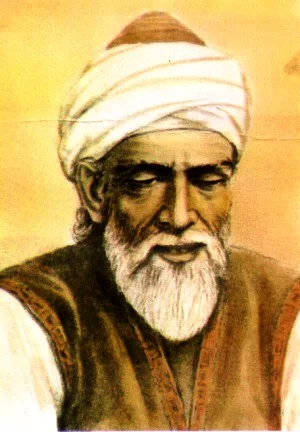
Ibn Irâk (Ebû Nasr Mansûr b. Alî b. Irâk) was a mathematician and astronomer who worked in Khwarezm and Ghazni in the 10th and 11th centuries. He is known for his role in revealing the sine theorem regarding spherical triangles and for being the teacher of Biruni.
He was born in the second half of the 10th century; The year and place of birth are given differently in sources. He belonged to the Afrîgî dynasty, which ruled Khwarezm until 995; Muhammad b., one of the last rulers of this dynasty. He was Iraq's nephew. He spent most of his life in Khwarezm, under the protection of the Ma'munids.
His studies with Biruni
He taught geometry and astronomy to young Biruni. Biruni calls him "my master", an expression he does not use for anyone else. The scientific partnership of the two lasted for many years; They dedicated numerous treatises to each other and worked together on topics such as determining the inclination of the ecliptic. When Mahmud of Ghazni captured Khwarezm in 1017, Ibn Iraq was taken to Ghazni with his student Biruni and spent the rest of his life there. He died in Ghazni around 1036.
Most of his more than twenty works have survived to the present day; Some of them are about mathematics, most of them are about astronomy. One of his most important works is the corrected and annotated Arabic text of Sphaerica, Menelaus of Alexandria's book on spherical geometry. Astrolabe construction, azimuth calculation and trigonometric tables for spherical astronomy are among the topics he deals with.
The theorem showing that the ratio between the sines of the sides and the sines of the opposite angles in spherical triangles is constant is attributed to Ebü'l-Vefâ el-Bûzcânî and Hucendî.
Ibn Irâk is remembered as one of the names who contributed to the development of trigonometry as an independent discipline in the Islamic world.