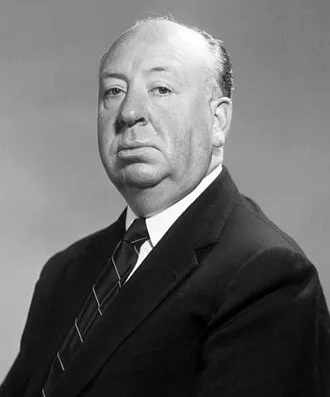
Hitchcock initially trained as a technical clerk and copywriter before entering the film industry in 1919 as a title card designer. His directorial debut was the British–German silent film The Pleasure Garden (1926). His first successful film, The Lodger: A Story of the London Fog (1927), helped to shape the thriller genre, and Blackmail (1929) was the first British "talkie".
His thrillers The 39 Steps (1935) and The Lady Vanishes (1938) are ranked among the greatest British films of the 20th century. By 1939, he had earned international recognition, and producer David O. Selznick persuaded him to move to Hollywood. A string of successful films followed, including Rebecca (1940), Foreign Correspondent (1940), Suspicion (1941), Shadow of a Doubt (1943) and Notorious (1946). Rebecca won the Academy Award for Best Picture, with Hitchcock nominated as Best Director.
He also received Oscar nominations for Lifeboat (1944), Spellbound (1945), Rear Window (1954) and Psycho (1960).
Hitchcock's other notable films include Rope (1948), Strangers on a Train (1951), Dial M for Murder (1954), To Catch a Thief (1955), The Trouble with Harry (1955), Vertigo (1958), North by Northwest (1959), The Birds (1963), Marnie (1964) and Frenzy (1972), all of which were also financially successful and are highly regarded by film historians.
Hitchcock made a number of films with some of the biggest stars in Hollywood, including four with Cary Grant, four with James Stewart, three with Ingrid Bergman and three consecutively with Grace Kelly. Hitchcock became an American citizen in 1955.
In 2012, Hitchcock's psychological thriller Vertigo, starring Stewart, displaced Orson Welles' Citizen Kane (1941) as the British Film Institute's greatest film ever made based on its world-wide poll of hundreds of film critics. As of 2021[update], nine of his films had been selected for preservation in the United States National Film Registry, including his personal favourite, Shadow of a Doubt (1943).
He received the BAFTA Fellowship in 1971, the AFI Life Achievement Award in 1979, and was knighted in December of that year, four months before his death on 29 April 1980.
Life and career
Early life: 1899–1919
Early childhood and education
Alfred Joseph Hitchcock was born on 13 August 1899 at the flat above his parents' leased greengrocer's shop at 517 High Road in Leytonstone, which was then part of Essex (now part of the London Borough of Waltham Forest). He was the son of greengrocer and poulterer, William Edgar Hitchcock (1862–1914) and Emma Jane Whelan; 1863–1942.
The household was "characterised by an atmosphere of discipline". He had an older brother named William John (1888–1943) and an older sister named Ellen Kathleen (1892–1979) who used the nickname "Nellie". His parents were both Roman Catholics with English and Irish ancestry. His father was a greengrocer, as his grandfather had been.
There was a large extended family, including uncle John Hitchcock with his five-bedroom Victorian house on Campion Road in Putney, complete with a maid, cook, chauffeur, and gardener. Every summer, his uncle rented a seaside house for the family in Cliftonville, Kent. Hitchcock said that he first became class-conscious there, noticing the differences between tourists and locals.
Describing himself as a well-behaved boy – his father called him his "little lamb without a spot" – Hitchcock said he could not remember ever having had a playmate. One of his favourite stories for interviewers was about his father sending him to the local police station with a note when he was five; the policeman looked at the note and locked him in a cell for a few minutes, saying, "This is what we do to naughty boys." The experience left him with a lifelong phobia of law enforcement, and he told Tom Snyder in 1973 that he was "scared stiff of anything ... to do with the law" and that he would refuse to even drive a car in case he got a parking ticket.
When he was six, the family moved to Limehouse and leased two stores at 130 and 175 Salmon Lane, which they ran as a fish-and-chip shop and fishmongers' respectively; they lived above the former. Hitchcock attended his first school, the Howrah House Convent in Poplar, which he entered in 1907, at age 7. According to biographer Patrick McGilligan, he stayed at Howrah House for at most two years.
He also attended a convent school, the Wode Street School "for the daughters of gentlemen and little boys" run by the Faithful Companions of Jesus. He then attended a primary school near his home and was for a short time a boarder at Salesian College in Battersea.
The family moved again when Hitchcock was eleven, this time to Stepney, and on 5 October 1910 he was sent to St Ignatius College in Stamford Hill, a Jesuit grammar school with a reputation for discipline. As corporal punishment, the priests used a flat, hard, springy tool made of gutta-percha and known as a "ferula" which struck the whole palm; punishment was always at the end of the day, so the boys had to sit through classes anticipating the punishment if they had been written up for it.
He later said that this is where he developed his sense of fear. The school register lists his year of birth as 1900 rather than 1899; biographer Donald Spoto says he was deliberately enrolled as a ten-year-old because he was a year behind with his schooling. While biographer Gene Adair reports that Hitchcock was "an average, or slightly above-average, pupil", Hitchcock said that he was "usually among the four or five at the top of the class"; at the end of his first year, his work in Latin, English, French and religious education was noted. He told Peter Bogdanovich: "The Jesuits taught me organisation, control and, to some degree, analysis."
Hitchcock's favourite subject was geography and he became interested in maps and the timetables of trains, trams and buses; according to John Russell Taylor, he could recite all the stops on the Orient Express. He had a particular interest in London trams. An overwhelming majority of his films include rail or tram scenes, in particular The Lady Vanishes, Strangers on a Train and Number Seventeen.
A clapperboard shows the number of the scene and the number of takes, and Hitchcock would often take the two numbers on the clapperboard and whisper the London tram route names. For example, if the clapperboard showed "Scene 23; Take 3", he would whisper "Woodford, Hampstead"—Woodford being the terminus of the route 23 tram, and Hampstead the end of route 3.
Henley's
Hitchcock told his parents that he wanted to be an engineer, and on 25 July 1913, he left St Ignatius and enrolled in night classes at the London County Council School of Engineering and Navigation in Poplar. In a book-length interview in 1962, he told François Truffaut that he had studied "mechanics, electricity, acoustics, and navigation".
Then, on 12 December 1914, his father, who had been suffering from emphysema and kidney disease, died at the age of 52. To support himself and his mother – his older siblings had left home by then – Hitchcock took a job, for 15 shillings a week (£75 in 2025), as a technical clerk at the Henley Telegraph and Cable Company in Blomfield Street, near London Wall.
He continued night classes, this time in art history, painting, economics and political science. His older brother ran the family shops, while he and his mother continued to live in Salmon Lane.
Hitchcock was too young to enlist when the First World War started in July 1914, and when he reached the required age of 18 in 1917, he received a C3 classification ("free from serious organic disease, able to stand service conditions in garrisons at home ... only suitable for sedentary work"). He joined a cadet regiment of the Royal Engineers and took part in theoretical briefings, weekend drills and exercises.
John Russell Taylor wrote that, in one session of practical exercises in Hyde Park, Hitchcock was required to wear puttees. He could never master wrapping them around his legs, and they repeatedly fell down around his ankles.
After the war, Hitchcock took an interest in creative writing. In June 1919, he became a founding editor and business manager of Henley's in-house publication, The Henley Telegraph (sixpence a copy), to which he submitted several short stories. Henley's promoted him to the advertising department, where he wrote copy and drew graphics for electric cable advertisements.
He enjoyed the job and would stay late at the office to examine the proofs; he told Truffaut that this was his "first step toward cinema". He enjoyed watching films, especially American cinema, and from the age of 16 read the trade papers; he watched Charlie Chaplin, D. W. Griffith and Buster Keaton, and particularly liked Fritz Lang's Der müde Tod (released in Britain in 1921 as Destiny).
Inter-war career: 1919–1939
Famous Players–Lasky
While still at Henley's, he read in a trade paper that Famous Players–Lasky, the production arm of Paramount Pictures, was opening a studio in London. They were planning to film The Sorrows of Satan by Marie Corelli, so he produced some drawings for the title cards and sent his work to the studio. They hired him, and in 1919 he began working for Islington Studios in Poole Street, Hoxton, as a title-card designer.
Donald Spoto wrote that most of the staff were Americans with strict job specifications, but the English workers were encouraged to try their hand at anything, which meant that Hitchcock gained experience as a co-writer, art director and production manager on at least 18 silent films. The Times wrote in February 1922 about the studio's "special art title department under the supervision of Mr.
A. J. Hitchcock". His work included Number 13 (1922), also known as Mrs. Peabody; it was cancelled because of financial problems - the few finished scenes are lost – and Always Tell Your Wife (1923), which he and Seymour Hicks finished together when Hicks was about to give up on it.
Hicks wrote later about being helped by "a fat youth who was in charge of the property room ... [n]one other than Alfred Hitchcock".
Gainsborough Pictures and work in Germany
When Paramount pulled out of London in 1922, Hitchcock was hired as an assistant director by a new firm run in the same location by Michael Balcon, later known as Gainsborough Pictures. Hitchcock worked on Woman to Woman (1923) with the director Graham Cutts, designing the set, writing the script and producing.
He said: "It was the first film that I had really got my hands onto." The editor and "script girl" on Woman to Woman was Alma Reville, his future wife. He also worked as an assistant to Cutts on The White Shadow (1924), The Passionate Adventure (1924), The Blackguard (1925) and The Prude's Fall (1925). The Blackguard was produced at the Babelsberg Studios in Potsdam, where Hitchcock watched part of the making of F.
W. Murnau's The Last Laugh (1924). He was impressed with Murnau's work, and later used many of his techniques for the set design in his own productions.
In the summer of 1925, Balcon asked Hitchcock to direct The Pleasure Garden (1926), starring Virginia Valli, a co-production of Gainsborough and the German firm Emelka at the Geiselgasteig studio near Munich. Reville, by then Hitchcock's fiancée, was assistant director-editor. Although the film was a commercial flop, Balcon liked Hitchcock's work; a Daily Express headline called him the "Young man with a master mind".
On an early sign of his high profile, the British Film Institute (BFI) would write, "In an unusual display of confidence for a first time director, Hitchcock included his own signature in the titles." In March 1926, the British film magazine Picturegoer ran an article entitled "Alfred the Great" by the film critic Cedric Belfrage, who praised Hitchcock for possessing "such a complete grasp of all the different branches of film technique that he is able to take far more control of his production than the average director of four times his experience." Production of The Pleasure Garden encountered obstacles which Hitchcock would later learn from: on arrival to Brenner Pass, he failed to declare his film stock to customs and it was confiscated; one actress could not enter the water for a scene because she was on her period; budget overruns meant that he had to borrow money from the actors. Hitchcock also needed a translator to give instructions to the cast and crew.
In Germany, Hitchcock observed the nuances of German cinema and filmmaking which had a big influence on him. When he was not working, he would visit Berlin's art galleries, concerts and museums. He would also meet with actors, writers and producers to build connections. Balcon asked him to direct a second film in Munich, The Mountain Eagle (1926), based on an original story titled Fear o' God.
The film is lost, and Hitchcock called it "a very bad movie". A year later, Hitchcock wrote and directed The Ring; although the screenplay was credited solely to his name, Elliot Stannard assisted him with the writing. The Ring garnered positive reviews; the Bioscope critic called it "the most magnificent British film ever made".
When he returned to England, Hitchcock was one of the early members of the London Film Society, newly formed in 1925. Through the Society, he became fascinated by the work of Soviet filmmakers Dziga Vertov, Lev Kuleshov, Sergei Eisenstein and Vsevolod Pudovkin. He would also socialise with fellow English filmmakers Ivor Montagu, Adrian Brunel and Walter Mycroft.
Hitchcock recognised the value in cultivating his own brand, with the director aggressively promoting himself during this period. In a 1925 London Film Society meeting he declared directors were what mattered most in making films, with Donald Spoto writing that Hitchcock proclaimed, "We make a film succeed. The name of the director should be associated in the public's mind with a quality product. Actors come and go, but the name of the director should stay clearly in the mind of the audience."
Visually, it was extraordinarily imaginative for the time, most notably in the scene in which Hitchcock installed a glass floor so that he could show the lodger pacing up and down in his room from below, as though overheard by his landlady.
Hitchcock established himself as a name director with his first thriller, The Lodger: A Story of the London Fog (1927). The film concerns the hunt for a Jack the Ripper-style serial killer who, wearing a black cloak and carrying a black bag, is murdering young blonde women in London, and only on Tuesdays. A landlady suspects that her lodger is the killer, but he turns out to be innocent.
Hitchcock had wanted the leading man to be guilty, or for the film at least to end ambiguously, but the star was Ivor Novello, a matinée idol, and the "star system" meant that Novello could not be the villain. Hitchcock told Truffaut: "You have to clearly spell it out in big letters: 'He is innocent.'" (He had the same problem years later with Cary Grant in Suspicion (1941).) Released in January 1927, The Lodger was a commercial and critical success in the UK.
Upon its release, the trade journal Bioscope wrote: "It is possible that this film is the finest British production ever made". Hitchcock told Truffaut that the film was the first of his to be influenced by German Expressionism: "In truth, you might almost say that The Lodger was my first picture." In a strategy for self-publicity, The Lodger saw him make his first cameo appearance in a film, where he sat in a newsroom.
Continuing to market his brand following the success of The Lodger, Hitchcock wrote a letter to the London Evening News in November 1927 about his filmmaking, participated in studio-produced publicity, and by December 1927 he developed the original sketch of his widely recognised profile which he introduced by sending it to friends and colleagues as a Christmas present.
Marriage
On 2 December 1926, Hitchcock married the English screenwriter Alma Reville at the Brompton Oratory in South Kensington. The couple honeymooned in Paris, Lake Como and St. Moritz, before returning to London to live in a leased flat on the top two floors of 153 Cromwell Road, Kensington. Reville, who was born just hours after Hitchcock, converted from Protestantism to Catholicism, apparently at the insistence of Hitchcock's mother; she was baptised on 31 May 1927 and confirmed at Westminster Cathedral by Cardinal Francis Bourne on 5 June.
In 1928, when they learned that Reville was pregnant, the Hitchcocks purchased "Winter's Grace", a Tudor farmhouse set in eleven acres on Stroud Lane, Shamley Green, Surrey, for £2,500. Their daughter and only child, Patricia (Pat) Alma Hitchcock, was born on 7 July that year. Pat died on 9 August 2021 at the age of 93.
Reville became her husband's closest collaborator; Charles Champlin wrote in 1982: "The Hitchcock touch had four hands, and two were Alma's." When Hitchcock accepted the AFI Life Achievement Award in 1979, he said that he wanted to mention "four people who have given me the most affection, appreciation and encouragement, and constant collaboration.
The first of the four is a film editor, the second is a scriptwriter, the third is the mother of my daughter, Pat, and the fourth is as fine a cook as ever performed miracles in a domestic kitchen. And their names are Alma Reville." Reville wrote or co-wrote on many of Hitchcock's films, including Shadow of a Doubt, Suspicion and The 39 Steps.
Early sound films
Hitchcock began work on his tenth film, Blackmail (1929), when its production company, British International Pictures (BIP), converted its Elstree studios to sound. The film was the first British "talkie"; this followed the rapid development of sound films in the United States, from the use of brief sound segments in The Jazz Singer (1927) to the first full sound feature Lights of New York (1928). Blackmail began the Hitchcock tradition of using famous landmarks as a backdrop for suspense sequences, which includes an early example of a red telephone box being used for criminal activity, while the climax takes place on the dome of the British Museum.
It also features one of his longest cameo appearances, which shows him being bothered by a small boy as he reads a book on the London Underground. In the PBS series The Men Who Made The Movies, Hitchcock explained how he used early sound recording as a special element of the film to create tension, with a gossipy woman (Phyllis Monkman) stressing the word "knife" in her conversation with the woman suspected of murder.
During this period, Hitchcock directed segments for a BIP revue, Elstree Calling (1930), and directed a short film, An Elastic Affair (1930), featuring two Film Weekly scholarship winners. An Elastic Affair is one of the lost films.