
















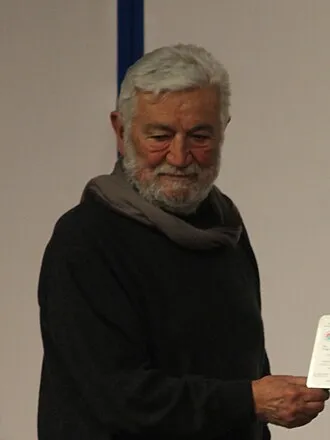
Cengiz Bektaş is known as a Turkish architect, poet and writer who was born in Denizli on 26 November 1934 and died in Istanbul on 20 March 2020. After completing the interior design and architecture departments at the Istanbul State Academy of Fine Arts, he received his architecture diploma from the Technical University of Munich in 1959 and took additional courses at the German Urban Planning Academy in 1960.
In Munich, Prof. Dr. He ran a joint office with Fred Angerer and Alexander Baron von Branca, and then continued to work as a freelance architect.
Bektaş, who started working as a lecturer at Middle East Technical University in 1962, managed the architectural office responsible for construction works there, but left the university at his own request. The artist, who started working in the private sector since 1963, taught at Zafer Engineering and Architecture School between 1966 and 1969 and taught "Folk Building Art" at Trakya University for two years.
Since the fall of 1999, he has lectured on "The Effect of Culture on Planning" to graduate students of the urban planning department at Mimar Sinan Fine Arts University, and on "Aesthetics" at the Faculty of Fine Arts, and has also been a guest lecturer and held conferences in Macedonia, America and Germany. He won more than 25 awards in national and international architecture competitions and contributed important works to the architecture of the Republican period.
Bektaş's architectural portfolio covers a wide range, from public buildings such as Etimesgut Mosque (Ankara, 1964) and Babadağlılar İşhanı (Denizli, 1973) to cultural projects such as the Turkish Language Association (Ankara, 1974) and Kantoğan House (Datça, 1977). In addition to his modern buildings such as Mertim Skyscraper in Mersin (1987), Hakiç House in Istanbul (1988) and Bakırköy International Industrial Bank (1988), works of local character such as Ayfer Yağcı İşhanı (1989) in Balıkesir and Büyükada Turkish-Swedish Culture House (1989) also bear his signature.
Bektaş, who received the Aga Khan award for his Olbia Social Center (1999) project at Akdeniz University, has also encountered controversial situations from time to time, such as the dismantling of the Meltem entrance of the same university in 2019. In recent years, it has undertaken projects protecting cultural heritage such as the Aphrodisias Oct Museum (2007) and Çine Beekeeping Museum (2010) in Aydın.
Continuing his identity as a writer, Bektaş stepped into the world of literature with his work "Terrible Years" in 1959, and then consolidated his authorship with works such as "Person" (1964), "Criticism in Architecture" (1967) and "Koca Sinan" (1968). In the 1970s, her books such as "Mediterranean" and "They Were Four People and Me" were published, as well as her works such as "Purple" in 1974, "The Heart of the Earth" and "Conversations on Sappho" in 1978.
In the 1980s, he wrote books on different themes such as "My Son Bina Okur", "Zeytinli Fırın Sokak", "Koca Rıza" and "Outside the Walls Are Yours", and in 1983 he combined architecture and folk art with his work "Bodrum: An Example of Public Building Art". He continued his literary production with his book "Fide" in 1987, thus leaving a versatile legacy in the fields of architecture, poetry and criticism.