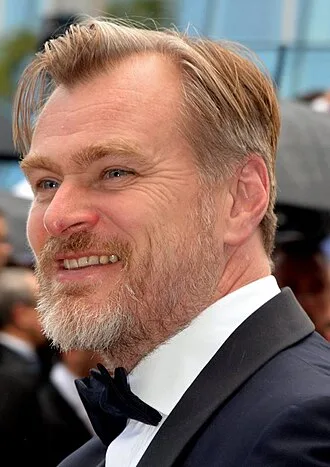
Nolan developed an interest in filmmaking from a young age. After studying English literature at University College London, he made several short films before his feature film debut with Following (1998). Nolan gained international recognition with his second film, Memento (2000), and transitioned into studio filmmaking with Insomnia (2002).
He became a high-profile director with The Dark Knight trilogy (2005–2012) and found further success with The Prestige (2006), Inception (2010), Interstellar (2014) and Dunkirk (2017). After the release of the critically polarising Tenet (2020), Nolan parted ways with longtime distributor Warner Bros.
Pictures over their streaming release strategy and signed with Universal Pictures for the highly successful Oppenheimer (2023) and The Odyssey (2026). The former won him Academy Awards for Best Director and Best Picture.
Three of Nolan's films have been inducted into the United States National Film Registry. Additionally, two of his films are among the highest-grossing of all time. Infused with a metaphysical outlook, his works thematise epistemology, existentialism, ethics, the construction of time and the malleable nature of memory and personal identity.
They feature mathematically inspired images and concepts, unconventional narrative structures, practical special effects, experimental soundscapes, large-format film photography and materialistic perspectives. His enthusiasm for the use and preservation of analogue and IMAX film cameras in cinema production, as opposed to digital, has also garnered significant attention.
He has co-written several of his films with his brother, Jonathan, and runs the production company Syncopy Inc. with his wife, Emma Thomas. Nolan has been president of the Directors Guild of America since 2025.
Early life and education
Just to be clear, I didn't go to film school because I couldn't get into film school. My father knew I wanted to be a filmmaker, but he advised me to get what he referred to as 'a real degree in a real subject,' so I'd have something to fall back on and then you can go to film school afterwards, which turned out not to be the case.
So I studied English because that was the academic subject that I was best at and inclined most towards. But what I found when I studied at English at UCL, is it greatly informed my filmmaking process, my writing process. I started to become more at ease with a lot of the literary concepts that underlie film criticism in particular.
Christopher Edward Nolan was born on 30 July 1970 in the Westminster district of London. His father, Brendan James Nolan (1936–2009), was a British advertising executive of Irish descent who worked as a creative director. His mother, Christina Jensen (born 1942), is an American former flight attendant from Evanston, Illinois; she also worked as a teacher of English.
He has an older brother, Matthew, and a younger brother, Jonathan, also a filmmaker. The three brothers were raised Catholic in Highgate and spent their summers in Evanston. Nolan also spent time living in Chicago during his youth, and he holds dual British and American citizenship.
Growing up, Nolan was particularly influenced by the work of Ridley Scott and the science fiction films 2001: A Space Odyssey (1968) and Star Wars (1977). He would repeatedly watch the latter film and extensively research its making. Nolan began making films at age seven, borrowing his father's Super 8 camera and shooting short films with his action figures.
These films included a stop motion animation homage to Star Wars called Space Wars. He cast his brother Jonathan and built sets from "clay, flour, egg boxes and toilet rolls". His uncle, who had worked at NASA building guidance systems for the Apollo rockets, sent him some launch footage: "I re-filmed them off the screen and cut them in, thinking no-one would notice", Nolan later remarked.
From age eleven, he aspired to be a professional filmmaker. Between 1981 and 1983, Nolan enrolled at Barrow Hills, a Catholic prep school in Witley, Surrey. In his teenage years, Nolan began making films with Adrien and Roko Belic. Nolan and Roko co-directed the surreal 8 mm Tarantella (1989), which was shown on Image Union, an independent film and video showcase on the Public Broadcasting Service.
In 2021, after a fan posted a copy of Tarantella online, Nolan's production company filed a copyright infringement claim to have the film removed.
Nolan was privately educated at Haileybury and Imperial Service College in Hertford Heath, Hertfordshire, and later studied English literature at University College London (UCL). Having not been accepted to a film school, he pursued "a degree in something unrelated", which his father suggested "gives a different take on things".
He chose UCL specifically for its filmmaking facilities, which comprised a Steenbeck editing suite and 16 mm film cameras. Nolan was president of UCL's Film Society, and with Emma Thomas (his girlfriend and future wife) he screened feature films in 35mm during the school year and used the money earned to produce 16 mm films over the summers.
He graduated in 1993 with a bachelor's degree in English literature. Thomas, who studied history at UCL and was also active in the Film Society, met Nolan on his first day at his hall of residence, Ramsay Hall. They later married and co-founded the production company Syncopy. Both have retained strong ties with UCL, receiving honorary fellowships (Nolan in 2006, Thomas in 2013). In 2017, Nolan was awarded an honorary doctorate.
Career
1993–2003: Early career and breakthrough
After earning his bachelor's degree in English literature in 1993, Nolan worked as a script reader, camera operator and director of corporate films and industrial films. He directed, wrote and edited the short film Larceny (1996), which was filmed over a weekend in black and white with limited equipment and a small cast and crew.
Funded by Nolan and shot with the UCL Union Film society's equipment, it appeared at the Cambridge Film Festival in 1996 and is considered one of UCL's best shorts. For unknown reasons, the film has since been removed from public view. Nolan filmed a second short, Doodlebug (1997), about a man seemingly chasing an insect with his shoe, only to discover that it is a miniature of himself.
Nolan and Thomas first attempted to make a feature in the mid-1990s titled Larry Mahoney, which they scrapped. During this period in his career, Nolan had little to no success getting his projects off the ground, facing several rejections; he added, "[T]here's a very limited pool of finance in the UK. To be honest, it's a very clubby kind of place ... Never had any support whatsoever from the British film industry."
Shortly after abandoning Larry Mahoney, Nolan conceived the idea for his first feature, Following (1998), which he wrote, directed, photographed and edited. The film depicts an unemployed young writer (Jeremy Theobald) who trails strangers through London, hoping they will provide material for his first novel, but is drawn into a criminal underworld when he fails to keep his distance.
It was inspired by Nolan's experience of living in London and having his apartment burgled; he observed that the common attribute between larceny and pursuing someone through a crowd was that they both cross social boundaries. Co-produced by Nolan with Thomas and Theobald, it was made on a budget of around £3,000. Most of the cast and crew were friends of Nolan, and shooting took place on weekends over the course of a year.
To conserve film stock, each scene was rehearsed extensively to ensure that the first or second take could be used in the final edit. Following won several awards during its festival run and was well received by critics who labelled Nolan a majorly talented debutant. Scott Timberg of New Times LA wrote that it "echoed Hitchcock classics", but was "leaner and meaner".
Janet Maslin of The New York Times was impressed with its "spare look" and "agile hand-held camerawork", saying, "As a result, the actors convincingly carry off the before, during and after modes that the film eventually, and artfully, weaves together."
"The difference between shooting Following with a group of friends wearing our own clothes and my mum making sandwiches to spending $4 million of somebody else's money on Memento and having a crew of a hundred people is, to this day, by far the biggest leap I've ever made."
Following's success afforded Nolan the opportunity to make Memento (2000), which became his breakthrough film. His brother Jonathan pitched the idea to him, about a man with anterograde amnesia who uses notes and tattoos to hunt for his wife's murderer.
Jonathan worked the idea into a short story, "Memento Mori" (2001), and Nolan developed it into a screenplay that told the story in reverse. Aaron Ryder, an executive for Newmarket Films, said it was "perhaps the most innovative script I had ever seen". The film was optioned and given a budget of $4.5 million, with Guy Pearce and Carrie-Anne Moss in the starring roles.
Newmarket also distributed the film after it was rejected by studios who feared that it would not attract a wide audience. Following a positive word of mouth and screenings in 500 theatres, it earned $40 million. Memento premiered at the Venice Film Festival in September 2000 to critical acclaim.
Joe Morgenstern of The Wall Street Journal wrote in his review, "I can't remember when a movie has seemed so clever, strangely affecting and slyly funny at the very same time." In the book The Philosophy of Neo-Noir, Basil Smith drew a comparison with John Locke's An Essay Concerning Human Understanding, which argues that conscious memories constitute our identities – a theme Nolan explores in the film. Memento earned Nolan many accolades, including nominations for an Academy Award and a Golden Globe Award for Best Screenplay, as well as two Independent Spirit Awards: Best Director and Best Screenplay.
Six critics listed it as one of the best films of the 2000s. In 2001, Nolan and Emma Thomas founded the production company Syncopy Inc.
Impressed by his work on Memento, filmmaker Steven Soderbergh recommended Nolan to Warner Bros. to direct the psychological thriller Insomnia (2002), although the studio initially wanted a more seasoned director. A remake of the 1997 Norwegian thriller of the same name, the film is viewed as "the outlier of Nolan's filmography" due to its perceived lack of unconventionality he is known for.
Starring Al Pacino, Robin Williams and Hilary Swank, Insomnia follows two Los Angeles detectives sent to a northern Alaskan town to investigate the murder of a local teenager. It received positive reviews from critics and earned $113 million against a budget of $46 million.
Film critic Roger Ebert praised the film for introducing new perspectives and ideas on the issues of morality and guilt, adding, "Unlike most remakes, the Nolan Insomnia is not a pale retread, but a re-examination of the material, like a new production of a good play." Richard Schickel of Time deemed Insomnia a "worthy successor" to Memento and "a triumph of atmosphere over a none-too-mysterious mystery".
Following, Memento and Insomnia established Nolan's image as an "auteur". After the lattermost, he wrote a screenplay for a Howard Hughes biopic. Nolan reluctantly tabled his script after learning that Martin Scorsese was already making one such film: The Aviator (2004). He was then briefly attached to direct a film adaptation of Ruth Rendell's novel The Keys to the Street for Fox Searchlight Pictures but chose to direct Batman Begins instead.
In April 2003, filmmaker David O. Russell put Nolan in a headlock at a Hollywood party after learning that Jude Law, whom Russell wanted to cast, had decided to work with Nolan instead. Russell pressured Nolan to display "artistic solidarity" by relinquishing Law from his cast.
2003–2013: Widespread recognition
In early 2003, Nolan was set to direct Troy (2004), based on Homer's Iliad. After leaving Troy, Nolan approached Warner Bros. with the idea of making a new Batman film, based on the character's origin story. Nolan was fascinated by the notion of grounding it in a more realistic world than a comic-book fantasy.
Warner Bros. let Nolan make Batman Begins (2005) to reconcile with him after he was forced out of Troy when Wolfgang Petersen, the film's producer, decided to direct it. On Batman Begins, Nolan relied heavily on traditional stunts and miniature effects during filming, with minimal use of computer-generated imagery (CGI). Batman Begins was the biggest project Nolan had undertaken to that point, and it was released to critical acclaim and commercial success.
Starring Christian Bale as Bruce Wayne / Batman—along with Michael Caine, Gary Oldman, Morgan Freeman and Liam Neeson—Batman Begins revived the Batman franchise. Batman Begins was 2005's ninth-highest-grossing film and was praised for its psychological depth and contemporary relevance; it is cited as one of the most influential films of the 2000s.
Film author Ian Nathan wrote that within five years of his career, Nolan "[went] from unknown to indie darling to gaining creative control over one of the biggest properties in Hollywood, and (perhaps unwittingly) fomenting the genre that would redefine the entire industry".
Nolan directed, co-wrote and produced The Prestige (2006), an adaptation of the Christopher Priest novel about two rival 19th-century magicians. The screenplay was the result of an intermittent, five-year collaboration between him and his brother Jonathan, who had begun writing it in 2001. Nolan initially intended to make the film as early as 2003, but had postponed the project after agreeing to make Batman Begins.
Starring Hugh Jackman and Christian Bale in the lead roles of rival magicians, The Prestige received critical acclaim and received two Academy Award nominations. Roger Ebert described it as "quite a movie – atmospheric, obsessive, almost satanic", and Kenneth Turan of the Los Angeles Times called it an "ambitious, unnerving melodrama". The Guardian's Philip French wrote: "In addition to the intellectual or philosophical excitement it engenders, The Prestige is gripping, suspenseful, mysterious, moving and often darkly funny." Despite a negative box-office prognosis, the film earned over $109 million against a budget of $40 million.
The Dark Knight (2008), the follow-up to Batman Begins, was Nolan's next venture. Initially reluctant to make a sequel, he agreed after Warner Bros. repeatedly insisted. Nolan wanted to expand on the noir quality of the first film by broadening the canvas and taking on "the dynamic of a story of the city, a large crime story ... where you're looking at the police, the justice system, the vigilante, the poor people, the rich people, the criminals".
Continuing to minimise the use of CGI, Nolan employed high-resolution IMAX cameras, making it the first major motion picture to use this technology. The Dark Knight has been ranked as one of the best films of the 2000s and one of the best superhero films ever made. Many critics declare The Dark Knight to be "the most successful comic book film ever made".
Manohla Dargis of The New York Times found the film to be of higher artistic merit than many Hollywood blockbusters: "Pitched at the divide between art and industry, poetry and entertainment, it goes darker and deeper than any Hollywood movie of its comic-book kind." Ebert expressed a similar point of view, describing it as a "haunted film that leaps beyond its origins and becomes an engrossing tragedy". The Dark Knight set many box-office records during its theatrical run, earning over $1 billion worldwide.
At the 81st Academy Awards, the film was nominated in eight categories, winning two: Best Sound Editing for Richard King and a posthumous Best Supporting Actor award for Heath Ledger for his portrayal of the Joker. The film's failure to garner a Best Picture nomination was criticised by the media. Beginning in 2010, the Academy increased their Best Picture nominees from five to ten, a change known as "The Dark Knight Rule".
Nolan received many awards and nominations for his work on the film. In the late 2000s, Nolan was reported to direct a film adaptation of the 1960s television series The Prisoner.
The success of The Dark Knight allowed Warner Bros. to sign Nolan to write, direct and co-produce Inception (2010) – a film for which he had the idea around nine years before its release. Nolan described the film as "a contemporary sci-fi actioner set within the architecture of the mind". Starring a large ensemble cast led by Leonardo DiCaprio, the film became a critical and commercial success upon its release.
Film critic Mark Kermode named it the best film of 2010, stating "Inception is proof that people are not stupid, that cinema is not trash, and that it is possible for blockbusters and art to be the same thing." Philosophy professor David Kyle Johnson wrote that "Inception became a classic almost as soon as it was projected on silver screens", praising its exploration of philosophical ideas, including leap of faith and allegory of the cave.
The film grossed over $836 million worldwide. Nominated for eight Academy Awards—including Best Picture and Best Original Screenplay—it won Best Cinematography, Best Sound Mixing, Best Sound Editing and Best Visual Effects. Nolan was nominated for a BAFTA Award and a Golden Globe Award for Best Director, among other accolades.
Around the release of The Dark Knight Rises (2012), Nolan's third and final Batman film, Joseph Bevan of the British Film Institute wrote a profile on him: "In the space of just over a decade, Christopher Nolan has shot from promising British indie director to undisputed master of a new brand of intelligent escapism." After initial hesitation, Nolan agreed to return to direct The Dark Knight Rises and worked with his brother and David S.
Goyer to develop a story that he felt would end the trilogy on a high note. The film was released to positive reviews. Kenneth Turan found the film "potent, persuasive and hypnotic" and "more than an exceptional superhero movie, it is masterful filmmaking by any standard". Christy Lemire of HuffPost wrote in her review that Nolan concluded his trilogy in a "typically spectacular, ambitious fashion", but disliked the "overloaded" story and excessive grimness. The Dark Knight Rises was a box office success, becoming the thirteenth film to gross $1 billion.
The Dark Knight trilogy inspired a trend in future superhero films seeking to replicate its gritty, realistic tone to little success. The second instalment in particular revitalised the genre at a time when recent superhero films had failed to meet expectations. Ben Child of The Guardian wrote that the three films "will remain thrilling totems of the genre for decades to come".
During story discussions for The Dark Knight Rises, Goyer told Nolan of his idea about Man of Steel (2013), which the latter would produce. Impressed with Zack Snyder's work in 300 (2006) and Watchmen (2009), Nolan hired him to direct the film. Starring Henry Cavill as Clark Kent who learns that he is a powerful alien, Man of Steel received mixed reviews and grossed more than $660 million against a budget of $220 million.