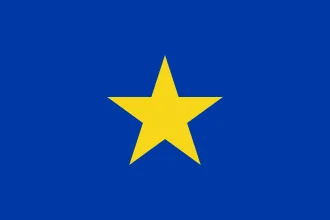
The state included the entire area of the present Democratic Republic of the Congo and existed from 1885 to 1908, when the Belgian Parliament reluctantly annexed the state as a colony belonging to Belgium after international pressure.
Leopold's reign in the Congo eventually earned infamy on account of the atrocities perpetrated on the Indigenous people. Ostensibly, the Congo Free State aimed to bring civilization to the locals and to develop the region economically. In reality, Leopold II's administration extracted ivory, rubber, and minerals from the upper Congo Basin for sale on the world market through a series of international concessionary companies that brought little benefit to the area.
Under Leopold's administration, the Free State became one of the greatest international scandals of the early 20th century. The Casement Report of the British Consul Roger Casement led to the arrest and punishment of officials who had been responsible for killings during a rubber-collecting expedition in 1903.
The loss of life and atrocities inspired literature such as Joseph Conrad's novel Heart of Darkness and raised an international outcry. Debate has been ongoing about the high death rate in this period. The highest estimates state that the widespread use of forced labour, torture, and murder led to the deaths of 50 per cent of the population in the rubber provinces.
The lack of accurate records makes it difficult to quantify the number of deaths caused by the exploitation and the lack of immunity to new diseases introduced by contact with European colonists. During the Congo Free State propaganda war, European and US reformers exposed atrocities in the Congo Free State to the public through the Congo Reform Association (CRA), founded by Casement and the journalist, author, and politician E.
D. Morel. Also active in exposing the activities of the Congo Free State was the author Arthur Conan Doyle, whose book The Crime of the Congo was widely read in the early 1900s.
By 1908, public pressure and diplomatic manoeuvres led to the end of Leopold II's absolutist rule; the Belgian Parliament annexed the Congo Free State as a colony of Belgium. It became known thereafter as the Belgian Congo. In addition, a number of major Belgian investment companies pushed the Belgian government to take over the Congo and develop the mining sector as it was virtually untapped.
Background
Early European exploration
Diogo Cão travelled around the mouth of the Congo River in 1482, leading Portugal to claim the region. Until the middle of the 19th century, the Congo was at the heart of independent Africa, as European colonialists seldom entered the interior. Along with fierce local resistance,[citation needed] the rainforest, swamps, malaria, sleeping sickness, and other diseases made it a difficult environment for Europeans to settle. Western states were at first reluctant to colonize the area in the absence of obvious economic benefits.
Stanley's exploration
In 1876, Leopold II of Belgium hosted the Brussels Geographic Conference, inviting famous explorers, philanthropists, and members of geographic societies to stir up interest in a "humanitarian" endeavour for Europeans in central Africa to "improve" and "civilize" the lives of the Indigenous peoples. At the conference, Leopold organized the International African Association with the cooperation of European and US explorers and the support of several European governments, and was himself elected chairman.
Leopold used the association to promote plans to seize independent central Africa under this philanthropic guise.
Henry Morton Stanley, famous for making contact with British missionary David Livingstone in Africa in 1871, explored the region in 1876–1877, a journey that was described in Stanley's 1878 book Through the Dark Continent. Failing to enlist British interest in the Congo region, Stanley took up service with Leopold II, who hired him to help gain a foothold in the region and annex the region for himself.
From August 1879 to June 1884 Stanley was in the Congo Basin, where he built a road from the lower Congo up to Stanley Pool and launched steamers on the upper river. While exploring the Congo for Leopold, Stanley set up treaties with the local chiefs and local leaders. In essence, the documents gave over all rights of their respective pieces of land to Leopold.
With Stanley's help, Leopold was able to claim a great area along the Congo River, and military posts were established.
Christian de Bonchamps, a French explorer who served Leopold in Katanga, expressed attitudes towards such treaties shared by many Europeans, saying:
The treaties with these little African tyrants, which generally consist of four long pages of which they do not understand a word, and to which they sign a cross in order to have peace and to receive gifts, are really only serious matters for the European powers, in the event of disputes over the territories. They do not concern the black sovereign who signs them for a moment.
King Leopold's campaign
Leopold began to create a plan to convince other European powers of the legitimacy of his claim to the region, all the while maintaining the guise that his work was for the benefit of the Indigenous people under the name of a philanthropic "association".
The king launched a publicity campaign in Britain to distract critics, drawing attention to Portugal's record of slavery, and offering to drive slave traders from the Congo Basin. He also secretly told British merchant houses that if he was given formal control of the Congo for this and other humanitarian purposes, he would then give them the same most favoured nation (MFN) status Portugal had offered them.
At the same time, Leopold promised Bismarck he would not give any one nation special status, and that German traders would be as welcome as any other.
"I do not want to risk ... losing a fine chance to secure for ourselves a slice of this magnificent African cake."
Leopold then offered France the support of the association for French ownership of the entire northern bank of the Congo, and sweetened the deal by proposing that, if his personal wealth proved insufficient to hold the entire Congo, as seemed utterly inevitable, that it should revert to France. On 23 April 1884, the International Association's claim on the southern Congo Basin was formally recognized by France on condition that the French got the first option to buy the territory if the Association decided to sell.
This may also have helped Leopold to gain recognition for his claim by the other major powers, who thus wanted him to succeed instead of selling his claims to France.
He also enlisted the aid of the United States, sending President Chester A. Arthur carefully edited copies of the cloth-and-trinket treaties that Stanley (a Welsh-American) claimed to have negotiated with various local authorities, and proposing that, as an entirely disinterested humanitarian body, the Association would administer the Congo for the good of all, handing over power to the natives as soon as they were ready for that responsibility.
Leopold wanted to have the United States support his plans for the Congo in order to gain support from the European nations. He had help from US businessman Henry Shelton Sanford, who had recruited Stanley for Leopold. Henry Sanford swayed President Arthur by inviting him to stay as his guest at Sanford House hotel on Lake Monroe while he was in Belgium.
On 29 November 1883, during his meeting with the President, as Leopold's envoy, he convinced the President that Leopold's agenda was similar to the US' involvement in Liberia. This satisfied Southern US politicians and businessmen, especially Alabama Senator John Tyler Morgan.
Morgan saw Congo as the same opportunity to send freedmen to Africa so they could contribute to and build the cotton market. Sanford also convinced the people in New York that they were going to abolish slavery and aid travellers and scientists in order to have the public's support. After Henry's actions in convincing President Arthur, the United States was the first country to recognize Congo as a legitimate sovereign state.
The United States further participated in the process of recognition by sending the US Navy Congo River Expedition of 1885, which gave a detailed description of travel along the river.
Lobbying and claiming the region
Leopold was able to attract scientific and humanitarian backing for the International African Association (French: Association internationale africaine, or AIA), which he formed during a Brussels Geographic Conference of geographic societies, explorers, and dignitaries he hosted in 1876. At the conference, Leopold proposed establishing an international benevolent committee for the propagation of civilization among the peoples of central Africa (the Congo region).
The AIA was originally conceived as a multi-national, scientific, and humanitarian assembly, and even invited Gustave Moynier as member of the International Law Institute and president of the International Committee of the Red Cross to attend their 1877 conference. The International Law Institute was supportive of the project under the belief that it was aimed to abolish the Congo Basin slave trade. Nevertheless, the AIA eventually became a development company controlled by Leopold.
After 1879 and the crumbling of the International African Association, Leopold's work was done under the auspices of the "Committee for Studies of the Upper Congo" (French: Comité d'Études du Haut-Congo). The committee, supposedly an international commercial, scientific, and humanitarian group, was in fact made of a group of businessmen who had shares in the Congo, with Leopold holding a large block by proxy.
The committee itself eventually disintegrated, but Leopold continued to refer to it and use the defunct organization as a smokescreen for his operations in laying claim to the Congo region.
"Belgium does not need a colony. Belgians are not drawn towards overseas enterprises: they prefer to spend their energy and capital in countries which have already been explored or on less risky schemes ... Still, you can assure His Majesty of my whole-hearted sympathy for the generous plan he had conceived, as long as the Congo does not make any international difficulties for us."
Determined to look for a colony for himself and inspired by recent reports from central Africa, Leopold began patronizing a number of leading explorers, including Henry Morton Stanley. Leopold established the International African Association, a charitable organization to oversee the exploration and surveying of a territory based around the Congo River, with the stated goal of bringing humanitarian assistance and civilization to the natives.
In the Berlin Conference of 1884–85, European leaders officially noted Leopold's control over the 2,600,000 km2 (1,000,000 sq mi) of the notionally independent Congo Free State.
To give his African operations a name that could serve for a political entity, Leopold created, between 1879 and 1882, the International Association of the Congo (French: Association internationale du Congo, or AIC) as a new umbrella organization. This organization sought to combine the numerous small territories acquired into one sovereign state and asked for recognition from the European powers.
On 22 April 1884, thanks to the successful lobbying of businessman Henry Shelton Sanford at Leopold's request, President Chester A. Arthur of the United States decided that the cessions claimed by Leopold from the local leaders were lawful and recognized the International Association of the Congo's claim on the region, becoming the first country to do so.
In 1884, the US Secretary of State said, "The Government of the United States announces its sympathy with and approval of the humane and benevolent purposes of the International Association of the Congo."
Berlin Conference
In November 1884, Otto von Bismarck convened a 14-nation conference to submit the Congo question to international control and to finalize the colonial partitioning of the African continent. Most major powers (including Austria-Hungary, Belgium, France, Germany, Portugal, Italy, the United Kingdom, Russia, the Ottoman Empire, and the United States) attended the Berlin Conference, and drafted an international code governing the way that European countries should behave as they acquired African territory.
The conference officially recognized the International Congo Association, and specified that it should have no connection with Belgium, beyond a personal union, or any other country, but would be under the personal control of King Leopold.
It drew specific boundaries and specified that all nations should have access to do business in the Congo with no tariffs. The slave trade would be suppressed. In 1885, Leopold emerged triumphant. France was given 666,000 km2 (257,000 sq mi) on the north bank (the modern Congo-Brazzaville and Central African Republic), Portugal 909,000 km2 (351,000 sq mi) to the south (modern Angola), and Leopold's personal organization received the balance: 2,344,000 km2 (905,000 sq mi), with about 30 million people.[citation needed] However, it still remained for these territories to be occupied under the conference's "Principle of Effective Occupation".
International recognition
Following the United States' recognition of Leopold's colony, other Western powers deliberated on the news. Portugal flirted with the French at first, but the British offered to support Portugal's claim to the entire Congo in return for a free trade agreement and to spite their French rivals. Britain was uneasy at French expansion and had a technical claim on the Congo via Lieutenant Cameron's 1873 expedition from Zanzibar to bring home Livingstone's body, but was reluctant to take on yet another expensive, unproductive colony.
Bismarck of Germany had vast new holdings in southwest Africa, and had no plans for the Congo, but was happy to see rivals Britain and France excluded from the colony.
In 1885, Leopold's efforts to establish Belgian influence in the Congo Basin were awarded with the État Indépendant du Congo (CFS, Congo Free State). By a resolution passed in the Belgian Parliament, Leopold became roi souverain ('sovereign king'), of the newly formed CFS, over which he enjoyed nearly absolute control.
The CFS (today the Democratic Republic of the Congo), a country of over two million square kilometres, became Leopold's personal property, the Domaine Privé. Eventually,[when?] the Congo Free State was recognized as a neutral independent sovereignty by various European and North US states.
Government
Leopold used the title 'Sovereign of the Congo Free State' as ruler of the Congo Free State (CFS). He appointed the heads of the three departments of state: interior, foreign affairs and finances. Each was headed by an administrator-general (administrateur-général), later a secretary-general (secrétaire-général), who was obligated to enact the policies of the sovereign or else resign.
Below the secretaries-general were a series of bureaucrats of decreasing rank: directors general (directeurs généraux), directors (directeurs), division chiefs (chefs de divisions) and bureau chiefs (chefs de bureaux). The departments were headquartered in Brussels.
Finance was in charge of accounting for income and expenditure and tracking the public debt. Besides diplomacy, foreign affairs was in charge of shipping, education, religion and commerce. The department of the interior was responsible for defence, police, public health and public works. It was also charged with overseeing the exploitation of the Congo's natural resources and plantations.
In 1904, the secretary-general of the interior set up a propaganda office, the Bureau central de la presse ("Central Press Bureau"), in Frankfurt under the auspices of the Comité pour la représentation des intérêts coloniaux en Afrique (German: Komitee zur Wahrung der kolonialen Interessen in Afrika, 'Committee for the Representation of Colonial Interests in Africa').
The oversight of all the departments was nominally in the hands of the Governor-General (Gouverneur général), but this office was at times more honorary than real. When the governor-general was in Belgium he was represented in the Congo by a vice governor-general (vice-gouverneur général), who was nominally equal in rank to a secretary-general but in fact was beneath them in power and influence.
A consultative committee (Comité consultatif) made up of civil servants was set up in 1887 to assist the governor-general, but he was not obliged to consult it. The vice governor-general on the ground had a state secretary through whom he communicated with his district officers.
The Free State had an independent judiciary headed by a minister of justice at Boma. The minister was equal in rank to the vice governor-general and initially answered to the governor-general, but was eventually made responsible to the sovereign alone. There was a supreme court composed of three judges, which heard appeals, and below it a high court of one judge.
These sat at Boma. In addition to these, there were district courts and public prosecutors (procureurs d'état). Justice, however, was slow and the system ill-suited to a frontier society.
Leopold's rule
Leopold no longer needed the façade of the association, and replaced it with an appointed cabinet of Belgians who would do his bidding. To the temporary new capital of Boma, he sent a governor-general and a chief of police. The vast Congo Basin was split up into 14 administrative districts, each district into zones, each zone into sectors, and each sector into posts.
From the district commissioners down to post level, every appointed head was European. With little financial means, the Free State mainly relied on local elites to rule and tax the vast and hard-to-reach Congolese interior.
In the Free State, Leopold exercised total personal control without much delegation to subordinates. African chiefs played an important role in the administration by implementing government orders within their communities. Throughout much of its existence, Free State presence in the territory that it claimed was patchy, with its few officials concentrated in a number of small and widely dispersed "stations" which controlled only small amounts of hinterland.
In 1900, there were just 3,000 Europeans in the Congo, of whom only half were Belgian. The colony was perpetually short of administrative staff and officials, who numbered between 700 and 1,500 during the period.
Leopold pledged to suppress the east African slave trade; promote humanitarian policies; guarantee free trade within the colony; impose no import duties for twenty years; and encourage philanthropic and scientific enterprises. Beginning in the mid-1880s, Leopold first decreed that the state asserted rights of proprietorship over all vacant lands throughout the Congo territory.
In three successive decrees, Leopold promised the rights of the Congolese in their land to local villages and farms, essentially making nearly all of the CFS terres domaniales, 'state-owned land'.
Leopold further decreed that merchants should limit their commercial operations in rubber trade with the locals. Additionally, the colonial administration liberated thousands of slaves.
Four main problems presented themselves over the next few years.
- Leopold II ran up huge debts to finance his colonial endeavour and risked losing his colony to Belgium.
- Much of the Free State was unmapped jungle, which offered little fiscal and commercial return.
- Cecil Rhodes, Prime Minister of the Cape Colony (part of modern South Africa), was expanding his British South Africa Company's charter lands from the south and threatened to occupy Katanga (southern Congo) by exploiting the "Principle of Effectivity" loophole in the Berlin Treaty. In this he was supported by Harry Johnston, the British Commissioner for Central Africa, who was London's representative in the region.
- The Congolese interior was ruled by Arab Zanzibari slavers and sultans, powerful kings and warlords who had to be coerced or defeated by use of force. For example, the slaving gangs of Zanzibar trader Tippu Tip had a strong presence in the eastern part of the territory in the modern-day Maniema, Tanganyika and Ituri regions. They were linked to the Swahili coast via Uganda and Tanzania and had established independent slave states.
Early economy and concessions
Leopold could not meet the costs of running the Congo Free State. Desperately, he set in motion a system to maximize revenue. The first change was the introduction of the concept of terres vacantes, 'vacant land', which was any land that did not contain a habitation or a cultivated garden plot.
All of this land (i.e., most of the country) was therefore deemed to belong to the state. Servants of the state (namely any men in Leopold's employ) were encouraged to exploit it.
Shortly after the Brussels Anti-Slavery Conference (1889–1890), Leopold issued a new decree mandating that Africans in a large part of the Free State could sell their harvested products (mostly ivory and rubber) only to the state. This law extended an earlier decree declaring that all "unoccupied" land belonged to the state.
Any ivory or rubber collected from the state-owned land, the reasoning went, must belong to the state, thus creating a de facto state-controlled monopoly. Therefore, a large share of the local population could sell only to the state, which could set prices and thereby control the income the Congolese could receive for their work.
For local elites, however, this system presented new opportunities, as the Free State and concession companies paid them with guns to tax their subjects in kind.
Trading companies began to lose out to the Free State government, which not only paid no taxes but also collected all the potential income. These companies were outraged by the restrictions on free trade, which the Berlin Act had so carefully protected years before. Their protests against the violation of free trade prompted Leopold to take another, less obvious tack to make money.
A decree in 1892 divided the terres vacantes into a domainal system that privatized extraction rights over rubber for the state in certain private domains, allowing Leopold to grant vast concessions to private companies. In other areas, private companies could continue to trade but were highly restricted and taxed.
The domainal system enforced an in-kind tax on the Free State's Congolese subjects. As essential intermediaries, local rulers forced their men, women and children to collect rubber, ivory and foodstuffs. Depending on the power of local rulers, the Free State paid prices below the rising market prices.
In October 1892, Leopold granted concessions to a number of companies. Each company was given a large amount of land in the Congo Free State on which to collect rubber and ivory for sale in Europe. These companies were allowed to detain Africans who did not work hard enough, to police their vast areas as they saw fit and to take all the products of the forest for themselves.
In return for their concessions, these companies paid an annual dividend to the Free State. At the height of the rubber boom, from 1901 until 1906, these dividends also filled the royal coffers.