













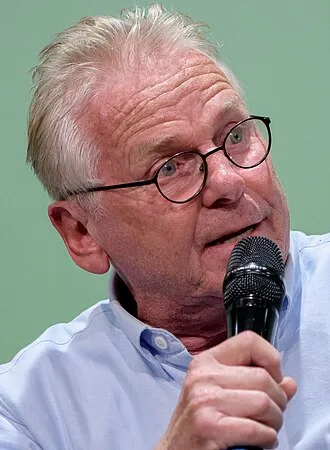
Daniel Cohn-Bendit is a French and German politician. He became known as one of the prominent figures of the student movement in Paris during the May 1968 events; She was nicknamed "Red Dany" (Dany le Rouge) because of both her political attitude and her red hair. Later, he became one of the important representatives of green politics across Europe.
He was born on April 4, 1945, in Montauban, France, to a Jewish family who had escaped from Nazi Germany. He remained stateless for a long time; He received German citizenship in 1959 and French citizenship in 2015. While studying at the university in Nanterre, he became a spokesperson for protests on campus.
Years of exile and Germany
He was deported from France during the height of the 1968 events and was banned from entering the country for ten years. He settled in Frankfurt and became one of the influential figures of the left-wing "Sponti" circle there; In 1978, he started publishing the magazine Pflasterstrand, the media organ of this circle. He took part in protests against nuclear energy and airport expansion, and joined the German Green Party in 1984.
As deputy mayor of Frankfurt between 1989 and 1997, he held the newly established position responsible for the city's multicultural affairs.
European Parliament
He was elected to the European Parliament in 1994 and served as a member of parliament until 2014. During this period, he was alternately a candidate from Germany and France: he led the list of French ecologists in the 1999 and 2009 elections, and the list of the German Greens in 2004. He was one of the pioneers of the Europe Écologie coalition in France in the 2009 elections.
From 2004 to 2014, he co-chaired the Greens/European Free Alliance group and was one of the co-chairs of the Spinelli Group, which advocates European federalism. The book titled Obsolete Communism: The Left-Wing Alternative, which he wrote together with his brother Gabriel in 1968, is considered one of the important texts of the period.
Cohn-Bendit is one of the most well-known figures of the 1968 generation, with his line extending from student activism to institutional European politics.