















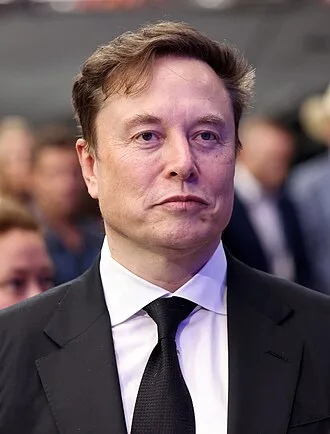
Born into the wealthy Musk family in Pretoria, South Africa, Musk emigrated in 1989 to Canada; he has Canadian citizenship since his mother was born there. He received bachelor's degrees in 1997 from the University of Pennsylvania before moving to California to pursue business ventures. In 1995, Musk co-founded Zip2, a web software company.
Following its sale in 1999, he co-founded X.com, an e-commerce payment system that merged with Confinity in March 2000 to form PayPal, which was acquired by eBay in 2002. Musk also became an American citizen in 2002.
In 2002, Musk founded and became CEO and chief engineer of SpaceX, a space technology company; the company has since led innovations in reusable rockets and commercial spaceflight. Musk joined Tesla as an early investor in 2004 and became its CEO and product architect in 2008; it has since become a leader in electric vehicles.
In 2015, Musk co-founded OpenAI to advance artificial intelligence (AI) research, but later left; his growing discontent with the organization's direction and leadership in the AI boom in the 2020s led him to establish xAI, which became a subsidiary of SpaceX in 2026. In 2022, he acquired Twitter, a social networking service, and made significant changes, including rebranding it as X in 2023.
His other businesses include Neuralink, a neurotechnology company that he co-founded in 2016, and the Boring Company, a tunneling company that he founded in 2017. In November 2025, Tesla approved a pay package worth $1 trillion for Musk, which he is to receive over 10 years if certain milestones are met, such as achieving a market capitalization of $8.5 trillion.
Musk became the first US-dollar trillionaire upon the initial public offering of SpaceX in June 2026, though a SpaceX stock collapse brought him under the threshold by the next month.
Musk was the largest donor in the 2024 U.S. presidential election, where he supported Donald Trump. After Trump was inaugurated in January 2025, Musk was Senior Advisor to the President and the de facto head of the Department of Government Efficiency (DOGE). Musk left the Trump administration in May 2025 and returned to managing his companies; shortly thereafter he had a public feud with Trump.
Musk is a supporter of global far-right politics, figures, and political parties. His political activities, statements and views have made him a polarizing figure. He has been criticized for making unscientific and misleading statements, including spreading COVID-19 misinformation, promoting conspiracy theories, and affirming antisemitic, white nationalist, racist, and transphobic comments.
His acquisition of Twitter was controversial because, following his pledge to decrease censorship, there was an increase in hate speech and misinformation on the service. His role in the second Trump administration attracted public backlash, particularly in response to DOGE and its cuts to the US Agency for International Development (USAID).
Early life and education
Elon Reeve Musk was born on June 28, 1971, in Pretoria, South Africa's administrative capital. He is of British and Pennsylvania Dutch ancestry. His mother, Maye (née Haldeman), is a model and dietitian born in Saskatchewan, Canada, and raised in South Africa. Musk therefore holds both South African and Canadian citizenship from birth.
His father, Errol Musk, is a South African electromechanical engineer, pilot, sailor, consultant, emerald dealer, and property developer, who partly owned a rental lodge at Timbavati Private Nature Reserve.
His maternal grandfather, Joshua N. Haldeman, who died in a plane crash when Musk was a toddler, was an American-born Canadian chiropractor, aviator and political activist in the technocracy movement who moved to South Africa in 1950. Haldeman's anti-government, anti-democratic and conspiracist views, which included the promotion of far-right antisemitic conspiracy theories, "fanatical" support of apartheid, and according to Errol, support of Nazism, have been suggested as an influence on Musk.
During his childhood, Musk was told stories by his grandmother of Haldeman's travels and exploits, and he has suggested that all of Haldeman's descendants have his "desire for adventure, exploration – doing crazy things".
Musk has a younger brother, Kimbal, a younger sister, Tosca, and four paternal half-siblings. He was baptized as a child in the Anglican Church of Southern Africa. The Musk family was wealthy during his youth. Despite both Musk and Errol previously stating that Errol was a part owner of a Zambian emerald mine, in 2023, Errol recounted that the deal he made was to receive "a portion of the emeralds produced at three small mines".
Errol was elected to the Pretoria City Council as a representative of the anti-apartheid Progressive Party and has said that his children shared their father's dislike of apartheid.
After his parents divorced in 1979, Musk, aged around 9, chose to live with his father because he had an Encyclopædia Britannica set and a computer. He later regretted his decision and became estranged from his father. Musk has recounted trips to a wilderness school that he described as a "paramilitary Lord of the Flies" where "bullying was a virtue" and children were encouraged to fight over rations.
In one incident, after an altercation with a fellow pupil, Musk was thrown down concrete steps and beaten severely, leading to him being hospitalized for his injuries. He described his father berating him after he was discharged from the hospital. Errol denied berating Musk and claimed, "The [other] boy had just lost his father to suicide, and Musk had called him stupid. He had a tendency to call people stupid. How could I possibly blame that child?"
Musk was an enthusiastic reader of books, and had attributed his success in part to having read The Lord of the Rings, the Foundation series, and The Hitchhiker's Guide to the Galaxy. At age ten, he developed an interest in computing and video games, teaching himself how to program from the VIC-20 user manual.
At age twelve, in 1983, Musk sold his BASIC-based game Blastar to PC and Office Technology magazine for approximately $500 (equivalent to $1,600 in 2025).
Education
Musk attended Waterkloof House Preparatory School, Bryanston High School, and then Pretoria Boys High School, where he graduated. He was a decent but unexceptional student, earning a 61/100 in Afrikaans and a B on his senior math certification. He applied for a Canadian passport through his Canadian-born mother to avoid South Africa's mandatory military service, which would have forced him to participate in the apartheid regime's mandatory military service for young white South African men, as well as to ease his path to immigration to the United States.
While waiting for his application to be processed, he attended the University of Pretoria for five months.
Musk arrived in Canada in June 1989, connected with a second cousin in Saskatchewan, and worked odd jobs, including at a farm and a lumber mill. In 1990, he entered Queen's University in Kingston, Ontario. Two years later, he transferred to the University of Pennsylvania, where he studied until 1995. Although Musk has said that he earned his degrees in 1995, the University of Pennsylvania did not award them until 1997 – a Bachelor of Arts in physics and a Bachelor of Science in economics from the university's Wharton School.
He reportedly hosted large, ticketed house parties to help pay for tuition, and wrote a business plan for an electronic book-scanning service similar to Google Books.
In 1994, Musk held two internships in Silicon Valley: one at energy storage startup Pinnacle Research Institute, which investigated electrolytic supercapacitors for energy storage, and another at Palo Alto–based startup Rocket Science Games. In 1995, he was accepted to a graduate program in materials science at Stanford University, but did not enroll.
Musk decided to join the Internet boom of the 1990s, applying for a job at Netscape, to which he reportedly never received a response. The Washington Post reported that Musk lacked legal authorization to remain and work in the United States after failing to enroll at Stanford. In response, Musk said he was allowed to work at that time and that his student visa transitioned to an H1-B.
According to numerous former business associates and shareholders, Musk said he was on a student visa at the time.
Business career
Zip2
In 1995, Musk, his brother Kimbal, and Greg Kouri founded Zip2, a web software company, with funding from a group of angel investors. They housed the venture at a small rented office in Palo Alto. Replying to Rolling Stone, Musk denounced the notion that they started their company with funds borrowed from Musk's father Errol Musk, but in a tweet, he recognized that his father contributed 10% of a later funding round.
The company developed and marketed an Internet city guide for the newspaper publishing industry, with maps, directions, and yellow pages.
According to Musk, "The website was up during the day and I was coding it at night, seven days a week, all the time." To impress investors, Musk built a large plastic structure around a standard computer to create the impression that Zip2 was powered by a small supercomputer. The Musk brothers obtained contracts with The New York Times and the Chicago Tribune, and persuaded the board of directors to abandon plans for a merger with CitySearch.
Musk's attempts to become CEO were thwarted by the board. Compaq acquired Zip2 for $307 million in cash in February 1999 (equivalent to $590,000,000 in 2025), and Musk received $22 million (equivalent to $43,000,000 in 2025) for his 7-percent share.
X.com and PayPal
In 1999, Musk co-founded X.com, an online financial services and e-mail payment company. The startup was one of the first federally insured online banks, and, in its initial months of operation, over 200,000 customers joined the service. The company's investors regarded Musk as inexperienced and replaced him with Intuit CEO Bill Harris by the end of the year.
The following year, X.com merged with online bank Confinity to avoid competition. Founded by Max Levchin and Peter Thiel, Confinity had its own money-transfer service, PayPal, which was more popular than X.com's service.
Within the merged company, Musk returned as CEO. Musk's preference for Microsoft software over Unix created a rift in the company and caused Thiel to resign. Due to resulting technological issues and lack of a cohesive business model, the board ousted Musk and replaced him with Thiel in 2000. Under Thiel, the company focused on the PayPal service and was renamed PayPal in 2001.
In 2002, PayPal was acquired by eBay for $1.5 billion (equivalent to $2,700,000,000 in 2025) in stock, of which Musk—the largest shareholder with 11.72% of shares—received $175.8 million (equivalent to $320,000,000 in 2025). In 2017, Musk purchased the domain X.com from PayPal for an undisclosed amount, stating that it had sentimental value. He later used the domain in his rebrand of Twitter to X.
SpaceX
In 2001, Musk became involved with the nonprofit Mars Society and discussed funding plans to place a growth-chamber for plants on Mars. Seeking a way to launch the greenhouse payloads into space, Musk made two unsuccessful trips to Moscow to purchase intercontinental ballistic missiles (ICBMs) from Russian companies NPO Lavochkin and Kosmotras.
Musk instead decided to start a company to build affordable rockets. With $100 million of his early fortune, (equivalent to $180,000,000 in 2025) Musk founded SpaceX in May 2002 and became the company's CEO and Chief Engineer.
SpaceX attempted its first launch of the Falcon 1 rocket in 2006. Although the rocket failed to reach Earth orbit, it was awarded a Commercial Orbital Transportation Services program contract from NASA, then led by Mike Griffin. After two more failed attempts that nearly caused Musk to go bankrupt, SpaceX succeeded in launching the Falcon 1 into orbit in 2008.
Later that year, SpaceX received a $1.6 billion NASA contract (equivalent to $2,400,000,000 in 2025) for Falcon 9-launched Dragon spacecraft flights to the International Space Station (ISS), replacing the Space Shuttle after its 2011 retirement. In 2012, the Dragon vehicle docked with the ISS, a first for a commercial spacecraft.
Working towards its goal of reusable rockets, in 2015 SpaceX successfully landed the first stage of a Falcon 9 on a land platform. Later landings were achieved on autonomous spaceport drone ships, an ocean-based recovery platform. In 2018, SpaceX launched the Falcon Heavy; the inaugural mission carried Musk's personal Tesla Roadster as a dummy payload.
Since 2019, SpaceX has been developing Starship, a reusable, super heavy-lift launch vehicle intended to replace the Falcon 9 and Falcon Heavy. In 2020, SpaceX launched its first crewed flight, the Demo-2, becoming the first private company to place astronauts into orbit and dock a crewed spacecraft with the ISS. In 2024, NASA awarded SpaceX an $843 million (equivalent to $865,000,000 in 2025) contract to build a spacecraft that NASA will use to deorbit the ISS at the end of its lifespan.
Starlink
In 2015, SpaceX began development of the Starlink constellation of low Earth orbit satellites to provide satellite Internet access. After the launch of prototype satellites in 2018, the first large constellation was deployed in May 2019. As of May 2025[update], over 7,600 Starlink satellites are operational, comprising 65% of all operational Earth satellites.
The total cost of the decade-long project to design, build, and deploy the constellation was estimated by SpaceX in 2020 to be $10 billion (equivalent to $12,000,000,000 in 2025).
During the Russian invasion of Ukraine, Musk provided free Starlink service to Ukraine, permitting Internet access and communication at a yearly cost to SpaceX of $400 million (equivalent to $440,000,000 in 2025). However, Musk refused to block Russian state media on Starlink. In 2023, Musk denied Ukraine's request to activate Starlink over Crimea to aid an attack against the Russian navy, citing fears of a nuclear response.
Tesla
Tesla, Inc., originally Tesla Motors, was incorporated in July 2003 by Martin Eberhard and Marc Tarpenning. Both men played active roles in the company's early development prior to Musk's involvement. Musk led the Series A round of investment in February 2004; he invested $6.35 million (equivalent to $11,000,000 in 2025), became the majority shareholder, and joined Tesla's board of directors as chairman.
Musk took an active role within the company and oversaw Roadster product design, but was not deeply involved in day-to-day business operations. Following a series of escalating conflicts in 2007 and the 2008 financial crisis, Eberhard was ousted from the firm.[page needed] Musk assumed leadership of the company as CEO and product architect in 2008.
A 2009 lawsuit settlement with Eberhard designated Musk as a Tesla co-founder, along with Tarpenning and two others.
Tesla began delivery of the Roadster, an electric sports car, in 2008. With sales of about 2,500 vehicles, it was the first mass production all-electric car to use lithium-ion battery cells. Under Musk, Tesla has since launched several well-selling electric vehicles, including the four-door sedan Model S (2012), the crossover Model X (2015), the mass-market sedan Model 3 (2017), the crossover Model Y (2020), and the pickup truck Cybertruck (2023).
The company has also constructed multiple lithium-ion battery and electric vehicle factories, called Gigafactories.
In May 2020, Musk resigned as chairman of the board as part of the settlement of a lawsuit from the SEC over him tweeting that funding had been "secured" for potentially taking Tesla private.
Since its initial public offering in 2010, Tesla stock has risen significantly; it became the most valuable carmaker in summer 2020, and it entered the S&P 500 later that year. In October 2021, it reached a market capitalization of $1 trillion (equivalent to $1,200,000,000,000 in 2025), the sixth company in U.S. history to do so.
SolarCity and Tesla Energy
Musk provided the initial concept and financial capital for SolarCity, which his cousins Lyndon and Peter Rive founded in 2006. By 2013, SolarCity was the second largest provider of solar power systems in the United States. In 2014, Musk promoted the idea of SolarCity building an advanced production facility in Buffalo, New York, triple the size of the largest solar plant in the United States.
Construction of the factory started in 2014 and was completed in 2017. It operated as a joint venture with Panasonic until early 2020.
Tesla acquired SolarCity for $2 billion in 2016 (equivalent to $2,700,000,000 in 2025) and merged it with its battery unit to create Tesla Energy. The deal's announcement resulted in a more than 10% drop in Tesla's stock price; at the time, SolarCity was facing liquidity issues. Multiple shareholder groups filed a lawsuit against Musk and Tesla's directors, stating that the purchase of SolarCity was done solely to benefit Musk and came at the expense of Tesla and its shareholders.
Tesla directors settled the lawsuit in January 2020, leaving Musk the sole remaining defendant. Two years later, the court ruled in Musk's favor.
Neuralink
In 2016, Musk co-founded Neuralink, a neurotechnology startup, with an investment of $100 million. Neuralink aims to integrate the human brain with artificial intelligence (AI) by creating devices that are embedded in the brain. Such technology could enhance memory or allow the devices to communicate with software.
The company also hopes to develop devices to treat neurological conditions like spinal cord injuries. In 2022, Neuralink announced that clinical trials would begin by the end of the year. In September 2023, the Food and Drug Administration approved Neuralink to initiate six-year human trials.