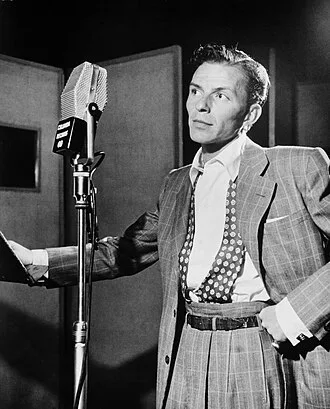
Born to Italian immigrants in Hoboken, New Jersey, Sinatra began his musical career in the swing era. He joined the Harry James band as the vocalist in 1939 before signing with Columbia Records four years later and becoming the idol of the "bobby soxers". In 1946, Sinatra released his debut album, The Voice of Frank Sinatra.
He then signed with Capitol Records and released several albums with arrangements by Nelson Riddle, notably In the Wee Small Hours (1955) and Songs for Swingin' Lovers! (1956). In 1960, Sinatra left Capitol Records to start his own record label, Reprise Records, releasing a string of successful albums. He collaborated with Count Basie on Sinatra-Basie: An Historic Musical First (1962) and It Might as Well Be Swing (1964).
In 1965, he recorded September of My Years and starred in the Emmy-winning television special Frank Sinatra: A Man and His Music.
After releasing Sinatra at the Sands in 1966, Sinatra recorded one of his most famous collaborations with Tom Jobim, Francis Albert Sinatra & Antonio Carlos Jobim. It was followed by 1968's Francis A. & Edward K. with Duke Ellington. Sinatra retired in 1971 following the release of "My Way" but came out of retirement two years later.
He recorded several albums and released "New York, New York" in 1980. Sinatra is among the world's best-selling music artists, with an estimated 150 million record sales globally.
Sinatra also forged a highly successful acting career. After winning the Academy Award for Best Supporting Actor for From Here to Eternity (1953), he starred in The Man with the Golden Arm (1955) and The Manchurian Candidate (1962). Sinatra also appeared in musicals such as On the Town (1949); Guys and Dolls (1955); High Society (1956); and Pal Joey (1957), the last of which won him a Golden Globe Award.
Toward the end of his career, Sinatra frequently played detectives, including the title character in Tony Rome (1967) and the titular The Detective (1968). He received the Golden Globe Cecil B. DeMille Award in 1971. Sinatra also directed the anti-war drama None but the Brave (1965). On television, The Frank Sinatra Show began on CBS in 1950, and Sinatra continued to make appearances on television throughout the 1950s and 1960s.
Sinatra was recognized at the Kennedy Center Honors in 1983, awarded the Presidential Medal of Freedom in 1985, and received the Congressional Gold Medal in 1997. He earned 13 Grammy Awards, including the Grammy Trustees Award, Grammy Legend Award, and the Grammy Lifetime Achievement Award. American music critic Robert Christgau called Sinatra "the greatest singer of the 20th century" and he continues to be regarded as an iconic figure.
Early life
They'd fought through his childhood and continued to do so until her dying day. But I believe that to counter her steel will he'd developed his own. To prove her wrong when she belittled his choice of career ... Their friction first had shaped him; that, I think, had remained to the end and a litmus test of the grit in his bones. It helped keep him at the top of his game.
Francis Albert Sinatra was born on December 12, 1915, in a tenement at 415 Monroe Street in Hoboken, New Jersey, the only child of Italian immigrants Natalina "Dolly" Garaventa and Antonino Martino "Marty" Sinatra. His mother was from Genoa, Liguria, while his father was from Sicily. Sinatra weighed 13.5 pounds (6.1 kg) at birth and had to be delivered with the aid of forceps, which caused severe scarring to his left cheek, neck, and lifelong damage to his left eardrum, delaying his baptism to April 2, 1916.
A childhood operation left major scarring on his neck, and during adolescence, Sinatra was further scarred by cystic acne. His excessively skinny frame as a child and young man later became the subject of jokes during stage shows. He was raised in the Catholic Church.
Sinatra's mother, Dolly, was energetic and driven; biographers believe that she was the dominant factor in the development of her son's personality and self-confidence. Sinatra's fourth wife, Barbara, would later claim that Dolly "knocked him around a lot" when he was a child. Dolly became influential in Hoboken and in local Democratic Party circles.
During the Great Depression, Dolly provided money to her son for outings with friends and to buy expensive clothes, resulting in neighbors describing him as the "best-dressed kid in the neighborhood".
Sinatra's illiterate father, Marty, was a bantamweight boxer who later worked at the Hoboken Fire Department, working his way up to captain. Due to his illiteracy, Marty stressed the importance of a "complete and full" education and had instilled in his son the desire to become a civil engineer and enroll at Stevens Institute of Technology in Hoboken.
Sinatra spent much time at his parents' tavern in Hoboken, working on his homework and occasionally singing for spare change.
At a young age, Sinatra developed an interest in music, particularly big band jazz and listened to Gene Austin, Rudy Vallée, Russ Colombo, and Bob Eberly while idolizing Bing Crosby. For his 15th birthday, Sinatra received a ukulele from his uncle Domenico, with which he performed at family gatherings. Sinatra attended David E.
Rue Jr. High School from 1928, and A. J. Demarest High School (since renamed Hoboken High School) in 1931, where he arranged bands for school dances, but left without graduating after having attended only 47 days before being expelled for "general rowdiness".
To please his mother, Sinatra enrolled at Drake Business School, but departed after 11 months. Dolly found him working as a delivery boy at the Jersey Observer newspaper (since merged into The Jersey Journal), where his godfather Frank Garrick worked; Sinatra later worked as a riveter at the Tietjen and Lang shipyard. He began performing in local Hoboken social clubs and sang for free on radio stations such as WAAT in Jersey City.
Music career
1935–1942: Career beginnings
Hoboken Four and Harry James
Sinatra began singing professionally as a teenager. He never learned to read music but learned by ear. Sinatra got his first break in 1935 when his mother persuaded a local singing group called the 3 Flashes, who were auditioning for the Major Bowes Amateur Hour show, to let him join. Baritone Fred Tamburro stated, "Frank hung around us like we were gods or something", admitting that they took him on board only because he owned a car and could chauffeur the group.[citation needed]
The group became the "Hoboken Four" and passed an audition from Major Bowes to appear on the show. They each earned $12.50, and attracted 40,000 votes to win first prize—a six-month contract to perform on stage and radio across the U.S. Sinatra quickly became the group's lead singer, and, much to the jealousy of his fellow group members, garnered most of the attention from the girls.
Due to the success of the group, Bowes kept asking for them to return, disguised under different names, varying from "The Secaucus Cockamamies" to "The Bayonne Bacalas," although this may be apocryphal, sourced from Sinatra's humorous stage patter during his appearance with the Count Basie orchestra at the Sands (1966).
In March 1939, saxophone player Frank Mane, who knew Sinatra from Jersey City radio station WAAT, arranged for him to audition and record "Our Love", his first solo studio recording. In June, bandleader Harry James, who had heard Sinatra sing on "Dance Parade", signed him to a two-year contract of $75 a week after a show at the Paramount Theatre in New York.
It was with the James band that Sinatra released his first commercial record "From the Bottom of My Heart" in July. No more than 8,000 copies were sold, and further records released with James through 1939, such as "All or Nothing at All", also had weak sales on their initial release. Thanks to his vocal training, Sinatra could now sing two tones higher, and developed a repertoire that included songs such as "My Buddy", "Willow Weep for Me", "It's Funny to Everyone but Me", "Here Comes the Night", "On a Little Street in Singapore", "Ciribiribin", and "Every Day of My Life".
Sinatra became increasingly frustrated with the Harry James band, feeling that he was not achieving the major success and acclaim he was looking for. Sinatra's pianist and close friend Hank Sanicola persuaded him to stay with the group, but Sinatra left James in November 1939 to replace Jack Leonard as the lead singer of the Tommy Dorsey band.
Sinatra earned $125 a week, appearing at the Palmer House in Chicago, and James released Sinatra from his contract.
Tommy Dorsey band
On January 26, 1940, Sinatra made his first public appearance with the band at the Coronado Theatre in Rockford, Illinois, opening the show with "Stardust". Dorsey recalled: "You could almost feel the excitement coming up out of the crowds when the kid stood up to sing. Remember, he was no matinée idol. He was just a skinny kid with big ears. I used to stand there so amazed I'd almost forget to take my own solos".
Dorsey was a major influence on Sinatra and became a father figure. Sinatra copied Dorsey's mannerisms and traits, becoming a demanding perfectionist like him, even adopting his hobby of toy trains. Sinatra asked Dorsey to be godfather to his daughter Nancy in June 1940. Sinatra later said that "The only two people I've ever been afraid of are my mother and Tommy Dorsey." Sinatra and drummer Buddy Rich were friends and even roommates when the band was on the road, but professional jealousy surfaced as both men wanted to be considered the star of Dorsey's band.
Later, Sinatra helped Rich form his own band with a $25,000 loan and provided financial help to Rich during times of the drummer's serious illness.
In his first year with Tommy Dorsey, Sinatra recorded more than 40 songs. His first vocal hit was the song "Polka Dots and Moonbeams" in late April 1940. Two more chart appearances followed with "Say It" and "Imagination", which was Sinatra's first top-10 hit. His fourth chart appearance (and his first on the first officially published Billboard chart) was "I'll Never Smile Again", topping the charts for twelve weeks beginning in mid-July.
Other records with Dorsey issued by RCA Victor include "Our Love Affair" and "Stardust" in 1940; "Oh! Look at Me Now", "Dolores", "Everything Happens to Me", and "This Love of Mine" in 1941; "Just as Though You Were There", "Take Me", and "There Are Such Things" in 1942; and "It Started All Over Again", "In the Blue of Evening", and "It's Always You" in 1943.
As his success and popularity grew, Sinatra pushed Dorsey to allow him to record some solo songs. Dorsey eventually relented, and on January 19, 1942, Sinatra recorded "Night and Day", "The Night We Called It a Day", "The Song is You", and "Lamplighter's Serenade" at a Bluebird recording session, with Axel Stordahl as arranger and conductor.
Sinatra first heard the recordings at the Hollywood Palladium and Hollywood Plaza and was astounded at how good he sounded. Stordahl recalled: "He just couldn't believe his ears. He was so excited you almost believed he had never recorded before. I think this was a turning point in his career. I think he began to see what he might do on his own".
After the 1942 recordings, Sinatra believed that he needed to go solo, with an insatiable desire to compete with Bing Crosby, but Sinatra was hampered by his contract which gave Dorsey 43% of Sinatra's lifetime earnings. A legal battle ensued, eventually settled in August 1942. On September 3, 1942, Dorsey bade farewell to Sinatra, reportedly saying, "I hope you fall on your ass", but he was more gracious on the air when replacing Sinatra with singer Dick Haymes.
Rumors began spreading in newspapers that Sinatra's mobster godfather, Willie Moretti, coerced Dorsey at gunpoint to let Sinatra out of his contract for a few thousand dollars. Sinatra persuaded Stordahl to come with him and become his personal arranger, offering him $650 a month, five times his salary from Dorsey. Dorsey and Sinatra, who had been very close, never reconciled their differences.
1942–1945: Onset of Sinatramania and role in World War II
By May 1941, Sinatra topped the male singer polls in Billboard and DownBeat magazines. His appeal to bobby soxers, a subculture of teenage girls, revealed a new audience for popular music, which had previously been recorded mainly for adults. The phenomenon became known as "Sinatramania" after his opening at the Paramount Theatre in New York on December 30, 1942.
According to Nancy Sinatra, Jack Benny later said, "I thought the goddamned building was going to cave in. I never heard such a commotion ... All this for a fellow I never heard of." Sinatra performed for four weeks at the theatre, his act following the Benny Goodman orchestra, after which his contract was renewed for another four weeks by Bob Weitman due to his popularity.
Sinatra became known as "Swoonatra" or "The Voice", and his fans "Sinatratics". They organized meetings and sent masses of letters of adoration, and within a few weeks of the show, some 1,000 Sinatra fan clubs had been reported across the US.
Sinatra's publicist, George Evans, encouraged interviews and photographs with fans and was the man responsible for depicting Sinatra as a vulnerable, shy, Italian–American with a rough childhood who made good. When Sinatra returned to the Paramount in October 1944, only 250 persons left the first show, and 35,000 fans left outside caused a near riot, known as the Columbus Day Riot, outside the venue because they were not allowed in.
Such was the bobby-soxer devotion to Sinatra that they were known to write his song titles on their clothing, bribe hotel maids for an opportunity to touch his bed, and steal clothing Sinatra was wearing.
Sinatra signed with Columbia Records as a solo artist on June 1, 1943, during the 1942–44 musicians' strike. Columbia Records re-released Harry James and Sinatra's August 1939 version of "All or Nothing at All", which reached number 2 on June 2 and was on the best-selling list for 18 weeks. Sinatra initially had great success, and performed on the radio on Your Hit Parade from February 1943 until December 1944, and on stage.[citation needed]
Columbia wanted new recordings of their growing star as quickly as possible, so Alec Wilder was hired as an arranger and conductor for several sessions with a vocal group called the Bobby Tucker Singers. Of the nine songs recorded during these sessions, seven charted on the best-selling list. That year he made his first solo nightclub appearance at New York's Riobamba, and a successful concert in the Wedgewood Room of the prestigious Waldorf-Astoria New York that year secured his popularity in New York high society.
Sinatra released "You'll Never Know", "Close to You", "Sunday, Monday, or Always" and "People Will Say We're in Love" as singles. By the end of 1943, he was more popular in a DownBeat poll than Bing Crosby.
Sinatra did not serve in the military during World War II. However, Army files reported that Sinatra had actually been rejected because he was "not acceptable material from a psychiatric viewpoint;" Sinatra's emotional instability was hidden to avoid "undue unpleasantness for both the selectee and the induction service".
Rumors reported by columnist Walter Winchell stated that Sinatra paid $40,000 to avoid military service, but the FBI found this to be without merit.
Toward the end of the war, Sinatra entertained the troops during several successful overseas USO tours with comedian Phil Silvers. During one trip to Rome, he met Pope Pius XII, who asked Sinatra if he was an operatic tenor. Sinatra worked frequently with the popular Andrews Sisters in radio in the 1940s, and many USO shows were broadcast to troops via the Armed Forces Radio Service (AFRS).
In 1944, he released "I Couldn't Sleep a Wink Last Night" as a single and recorded his own version of Irving Berlin's "White Christmas". The following year, Sinatra released "I Dream of You (More Than You Dream I Do)", "Saturday Night (Is the Loneliest Night of the Week)", "Dream", and "Nancy (with the Laughing Face)" as singles.
1946–1952: Columbia years and career slump
Despite being heavily involved in political activity in 1945 and 1946, Sinatra sang on 160 radio shows, recorded 36 times, and shot four films in those two years. By 1946, he was performing on stage up to 45 times a week, singing up to 100 songs daily, and earning up to $93,000 a week.
In 1946, Sinatra released "Oh! What it Seemed to Be", "Day by Day", "They Say It's Wonderful", "Five Minutes More", and "The Coffee Song" as singles, and launched his first album, The Voice of Frank Sinatra, which reached No. 1 on the Billboard chart. William Ruhlmann of AllMusic wrote that Sinatra "took the material very seriously, singing the love lyrics with utter seriousness" and that his "singing and the classically influenced settings gave the songs unusual depth of meaning." Sinatra was soon selling 10 million records a year.
Such was Sinatra's command at Columbia that his love of conducting was indulged with the release of the set Frank Sinatra Conducts the Music of Alec Wilder, an offering unlikely to appeal to Sinatra's core fanbase of teenage girls at the time. In 1947, he released his second album, Songs by Sinatra, featuring songs of a similar mood and tempo such as Irving Berlin's "How Deep is the Ocean?" and Harold Arlen's and Jerome Kern's "All The Things You Are". "Mam'selle", composed by Edmund Goulding with lyrics by Mack Gordon for the film The Razor's Edge (1946), was released as a single.
Sinatra had competition; versions by Art Lund, Dick Haymes, Dennis Day, and The Pied Pipers also reached the top ten of the Billboard charts. In December, Sinatra recorded "Sweet Lorraine" with the Metronome All-Stars, featuring talented jazz musicians such as Coleman Hawkins, Harry Carney and Charlie Shavers, with Nat King Cole on piano, in what Charles L. Granata describes as "one of the highlights of Sinatra's Columbia epoch".
Sinatra's third album, Christmas Songs by Sinatra, was originally released in 1948 as a 78 rpm album set, and a 10" LP record was released two years later. When Sinatra was featured as a priest in The Miracle of the Bells, due to press negativity surrounding his Mafia connections at the time, it was announced that Sinatra would donate his $100,000 in wages from the film to the Catholic Church.
By the end of 1948, Sinatra had slipped to fourth on DownBeat's annual poll of most popular singers, and the following year, he was pushed out of the top spots in polls for the first time since 1943. Frankly Sentimental (1949) was panned by DownBeat, who commented that "for all his talent, it seldom comes to life."