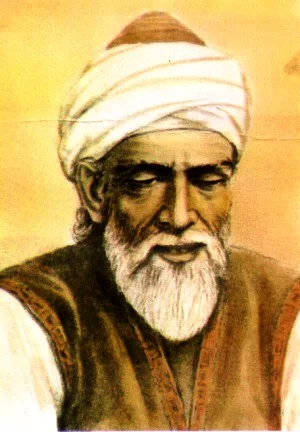
Ebû Mahmûd Hâmid bin Hıdır al-Hucendî was a Muslim astronomer and mathematician who lived in the 10th century. He is known for the giant observation instrument he built near Rey and the measurements he made for the Earth's axial tilt.
He was called with this name because he came from the city of Khujand in Tajikistan today. He spent the last period of his life in Rey under the protection of the Buwayhid ruler Fahrüddevle and died there around the year 1000.
astronomy studies
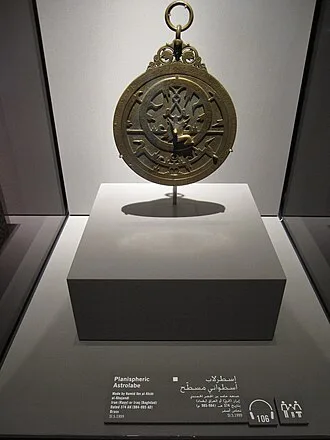
The large wall sextant (es-Süds el-Fahri), which was built in honor of Fahrüddevle and named after him, was one of the greatest observation instruments of its time. In 994, he measured the meridian altitude of the Sun with this instrument and calculated the obliquity of the ecliptic as 23° 32′ 19″. The value he found was lower than the values given by previous astronomers; This difference contributed to the idea that axial tilt changes over time. His treatises on the sextant and an observation instrument of universal use have survived to this day.
Mathematics studies
He is mentioned among the first to put forward the sine theorem used in spherical triangles; However, it is controversial to whom this invention belongs. He tried to show that the sum of two cube numbers cannot still be a cube number; This is the special case for n=3 of the proposition that would later be known as Fermat's last theorem. Most of his mathematical works have been lost.
Hucendi is remembered as one of the names involved in the development of astronomy in the Islamic world with his works combining observation instruments and theoretical mathematics.