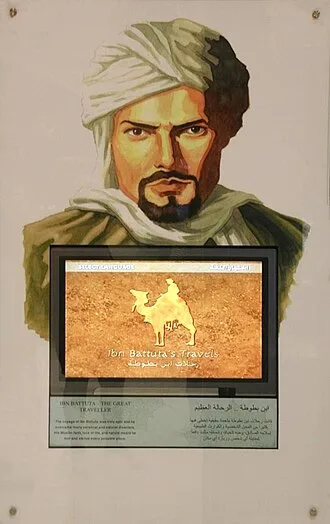
Ibn Battuta travelled more than any other explorer in pre-modern history, totalling around 117,000 km (73,000 mi), surpassing Zheng He with about 50,000 km (31,000 mi) and Marco Polo with 24,000 km (15,000 mi).
Name
"Ibn Battuta" is a patronymic, literally meaning 'son of a duckling'. His most common full name is given as Abu Abdullah Muhammad ibn Battuta. In his travelogue, The Rihla, he gives his full name as "Shams al-Din Abu ’Abdallah Muhammad ibn ’Abdallah ibn Muhammad ibn Ibrahim ibn Muhammad ibn Yusuf Lawati al-Tanji ibn Battuta".
Early life
All that is known about Ibn Battuta's life comes from the autobiographical information included in the account of his travels, which records that he was of Arabised Berber descent, born into a family of Islamic legal scholars (known as qadis in the Muslim traditions of Morocco) in Tangier on 24 February 1304, during the reign of the Marinid dynasty.
His family belonged to a Berber tribe clan known as the Lawata. As a young man, he would have studied at a Sunni Maliki school, the dominant form of education in North Africa at that time. Maliki Muslims requested that Ibn Battuta serve as their religious judge, as he was from an area where it was practised.
Journeys
Itinerary, 1325–1332

First pilgrimage
On 2 Rajab 725 AH (14 June 1325 AD), Ibn Battuta set off from his home town at the age of 21 to perform a hajj (pilgrimage) to Mecca, a journey that would ordinarily take sixteen months. He was eager to learn more about far-away lands and craved adventure. He would not return to Morocco again for 24 years.
I set out alone, having neither fellow-traveler in whose companionship I might find cheer, nor caravan whose part I might join, but swayed by an overmastering impulse within me and a desire long-cherished in my bosom to visit these illustrious sanctuaries. So I braced my resolution to quit my dear ones, female and male, and forsook my home as birds forsake their nests.
My parents being yet in the bonds of life, it weighed sorely upon me to part from them, and both they and I were afflicted with sorrow at this separation.
He travelled to Mecca overland, following the North African coast across the sultanates of Abd al-Wadid and Hafsid. The route took him through Tlemcen, Béjaïa, and then Tunis, where he stayed for two months. For safety, Ibn Battuta usually joined a caravan to reduce the risk of being robbed. He took a bride in the town of Sfax, but soon left her due to a dispute with the father. That was the first in a series of marriages that would feature in his travels.
In the early spring of 1326, after a journey of over 3,500 km (2,200 mi), Ibn Battuta arrived at the port of Alexandria, at the time part of the Bahri Mamluk empire. He met two ascetic pious men in Alexandria. One was Sheikh Burhanuddin, who is supposed to have foretold the destiny of Ibn Battuta as a world traveller and told him, "It seems to me that you are fond of foreign travel.
You must visit my brother Fariduddin in India, Rukonuddin in Sind, and Burhanuddin in China. Convey my greetings to them." Another pious man, Sheikh Murshidi, interpreted a dream of Ibn Battuta as being that he was meant to be a world traveller.
He spent several weeks visiting sites in the area, and then headed inland to Cairo, the capital of the Mamluk Sultanate. After spending about a month in Cairo, he embarked on the first of many detours within the relative safety of Mamluk territory. Of the three usual routes to Mecca, Ibn Battuta chose the least-travelled, which involved a journey up the Nile valley, then east to the Red Sea port of ʿAydhab. Upon approaching the town, however, a local rebellion forced him to turn back.