















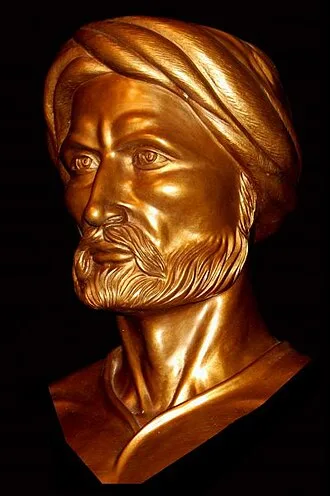
His best-known book is the Muqaddimah or Prolegomena ("Introduction"), which he wrote in six months as he states in his autobiography. It later influenced 17th-century and 19th-century Ottoman historians such as Kâtip Çelebi, Mustafa Naima and Ahmed Cevdet Pasha, who used its theories to analyze the growth and decline of the Ottoman Empire. Ibn Khaldun interacted with Tamerlane, the founder of the Timurid Empire.
He has been called one of the most prominent Muslim and Arab scholars and historians. Recently, Ibn Khaldun's works have been compared with those of influential European philosophers such as Niccolò Machiavelli, Giambattista Vico, David Hume, G. W. F. Hegel, Karl Marx, and Auguste Comte as well as the economists David Ricardo and Adam Smith, suggesting that their ideas found precedent (although not direct influence) in his.
He has also been influential on certain modern Islamic thinkers (e.g. those of the traditionalist school).
Early life
Ibn Khaldun's life is well-documented as a result of his biography. However, despite it being described by the historian Allen Fromherz as "the most detailed autobiography in Medieval Muslim literature", it lacked many personal details.
Both the scholars Walter Joseph Fischel and Syed Farid Alatas divided Ibn Khaldun's life into phases with the former dividing it into two and the latter into three. Fischel divides his life into the period he lived in the Maghreb (birth to fifty years) and the period he lived in Egypt. Alatas divides it into the first twenty years covering his education, the next twenty years in political office and the final twenty where he served as a scholar, teacher and magistrate.
Birth and family
ʿAbd al-Raḥmān ibn Khaldūn was born in Tunis on 26 May 1332 (1 Ramadan 732 AH) into an upper-class Andalusian family of Yemeni Arab descent, the Banū Khaldūn.[page needed] He traced family's ancestry to Ḥaḍramawt with his lineage specifically going back to Wāʾil Ibn Hujr a companion of the Islamic prophet Muhammad and a prominent chief:
Our ancestry goes back to Ḥaḍramawt, [we belong to the] Arabs of the Yemen, and descend from Wāʾil Ibn Hujr. He was one of the leaders of the Arabs, was known, and had a following.
— Riḥlat Ibn Khaldūn
In a delegation to Madina visiting the prophet, Wāʾil received a blessing from the Prophet: "O Allah, bless Wa'il and his descendants!". He narrated about seventy hadiths and was also a close companion of the Umayyad caliph Muʿāwiya. The specific tribe Ibn Khaldun traced his ancestry to was Kinda. The eponymous ancestor of the Banū Khaldūn was ʿUthmān ibn Bakr ibn Khālid, also known as Khaldūn, who originally settled in Carmona then in Seville.
Both Ibn Ḥazm and Ibn Ḥayyān mentioned the Banū Khaldūn as one of the most important Arab families in al-Andalus occupying prominent governmental and scholarly positions in Seville. However, during the first three centuries of Muslim rule, there is little information about the Banū Khaldūn. At the start of the Umayyad caliph ʿAbd Allāh's reign in the 9th century, the Banū Khaldūn alongside the Banū l-Ḥajjāj were the leading Arab families of Seville.
One of Ibn Khaldun's ancestors, Kurayb, led a revolt at that time and established a quasi-independent state in Seville. In the taifa period, the Banū Khaldūn served as viziers under the Abbadid dynasty. Under the Almohads, the Banū Khaldūn reappeared as members of the Sevillan ellite and they had ties with the Almohad governors.
Ibn Khaldun was linked to the Hafsids on his maternal side as one of his maternal ancestors, Ibn al-Muhtasib, gave a Galician concubine to the Hafsid Abū Zakariyyāʾ. A descendant of this relationship was the Hafsid ruler in Tunis.
The Banū Khaldūn left Seville in 1232 before the Reconquista and the city's occupation in 1248. They first settled in the city of Ceuta before moving to Tunis. The fourth-grandfather of Ibn Khaldun, al-Ḥasan ibn Muḥammad, joined Abū Zakariyyāʾ in Bona. Ibn Khaldun's great grandfather, Abū Bakr Muḥammad ibn al-Ḥasan, served as Director of Finances (ʿamal al-ashgāl) to Abū Isḥāq.
However, he died during an anti-Hafsid revolt by the pretender Ibn Abī ʿUmāra who arrested, tortured and executed Abū Bakr Muḥammad. Ibn Khaldun's grandfather, Muḥammad, was initially named Chamberlain to the Crown Prince, Abū Fāris, under Abū Isḥāq.
After Abū Yaḥyā ibn al-Liḥyānī conquered Tunis, Muḥammad was appointed chamberlain. Abū Yaḥyā would often leave the affairs of state under Muḥammad's administration. Muḥammad held a number of minor positions under multiple Hafsid rulers but avoided higher appointments (potentially because of the fate of his father).
After two pilgrimages to Mecca, he retired to become a religious scholar. He died in 1337. Ibn Khaldun's father, Muḥammad Abū Bakr, broke from the familial tradition and stayed out of politics.[page needed] He devoted himself to fiqh, literature and piety.
Ibn Khaldun had a younger brother, Yaḥyā, who was also a scholar and historian, and an older brother, Muḥammad, who there is little information about.
The Black Death (or simply the plague) was a major turning point during Ibn Khaldun's youth in which he lost close family members including both his mother and father and much of his extended family. The scholars Douglas H. Garrison and Allen Fromherz argue that the plague impacted Ibn Khaldun's worldview on public sanitation, urban life and urbanisation as well as inspiring him to write the Muqaddimah.
Education
Ibn Khaldun's first and most influential teacher was his father. Under his father's tutelage, he studied both the Islamic and the rational sciences with his father also shaping his independent thinking and appreciation for Sufism. Coming from an erudite and socially prominent family, he studied a standard curriculum which qualified him for either scholarly or administrative professions.
He also benefitted from a number of other teachers which encompassed locally prominent Moroccan and Tunisian scholars along with Andalusian exiles who had settled in Tunis and other North African cities. Ibn Khaldun learnt a number of Islamic sciences including Quranic recitation and its different styles, Quranic orthography, Maliki law, the hadiths and poetry.
Under his father and several grammarians and literary scholars he studied Arabic. With the Andalusian scholar Abu ʿAbdallah Muhammad al- Ansari, he studied the Quran and fiqh. At a young age, he became a hafiz. The specific style of recitation he learnt was the Yaʿqub recitation. He would also go on to memorise volumes of poetry, literature, and hadith.
He received an ijāza to transmit teachings in language and law from the leading hadith scholar in Tunis, Abū ʿAbd Allāh Muḥammad ibn Jābir ibn Sulṭān al-Qaysī al-Wādīyāshī. He also received an ijaza from a number of other scholars.[page needed] Ibn Khaldun studied Maliki law under a number of scholars with Ibn ʿAbd Allāh al-Jayyānī teaching him the entire Kitāb al-Muwaṭṭaʾ the basis of Maliki law.
During the Marinid occupation of Ifriqya under the ruler Abu al-Hasan, Ibn Khaldun was able to access a number of scholars from the western Maghrib. This included who would become his most prominent teacher, Muḥammad ibn Ibrāhīm al-Ābilī, described by Ibn Khaldun as "the grand master of the rational sciences".[page needed] Under al-Ābilī, he studied philosophy, logic and mathematics. al-Ābilī was a rationalist and was highly influenced by Greco-Islamic thought namely that of al-Farabi, Ibn Sina, Ibn Rushd and Fakhr al-Din al-Razi.
At the age of 19, under al-Ābilī, Ibn Khaldun completed an abridgement of al-Razi's Lubab al-Muhassal. Through al-Ābilī, Ibn Khaldun developed his opposition to madrasas which were typically used by the state to disseminate their own views. Not being restricted to specific institutions and having access to many teachers allowed Ibn Khaldun to have a very diverse education giving him freedom to study under any teacher who would take him.
In Tunis, both in the morning and the evening—
And the morning belongs to God as does the evening—
There is fear and hunger and death,
Stirred up by tumult and pestilence
The plague would kill many of his teachers. It also killed many of Abu al-Hasan's retinue and army with his remaining followers retreating back towards Fes. Eventually, al-Ābilī would also return to Fes.[page needed]
Political career
At the age of 20, he began his political career in the chancellery of the Tunisian ruler Ibn Tafrakin with the position of Kātib al-'Alāmah (seal-bearer), which consisted of writing in fine calligraphy the typical introductory notes of official documents. In 1352, Abū Ziad, the sultan of Constantine, marched on Tunis and defeated it.
Ibn Khaldūn, in any case unhappy with his respected but politically meaningless position, followed his teacher Abili to Fez. There, the Marinid sultan, Abū Inan Fares I, appointed him as a writer of royal proclamations, but Ibn Khaldūn still schemed against his employer, which, in 1357, got the 25-year-old a 22-month prison sentence.
Upon the death of Abū Inan in 1358, Vizier al-Hasān ibn-Umar granted him freedom and reinstated him to his rank and offices. Ibn Khaldūn then schemed against Abū Inan's successor, Abū Salem Ibrahim III, with Abū Salem's exiled uncle, Abū Salem. When Abū Salem came to power, he gave Ibn Khaldūn a ministerial position, the first position to correspond with Ibn Khaldūn's ambitions.
Al-Sakhāwī summarizes his career as including travel through major western Islamic centers such as Fez, Granada, and Tlemcen, alongside repeated shifts between political roles. The same entry notes that he later arrived in Cairo in Shaʿbān 782 AH/1380 CE.
The treatment that Ibn Khaldun received after the fall of Abū Salem through Ibn-Amar ʻAbdullah, a friend of Ibn Khaldūn's, was not to his liking, as he received no significant official position. At the same time, Amar successfully prevented Ibn Khaldūn, whose political skills he knew well, from allying with the Abd al-Wadids in Tlemcen.
Ibn Khaldūn, therefore, decided to move to Granada. He could be sure of a positive welcome there since at Fez, he had helped the Sultan of Granada, the Nasrid Muhammad V, regain power from his temporary exile. In 1364, Muhammad entrusted him with a diplomatic mission to the king of Castile, Pedro the Cruel, to endorse a peace treaty.
Ibn Khaldūn successfully carried out this mission and politely declined Pedro's offer to remain at his court and have his family's Spanish possessions returned to him.
In Granada, Ibn Khaldūn quickly came into competition with Muhammad's vizier, Ibn al-Khatib, who viewed the close relationship between Muhammad and Ibn Khaldūn with increasing mistrust. Ibn Khaldūn tried to shape the young Muhammad into his ideal of a wise ruler, an enterprise that Ibn al-Khatib thought foolish and a danger to peace in the country.
As a result of al-Khatib's influence, Ibn Khaldūn was eventually sent back to North Africa. Al-Khatib himself was later accused by Muhammad of having unorthodox philosophical views and murdered despite an attempt by Ibn Khaldūn to intercede on behalf of his old rival.
In his autobiography, Ibn Khaldūn tells little about his conflict with Ibn al-Khatib and the reasons for his departure. Twentieth century Orientalist Muhsin Mahdi interprets that as showing that Ibn Khaldūn later realised that he had completely misjudged Muhammad V.
Back in Ifriqiya, the Hafsid sultan of Béjaïa, Abū ʻAbdallāh, who had been his companion in prison, received him with great enthusiasm and made Ibn Khaldūn his prime minister. Ibn Khaldūn carried out a daring mission to collect taxes among the local Berber tribes. After the death of Abū ʻAbdallāh in 1366, Ibn Khaldūn changed sides once again and allied himself with the Sultan of Tlemcen, Abū l-Abbas.
A few years later, he was taken prisoner by Abu Faris Abdul Aziz, who had defeated the sultan of Tlemcen and seized the throne. He then entered a monastic establishment and occupied himself with scholastic duties until 1370. In that year, he was sent for to Tlemcen by the new sultan. After the death of ʻAbdu l-Azīz, he resided at Fez, enjoying the patronage and confidence of the regent.
Ibn Khaldūn's political skills and, above all, his good relationship with the wild Berber tribes were in high demand among the North African rulers, but he had begun to tire of politics and constantly switching allegiances. In 1375, he was sent by Abū Hammu, the Abd al-Wadid Sultan of Tlemcen, on a mission to the Dawadida Arabs tribes of Biskra.
After his return to the West, Ibn Khaldūn sought refuge with one of the Berber tribes in the west of Algeria, in the town of Qalat Ibn Salama. He lived there for over three years under their protection, taking advantage of his seclusion to write the Muqaddimah "Prolegomena", the introduction to his planned history of the world.
In Ibn Salama, however, he lacked the necessary texts to complete the work. Therefore, in 1378, he returned to his native Tunis, which had meanwhile been conquered by Abū l-Abbas, who took Ibn Khaldūn back into his service. There, he devoted himself almost exclusively to his studies and completed his history of the world.
His relationship with Abū l-Abbas remained strained, as the latter questioned his loyalty. That was brought into sharp contrast after Ibn Khaldūn presented him with a copy of the completed history that omitted the usual panegyric to the ruler. Under pretence of going on the Hajj to Mecca, something for which a Muslim ruler could not simply refuse permission, Ibn Khaldūn was able to leave Tunis and to sail to Alexandria.
Later life
Ibn Khaldun said of Egypt, "He who has not seen it does not know the power of Islam." While other Islamic regions had to cope with border wars and inner strife, Mamluk Egypt enjoyed prosperity and high culture. In 1384, the Egyptian Sultan, al-Malik udh-Dhahir Barquq, made Khaldun professor of the Qamhiyyah Madrasah and appointed him as the Grand qadi of the Maliki school of fiqh (one of four schools, the Maliki school was widespread primarily in Western Africa).
Al-Sakhāwī similarly states that Ibn Khaldūn taught at al-Azhar and was appointed to the Mālikī judgeship in Cairo more than once. Ibn Khaldūn's view on the administration of justice in Egypt was less than favorable, and he had resolved to do his best to reform what he believed to be abuses of the system. He also insisted that the Egyptians were far too easy-going and did not have any sense of urgency for the Day of Judgment.
His efforts at reform encountered resistance, however, and within a year, he had to resign his judgeship. Also in 1384, a ship carrying Khaldun's wife and children sank off of Alexandria.
After his return from a pilgrimage to Mecca in May 1388, Ibn Khaldūn concentrated on teaching at various Cairo madrasas. At the Mamluk court he fell from favor because during revolts against Barquq, he had, apparently under duress, with other Cairo jurists, issued a fatwa against Barquq. Later relations with Barquq returned to normal, and he was once again named the Maliki qadi. Altogether, he was called six times to that high office, which, for various reasons, he never held long.
In 1401, under Barquq's successor, his son Faraj, Ibn Khaldūn took part in a military campaign against the Mongol conqueror, Timur, who besieged Damascus in 1400. Ibn Khaldūn cast doubt upon the viability of the venture and really wanted to stay in Egypt. His doubts were vindicated, as the young and inexperienced Faraj, concerned about a revolt in Egypt, left his army to its own devices in Syria and hurried home.
Ibn Khaldūn remained at the besieged city for seven weeks, being lowered over the city wall by ropes to negotiate with Timur, in a historic series of meetings that he reported extensively in his autobiography. Timur questioned him in detail about conditions in the lands of the Maghreb. At his request, Ibn Khaldūn even wrote a long report about it.
As he recognized Timur's intentions, he did not hesitate, on his return to Egypt, to compose an equally-extensive report on the history of the Tatars, together with a character study of Timur, sending them to the Merinid rulers in Fez.
Ibn Khaldūn spent the next five years in Cairo completing his autobiography and his history of the world and acting as teacher and judge. Meanwhile, he was alleged to have joined an underground party, Rijal Hawa Rijal, whose reform-oriented ideals attracted the attention of local political authorities. The elderly Ibn Khaldun was placed under arrest. He died on 17 March 1406, one month after his sixth selection for the office of the Maliki qadi (Judge).
Works
al-Muqaddima and the rest of Kitāb al-ʻIbar
- Kitāb al-ʻIbar, (full title: Kitāb al-ʻIbar wa-Dīwān al-Mubtadaʼ wa-l-Khabar fī Taʼrīkh al-ʻArab wa-l-Barbar wa-Man ʻĀṣarahum min Dhawī ash-Shaʼn al-Akbār: "Book of Lessons, Record of Beginnings and Events in the History of the Arabs and the Berbers and Their Powerful Contemporaries"); begun as a history of the Berbers and expanded to a universal history in seven books.
- Book 1; Al-Muqaddima ('The Introduction'), a socio-economic-geographical universal history of empires, and the best known of his works.
- Books 2–5; World History up to the author's own time.
- Books 6–7; Historiography of the Berbers and the Maghreb. Khaldun departs from the classical style of Arab historians by synthesising multiple, sometimes contradictory, sources without citations. He reproduces some errors originating probably from his 14th-century Fez source, the work Rawḍ al-Qirṭās by Ibn Abi Zar, yet Al-'Ibar remains an invaluable source of Berber history.
Concerning the discipline of sociology, he described the dichotomy of sedentary life versus nomadic life as well as the inevitable loss of power that occurs when warriors conquer a city. Al-Sakhāwī describes Kitāb al-ʿIbar as Ibn Khaldūn’s major historical work and notes that it was prefaced with a lengthy introduction addressing civilization (ʿumrān), kingship, livelihood, and the sciences.
Encyclopaedia Britannica likewise highlights the Muqaddimah as his best-known work and a landmark statement of his philosophy of history. According to the Arab scholar Sati' al-Husri, the Muqaddimah may be read as a sociological work. The work is based around Ibn Khaldun's central concept of aṣabiyyah, translated as "group cohesiveness" or "solidarity".
This social cohesion arises spontaneously in tribes and other small kinship groups; it can be intensified and enlarged by a religious ideology. Ibn Khaldun's analysis looks at how this cohesion carries groups to power but contains within itself the seeds – psychological, sociological, economic, political – of the group's downfall, to be replaced by a new group, dynasty or empire bound by a stronger (or at least younger and more vigorous) cohesion.
Some of Ibn Khaldun's views, particularly those concerning the Zanj people of sub-Saharan Africa, have been cited as racist. According to the scholar Abdelmajid Hannoum, Ibn Khaldun's description of the distinctions between Berbers and Arabs were misinterpreted by the translator William McGuckin de Slane, who wrongly inserted a "racial ideology that sets Arabs and Berbers apart and in opposition" into his translation of part of`Ibar translated under the title Histoire des Berbères.
Perhaps the most frequently cited observation drawn from Ibn Khaldūn's work is the notion that when a society becomes a great civilization, its high point is followed by a period of decay. This means that the next cohesive group that conquers the diminished civilization is, by comparison, a group of barbarians. Once the barbarians solidify their control over the conquered society, however, they become attracted to its more refined aspects, such as literacy and arts, and either assimilate into or appropriate such cultural practices.
Then, eventually, the former barbarians will be conquered by a new set of barbarians, who will repeat the process.
Georgetown University Professor Ibrahim Oweiss, an economist and historian, argues that Ibn Khaldun was a major forerunner of modern economists and, in particular, originated the labor theory of value long before better known proponents such as Adam Smith and David Ricardo, although Khaldun did not refer to it as either a labor theory of value or theory.
Ibn Khaldun also called for the creation of a science to explain society and went on to outline these ideas in his major work, the Muqaddimah, which states that "Civilization and its well-being, as well as business prosperity, depend on productivity and people's efforts in all directions in their own interest and profit".
Ibn Khaldun diverged from norms that Muslim historians followed and rejected their focus on the credibility of the transmitter and focused instead on the validity of the stories and encouraged critical thinking.
Ibn Khaldun also outlines early theories of division of labor, taxes, scarcity, and economic growth.
He argued that poverty was a result of the destruction of morality and human values. He also looked at what factors contribute to wealth, such as consumption, government, and investment. Khaldun also argued that poverty was not necessarily a result of poor financial decision-making but of external consequences and therefore the government should be involved in alleviating poverty.
Researchers from Malaysia's Insaniah University College and Indonesia's Tazkia University College of Islamic Economics created a dynamics model based upon Ibn Khaldun's writings to measure poverty in the Muslim nations of South Asia and Southeast Asia.
Ibn Khaldun also believed that the currency of an Islamic monetary system should have intrinsic value and therefore be made of gold and silver (such as the dirham). He emphasized that the weight and purity of these coins should be strictly followed: the weight of one dinar should be one mithqal (the weight of 72 grains of barley, roughly 4.25 grams) and the weight of 7 dinar should be equal to weight of 10 dirhams (7/10 of a mithqal or 2.96 grams).
Ibn Khaldun's writings regarding the division of labor are often compared to Adam Smith's writings on the topic.