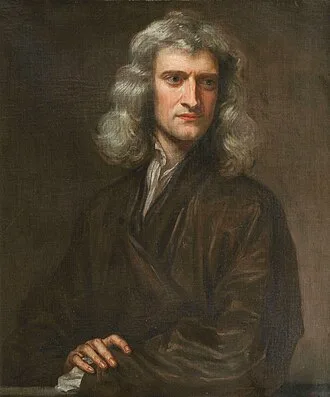
In the Principia, Newton formulated the laws of motion and universal gravitation that formed the dominant scientific viewpoint for centuries until it was superseded by the theory of relativity. While this is the case, his laws still serve as sufficient approximations for all physical phenomena involving low speeds (much less than the speed of light) and weak gravitational fields.
He used his mathematical description of gravity to derive Kepler's laws of planetary motion, account for tides, the trajectories of comets, the precession of the equinoxes and other phenomena, eradicating doubt about the Solar System's heliocentricity. Newton solved the two-body problem and introduced the three-body problem.
He demonstrated that the motion of objects on Earth and celestial bodies could be accounted for by the same principles. Newton's inference that the Earth is an oblate spheroid was subsequently confirmed by the geodetic measurements of Pierre Louis Maupertuis, Alexis Clairaut, Charles Marie de La Condamine, and others, convincing most European scientists of the superiority of Newtonian mechanics over earlier systems.
He was also the first to calculate the age of Earth by experiment, and described a precursor to the modern wind tunnel. Further, he was the first to provide a quantitative estimate of the solar mass.
Newton built the first reflecting telescope and developed a sophisticated theory of colour based on the observation that a prism separates white light into the colours of the visible spectrum. His work on light was collected in his book Opticks, published in 1704. He originated prisms as beam expanders and multiple-prism arrays, which would later become integral to the development of tunable lasers.
Newton also formulated an empirical law of cooling, which was the first heat transfer formulation and serves as the formal basis of convective heat transfer, made the first theoretical calculation of the speed of sound, and introduced the notions of a Newtonian fluid and a black body. He was also the first to explain the Magnus effect.
Moreover, he was the first to analyse Couette flow. In addition to his creation of calculus, Newton's work on mathematics was extensive. He generalised the binomial theorem to any real number, introduced the Puiseux series, was the first to state Bézout's theorem, classified most of the cubic plane curves, contributed to the study of Cremona transformations, developed a method for approximating the roots of a function, originated the Newton–Cotes formulas used for numerical integration, and further produced the earliest explicit enunciation of the general Taylor series.
Additionally, Newton initiated the field of calculus of variations, formulated and solved the earliest problem in geometric probability, devised the earliest form of linear regression, and was a pioneer of vector analysis.
Newton was a fellow of Trinity College and the second Lucasian Professor of Mathematics at the University of Cambridge; he was appointed at the age of 26. He was a devout but unorthodox Christian who privately rejected the doctrine of the Trinity. He refused to take holy orders in the Church of England, unlike most members of the Cambridge faculty of the day.
Beyond his work on the mathematical sciences, Newton dedicated much of his time to the study of alchemy and biblical chronology, but most of his work in those areas remained unpublished until long after his death. Politically and personally tied to the Whigs, Newton served two brief terms as Member of Parliament for the University of Cambridge, in 1689–1690 and 1701–1702.
He was knighted by Queen Anne in 1705 and spent the last three decades of his life in London, serving as Warden (1696–1699) and Master (1699–1727) of the Royal Mint, in which he increased the accuracy and security of British coinage. He was also the president of the Royal Society (1703–1727). He died at the age of 84 and was the first scientist to be buried at Westminster Abbey.
Early life
Isaac Newton was born (according to the Julian calendar in use in England at the time) on Christmas Day, 25 December 1642 (NS 4 January 1643) at Woolsthorpe Manor in Woolsthorpe-by-Colsterworth, a hamlet in Lincolnshire. His father, also named Isaac Newton, had died three months before. Born prematurely, Newton was a small child; his mother, Hannah Ayscough, said that he could have fit inside a quart mug.
When Newton was three, his mother remarried and went to live with her new husband, the Reverend Barnabas Smith, leaving her son in the care of his maternal grandmother, Margery Ayscough (née Blythe). Newton disliked his stepfather and maintained some enmity towards his mother for marrying him, as revealed by this entry in a list of sins committed up to the age of 19: "Threatening my father and mother Smith to burn them and the house over them." Newton's mother had three children (Mary, Benjamin, and Hannah) from her second marriage.
The King's School
From the age of about twelve until he was seventeen, Newton was educated at The King's School in Grantham, which taught Latin and Ancient Greek and probably imparted a significant foundation of mathematics. He was removed from school by his mother and returned to Woolsthorpe by October 1659. His mother, widowed for the second time, attempted to make him a farmer, an occupation he hated.
Henry Stokes, master at The King's School, and Reverend William Ayscough (Newton's uncle) persuaded his mother to send him back to school. Motivated by a desire for revenge against a schoolyard bully, whom Newton beat in a fight and humiliated, he became the top-ranked student, distinguishing himself mainly by building sundials and models of windmills.
University of Cambridge
In June 1661, Newton was admitted to Trinity College at the University of Cambridge. His uncle the Reverend William Ayscough, who had studied at Cambridge, recommended him to the university. At Cambridge, Newton started as a subsizar, paying his way by performing valet duties until he was awarded a scholarship in 1664, which covered his university costs for four more years until the completion of his MA.
At the time, Cambridge's teachings were based on those of Aristotle, whom Newton read along with then more modern philosophers, including René Descartes and astronomers such as Galileo Galilei and Thomas Street. He set down in his notebook a series of "Quaestiones" about mechanical philosophy as he found it. In 1665, he discovered the generalised binomial theorem and began to develop a mathematical theory that later became calculus.
Soon after Newton obtained his BA degree at Cambridge in August 1665, the university temporarily closed as a precaution against the Great Plague.
Although he had been undistinguished as a Cambridge student, his private studies and the years following his bachelor's degree have been described as "the richest and most productive ever experienced by a scientist". The next two years alone saw the development of theories on calculus, optics, and the law of gravitation, at his home in Woolsthorpe.
The physicist Louis Trenchard More writes that "There are no other examples of achievement in the history of science to compare with that of Newton during those two golden years."
Newton has been described as an "exceptionally organized" person when it came to note-taking, further dog-earing pages he saw as important. Furthermore, Newton's "indexes look like present-day indexes: They are alphabetical, by topic." His books showed his interests to be wide-ranging, with Newton himself described as a "Janusian thinker, someone who could mix and combine seemingly disparate fields to stimulate creative breakthroughs." William Stukeley wrote that Newton "was not only very expert with his mechanical tools, but he was equally so with his pen", and further illustrated how Newton's lodging room wall at Grantham was covered in drawings of "birds, beasts, men, ships & mathematical schemes. & very well designed". He also noted his "uncommon skill & industry in mechanical works".
In April 1667, Newton returned to the University of Cambridge, and in October he was elected as a fellow of Trinity. Fellows were required to take holy orders and be ordained as Anglican priests, although this was not enforced in the Restoration years, and an assertion of conformity to the Church of England was sufficient.
He made the commitment that "I will either set Theology as the object of my studies and will take holy orders when the time prescribed by these statutes [7 years] arrives, or I will resign from the college." Up until this point he had not thought much about religion and had twice signed his agreement to the Thirty-nine Articles, the basis of Church of England doctrine. By 1675 the issue could not be avoided, and his unconventional views stood in the way.
His academic work impressed the Lucasian Professor Isaac Barrow, who was anxious to develop his own religious and administrative potential (he became master of Trinity College two years later); in 1669, Newton succeeded him, only one year after receiving his MA. Newton argued that this should exempt him from the ordination requirement, and King Charles II, whose permission was needed, accepted this argument; thus, a conflict between Newton's religious views and Anglican orthodoxy was averted. He was appointed at the age of 26.
As accomplished as Newton was as a theoretician, he was less effective as a teacher; his classes were almost always empty. Humphrey Newton, his sizar (assistant), noted that Newton would arrive on time and, if the room was empty, he would reduce his lecture time in half from 30 to 15 minutes, talk to the walls, then retreat to his experiments, thus fulfilling his contractual obligations.
For his part Newton enjoyed neither teaching nor students. Over his career he was only assigned three students to tutor and none were noteworthy.
Newton was elected a Fellow of the Royal Society (FRS) in 1672.
Revision of Geographia Generalis
The Lucasian Professor of Mathematics at Cambridge position included the responsibility of instructing geography. In 1672, and again in 1681, Newton published a revised, corrected, and amended edition of the Geographia Generalis, a geography textbook first published in 1650 by the then-deceased Bernhardus Varenius.
In the Geographia Generalis, Varenius attempted to create a theoretical foundation linking scientific principles to classical concepts in geography, and considered geography to be a mix between science and pure mathematics applied to quantifying features of the Earth. While it is unclear if Newton ever lectured in geography, the 1733 Dugdale and Shaw English translation of the book stated Newton published the book to be read by students while he lectured on the subject.
The Geographia Generalis is viewed by some as the dividing line between ancient and modern traditions in the history of geography, and Newton's involvement in the subsequent editions is thought to be a large part of the reason for this enduring legacy.
Scientific studies
Mathematics
Newton's work has been said "to distinctly advance every branch of mathematics then studied". His work on calculus, usually referred to as fluxions, began in 1664, and by 20 May 1665 as seen in a manuscript, Newton "had already developed the calculus to the point where he could compute the tangent and the curvature at any point of a continuous curve".
His work by 1665 amounted to a systematic calculus that unified differentiation and integration, which he applied to the dynamic analysis of algebraic and transcendental curves, an approach described by scholar Tom Whiteside as "radically novel, indeed unprecedented" and which later directly informed the theory of central-force orbits in the Principia.
Another manuscript of October 1666, is now published among Newton's mathematical papers. Newton recorded a definitive tract of calculus in what is called his "Waste Book". He was self-taught in mathematics and did his research without help, as according to scholar Richard S. Westfall, "By every indication we have, Newton carried out his education in mathematics and his program of research entirely on his own." His work De analysi per aequationes numero terminorum infinitas, sent by Isaac Barrow to John Collins in June 1669, was identified by Barrow in a letter sent to Collins that August as the work "of an extraordinary genius and proficiency in these things".
Newton later became involved in a dispute with the German polymath Gottfried Wilhelm Leibniz over priority in the development of calculus. Both are now credited with independently developing calculus, though with very different mathematical notations. However, it is established that Newton came to develop calculus much earlier than Leibniz.
Despite this, the notation of Leibniz is recognised as the more convenient notation, being adopted by continental European mathematicians, and after 1820, by British mathematicians.
The historian of science A. Rupert Hall notes that while Leibniz deserves credit for his independent formulation of calculus, Newton was undoubtedly the first to develop it, stating:
But all these matters are of little weight in comparison with the central truth, which has indeed long been universally recognized, that Newton was master of the essential techniques of the calculus by the end of 1666, almost exactly nine years before Leibniz . . . Newton's claim to have mastered the new infinitesimal calculus long before Leibniz, and even to have written — or at least made a good start upon — a publishable exposition of it as early as 1671, is certainly borne out by copious evidence, and though Leibniz and some of his friends sought to belittle Newton's case, the truth has not been seriously in doubt for the last 250 years.
Hall further notes that in Principia, Newton was able to "formulate and resolve problems by the integration of differential equations" and "in fact, he anticipated in his book many results that later exponents of the calculus regarded as their own novel achievements." Hall notes Newton's rapid development of calculus in comparison to his contemporaries, stating that Newton "well before 1690 . . . had reached roughly the point in the development of the calculus that Leibniz, the two Bernoullis, L'Hospital, Hermann and others had by joint efforts reached in print by the early 1700s".
Despite the convenience of Leibniz's notation, it has been noted that Newton's notation could also have developed multivariate techniques, with his dot notation still widely used in physics. Some academics have noted the richness and depth of Newton's work, such as the physicist Roger Penrose, stating "in most cases Newton's geometrical methods are not only more concise and elegant, they reveal deeper principles than would become evident by the use of those formal methods of calculus that nowadays would seem more direct." The mathematician Vladimir Arnold stated that "Comparing the texts of Newton with the comments of his successors, it is striking how Newton's original presentation is more modern, more understandable and richer in ideas than the translation due to commentators of his geometrical ideas into the formal language of the calculus of Leibniz."
His work extensively uses calculus in geometric form based on limiting values of the ratios of vanishingly small quantities: in the Principia itself, Newton gave demonstration of this under the name of "the method of first and last ratios" and explained why he put his expositions in this form, remarking also that "hereby the same thing is performed as by the method of indivisibles." Because of this, the Principia has been called "a book dense with the theory and application of the infinitesimal calculus" in modern times and in Newton's time "nearly all of it is of this calculus." His use of methods involving "one or more orders of the infinitesimally small" is present in his De motu corporum in gyrum of 1684 and in his papers on motion "during the two decades preceding 1684".
It has been argued that Newton had an imprecise or limited understanding of limits. However, the mathematician Bruce Pourciau contends that in his Principia, Newton actually demonstrated a more sophisticated understanding of limits than he is generally credited with, including being the first to present an epsilon argument.
Newton had been reluctant to publish his calculus because he feared controversy and criticism. He was close to the Swiss mathematician Nicolas Fatio de Duillier. In 1691, Duillier started to write a new version of Newton's Principia, and corresponded with Leibniz. In 1693, the relationship between Duillier and Newton deteriorated and the book was never completed.
Starting in 1699, Duillier accused Leibniz of plagiarism. The mathematician John Keill accused Leibniz of plagiarism in 1708 in the Royal Society journal, thereby deteriorating the situation even more. The dispute then broke out in full force in 1711 when the Royal Society proclaimed in a study that it was Newton who was the true discoverer and labelled Leibniz a fraud; it was later found that Newton wrote the study's concluding remarks on Leibniz. Thus began the bitter controversy which marred the lives of both men until Leibniz's death in 1716.