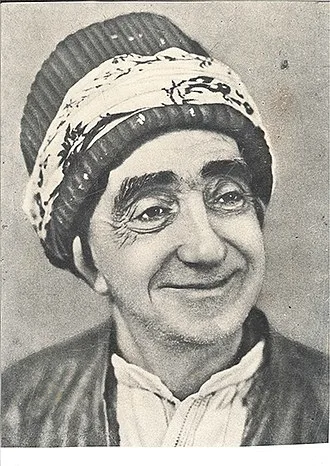
İsmail Hakkı Dümbüllü was born in Istanbul in 1899 and died in the same city in 1973. Dümbüllü, one of the last great representatives of traditional Turkish theatre, was known especially for his mastery of the middle dance and the art of tuluat. While he reached many new generations thanks to his deep knowledge in these fields, he also carried his art to modern media such as radio and cinema.
Dümbüllü, who started his artistic life at a young age, had to leave the military school due to his interest in theater. He had his first professional experience in Kel Hasan Efendi's group. This experience paved the way for him to learn the art of tuluat and later to continue this tradition in the best way possible.
Inspired by other important artists of the period, Dümbüllü took over the stage in his turban and fez and became one of the symbols of this art.
Dümbüllü, who founded the Hilal Theater with Tevfik İnce in 1928, reinterpreted the character of Kavuklu in his middle play with a different interpretation. During this period, he went on tours to various regions of Anatolia, bringing traditional Turkish theater to wider audiences. At the same time, he managed to introduce his art to the audience through radio programs.
He took part in the programs broadcast on TRT Istanbul Radio and introduced traditional theater to the audience.
Dümbüllü, who also stepped into the world of cinema, took part in many films, especially since the late 1940s. The artist, who was known as the "folk comic" during this period, also gained great fame with his portrayal of Nasreddin Hodja, the most frequently used character in his films. Dümbüllü, who starred in nearly fifty films since 1946, became one of the important names of Turkish cinema.