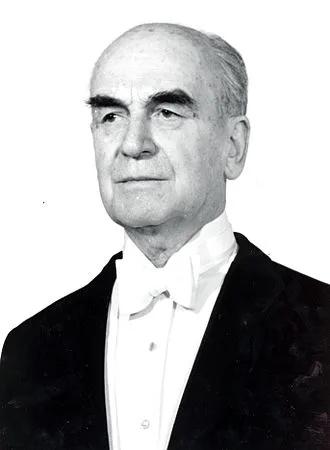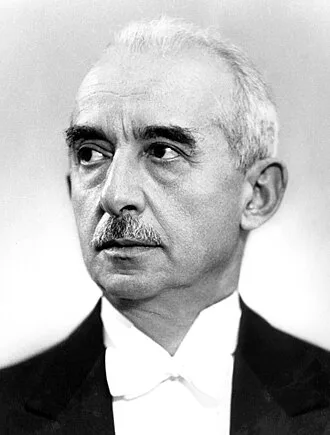
İnönü is acknowledged by many as Mustafa Kemal Atatürk's right-hand man, with their friendship going back to the Caucasus campaign. In the Greco-Turkish War of 1919–1922, he served as the first chief of the General Staff from 1922 to 1924 for the regular Turkish army, during which he commanded forces during the First and Second Battles of İnönü.
Atatürk bestowed İsmet with the surname İnönü, the site of the battles, when the 1934 Surname Law was adopted. He served as the chief negotiator for the Ankara government, first as an army general following the defeat of invading forces during the Armistice of Mudanya talks, later as Minister of Foreign Affairs at the Lausanne Conferences (1922–1923).
He secured recognition of the Turkish victory by the Allies and replacing the imposed Treaty of Sèvres with the Treaty of Lausanne. As prime minister for most of Atatürk's presidency, İnönü executed many of Atatürk's modernizing and nationalist reforms.
İnönü succeeded Atatürk as president of Turkey after his death in 1938 and was granted the official title of Millî Şef ("National Chief") by the parliament. As president and chairman of the Republican People's Party (CHP), İnönü initially continued Turkey's one party state.
Kemalist style programs continued to make great strides in education by supporting projects such as Village Institutes. His governments implemented notably heavy statist economic policies. The Hatay State was annexed in 1939, and Turkey was able to maintain an armed neutrality during World War II, joining the Allied powers only three months before the end of hostilities in the European Theater.
The Turkish Straits crisis prompted İnönü to build closer ties with the Western powers, with the country eventually joining NATO in 1952, though by then he was no longer president.
Factionalism between statists and liberals in the CHP led to the creation of the Democrat Party in 1946. İnönü held the first multiparty elections in the Republic's history that year, beginning Turkey's multiparty period. 1950 saw a peaceful transfer of power to the Democrats when the CHP suffered defeat in the elections.
For ten years, İnönü served as the leader of the opposition before returning to power as prime minister following the 1961 election, held after the 1960 coup-d'état. The 1960s saw İnönü reinvent the CHP as a political party, which was "Left of Center" as a new party cadre led by Bülent Ecevit became more influential.
İnönü remained leader of the CHP until 1972, when he was defeated by Ecevit in a leadership contest. He died on 25 December 1973, of a heart attack, at the age of 89. He is interred opposite to Atatürk's mausoleum at Anıtkabir in Ankara.
Early life
İsmet İnönü (born Mustafa İsmet) was born in 1884 in Smyrna (İzmir) in the Aidin Vilayet to Hacı Reşit and Cevriye (later Cevriye Temelli). Hacı Reşit was retired after serving as director of the First Examinant Department of the Legal Affairs Bureau of the War Ministry (Harbiye Nezareti Muhakemat Dairesi Birinci Mümeyyizliği).
A member of the Kürümoğlu family of Bitlis, İnönü's father was born in Malatya. According to its members studying the ancestral background of the family, Kürümoğlus were of Turkish origin, while secondary sources refer to the family as of Kurdish descent. His mother was the daughter of Müderris Hasan Efendi, who belonged to the ulema and was a member of the Turkish family of Razgrad (present-day Bulgaria).
In 1933 he visited Razgrad since the city's Turkish cemetery was attacked. İsmet was the family's second child; he had three brothers, including the family's first child, Ahmet Midhat, two younger brothers, Hasan Rıza and Hayri (Temelli), as well as a sister Seniha (Otakan). Due to his father's assignments, the family moved from one city to another.[citation needed]
Military career
In the Ottoman Empire
İnönü completed his primary education in Sivas and graduated from Sivas Military Junior High School (Sivas Askerî Rüştiyesi) in 1894. He then studied at the Sivas School for Civil Servants (Sivas Mülkiye İdadisi) for a year. He graduated from the Imperial School of Military Engineering in 1904 as a lieutenant gunnery officer and entered the Military Academy to graduate as a first-rank staff captain on 26 September 1906.
İnönü started his duty in the Second Army based in Adrianople (Edirne) on 2 October 1906, in the 3rd Battery Command of the 8th Field Artillery Regiment. As part of his platoon officer staff internship, he gave lessons in military strategy and artillery. Captain İsmet was also part of the Ottoman–Bulgarian commissions.
Through Ali Fethi (Okyar), he briefly joined the Committee of Union and Progress in 1907, which wished to overthrow Sultan Abdul Hamid II. During the 31 March Incident, he was on the staff of the Second Cavalry Division, which was mobilized to join the Action Army and marched on Constantinople (İstanbul) to depose Abdul Hamid II. Returning to Adrianople following the suppression of the mutiny, İnönü left the CUP in the summer of 1909.
He won his first military victory by suppressing Imam Yahya Muhammad Hamiddin's revolt in Yemen. İsmet eventually became chief of staff of the force sent to suppress the rebellion and personally negotiated with Imam Yahya in Kaffet-ül-Uzer to bring Yemen back into the empire. For this, he was promoted to the rank of major.
He returned to Constantinople in March 1913 to defend the capital from Bulgarian attack during the First Balkan War. İnönü was part of the Turkish delegation that negotiated the Treaty of Constantinople with the Bulgarians as a military adviser. He held a close relationship with Enver Pasha and played an active role in the reformation of the army.
World War I
İnönü began climbing the ranks during World War I, becoming lieutenant colonel on 29 November 1914, and then being appointed as the First Branch Manager of the General Headquarters on 2 December. He was appointed chief of staff of the Second Army on 9 October 1915, and was promoted to the rank of colonel on 14 December 1915.
İnönü was a member of the Special Organization, an intelligence, paramilitary, and secret police organization in the Ottoman Empire known for its key role in the commission of the Armenian genocide. In his post in the Caucasus front, İnönü requested that Armenians should be either extradited to Russia or deported to inner Anatolia, weeks before the government ordered the deportation of all Armenians from the eastern border areas and the shores of Lake Van to the Syrian Desert.
He began working with Mustafa Kemal (Atatürk) Pasha as a corps commander on the Caucasian Front. İnönü was appointed to the IV Corps Command on 12 January 1917, upon the recommendation of Atatürk. He was recalled to Constantinople after a while and returned to take part as a corps commander of the Seventh Army. On 1 May, he was appointed to command XX Corps on the Palestine Front, and then III Corps on 20 June.
He once again came into contact with Atatürk when he assumed command of the Seventh Army. İnönü's forces received the brunt of Edmond Allenby's attack on Beersheba that ended the stalemate on the Sinai front. He was wounded in the Battle of Megiddo and was sent back to Constantinople, where he held various administrative positions in the War Ministry during the armistice period.
Turkish War of Independence
After the military occupation of Constantinople on 16 March 1920, İnönü decided to escape to Anatolia to join the Ankara government. He and his chief of staff, Major Saffet (Arıkan) escaped Maltepe in the evening of 19 March and arrived in Ankara on 9 April. He joined the Grand National Assembly (GNA), which was opened on 23 April 1920, as a deputy of Edirne.
Like many others in the Turkish National Movement, he was sentenced to death in absentia by the Ottoman government on 6 June 1920.[citation needed] In May 1920, he was appointed chief of the general staff.
The next year, he was appointed commander of the Western Front of the Army of the GNA, a position in which he remained during the Turkish War of Independence. He was promoted to the rank of Mirliva (to that extent, Pasha) after winning the First and Second Battles of İnönü. When the 1934 Surname Law was adopted Atatürk bestowed İsmet Pasha with the surname İnönü, where the battles took place.
İnönü was replaced by Mustafa Fevzi Pasha (Çakmak), who was also the prime minister and minister of defense at the time, as the chief of staff after the Turkish forces lost major battles against the advancing Greek Army in July 1921, as a result of which the cities of Afyonkarahisar, Kütahya and Eskişehir were temporarily lost. He participated as a staff officer (with the rank Brigadier General) in the later battles, including the Battle of the Sakarya and Dumlupınar.
Chief negotiator in Mudanya and Lausanne
After the War of Independence was won, İnönü was appointed as the chief negotiator of the Turkish delegation, both for the Armistice of Mudanya and for the Treaty of Lausanne.
The Lausanne conference convened in late 1922 to settle the terms of a new treaty that would take the place of the Treaty of Sèvres. İnönü became famous for his stubborn resolve in determining the position of Ankara as the legitimate, sovereign government of Turkey. After delivering his position, İsmet turned off his hearing aid during the speeches of British foreign secretary Lord Curzon.
When Curzon had finished, İnönü reiterated his position as if Curzon had never said a word. Bulgarian diplomat Nadejda Stancioff served as an intermediary between İnönü and Curzon.
Prime ministership
İsmet İnönü served as the prime minister of Turkey throughout Mustafa Kemal Atatürk's presidency, stepping down as prime minister for three months during Fethi Okyar's premiership and in the last year of Atatürk's presidency when he was replaced by Celâl Bayar. He therefore helped to execute most of Atatürk's reformist programs.
It was his suggestion to make Ankara the capital of Turkey, which was approved by the parliament. İnönü was also an important factor in the proclamation of the Republic and the abolition of the Caliphate and Evkaf Ministry. He resigned from the premiership for health reasons on 22 November 1924 for Fethi Okyar, but since Okyar lost a vote of confidence from parliament due to the Sheikh Said rebellion, İnönü returned to the position of prime minister.
İnönü immediately banned all opposition parties (including the Progressive Republican Party) and the press. Independence Tribunals were reestablished to prosecute the Kurdish rebels. In 1926, it allegedly came out that former members of the CUP attempted to assassinate Atatürk in the İzmir plot, which resulted in the remaining CUP leaders being executed. İnönü retired his military command in 1927.[citation needed]
Nationalist policy
While dealing with the Sheikh Said revolt, İnönü proclaimed a Turkish nationalist policy and encouraged the Turkification of the non-Turkish population. Following the suppression of the Sheikh Said rebellion, he presided over the Reform Council for the East, which prepared the Report for Reform in the East, which recommended impede the establishment of a Kurdish elite, forbid non-Turkish languages, and create regional administrative units called Inspectorates-General, which were to be governed by martial law.
He stated the following in regards to the Kurds; "We're frankly nationalists, and nationalism is our only factor of cohesion. Before the Turkish majority, other elements had no kind of influence. At any price, we must Turkify the inhabitants of our land, and we will annihilate those who oppose." Following this report, three Inspectorate-Generals were established in the Kurdish areas, which comprise several provinces.
Under İnönü's regime, the Zilan massacre of thousands of Kurdish civilians was perpetrated by the Turkish Land Forces in the Zilan Valley of Van Province on 12 and 13 July 1930, during the Ararat rebellion. Nation building was codified into law when a new settlement regime was enacted in 1934, resettling Albanians, Abkhazians, Circassians, and Kurds in new areas in order to create a homogeneous Turkish state.
İnönü is also considered one of the perpetrators of the Dersim massacre, being one of the parties responsible for the violence.
Social policy
İnönü was responsible for most of the reformist legislation promulgated during Turkey's one party period. The Hat Law and the closure of Dervish lodges were enacted in 1925; in 1928, the Turkish alphabet switched to being written with Latin characters, and in 1934, titles such as Efendi, Bey, and Pasha were abolished; and certain articles of religious clothing were banned, though İnönü was and still is popularly known as İsmet Pasha. 1934 was also the year that the Surname Law was adopted, with Mustafa Kemal Atatürk bestowing İsmet with the surname İnönü, the location where İsmet won the battles against the Greek army in 1921. He was also a proponent of replacing foreign loan words with "Pure Turkish" words.
Economic policy
İnönü managed the economy with heavy-handed government intervention, especially during the Great Depression, by implementing an economic plan inspired by the Five Year Plan of the Soviet Union. In doing so, he took much private property under government control. Due to his efforts, to this day, more than 70% of land in Turkey is still owned by the state.[citation needed]
Desiring a more liberal economic system, Atatürk dissolved the government of İnönü in 1937 and appointed Celâl Bayar, the founder of the first Turkish commercial bank, Türkiye İş Bankası, as prime minister, thus beginning a decades long rivalry between Bayar and İnönü.
Presidency (1938–1950)
Prewar
After the death of Atatürk on 10 November 1938, İnönü was viewed as the most appropriate candidate to succeed him and was unanimously elected the second president of the Republic of Turkey and leader of the Republican People's Party (CHP). He attempted to build himself a cult of personality by receiving the official title of Millî Şef, i.e., "National Chief".
One of his first actions was to annex in 1939 the Hatay State, which declared independence from French Syria. İnönü also wished to move on from one-party rule by taking incremental steps to multiparty politics. He hoped to accomplish this by establishing the Independent Group as a force of opposition in the parliament, but they fell short of expectations under wartime conditions.
İnönü dismissed Bayar's government because of differences between the two on economic policy in 1939. İnönü was an avowed statist, while Bayar wished for a more liberal economy. Turkey's early industrialization accelerated under İnönü but the onset of World War II disrupted economic growth.
Much reform in education was accomplished during İnönü's presidency through the efforts of Hasan Âli Yücel, who was minister of education throughout İnönü's governments. 1940 saw the establishment of the Village Institutes, in which well-performing students from the country were selected to train as teachers and return to their hometown to run community development programs.
World War II
Foreign policy
World War II broke out in the first year of his presidency, and both the Allies and the Axis pressured İnönü to bring Turkey into the war on their side. The Germans sent Franz von Papen to Ankara in April 1939, while the British sent Hughe Knatchbull-Hugessen and the French René Massigli. On 23 April 1939, Turkish Foreign Minister Şükrü Saracoğlu told Knatchbull-Hugessen of his nation's fears of Italian claims to the Mediterranean as Mare Nostrum and German control of the Balkans and suggested an Anglo-Soviet-Turkish alliance as the best way of countering the Axis.
In May 1939, during the visit of Maxime Weygand to Turkey, İnönü told the French Ambassador René Massigli that he believed that the best way of stopping Germany was an alliance of Turkey, the Soviet Union, France and Britain; that if such an alliance came into being, the Turks would allow Soviet ground and air forces onto their soil; and that he wanted a major programme of French military aid to modernize the Turkish armed forces.
The signing of the Molotov–Ribbentrop Pact on 23 August 1939, drew Turkey away from the Allies; the Turks always believed that it was essential to have the Soviet Union as an ally to counter Germany, and thus the signing of the German–Soviet pact undercut completely the assumptions behind Turkish security policy. With the signing of the Molotov–Ribbentrop pact, İnönü chose to be neutral in World War II as taking on Germany and the Soviet Union at the same time would be too much for Turkey, though he signed a tripartite treaty of alliance with Britain and France on 19 October 1939, obligating Turkey's entry into the war if fighting spread to the Mediterranean.
However, with France's defeat in June 1940 İnönü abandoned the pro-Allied neutrality that he had followed since the beginning of the war. A major embarrassment for the Turks occurred in July 1940 when the Germans captured and published documents from the Quai d'Orsay in Paris showing the Turks were aware of Operation Pike—as the Anglo–French plan in the winter of 1939–40 to bomb the oil fields in the Soviet Union from Turkey was codenamed—which was intended by Berlin to worsen relations between Ankara and Moscow.
In turn, worsening relations between the Soviet Union and Turkey were intended to drive Turkey into the arms of the Reich. After the publication of the French documents relating to Operation Pike, İnönü pulled out of the tripartite pact signed with Britain and France and signed the German–Turkish Treaty of Friendship and the Clodius Agreement, which placed Turkey within the German economic sphere of influence, but İnönü went no further towards the Axis.