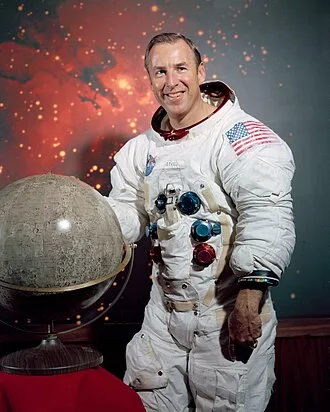
A 1952 graduate of the United States Naval Academy in Annapolis, Maryland, Lovell flew McDonnell F2H Banshee night fighters. He was deployed in the Western Pacific aboard the aircraft carrier USS Shangri-La. In January 1958, he entered a six-month test pilot training course at the Naval Air Test Center at Naval Air Station Patuxent River, Maryland, with Class 20 and graduated at the top of the class.
He was then assigned to Electronics Test, working with radar, and in 1960 he became the Navy's McDonnell Douglas F-4 Phantom II program manager. In 1961, he became a flight instructor and safety engineering officer at Naval Air Station Oceana in Virginia Beach, Virginia, and completed Aviation Safety School at the University of Southern California.
Lovell was passed over by NASA as one of the Mercury Seven astronauts because of a temporarily high bilirubin count. He was accepted in September 1962 as one of the second group of astronauts needed for the Gemini and Apollo programs. Before Apollo, Lovell flew in space on two Gemini missions: Gemini 7 (with Borman) in 1965 and Gemini 12 in 1966.
He was the first person to fly into space four times. He was the first person to reach the Moon twice, and the only returnee who never walked on the surface. He was a recipient of the Congressional Space Medal of Honor and the Presidential Medal of Freedom. He cowrote the 1994 book Lost Moon, on which the 1995 film Apollo 13 was based, and he was featured in a cameo appearance in the film. Lovell died in 2025, aged 97.
Early life
James Arthur Lovell Jr. was born in Cleveland, Ohio, on March 25, 1928. He was the only child of James Lovell Sr., a furnace salesman born in Toronto, Canada, who died in a car accident in 1933 when James Jr. was 5, and Blanche (née Masek), who was of Czech descent. For two years after the death of his father, Lovell and his mother lived with a relative in Terre Haute, Indiana.
They then moved to Milwaukee, Wisconsin, and he went to Juneau High School. He was a member of the Boy Scouts during his childhood and became an Eagle Scout, the organization's highest rank. He was interested in rocketry and built flying models as a teenager.
After graduating from high school, Lovell attended the University of Wisconsin in Madison for two years, where he studied engineering under the United States Navy's "Flying Midshipman" program from 1946 to 1948. He later credited the program for giving him the opportunity to attend college, saying that he otherwise did not have the money to attend.
At Wisconsin, he played college football and pledged to the Alpha Phi Omega fraternity. He supplemented a meager Navy stipend by working at a local restaurant washing dishes and busing tables, and caring for the university's lab rats and mice on weekends.
While Lovell was attending pre-flight training in the summer of 1948, the Navy was beginning to cut the program. Cadets were under pressure to transfer out because there were concerns that the Navy would lack pilot billets for some or most of them upon graduation. To avoid this, Lovell decided to apply to the United States Naval Academy in Annapolis, Maryland.
He secured a nomination from his local U.S. Representative, John C. Brophy, and entered Annapolis in July 1948.
During his first year, Lovell wrote a treatise on the liquid-propellant rocket engine. He graduated in the spring of 1952 with a Bachelor of Science degree and was commissioned as an ensign in the Navy.
Marriage and family
Lovell began dating Marilyn Lillie Gerlach while they were in high school. As a college student, she transferred from Wisconsin State Teachers College to George Washington University in Washington, D.C., to be near him while he was attending the Naval Academy. They married on June 6, 1952, in a ceremony at St. Anne's Church in Annapolis. The couple had four children: Barbara, James, Susan, and Jeffrey.
Navy career
Lovell was one of 50 members of his graduating class of 783 initially selected for naval aviation training. He went to flight training at Naval Air Station Pensacola from October 1952 to February 1954. He was designated a naval aviator on February 1, 1954, upon completion of pilot training, and was assigned to VC-3 at Moffett Field near San Francisco, California.
From 1954 to 1956, he flew McDonnell F2H Banshee night fighters. This included a Western Pacific deployment aboard the aircraft carrier USS Shangri-La. Lovell eventually completed 107 carrier landings. Upon his return to shore duty, he was assigned to train pilots moving to the North American FJ-4 Fury, McDonnell F3H Demon, and Vought F8U Crusader.
In January 1958, Lovell entered a six-month test pilot training course at the Naval Air Test Center (today, the United States Naval Test Pilot School) at Naval Air Station Patuxent River, Maryland, with Class 20, which also included future astronauts Wally Schirra and Pete Conrad, who gave Lovell the nickname "Shaky".
Lovell graduated at the top of the class. Usually, the top graduate was assigned to flight test on graduation. Still, the head of electronics test had complained about never getting the top graduate, so Lovell was assigned there, where he worked with radar sets.
Later that year, Lovell, Conrad, and Schirra were among 110 military test pilots selected as astronaut candidates for Project Mercury. Schirra went on to become one of the Mercury Seven, but Lovell was not selected because of a temporarily high bilirubin count. In 1960, electronics test and armaments test were combined and became weapons test, and Lovell became the McDonnell Douglas F-4 Phantom II program manager.
During this time future astronaut John Young served under him. In 1961, Lovell received orders for VF-101 "Detachment Alpha" at Naval Air Station Oceana in Virginia Beach, Virginia, as a flight instructor and safety engineering officer, and he completed Aviation Safety School at the University of Southern California.
NASA career
Astronaut selection
In 1962, NASA began recruiting its second group of astronauts, intended to fly during the Gemini and Apollo programs. This time the process was a public one. Lovell found out about the selection from an advertisement that had been placed in Aviation Week & Space Technology, and decided to apply a second time.
A three-person selection panel consisting of Mercury Seven astronauts Alan Shepard and Deke Slayton, and NASA test pilot Warren J. North, reduced the candidates to 32 finalists, who were sent to Brooks Air Force Base in San Antonio for medical examinations. The tests there were much the same as those employed to select the Mercury Seven, but this time Lovell passed.
The remaining 27 then went to Ellington Air Force Base near Houston, where they were individually interviewed by the selection panel.
On September 14, Slayton informed Lovell that he had been accepted. To avoid tipping off the media, Lovell checked into the Rice Hotel in Houston under the name of Max Peck, its general manager. On September 17, the media crowded into the 1800-seat Cullen Auditorium at the University of Houston for the official announcement, but it wasn't as big as the unveiling of the Mercury Seven three years before.
The group became known as the "Next Nine" or the "New Nine". The new astronauts moved to the Houston area in October 1962. Conrad and Lovell built houses in Timber Cove, south of the Manned Spacecraft Center (MSC). Developers in Timber Cove offered astronauts mortgages with small down payments and low interest rates. The MSC complex was not yet complete, so NASA temporarily leased office space in Houston.
The task of supervising the Next Nine's training fell to Mercury Seven astronaut Gus Grissom. Initially, each of the astronauts was given four months of classroom instruction on subjects such as spacecraft propulsion, orbital mechanics, astronomy, computing, and space medicine. Classes were for six hours a day, two days a week, and all sixteen astronauts had to attend.
There was also familiarization with the Gemini spacecraft, Titan II and Atlas boosters, and the Agena target vehicle. Jungle survival training was conducted at the United States Air Force (USAF) Tropic Survival School at Albrook Air Force Station in the Panama Canal Zone, desert survival training at Stead Air Force Base in Nevada, and water survival training on the Dilbert Dunker at the USN school at Naval Air Station Pensacola and on Galveston Bay.
Following the precedent set by the Mercury Seven, each of the Next Nine was assigned a special area in which to develop expertise that could be shared with the others, and to provide astronaut input to designers and engineers. Lovell became responsible for recovery systems.
Gemini program
Gemini 7
Lovell was selected as backup pilot for Gemini 4, which was officially announced on July 29, 1964. It put him in position for his first space flight three missions later, as pilot of Gemini 7 with command pilot Frank Borman, under a rotation system devised by Slayton. Borman was a USAF officer, and Lovell had first met him during the evaluation process for astronaut selection.
Their selection for the Gemini 7 mission was officially announced on July 1, 1965, along with that of Edward White and Michael Collins as their backup crew.
Like all Gemini missions, it was part of the preparations for Apollo. The flight's objective was to evaluate the effects on the crew and spacecraft from fourteen days in orbit, this being sufficiently long for any possible Moon mission, and would therefore enable doctors to evaluate the medical aspects of such a flight.
The Gemini 6 mission preceding it was to demonstrate techniques for space rendezvous, also a critical requirement for Apollo. These techniques had been worked out by Dean F. Grimm and Buzz Aldrin, who had written his doctoral thesis on the subject.
The Gemini 6 mission, which was commanded by Schirra with Tom Stafford as pilot, had a serious setback on October 15, 1965, when the Agena target vehicle that Gemini 6 was supposed to rendezvous with exploded soon after takeoff. Lovell was present at the Launch Control Center at Cape Kennedy when this occurred. Officials from McDonnell, the manufacturer of the Gemini spacecraft, then raised the possibility of a rendezvous between Gemini 6 and Gemini 7 during the two weeks while Gemini 7 was in orbit.
The only change to the latter's flight plan this required was to circularize its orbit to match that intended for the Agena target vehicle. Borman rejected a proposal by Schirra that Lovell and Stafford exchange places, on the grounds that it was hazardous and likely to jeopardize the fourteen-day mission objective through loss of oxygen.
In planning the mission, it was decided that both astronauts would sleep at the same time and observe the same work periods, one in the morning and one in the afternoon. Experiments were not scheduled, but fitted in when time allowed. Of the twenty experiments, eight were medical, aimed at gathering data about the effects of long-duration space flight.
Of the rest, four were tests of spacecraft systems, five involved radiometry or navigation, and three involved photography and observation, To save space, the G5C spacesuit was designed to incorporate a soft hood instead of a helmet and zippers instead of a neck ring. It weighed a third less than the standard Gemini space suit and could be stowed more easily.
Gemini 7 lifted off on December 4, 1965, and reached its intended 300-kilometer (160 nmi; 180 mi) near-circular orbit. Lovell, who was taller than Borman, had more difficulty donning and removing his spacesuit. Mission rules required that one astronaut remain suited at all times, but the suits made the astronauts uncomfortably warm.
Mission control eventually relented and allowed both to leave their suits off. Gemini 6, now called Gemini 6A, attempted to launch on December 12; the engines ignited, but shut down less than two seconds later due to an electrical problem and a fuel cap accidentally having been left in place. After repairs, Gemini 6A successfully lifted off on December 15, and rendezvoused with Gemini 7 on Gemini 6A's fourth orbit.
The two spacecraft then flew in tandem for three orbits, the distance between them varying between 0.30 and 90 meters (1 and 300 ft). Gemini 6A returned to Earth on December 16.
In the final two days of the mission, Lovell had time to read part of Drums Along the Mohawk by Walter D. Edmonds. As in earlier long-duration flights, malfunctions accumulated as the flight wore on. Two of the thrusters stopped working. After the flight, this was traced to the fact that they had an old type of laminate in the thrust chamber instead of the new type that had been developed to solve this problem.
This proved to be only an annoyance, but there was more concern over a loss of power in the fuel cells. By day thirteen, a warning light was illuminated continuously and it was feared that the cells, which were only giving partial output, might fail completely, and the mission might have to be cut short; tests were carried out in St.
Louis that demonstrated that the batteries could sustain them for the remainder of the flight. Gemini 7 made a successful return from orbit on December 18. The fourteen-day flight set an endurance record, making 206 orbits.
Gemini 12
On January 24, 1966, Lovell was named as the backup command pilot of Gemini 10, with Aldrin as the pilot. On March 21, this was changed as a result of the deaths of the Gemini 9 prime crew, Elliot See and Charles Bassett, in an air crash. The Gemini 9 backup crew of Tom Stafford and Gene Cernan became the prime crew of Gemini 9A, and Lovell and Aldrin became their backups.
This positioned Lovell for his second flight and first command, of Gemini 12. Lovell and Aldrin's selection for this mission was officially announced on June 17, along with that of Gordon Cooper and Gene Cernan as their backups.
The goals of Gemini 12, the final Gemini mission, were ill-defined at first. "Essentially Gemini 12 didn't have a mission", Lovell later recalled. "It was, I guess, by default ... supposed to wind up the Gemini program and catch all those items that were not caught on previous flights." By July, its mission had become to master extravehicular activity (EVA), something that had proven problematic on earlier Gemini missions, as they had been more strenuous than expected and performing simple tasks had been more complicated.
A series of innovations had been developed in response to the problems that had been encountered. It had been found that moving in space was similar to being underwater, and Aldrin made use of this new training technique. A waist restraint was provided on the space suit, and the Gemini spacecraft and the Agena target vehicle had additional handrails, handholds, and rings for tethering the waist restraint. Procedures were modified to minimize fatigue.
Gemini 12 lifted off on November 11, and quickly achieved orbit. Its first task was to rendezvous with its Agena target vehicle. This was complicated when the rendezvous radar set failed. Instead, Aldrin, who had written his PhD on the rendezvous, used a sextant to measure the angle between the spacecraft and the Agena, and then calculated the required actions using the onboard computer.
Lovell then flew the spacecraft accordingly. Rendezvous was achieved, and Gemini successfully docked with the Agena, achieving the fifth space rendezvous and fourth space docking with an Agena target vehicle. Lovell then successfully undocked and docked again.
Aldrin performed three EVAs. The first was a standup EVA on November 12, in which the spacecraft door was opened and he stood up, but did not leave the spacecraft. The standup EVA mimicked some of the actions he would do during his free-flight EVA, so he could compare the effort expended between the two. It set an EVA record of two hours and twenty minutes.
The next day Aldrin performed his free-flight EVA. He climbed across the newly installed hand-holds to the Agena and installed the cable needed for the gravity-gradient stabilization experiment. He performed several tasks, including installing electrical connectors and testing tools that would be needed for Apollo. The EVA concluded after two hours and six minutes.
Before returning to the spacecraft, Aldrin cleaned the pilot's window with a cloth, and Lovell jokingly asked him if he could change the oil too. A third, 55-minute standup EVA was conducted on November 14, during which Aldrin took photographs, conducted experiments, and discarded some unneeded items.
Gemini 12 returned to Earth on November 15, after 59 orbits. During re-entry a pouch containing books and small pieces of equipment broke free and landed in Lovell's lap. He did not want to grab it, as he feared he might pull on the D-ring that activated the ejector seat. It did not move any further, and the landing went well.
The spacecraft landed 5.6 kilometers (3 nmi; 3.5 mi) from the recovery ship, the aircraft carrier USS Wasp. Twelve experiments had been carried out. This mission proved that people could work effectively outside the spacecraft, which was required for the Apollo missions with the goal of getting man on the Moon by the end of the decade.
Apollo program
Apollo 1
On January 27, 1967, Grissom, White and Roger Chaffee were killed in the Apollo 1 fire. At the time, Lovell was in Washington, D.C., where, along with fellow astronauts Neil Armstrong, Scott Carpenter, Gordon Cooper and Richard Gordon, he had attended the signing of the Outer Space Treaty and the reception afterwards in the Green Room of the White House hosted by President Lyndon Johnson.
Four days later, Lovell flew to West Point, New York, with Borman in a NASA T-38 for the funeral service for White at the Old Cadet Chapel. After the service, White was laid to rest in the West Point Cemetery; Lovell served as a pallbearer along with Armstrong, Borman, Conrad, Stafford and Aldrin.
The Apollo command module was redesigned after the fire, and afterwards it underwent a series of qualification tests. In April 1968, Lovell, along with fellow astronauts Stuart Roosa and Charles Duke, spent 48 hours in command module CM-007A, bobbing in the Gulf of Mexico to test the seaworthiness of the Apollo spacecraft.
The NASA research vessel MV Retriever stood by with technicians and divers, while the astronauts assessed how quickly the spacecraft's flotation devices could right it from the "stable II" (upside down) position. The urine collection hose was used to vacuum up water that entered the cabin. Although this did not seem to bother Lovell, Duke regarded it as his worst experience as an astronaut, and Roosa became quite seasick.
The NASA Roundup newspaper wrote the event up under the headline, "Yo, Ho, Ho and a Bottle of Marezine", referencing the brand name of a motion sickness drug.
Apollo 8
Lovell was originally chosen as command module pilot (CMP) on the backup crew for Apollo 9 along with Armstrong as commander (CDR) and Aldrin as lunar module pilot (LMP). Apollo 9 was planned as a high-apogee Earth orbital test of the Lunar Module (LM). Lovell later replaced Michael Collins as CMP on the Apollo 9 prime crew in July 1968 when Collins needed to have surgery for a bone spur on his spine.
This reunited Lovell with his Gemini 7 commander Frank Borman, along with LMP William Anders. Aldrin became Lovell's backup CMP, and Fred Haise joined Armstrong's crew as LMP.
Construction delays of the first crewed LM prevented it from being ready in time to fly on Apollo 8, planned as a low Earth orbit test. It was decided to swap the Apollo 8 and Apollo 9 prime and backup crews in the flight schedule so that the crew trained for the low-orbit test could fly it as Apollo 9, when the LM would be ready.
A lunar orbital flight, now Apollo 8, replaced the original Apollo 9 medium Earth orbit test mission. The crew was informed of this decision on August 10, 1968, and the training schedule was adjusted accordingly. Starting in September, the crew spent ten hours a day in the simulator rehearsing the mission.