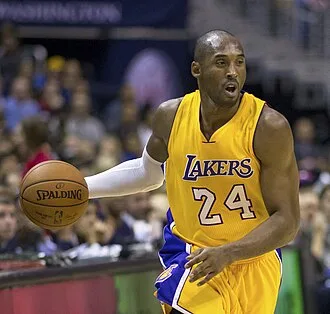
The son of NBA player Joe Bryant and his wife Pam, he was born in Philadelphia and spent part of his childhood in Italy. Bryant played high school basketball at Lower Merion High School outside of Philadelphia. He opted out of college basketball and declared for the 1996 NBA draft. He was selected by the Charlotte Hornets with the 13th pick; he was then traded to the Lakers.
Following his rookie season, he earned NBA All-Rookie Second Team honors and won the 1997 Slam Dunk Contest. He was named an All-Star in his second season. He had a feud with teammate Shaquille O'Neal that was well-documented. Nevertheless, the pair led the Lakers to three consecutive NBA championships from 2000 to 2002.
In 2003, Bryant was charged with sexual assault; the criminal charges were ultimately dismissed. In a related lawsuit, he settled and issued an apology while maintaining that the encounter was consensual.
After the Lakers lost the 2004 NBA Finals, O'Neal was traded and Bryant became the franchise's centerpiece. He led the NBA in scoring in the 2005–06 and 2006–07 seasons. On January 22, 2006, Bryant scored a career-high 81 points, the third most in an NBA game. He adopted the nickname Black Mamba during this time. Bryant won the 2008 NBA Most Valuable Player (MVP) Award, but lost the NBA Finals that same season.
He followed the defeat by leading the Lakers to consecutive championships in 2009 and 2010, and was named NBA Finals MVP both times. His remaining playing career was hampered by injuries and reduced playing time. He retired after the 2015–16 season. In 2017, the Lakers retired both his jersey numbers: 8 and 24, making him the only NBA player to have multiple numbers retired by one franchise. In 2018, Bryant won the Academy Award for Best Animated Short Film for Dear Basketball (2017).
Bryant was a 15-time member of the All-NBA Team, 12-time member of the All-Defensive Team, and two-time scoring champion. He ranks fourth in league all-time regular season and postseason scoring. He is the Lakers' all-time leading scorer and the NBA's first guard to play 20 seasons. His 18 All-Star designations are the third most ever, and his four NBA All-Star Game MVP Awards tied Bob Pettit's record.
In January 2020, Bryant and his 13-year-old daughter Gianna were among nine people killed in a helicopter crash in Calabasas, California. Tributes and memorials followed his death, including murals throughout Los Angeles, Kobe Bryant Day (8/24), and two statues outside Crypto.com Arena. The NBA All-Star Game MVP was also renamed in Bryant's honor.
Bryant was posthumously named to the NBA 75th Anniversary Team in 2021 and was a two-time inductee to the Naismith Memorial Basketball Hall of Fame, once in 2020 for his individual career, and in 2025 as part of the 2008 United States men's Olympic basketball team ("Redeem Team").
Early life
Kobe Bean Bryant was born on August 23, 1978, in Philadelphia, Pennsylvania. His mother, Pam Bryant (née Cox), is the sister of basketball player Chubby Cox, and his father, Joe Bryant, played eight seasons in the NBA. His father named him after the Kobe beef from Japan, which he saw on a restaurant menu, whereas his middle name, Bean, was derived from his father's nickname "Jellybean".
He had two older sisters: Sharia and Shaya. He was raised Catholic. He was fluent in English, Italian, and Spanish. The Lakers were his favorite team when he was growing up. He was also a fan of the New York Mets, wanting to be like Darryl Strawberry, and his hometown NFL team, the Philadelphia Eagles.
When his father was traded from the Philadelphia 76ers to the then-San Diego Clippers, Bryant and the family moved to San Diego in 1979. His mother said he first showed an interest in basketball at the age of three. He would watch his father play basketball on TV and pretended to be a part of the game. He attended preschool at the Gillispie School in La Jolla where he played basketball on the playground. His father played his final season in the NBA with the Houston Rockets in the 1983 NBA season.
Years in Italy
When Bryant was six years old, his father retired from the NBA and moved his family to Rieti, Italy to continue his professional basketball career for the team AMG Sebastiani Rieti. After two years, they moved to Reggio Calabria, then to Pistoia and Reggio Emilia. He became accustomed to his new lifestyle and learned to speak fluent Italian.
He was especially fond of Reggio Emilia, which he described as a loving place and the source of some of his fondest childhood memories. It was there that he began to take basketball seriously. His grandfather mailed him videos of NBA games for him to study. He also watched European films about sports, from which he learned more about basketball.
From 1987 to 1989, Bryant's father played for Olimpia Basket Pistoia where he paired with former Detroit Pistons player Leon Douglas. Bryant worked at the games as a ball and mop boy and practiced shooting during halftime. Douglas recalled, "At every one of our games at halftime, it was the Kobe show. He'd get out there and get his shot up.
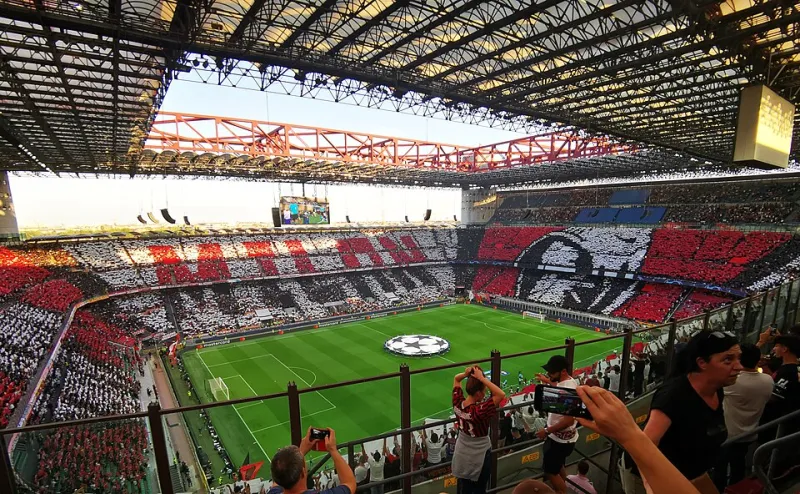
We'd come out of the locker room at halftime and have to chase him off the court". During the summer, he returned to the United States to play in a basketball summer league. He also played soccer while living in Italy, and A.C. Milan was his favorite team.
High school
When he was 13, Bryant and his family moved back to Philadelphia, where he enrolled in the eighth grade at Bala Cynwyd Middle School and then Lower Merion High School in Ardmore, Pennsylvania. He earned national recognition for his play at Lower Merion. He played on the varsity team as a freshman, but the team finished with a 4–20 record. The following three years, Lower Merion compiled a 77–13 record, with Bryant playing all five positions.
During his junior year, he averaged 31.1 points, 10.4 rebounds, 5.2 assists, 3.8 blocks and 2.3 steals, and was named a fourth-team Parade All-American. He considered playing collegiate basketball at Duke, Michigan, North Carolina and Villanova. His skills and SAT score of 1080 would have ensured admission to any college, but he did not officially visit campuses.
At the ABCD Camp, Bryant earned the 1995 senior MVP award while playing alongside future NBA teammate Lamar Odom. While in high school, then 76ers coach John Lucas invited Bryant to work out and scrimmage with the team, where he played one-on-one with Jerry Stackhouse.
As a senior, Bryant led Lower Merion to their first state championship in 53 years. During his senior year, he averaged 30.8 points, 12 rebounds, 6.5 assists, 4 steals, and 3.8 blocked shots in leading the school to a 31–3 record. He finished his high-school career as Southeastern Pennsylvania's all-time leading scorer at 2,883 points, surpassing both Wilt Chamberlain and Lionel Simmons.
As a senior, he was named Naismith High School Player of the Year, Gatorade Men's National Basketball Player of the Year, a McDonald's All-American, a first-team Parade All-American and a USA Today All-USA First Team player. His coach, Greg Downer, commented that he was "a complete player who dominates" and praised his work ethic. He was later honored as one of the 35 Greatest McDonald's All-Americans for his high school play.
Professional career
Bryant decided to forgo college basketball and entered the lottery for 1996 NBA draft, the sixth player and the first guard to do so. His announcement garnered publicity when prep-to-pro was rare. The day before the draft, the Charlotte Hornets agreed to trade their No.13 pick to the Lakers in exchange for Vlade Divac.
Before the agreement, the Hornets had never considered drafting Bryant. During the draft, the Lakers told the Hornets to select Bryant minutes before the pick was made. Lakers General Manager Jerry West made the trade for Bryant, after having watched him work out in Los Angeles. After the draft, the trade was put in jeopardy when Divac threatened to retire, but he relented and the trade was finalized.
Since he was a minor, his parents had to co-sign his $3.5 million three-year rookie contract. Bryant debuted in the Summer Pro League in Long Beach, California. Defenders struggled to get in front of him. He finished with averages of 24.5 points and 5.3 rebounds in the summer league.
Early years (1996–1999)
As a rookie in 1996–97, he became the second-youngest player ever to play in an NBA game (18 years, 72 days) and eventually became the youngest NBA starter (18 years, 158 days). He mostly came off the bench behind guards Eddie Jones and Nick Van Exel. He played limited minutes, but as the season continued, his playing time grew.
During the All-Star weekend, he participated in the Rookie Challenge and won the 1997 Slam Dunk Contest, the youngest dunk champion at age 18. The Lakers advanced to the Western Conference semifinals in the 1997 NBA playoffs against the Utah Jazz. He was pressed into a lead role at the end of Game 5. Byron Scott missed the game with a sprained wrist, Robert Horry was ejected for fighting with Jeff Hornacek, and O'Neal fouled out with 1:46 remaining.
He missed a game-winning shot in the fourth quarter, then misfired three three-point field goals in overtime, including two tying shots in the final minute. O'Neal commented that "[Bryant] was the only guy who had the guts at the time to take shots like that." His rookie campaign earned him a spot on the NBA All-Rookie Second Team.
In his second season, he received more playing time. His scoring averages more than doubled, from 7.6 to 15.4. Playing time increased when the Lakers "played small", which positioned Bryant as a small forward alongside the guards he usually played behind. Bryant was runner-up for the NBA's Sixth Man of the Year Award, and through fan voting, became the NBA's youngest All-Star starter.
Bryant was joined by teammates O'Neal, Van Exel, and Jones, making it the first time since 1983 that four players on one team were selected to play in an All-Star Game. Bryant's 15.4 points per game was the highest of any non-starter in the season.
The 1998–99 season marked Bryant's emergence as a premier guard. He started every game for the lockout-shortened 50-game season. He signed a six-year $70 million contract extension, keeping him a Laker through 2003–04. Sportswriters compared his skills to Michael Jordan and Magic Johnson. The Lakers made the playoffs, where they were swept by the eventual champion San Antonio Spurs in the Western Conference Semifinals.
Three-peat (1999–2002)
Bryant's play improved when Phil Jackson was hired in 1999. Jackson applied his triangle offense that he had developed for the Chicago Bulls.
Bryant was sidelined for six weeks prior to the start of the 1999–2000 season due to a preseason hand injury. When he returned, he played over 38 minutes a game and improved in all statistical categories. This included leading the team in assists and steals per game. O'Neal and Bryant, backed with a strong bench, led the Lakers to win 67 games.
For his season, Bryant was named to the All-NBA Second Team and All-NBA Defensive Team for the first time (the youngest to receive All-Defensive honors). In the 2000 NBA playoffs, he had some stellar performances, including a 25-point, 11-rebound, seven-assist, four-block in Game 7 of the Western Conference Finals against the Portland Trail Blazers. He threw an alley-oop to O'Neal to clinch the game and a trip to the Finals.
In the 2000 Finals, against the Indiana Pacers, Bryant injured his ankle in Game 2 after landing on Jalen Rose's foot. Rose admitted he placed his foot under Bryant intentionally. Bryant did not return, and missed Game 3. In Game 4, Bryant scored 22 in the second half and led the team to victory as O'Neal fouled out. Bryant scored the winner to put the Lakers ahead 120–118. With a 116–111 victory in Game 6, the Lakers won their first championship since the 1988 NBA Finals.
In the 2000–01 season, he increased his points per game to 28.5. The Shaq–Kobe feud surfaced. Bryant led the team in assists, with five per game. However, the Lakers only won 56 games, an 11-game drop from the previous year. The team responded by going 15–1 in the playoffs. They swept the Portland Trail Blazers in the first round, and the Sacramento Kings in the conference semifinals.
In Game 4 against the Kings, Bryant notched 48 points, 16 rebounds, and three assists in a 119–113 series-clinching victory. They swept the San Antonio Spurs in the Conference Finals, before losing their first game against Allen Iverson and the Philadelphia 76ers in the 2001 NBA Finals. The Lakers won the next four and their second championship.
He played heavy minutes lifting his game stats to 29.4 points, 7.3 rebounds, and 6.1 assists. Bryant earned All-NBA Second Team and All-NBA Defensive Team again. He was named a starter for the All-Star Game for the third year in a row.
In the 2001–02 season, Bryant played 80 games for the first time. On January 14, 2002, Bryant recorded a then career-high 56 points, with five rebounds, in a 120–81 victory over the visiting Memphis Grizzlies. He averaged 25.2 points, 5.5 rebounds, and 5.5 assists. He had a career-high 46.9% shooting percentage and led his team in assists.
He claimed his first All-Star MVP trophy after a 31-point performance in Philadelphia, where he was booed by fans throughout the game, stemming from his comment to a 76ers heckler during the Finals that the Lakers were "going to cut your hearts out." The Lakers won 58 games that year and finished second in the Pacific Division behind the Sacramento Kings.
Bryant was suspended for one game after he punched Reggie Miller of the Indiana Pacers. He was named to the All-NBA First Team for the first time.
The road to the 2002 NBA Finals was much tougher. While they swept the Blazers and defeated the Spurs 4–1 in the first two rounds, the Lakers did not have home-court advantage against the Kings. The series stretched to seven games, the first time for the Lakers since the 2000 Western Conference Finals. However, the Lakers dominated and made their third consecutive NBA Finals, in which Bryant averaged 26.8 points, 51.4% shooting, 5.8 rebounds, 5.3 assists, scoring a quarter of the team's points.
The Lakers swept the New Jersey Nets in the Finals. Bryant became the youngest player, at age 23, to win three championships. He was praised for his performance in fourth quarters, specifically the last two rounds.
Title defenses and struggles (2002–2005)
Bryant had one of his best individual seasons during the 2002–03 season. He broke an NBA record for three-pointers on January 7, 2003, when he made 12 against the Seattle SuperSonics. He averaged 30 points and embarked on a historic run, posting 40 or more points in nine consecutive games while averaging 40.6 in February.
He also averaged career-high 6.9 rebounds, 5.9 assists, and 2.2 steals. He was once again voted to both the All-NBA and All-Defensive First Teams, and came in third for the MVP award. After finishing 50–32 in the regular season, the Lakers floundered in the playoffs and lost in the semifinals in six games to the eventual champions San Antonio Spurs.
In 2003, he was arrested for sexual assault ahead of the 2003–04 season. This caused him to miss some games due to court appearances.
The 2003–04 NBA season brought the Lakers back to the Finals, but tension within the team was exposed. In the final game of the regular season, Bryant made two buzzer-beaters to win the game and the Pacific Division title. The Lakers advanced to the 2004 NBA Finals, where they lost to the Detroit Pistons in five games.
Bryant averaged 22.6 points and 4.4 assists while shooting 35.1%. Jackson's contract as coach was not renewed, and Rudy Tomjanovich took over. O'Neal was traded to the Miami Heat for Lamar Odom, Caron Butler, and Brian Grant. Bryant signed a seven-year, $136.4 million contract.
Bryant was closely scrutinized during the 2004–05 season. His reputation had been damaged from the prior year's events. A particularly damaging salvo came when Jackson wrote The Last Season: A Team in Search of Its Soul where he wrote that Bryant was "un-coachable". Midway through the season, Tomjanovich resigned and Frank Hamblen took over.
Bryant was the league's second-leading scorer at 27.6 points. The Lakers went 34–48 and missed the playoffs for the first time in a decade. Bryant did not make the NBA All-Defensive Team and made only the All-NBA Third Team. Bryant engaged in public feuds with Karl Malone and Ray Allen.
Scoring records (2005–2007)
Despite their differences, Jackson returned to coach the Lakers. Bryant endorsed the move, and they worked well together and the Lakers returned to the 2006 NBA playoffs. Bryant forged his finest statistical season and set numerous records. On December 20, 2005, Bryant scored 62 points in three quarters against the Dallas Mavericks.
Entering the fourth quarter, he had outscored the Mavericks team 62–61, the only time a player had done this through three quarters since the introduction of the shot clock. Bryant and O'Neal were friendly during the season and showed a pause in their feud.
On January 22, 2006, Bryant scored a career-high 81 points in a 122–104 victory over the Toronto Raptors. In addition to breaking the Elgin Baylor franchise record of 71, Bryant's feat was the second-best in NBA history, behind only Wilt Chamberlain's 100-point game. He also became the first player since 1964 to score 45 points or more in four consecutive games, joining Chamberlain and Baylor.
For January, he averaged 43.4 points per game, the eighth highest for a single month, behind only Chamberlain.