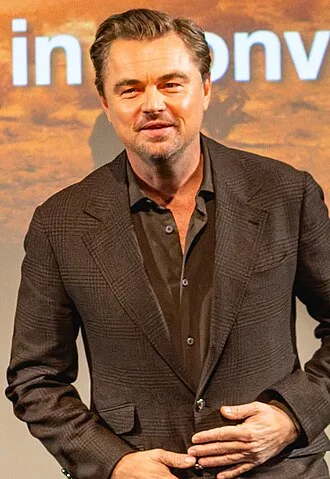
Born in Los Angeles, DiCaprio began his career in the late 1980s by appearing in television commercials. He had a starring role in the last season of the sitcom Growing Pains (1991–1992), and had his first major film part as author Tobias Wolff in This Boy's Life (1993). He received critical acclaim and his first Academy Award nomination for playing a developmentally disabled boy in What's Eating Gilbert Grape (1993).
DiCaprio achieved international stardom with the star-crossed romances Romeo + Juliet (1996) and Titanic (1997). After the latter became the highest-grossing film in the world at the time, he attempted to shed his image as a romantic hero, seeking roles in other genres, including the 2002 crime dramas Catch Me If You Can and Gangs of New York; the latter marked the first of his many successful collaborations with director Martin Scorsese.
DiCaprio continued to gain acclaim for his performances in the biopic The Aviator (2004), the political thriller Blood Diamond (2006), the crime thriller The Departed (2006), the romantic drama Revolutionary Road (2008), the action thriller Inception (2010), the western Django Unchained (2012), the biopic The Wolf of Wall Street (2013), the survival drama The Revenant (2015)—for which he won the Academy Award for Best Actor—the comedy-drama Once Upon a Time in Hollywood (2019), the crime drama Killers of the Flower Moon (2023) and the action film One Battle After Another (2025).
DiCaprio is the founder of Appian Way Productions—a production company that has made some of his films and environmental documentaries, such as the series Greensburg (2008–2010)—and the Leonardo DiCaprio Foundation, a nonprofit organization devoted to promoting environmental awareness. A United Nations Messenger of Peace, he regularly supports charitable causes.
In 2005, he was named a Commander of the Order of Arts and Letters for his contributions to the arts, and in 2016, he appeared in Time magazine's 100 most influential people in the world. DiCaprio was voted one of the 50 greatest actors of all time in a 2022 readers' poll by Empire magazine.
Early life and acting background
Leonardo Wilhelm DiCaprio was born on November 11, 1974, in Los Angeles, California. He is the only child of Irmelin Indenbirken, a legal secretary from Germany, and George DiCaprio, an American underground comix artist and distributor. The couple met while attending college and moved to Los Angeles after graduating. George's paternal grandparents, Salvatore Di Caprio and Rosina Cassella, were Italian, while his mother, Olga Anne Jacobs, was of German descent.
Irmelin's father, Wilhelm Indenbirken, was German, while her mother, Helene Indenbirken, was a Russian immigrant living in Germany. Some sources have falsely claimed that Helene was born in Odesa, Ukraine, but there is no evidence that DiCaprio has any relatives of Ukrainian birth or heritage.
DiCaprio got his name because his pregnant mother first felt him kick while she was looking at a Leonardo da Vinci painting in the Uffizi museum in Florence, Italy. When he was a year old, his parents divorced after his father fell in love with another woman and moved out. To raise DiCaprio together, his parents moved into twin cottages with a shared garden in Echo Park, Los Angeles.
DiCaprio's father lived with his girlfriend and her son, Adam Farrar, with whom DiCaprio developed a close bond. DiCaprio and his mother later moved to other neighborhoods, such as Los Feliz. He has described his parents as "bohemian in every sense of the word" and as "the people I trust the most in the world". DiCaprio has mentioned growing up poor in a neighborhood plagued with prostitution, crime and violence.
He was raised Catholic. DiCaprio attended the Los Angeles Center for Enriched Studies for four years and later Seeds Elementary School. He enrolled at John Marshall High School, but disliked public school and wanted to audition for acting jobs instead. He decided to drop out of high school, and later earned a general equivalency diploma (GED).
As a child, DiCaprio wanted to become either an actor or a marine biologist. He chose to pursue acting because he enjoyed imitating people and impersonating characters, and liked seeing people's reactions to his impressions. According to DiCaprio, his interest in performing began at the age of two, when he went onstage at a performance festival and danced spontaneously to a positive response from the crowd.
He was also motivated to learn acting when his stepbrother's appearance in a television commercial earned him $50,000. DiCaprio has said in interviews that his first television appearance was in the children's series Romper Room, and that he was dismissed from the show for being disruptive. The show's host has denied that any children were removed from the show in this way.
At age 11, DiCaprio almost quit acting to pursue breakdancing, after winning second place in a breakdancing competition in his mother's native Germany. Starting at age 14, he appeared in several commercials for Matchbox cars, which he calls his first role. DiCaprio also appeared in commercials for Kraft Singles, Bubble Yum, and Apple Jacks. In 1989, he played the role of Glen in two episodes of the television show The New Lassie.
At the beginning of his career, DiCaprio had difficulty finding an agent. When he finally found one, the agent suggested that he change his name to Lenny Williams to appeal to American audiences, which he refused to do. DiCaprio remained jobless for a year and a half, even despite 100 auditions.
Following this frustrating lack of success, DiCaprio was about to give up acting but his father convinced him to persevere, and he continued to audition. After a talent agent (who knew a friend of his mother's) recommended him to casting directors, DiCaprio secured roles in about 20 commercials.
By the early 1990s, DiCaprio began acting regularly on television, beginning with a role in the pilot of The Outsiders (1990) and one episode of the soap opera Santa Barbara (1990), in which he played an alcoholic teenager. Following this, DiCaprio was cast in Parenthood, a series based on the 1989 comedy film.
To prepare for the role of Garry Buckman, a troubled teen, he analyzed Joaquin Phoenix's performance in the original film. His work that year earned him two nominations at the 12th Youth in Film Awards—Best Young Actor in a Daytime Series for Santa Barbara and Best Young Actor Starring in a New Television Series for Parenthood.
Around this time, he was a contestant on the children's game show Fun House; on the show he performed several stunts, including catching the fish inside a small pool using only his teeth.
Career
1991–1996: Early work and breakthrough
DiCaprio made his film debut in 1991 as the stepson of an unscrupulous landlord in the low-budget horror sequel Critters 3—a part he later described as "your average, no-depth, standard kid with blond hair". DiCaprio has stated that he prefers not to remember Critters 3, viewing it as "possibly one of the worst films of all time" and the kind of role he wanted to avoid in the future.
Later in 1991, he became a recurring cast member on the sitcom Growing Pains, playing Luke Brower, a homeless boy who is taken in by the show's central family. Co-star Joanna Kerns recalls DiCaprio being "especially intelligent and disarming for his age" but she noted that he was also mischievous and jocular on set, and often made fun of his co-stars.
DiCaprio was cast by the producers to appeal to young female audience, but his arrival did not improve the show's ratings and he left before the end of its run. He was nominated for a Young Artist Award for Best Young Actor Co-starring in a Television Series. DiCaprio also had an uncredited role in 1991 in one episode of Roseanne.
In 1992, DiCaprio had a brief role in the first installment of the Poison Ivy film series, and was handpicked by Robert De Niro from a shortlist of 400 young actors to co-star with him in This Boy's Life. Adapted from the memoir by Tobias Wolff, the film focuses on the relationship between a rebellious teenager, Toby (DiCaprio), and his mother (Ellen Barkin) and abusive stepfather (De Niro).
Director Michael Caton-Jones said that DiCaprio did not know how to behave on set; accordingly, Caton-Jones used a strict mentoring style, after which DiCaprio's behavior began to improve. Bilge Ebiri of Rolling Stone found that the powerful bond between Barkin and DiCaprio elevated the film, praising DiCaprio's portrayal of his character's complex growth from a rebellious teen to an independent young man. This Boy's Life was the first film that gained him recognition.
DiCaprio's first talk show appearance was in 1992 on the Looseleaf Report, hosted by Victoria Looseleaf, who later wrote a 1998 (unauthorized) biography on him.
DiCaprio played the developmentally disabled brother of Johnny Depp's character in What's Eating Gilbert Grape (1993), a comedy-drama about a dysfunctional Iowa family. Caton-Jones recommended DiCaprio to director Lasse Hallström who was initially skeptical, as he considered DiCaprio too good-looking for the part.
Hallström cast DiCaprio after he emerged as "the most observant" auditionee. To ensure authenticity in his portrayal, DiCaprio studied similarly impaired children and their mannerisms, and Hallström allowed him to create the character using his own researched attributes. The film became a critical success. At age 19, DiCaprio earned a National Board of Review Award, as well as nominations for a Golden Globe Award and an Academy Award for Best Supporting Actor, making him the seventh-youngest Oscar nominee in the category. "The film's real show-stopping turn comes from Mr.
DiCaprio," wrote The New York Times critic Janet Maslin, "who makes Arnie's many tics so startling and vivid that at first he is difficult to watch. The performance has a sharp, desperate intensity from beginning to end." Caryn James, also writing for The New York Times, said of his performances in This Boy's Life and What's Eating Gilbert Grape: "He made the raw, emotional neediness of those boys completely natural and powerful."
DiCaprio's first role of 1995 was in Sam Raimi's Western The Quick and the Dead. When Sony Pictures became dubious over DiCaprio's casting, co-star Sharon Stone paid his salary herself. The film was released to dismal box office performance and mixed reviews from critics. DiCaprio next starred as a teenage Jim Carroll, a drug-addicted high school basketball player and budding writer, in the biopic The Basketball Diaries.
He starred in the erotic drama Total Eclipse (1995), driven by the desire to showcase an exceptional performance, which would focus on his acting talent rather than his much-discussed physical appeal. Directed by Agnieszka Holland, it is a fictionalized account of the same-sex relationship between Arthur Rimbaud (DiCaprio) and Paul Verlaine (David Thewlis).
DiCaprio was cast when River Phoenix died before filming began. Although the film failed commercially, it has been included in the catalog of the Warner Archive Collection, which releases classic and cult films from Warner Bros.' library on home video. A review in the San Francisco Chronicle called DiCaprio "his generation's great acting promise" but criticized the mismatch between Thewlis's "cultivated" British accent and DiCaprio's "Southern California twang".
DiCaprio next starred opposite Claire Danes in Baz Luhrmann's Romeo + Juliet (1996), an abridged modernization of William Shakespeare's romantic tragedy, which retained the original Shakespearean dialogue. DiCaprio was initially unsure about another Romeo and Juliet adaptation, but at his father's suggestion, he agreed to examine Luhrmann's work more closely.
DiCaprio and Luhrmann then spent a two-week workshop exchanging ideas, which led to the collaboration. Romeo + Juliet established DiCaprio as a leading Hollywood actor; according to film scholar Murray Pomerance, DiCaprio's newfound popularity helped the film become profitable only days after its release. Reviewing DiCaprio's early works, David Thomson of The Guardian called DiCaprio "a revelation" in What's Eating Gilbert Grape, "very moving" in This Boy's Life, "suitably desperate" in The Basketball Diaries and "a vital spark" in Romeo + Juliet.
The latter earned DiCaprio a Silver Bear for Best Actor at the 1997 Berlin International Film Festival. He then portrayed a young man who has been committed to a mental asylum in Marvin's Room (1996), a family drama about two estranged sisters, played by Meryl Streep and Diane Keaton, who are reunited through tragedy.
He played Hank, the troubled son of Streep's character. Lisa Schwarzbaum of Entertainment Weekly praised "the deeply gifted DiCaprio" for holding his own against veteran actresses Keaton and Streep, describing the three as "full-bodied and so powerfully affecting that you're carried along on the pleasure of being in the presence of their extraordinary talent".
1997–2001: Titanic and worldwide recognition
DiCaprio rejected a role in Boogie Nights (1997) to star opposite Kate Winslet in James Cameron's Titanic as members of different social classes who fall in love aboard RMS Titanic. DiCaprio had doubts, but was encouraged by Cameron to pursue the part. With a production budget of more than $200 million, Titanic was the most expensive in history at the time.
It became the highest-grossing film at the time, earning more than $2.1 billion in box-office receipts worldwide. It won 11 Academy Awards—the most wins for any film—including Best Picture; DiCaprio's failure to gain a nomination led to a protest against the Academy of Motion Picture Arts and Sciences by more than 200 fans. He was nominated for other high-profile awards, including a Golden Globe Award for Best Actor.
Titanic transformed DiCaprio into a superstar, drawing adoration among teenage girls and young women that became known as "Leo-mania". The success bolstered DiCaprio's standing as a teen idol and romantic lead, an image from which he sought to dissociate himself. Despite the film's success and its positive influence on his career, in 2025 DiCaprio said he regretted the decision to turn down Boogie Nights, saying it was "a profound movie of my generation".
In his 2015 Rolling Stone article, Ebiri called the Titanic role DiCaprio's best, writing that he and Winslet "infuse their earnest back-and-forth with so much genuine emotion that it's hard not to get swept up in their doomed love affair". A writer for Vanity Fair in 2008 labeled them "Hollywood's most iconic screen couple" since Humphrey Bogart and Ingrid Bergman.
Writing about her first viewing of Titanic in 2017, Vox contributor Alissa Wilkinson described DiCaprio's "boyish charm" and found his performance "natural and unaffected".
DiCaprio had a brief featured role in Woody Allen's 1998 satire of fame, Celebrity. Ebiri labeled DiCaprio "the best thing in the film". That year, he also took on the dual roles of villainous King Louis XIV and his secret, sympathetic twin brother Philippe in Randall Wallace's The Man in the Iron Mask, with common elements from the 1939 film and a 1929 film with Douglas Fairbanks.
It received mixed reviews, but grossed $180 million against a budget of $35 million. Entertainment Weekly critic Owen Gleiberman wrote that DiCaprio did not look old enough to play the part, but praised him as "a fluid and instinctive actor, with the face of a mischievous angel". The Guardian's Alex von Tunzelmann was similarly impressed with the actor's performance but found his talent wasted in the film. DiCaprio won a Golden Raspberry Award for Worst Screen Couple for the dual roles in 1999.
Following the release of Titanic, and The Man in the Iron Mask, DeCaprio chose to reduce his workload "to learn to hear [his] own voice in choosing the roles" that he wanted to pursue. He said in 2000: "I have no connection with me during that whole Titanic phenomenon and what my face became around the world [...] I'll never reach that state of popularity again, and I don't expect to [...] It's not something I'm going to try to achieve either."
DiCaprio was next cast to star in an earlier version of American Psycho (2000) for a reported salary of $20 million; after disagreements with Oliver Stone on the film's direction, DiCaprio left the project, taking the lead role in The Beach instead. Adapted from Alex Garland's 1996 novel, the film saw him play a backpacking American tourist who ends up in a secret island commune in the Gulf of Thailand.
Budgeted at $50 million, the film earned almost three times that at the box office, but was negatively reviewed by critics, and earned him a nomination for the Golden Raspberry Award for Worst Actor. Todd McCarthy of Variety thought DiCaprio gave a compelling performance but his character lacked defining qualities.
The film received criticism for damaging the filming location in Thailand, after which DiCaprio worked to restore the area. After shooting The Beach, DiCaprio auditioned for Luhrmann's Moulin Rouge! (2001) but was rejected; He later asserted it was due to his poor singing abilities.
In the mid-1990s, DiCaprio agreed to be in the mostly improvised black-and-white short film Don's Plum as a favor to aspiring director R. D. Robb. When Robb expanded it to a full-length film in the early 2000s to capitalize on the fame of DiCaprio and co-star Tobey Maguire, DiCaprio and Maguire had its release blocked in the US and Canada by court order, arguing they never intended to make a feature film. The film premiered at the 2001 Berlin International Film Festival but remains obscure.