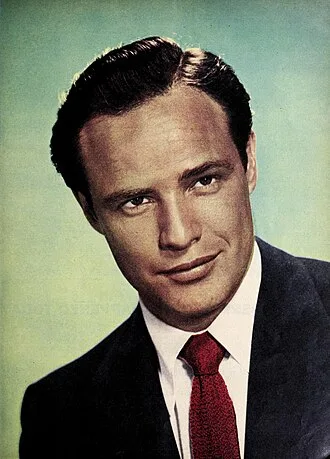
Brando came under the influence of Stella Adler and Stanislavski's system in the 1940s. He began his career on stage, where he was lauded for adeptly interpreting his characters. He made his Broadway debut in the play I Remember Mama (1944) and won Theater World Awards for his performances in Candida and Truckline Cafe (1946).
He returned to Broadway as Stanley Kowalski in the Tennessee Williams play A Streetcar Named Desire (1947), a role he reprised in the 1951 film adaptation directed by Elia Kazan.
He made his film debut playing a wounded G.I. in The Men (1950) and won two Academy Awards for Best Actor for his performances as dockworker Terry Malloy in On the Waterfront (1954) and crime boss Vito Corleone in The Godfather (1972). He was also Oscar-nominated for playing Stanley Kowalski in A Streetcar Named Desire (1951), Emiliano Zapata in Viva Zapata! (1952), Mark Antony in Julius Caesar (1953), an air force pilot in Sayonara (1957), an American expatriate in Last Tango in Paris (1973), and a lawyer in A Dry White Season (1989).
Brando was known for portraying rebellious characters who later became popular icons, such as Johnny Strabler in The Wild One (1953), and he came to be seen as an emblem of the era's "generation gap". He also starred in films such as Guys and Dolls (1955), The Young Lions (1958), The Fugitive Kind (1960), The Chase (1966), Burn! (1969), The Missouri Breaks (1976), Superman (1978), Apocalypse Now (1979), and The Freshman (1990).
He made his directorial debut with, and also starred in, the western drama One-Eyed Jacks (1961), which performed poorly at the box office.
On television, Brando won the Primetime Emmy Award for Outstanding Supporting Actor in a Limited Series or Movie for his role in the ABC miniseries Roots: The Next Generations (1979), after which he took a nine-year hiatus from acting. He later returned to film with varying degrees of commercial and critical success.
The last two decades of his life were marked by controversy, and his troubled private life received significant public attention, including struggles with mood disorders and legal issues. His final films included The Island of Dr. Moreau (1996) and The Score (2001).
Early life and education
Marlon Brando Jr. was born on April 3, 1924, in Omaha, Nebraska, the only son of Marlon Brando Sr. and Dorothy Pennebaker. His father was a salesman who frequently travelled out-of-state, while his mother was a stage actress who was often away from home. His mother's absence resulted in Brando becoming attached to the family's housekeeper, who eventually left to get married, causing Brando to develop abandonment issues. His two elder sisters were Jocelyn and Frances.
Despite some of his most notable film roles, Brando did not have Italian ancestry. Brando's ancestry was mostly German, Dutch, English, and Irish. His patrilineal immigrant ancestor, Johann Wilhelm Brandau, arrived in New York City in the early 1700s from the Palatinate in Germany. Brando was also a descendant of Louis DuBois, a French Huguenot, who arrived in New York around 1660.
His maternal great-grandfather, Myles Joseph Gahan, was an Irish immigrant who served as a medic in the American Civil War. In 1995, Marlon gave an interview in Ireland in which he said, "I have never been so happy in my life. When I got off the plane I had this rush of emotion. I have never felt at home in a place as I do here. I am seriously contemplating Irish citizenship."
In 1930, when Brando was six years old, the family moved to Evanston, Illinois, where Brando mimicked other people, developed a reputation for pranking, and met American actor Wally Cox, with whom he remained friends until Cox's death in 1973. In 1936, his parents separated and he and his siblings moved with their mother to Santa Ana, California.
Two years later, his parents reconciled, and his father purchased a farmhouse in Libertyville, Illinois. Brando attended Libertyville High School, excelling at sports and drama, but failing in every other subject. Consequently, he was held back for a year, and with his history of misbehaving, he was expelled in 1941.
Brando was sent by his father to Shattuck Military Academy, where his father had also studied. There, Brando continued to excel at acting until 1943, when he was put on probation for being insubordinate to an officer during maneuvers. He was confined to the campus, but sneaked into town and was caught. The faculty voted to expel him, although he was supported by the students who thought expulsion was too harsh.
Brando was invited back for the following year, but decided instead to drop out of high school. He then worked as a ditch-digger at a summer job arranged by his father and tried to enlist in the Army, but his routine physical revealed that a football injury he had sustained at Shattuck had left him with a trick knee; he was classified physically unfit for military service.
Brando decided to follow his sisters to New York, studying at the American Theatre Wing Professional School, part of the Dramatic Workshop of the New School, with influential German director Erwin Piscator. In a 1988 documentary, Marlon Brando: The Wild One, Brando's sister Jocelyn remembered, "He was in a school play and enjoyed it ...
So he decided he would go to New York and study acting because that was the only thing he had enjoyed. That was when he was 18." In the A&E Biography episode on Brando, George Englund said Brando fell into acting in New York because "he was accepted there. He wasn't criticized. It was the first time in his life that he heard good things about himself." He spent his first few months in New York sleeping on friends' couches. For a time he lived with Roy Somlyo, who later became a four-time Emmy-winning Broadway producer.
Brando was an avid student and proponent of Stella Adler, from whom he learned the techniques of the Stanislavski system. This technique encouraged the actor to explore both internal and external aspects to fully realize the character being portrayed. Brando's remarkable insight and sense of realism were evident early on.
Adler used to recount that, when teaching Brando, she had instructed the class to act like chickens, and added that a nuclear bomb was about to fall on them. Most of the class clucked and ran around wildly, but Brando sat calmly and pretended to lay an egg. Asked by Adler why he had chosen to react this way, he said, "I'm a chicken—what do I know about bombs?" Despite being commonly regarded as a method actor, Brando disagreed. He claimed to have abhorred Lee Strasberg's teachings:
After I had some success, Lee Strasberg tried to take credit for teaching me how to act. He never taught me anything. He would have claimed credit for the sun and the moon if he believed he could get away with it. He was an ambitious, selfish man who exploited the people who attended the Actors Studio and tried to project himself as an acting oracle and guru.
Some people worshipped him, but I never knew why. I sometimes went to the Actors Studio on Saturday mornings because Elia Kazan was teaching, and there were usually a lot of good-looking girls, but Strasberg never taught me acting. Stella (Adler) did—and later Kazan.
Brando was the first to bring a natural approach to acting on film. According to Dustin Hoffman in his online Masterclass, Brando would often talk to cameramen and fellow actors about their weekend even after the director would call action. Once Brando felt he could deliver the dialogue as naturally as that conversation, he would start the dialogue.
In the 2015 Brando documentary, Listen to Me Marlon, he says that before such a feeling of naturalness, actors seemed like breakfast cereals, meaning they were predictable. Critics would later say that this was Brando being difficult, but actors who worked opposite him said it was just all part of his technique.
Career
1944–1950: Early career
Brando used his Stanislavski System skills for his first summer stock roles in Sayville, New York, on Long Island. Brando established a pattern of erratic, insubordinate behavior in the few shows he had been in. His behavior had him kicked out of the cast of the New School's production in Sayville, but he was soon afterwards discovered in a locally produced play there.
Then, in 1944, he made it to Broadway in the bittersweet drama I Remember Mama, playing the son of Mady Christians. The Lunts wanted Brando to play the role of Alfred Lunt's son in O Mistress Mine, and Lunt even coached him for the audition, but Brando made no attempt to even read his lines at the audition and was not hired.
New York Drama Critics voted him "Most Promising Young Actor" for his role as an anguished veteran in Truckline Café, although the play was a commercial failure. In 1946, he appeared on Broadway as the young hero in the political drama A Flag Is Born, refusing to accept wages above the Actors' Equity rate.
In that same year, Brando played the role of Marchbanks alongside Katharine Cornell in her production's revival of Candida, one of her signature roles. Cornell also cast him as the Messenger in her production of Jean Anouilh's Antigone that same year. He was also offered the opportunity to portray one of the principal characters in the Broadway premiere of Eugene O'Neill's The Iceman Cometh, but turned the part down after falling asleep while trying to read the massive script and pronouncing the play "ineptly written and poorly constructed".
In 1945, Brando's agent recommended he take a co-starring role in The Eagle Has Two Heads with Tallulah Bankhead, produced by Jack Wilson. Bankhead had turned down the role of Blanche Dubois in A Streetcar Named Desire, which Williams had written for her, to tour the play for the 1946–1947 season. Bankhead recognized Brando's potential, despite her disdain (which most Broadway veterans shared) for method acting, and agreed to hire him even though he auditioned poorly.
The two clashed greatly during the pre-Broadway tour, with Bankhead reminding Brando of his mother, being her age and also having a drinking problem. Wilson was largely tolerant of Brando's behavior, but he reached his limit when Brando mumbled through a dress rehearsal shortly before the November 28, 1946, opening. "I don't care what your grandmother did," Wilson exclaimed, "and that Method stuff, I want to know what you're going to do!"[citation needed] Brando in turn raised his voice, and acted with great power and passion. "It was marvelous," a cast member recalled. "Everybody hugged him and kissed him.
He came ambling offstage and said to me, 'They don't think you can act unless you can yell.'"[citation needed]
Critics were not as kind, however. A review of Brando's performance in the opening assessed that Brando was "still building his character, but at present fails to impress."[citation needed] One Boston critic remarked of Brando's prolonged death scene, "Brando looked like a car in midtown Manhattan searching for a parking space." He received better reviews at subsequent tour stops, but what his colleagues recalled was only occasional indications of the talent he would later demonstrate. "There were a few times when he was really magnificent," Bankhead admitted to an interviewer in 1962. "He was a great young actor when he wanted to be, but most of the time I couldn't even hear him on the stage."[citation needed]
Brando displayed his apathy for the production by demonstrating some shocking onstage manners. He "tried everything in the world to ruin it for her," Bankhead's stage manager claimed. "He nearly drove her crazy: scratching his crotch, picking his nose, doing anything."[citation needed] After several weeks on the road, they reached Boston, by which time Bankhead was ready to dismiss him.
This proved to be one of the greatest blessings of his career, as it freed him up to play the role of Stanley Kowalski in Tennessee Williams' 1947 play A Streetcar Named Desire, directed by Elia Kazan. Moreover, to that end, Bankhead herself, in her letter declining Williams' invitation to play the role of Blanche, gave Brando this ringing—albeit acid-tongued—endorsement stating "I do have one suggestion for casting.
I know of an actor who can appear as this brutish Stanley Kowalski character. I mean, a total pig of a man without sensitivity or grace of any kind. Marlon Brando would be perfect as Stanley. I have just fired the cad from my play, The Eagle Has Two Heads, and I know for a fact that he is looking for work".
Pierpont writes that John Garfield was first choice for the role, but "made impossible demands." It was Kazan's decision to fall back on the far less experienced (and technically too young for the role) Brando. In a letter dated August 29, 1947, Williams confided to his agent Audrey Wood: "It had not occurred to me before what an excellent value would come through casting a very young actor in this part.
It humanizes the character of Stanley in that it becomes the brutality and callousness of youth rather than a vicious old man ... A new value came out of Brando's reading which was by far the best reading I have ever heard." Brando based his portrayal of Kowalski on the boxer Rocky Graziano, whom he had studied at a local gymnasium.
Graziano did not know who Brando was, but attended the production with tickets provided by the young man. He said, "The curtain went up and on the stage is that son of a bitch from the gym, and he's playing me."[page needed]
In 1947, Brando performed a screen test for an early Warner Brothers script for the novel Rebel Without a Cause (1944), which bore no relation to the film eventually produced in 1955. The screen test is included as an extra in the 2006 DVD release of A Streetcar Named Desire. Brando's first screen role was a bitter paraplegic veteran in The Men (1950).
He spent a month in bed at the Birmingham Army Hospital in Van Nuys to prepare for the role. The New York Times reviewer Bosley Crowther wrote that Brando as Ken "is so vividly real, dynamic and sensitive that his illusion is complete" and noted, "Out of stiff and frozen silences he can lash into a passionate rage with the tearful and flailing frenzy of a taut cable suddenly cut."
By Brando's own account, it may have been because of this film that his draft status was changed from 4-F to 1-A. He had had surgery on his trick knee, and it was no longer physically debilitating enough to incur exclusion from the draft. When Brando reported to the induction center, he answered a questionnaire by saying his race was "human", his color was "Seasonal-oyster white to beige", and he told an Army doctor that he was psychoneurotic.
When the draft board referred him to a psychiatrist, Brando explained that he had been expelled from military school and had severe problems with authority. Coincidentally, the psychiatrist knew a doctor friend of Brando. Brando avoided military service during the Korean War.
Early in his career, Brando began using cue cards instead of memorizing his lines. Despite the objections of several of the film directors he worked with, Brando felt that this helped bring realism and spontaneity to his performances. He felt otherwise he would appear to be reciting a writer's speech. In the TV documentary The Making of Superman: The Movie, Brando explained: "If you don't know what the words are but you have a general idea of what they are, then you look at the cue card and it gives you the feeling to the viewer, hopefully, that the person is really searching for what he is going to say—that he doesn't know what to say".
Some, however, thought Brando used the cards out of laziness or an inability to memorize his lines. Once, on the set of The Godfather, Brando was asked why he wanted his lines printed out. He responded: "Because I can read them that way."
1951–1954: Stardom and On the Waterfront
Brando brought his performance as Stanley Kowalski to the screen in Tennessee Williams' A Streetcar Named Desire (1951). It earned him his first Academy Award nomination in the Best Actor category. The role is regarded as one of Brando's greatest.[citation needed]
He was also nominated the next year for Viva Zapata! (1952), a fictionalized account of the life of Mexican revolutionary Emiliano Zapata. The film recounted Zapata's lower-class upbringing, his rise to power in the early 20th century, and death. The film was directed by Elia Kazan and co-starred Anthony Quinn.
In the biopic Marlon Brando: The Wild One, Sam Shaw says: "Secretly, before the picture started, he went to Mexico to the very town where Zapata lived and was born in and it was there that he studied the speech patterns of people, their behavior, movement." Most critics focused on the actor rather than the film, with Time and Newsweek publishing rave reviews.
Years later, in his autobiography, Brando remarked: "Tony Quinn, whom I admired professionally and liked personally, played my brother, but he was extremely cold to me while we shot that picture. During our scenes together, I sensed a bitterness toward me, and if I suggested a drink after work, he either turned me down or else was sullen and said little.
Only years later did I learn why." Brando explained that, to create on-screen tension between the two, "Gadg" (Kazan) had told Quinn – who had taken over the role of Stanley Kowalski from Brando on Broadway – that Brando had been unimpressed with his work. After achieving the desired effect, Kazan never told Quinn that he had misled him.
It was only many years later, after comparing notes, that Brando and Quinn realized the deception.[citation needed]
Brando's next film, Julius Caesar (1953), received highly favorable reviews. Brando portrayed Mark Antony. While most acknowledged Brando's talent, some critics felt Brando's "mumbling" and other idiosyncrasies betrayed a lack of acting fundamentals and, when his casting was announced, many remained dubious about his prospects for success.
Directed by Joseph L. Mankiewicz and co-starring British stage actor John Gielgud, Brando delivered an impressive performance, especially during Antony's noted "Friends, Romans, countrymen ..." speech. Gielgud was so impressed that he offered Brando a full season at the Hammersmith Theatre, an offer he declined. In his biography on the actor, Stefan Kanfer writes, "Marlon's autobiography devotes one line to his work on that film: Among all those British professionals, 'for me to walk onto a movie set and play Mark Anthony was asinine'—yet another example of his persistent self-denigration, and wholly incorrect."
Kanfer adds that after a screening of the film, director John Huston commented: "Christ! It was like a furnace door opening—the heat came off the screen. I don't know another actor who could do that." During the filming of Julius Caesar, Brando learned that Elia Kazan had cooperated with congressional investigators, naming a whole string of "subversives" to the House Committee on Un-American Activities (HUAC).
By all accounts, Brando was upset by his mentor's decision, but he worked with him again in On The Waterfront. "None of us is perfect," he later wrote in his memoir, "and I think that Gadg has done injury to others, but mostly to himself."
In 1953, Brando also starred in The Wild One, riding his own Triumph Thunderbird 6T motorcycle. Triumph's importers were ambivalent at the exposure, as the subject matter was rowdy motorcycle gangs taking over a small town. The film was criticized for its perceived gratuitous violence at the time, with Time stating: "The effect of the movie is not to throw light on the public problem, but to shoot adrenaline through the moviegoer's veins." Brando allegedly did not see eye to eye with the Hungarian director László Benedek and did not get on with costar Lee Marvin.[citation needed]
To Brando's expressed puzzlement, the movie inspired teen rebellion and made him a role model to the nascent rock-and-roll generation and future stars such as James Dean and Elvis Presley. After the movie's release, the sales of leather jackets and motorcycles skyrocketed. Reflecting on the movie in his autobiography, Brando concluded that it had not aged very well but said "More than most parts I've played in the movies or onstage, I related to Johnny, and because of this, I believe I played him as more sensitive and sympathetic than the script envisioned.
There's a line in the picture where he snarls, 'Nobody tells me what to do.' That's exactly how I've felt all my life."