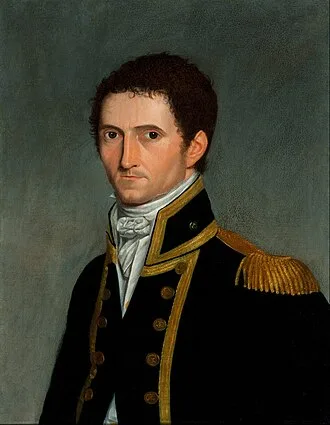
Flinders was involved in several voyages of discovery between 1791 and 1803, the most famous of which are the circumnavigation of Australia and an earlier expedition when he and George Bass confirmed that Van Diemen's Land was an island. While returning to Britain in 1803, Flinders was arrested by the French at the colony of Isle de France.
Although Britain and France were at war, Flinders thought the scientific nature of his work would ensure safe passage, but he remained under arrest for more than six years. In captivity, he recorded details of his voyages for future publication, and put forward his rationale for naming the new continent Australia, as an umbrella term for New Holland and New South Wales – a suggestion taken up later by Governor Macquarie.
Flinders' health had suffered, however, and although he returned to Britain in 1810, he did not live to see the success of his widely praised book and atlas, A Voyage to Terra Australis. The location of his grave had been lost by the mid-19th century, but archaeologists, excavating a former burial ground near London's Euston railway station for the High Speed 2 rail project, announced in January 2019 that his remains had been identified. On 13 July 2024, he was reburied in Donington, Lincolnshire, the village of his birth.
Early life
Matthew Flinders was born in Donington, Lincolnshire, the son of Matthew Flinders, a surgeon, and his wife Susannah (née Ward). He was educated at Cowley's Charity School, Donington, from 1780 and then at the Reverend John Shinglar's Grammar School at Horbling in Lincolnshire.
In his own words, he was "induced to go to sea against the wishes of my friends from reading Robinson Crusoe", and in 1789, at the age of fifteen, he joined the Royal Navy. Under the patronage of Captain Thomas Pasley, Flinders was initially assigned to HMS Alert as a servant, but was soon transferred as an able-seaman to HMS Scipio, and then in July 1790 was made midshipman on HMS Bellerophon.
Early career
Midshipman to Captain Bligh
In May 1791, on Pasley's recommendation, Flinders joined Captain William Bligh's expedition on HMS Providence transporting breadfruit from Tahiti to Jamaica. It was Bligh's second "Breadfruit Voyage", following his ill-fated voyage on HMS Bounty. The expedition sailed via the Cape of Good Hope and, in February 1792, they arrived at Adventure Bay on the eastern coast of Bruny Island off the south-eastern coast of the island now known as Tasmania.
The officers and crew spent over a week in the region obtaining water and lumber, and interacting with local Aboriginal people. It was Flinders' first association with any of the land which is now part of the Commonwealth of Australia.
After the expedition arrived in Tahiti in April 1792, obtaining the breadfruit plants to take to Jamaica, they sailed back west. Instead of travelling via Adventure Bay, Bligh navigated to the north of the Australian continent, sailing through the Torres Strait. There, off Zagai Island, they were involved in a naval skirmish with armed local men in a flotilla of sailing canoes, which resulted in the death of several Islanders and one crewman.
The expedition arrived in Jamaica in February 1793, offloading the breadfruit plants, and then returned to England, with Flinders disembarking in London in August 1793 after more than two years at sea.
HMS Bellerophon
In September 1793, Flinders re-joined HMS Bellerophon, which was captained by Pasley. In 1794, Flinders served on this vessel during the battle known as the Glorious First of June, the first and largest fleet action of the French Revolutionary Wars. Flinders wrote a detailed journal of the battle which described Pasley as having "lost his leg by an 18-pounder shot which came in through the barricadoes of the quarter-deck".
Both Pasley and Flinders survived, with Flinders deciding to pursue a preference for exploratory rather than military naval assignments.
Exploration around New South Wales
Flinders' desire for adventure led him to enlist as a midshipman aboard HMS Reliance in 1795. This vessel was headed to New South Wales carrying the recently appointed governor of that British colony, Captain John Hunter. On this voyage Flinders became friends with the ship's surgeon George Bass who was three years his senior and had been born at Aswarby, just 18 kilometres (11 mi) from Donington.[citation needed]
Expeditions in Tom Thumb and Tom Thumb II
Reliance arrived in Port Jackson in September 1795, and Bass and Flinders soon organised an expedition in a small open boat named Tom Thumb, in which they sailed with a boy, William Martin, to Botany Bay and up the Georges River. In March 1796, the two explorers, again with William Martin, set out on another voyage in a larger boat, dubbed Tom Thumb II.[full citation needed] They sailed south from Port Jackson but were soon forced to beach at Red Point (Port Kembla).
There, they accepted the help of two Aboriginal men who piloted the boat to the entrance of Lake Illawarra, where they were able to dry their gunpowder and obtain supplies of water from another group of Aboriginal people. During the return to Sydney, they had to seek shelter at Wattamolla and also explored some of Port Hacking (Deeban).
Circumnavigation of Van Diemen's Land
In 1798, Flinders, by then a lieutenant, was given command of the sloop Norfolk with orders "to sail beyond Furneaux's Islands, and, should a strait be found, pass through it, and return by the south end of Van Diemen's Land".[quote needs citation] Flinders and Bass had, in the months previously, both made separate journeys exploring the region but neither were conclusive as to the existence of a strait.
Flinders, with Bass and several crewmen, sailed Norfolk along the uncharted northern and western coasts of Van Diemen's Land, rounded Cape Pillar and returned to Furneaux's Islands. By doing so, Flinders had completed the circumnavigation of Van Diemen's Land and confirmed the presence of a strait between it and the mainland.
The passage was named Bass Strait after his close friend, and the largest island in the strait would later be named Flinders Island in his honour. During the voyage, Flinders and Bass rowed the ship's dinghy for some miles up the River Derwent, where they had their only encounter with Aboriginal Tasmanians.
Expedition to Hervey Bay
In 1799, Flinders' request to explore the coast north of Port Jackson was granted and, once more, the sloop Norfolk was assigned to him. Bass had returned to Britain by that time and, in his place, Flinders recruited his brother Samuel Flinders and was also accompanied on the voyage by a Indigenous Australian man named Bungaree.
They departed on 8 July 1799 and arrived in Moreton Bay six days later. Flinders rowed ashore at Woody Point (27°15′48″S 153°06′14″E / 27.2632°S 153.1039°E) and named a point 3.2 kilometres (2 mi) west of that (27°15′46″S 153°04′45″E / 27.2628°S 153.0792°E) as Redcliffe (on account of its red cliffs).
That point is now known as Clontarf Point, while the name Redcliffe is used by the town of Redcliffe to the north. He landed on Coochiemudlo Island (27°34′13″S 153°19′59″E / 27.5703°S 153.3331°E) on 19 July while he was searching for a river in the southern part of Moreton Bay.
In the northern part of Moreton Bay, Flinders explored a narrow waterway (27°04′14″S 153°08′34″E / 27.0705°S 153.1429°E) which he named the Pumice Stone River (presumably unaware it separated Bribie Island and the mainland); it is now called the Pumicestone Passage.
Most of the meetings between the Aboriginal people of Moreton Bay and Flinders were of a friendly nature, but on 15 July at the southern tip of Bribie Island, a spear was thrown which resulted in a local man being wounded by gunfire. Flinders named the place where this occurred Point Skirmish. While anchored in Pumicestone, Flinders ventured several kilometres overland with three crew including Bungaree and climbed the mountain Beerburrum. They turned back after meeting the steep cliffs of Mount Tibrogargan on about 26 July.
Exiting Moreton Bay, Flinders continued north exploring as far as Hervey Bay before returning south. They arrived back in Sydney on 20 August 1799.
Command of Investigator
In March 1800, Flinders rejoined Reliance and returned to Britain. During the voyage, the Antipodes Islands were discovered and charted. Flinders' work had come to the attention of many of the scientists of the day, in particular the influential Sir Joseph Banks, to whom Flinders dedicated his Observations on the Coasts of Van Diemen's Land, on Bass's Strait, etc..
Banks used his influence with Earl Spencer to convince the Admiralty of the importance of an expedition to chart the coastline of New Holland. As a result, in January 1801, Flinders was given command of HMS Investigator, a 334-ton sloop, and promoted to commander the following month.
Investigator set sail for New Holland on 18 July 1801. Attached to the expedition were the botanist Robert Brown, botanical artist Ferdinand Bauer, landscape artist William Westall, gardener Peter Good, geological assistant John Allen, and John Crosley as astronomer. Vallance et al. comment that compared to the Baudin expedition this was a "modest contingent of scientific gentlemen", which reflects "British parsimony" in scientific endeavour. The future explorer John Franklin, Flinders' cousin by marriage, served as midshipman.
Exploration of the Australian coastline
Surveying the southern coast
Aboard Investigator, Flinders reached and named Cape Leeuwin on 6 December 1801, and proceeded to make a survey along the southern coast of the Australian mainland. The expedition soon anchored in King George Sound and stayed there for a month exploring the area. The local Aboriginal people initially indicated that Flinders' group should "return from whence they came",[quote needs citation] but relations improved to the point where one resident participated in musket-drill with the ship's marines.
In nearby Oyster Harbour, Flinders found a copper plate that Captain Christopher Dixson, on Elligood, had left the year before.
While approaching Port Lincoln, which Flinders named after his home county of Lincolnshire, eight of his crew were lost when the sailing cutter, in which they were attempting to return to the ship after an expedition to the mainland, capsized. Flinders named nearby Memory Cove in their honour. On 21 March 1802, the expedition reached a large island where many kangaroos were sighted.
Flinders and some crew went ashore and found the animals so tame they could walk right up to them. They killed 31 kangaroos with Flinders writing that "in gratitude for so seasonable a supply [of meat], I named this southern land Kangaroo Island."[quote needs citation] The seals on the island proved less docile, with a crew member receiving a severe bite from one.
On 8 April 1802, while sailing east, Flinders sighted Géographe, a French corvette commanded by the explorer Nicolas Baudin, who was on a similar expedition for his government. Both men of science, Flinders and Baudin exchanged details of their discoveries, despite believing that their countries were at war. Flinders named the bay in which they met Encounter Bay.
Proceeding along the coast, Flinders explored Port Phillip (the site of the future city of Melbourne), which, unknown to him, had been explored only ten weeks earlier by John Murray aboard HMS Lady Nelson. Flinders scaled Arthur's Seat, the highest point near the shores of the southernmost parts of the bay, and wrote that the land had "a pleasing and, in many parts, a fertile appearance".
After scaling the You Yangs to the northwest of Port Phillip on 1 May, he left a scroll of paper with the ship's name on it and deposited it in a small pile of stones at the top of the peak.
With stores running low, Flinders proceeded to Sydney, arriving on 9 May 1802.
Circumnavigation of Australia
Flinders spent 12 weeks and 2 days in Sydney resupplying and enlisting further crew for the continuation of the expedition to the northern coast of Australia. Bungaree, an Aboriginal man who had accompanied him on his earlier coastal survey in 1799, joined the expedition as did another local Aboriginal man named Nanbaree.
It was arranged that Captain John Murray and his vessel Lady Nelson would accompany Investigator as a supply ship on this voyage.
Flinders set sail again on 22 July 1802, heading north and surveying the coast of what would later be called Queensland. They soon anchored at Sandy Cape where they, with Bungaree acting as a mediator, feasted on porpoise blubber with a group of Batjala people. In early August, Flinders sailed into a bay he named Port Curtis.
Here the local people threw stones at them as they attempted to land. Flinders ordered muskets be fired above their heads to disperse them. The expedition continued north but navigation became increasingly difficult as they entered the Great Barrier Reef. For Flinders, the collection of reefs served as a barrier to safe navigation, calling them Barrier Reefs in his 1814 book. Lady Nelson was deemed too unseaworthy to continue, and Captain Murray sailed her back to Sydney with his crew and Nanbaree, who wanted to return home.
Flinders exited the reefs near to the Whitsunday Islands and sailed Investigator north to the Torres Strait. On 29 October, they arrived at Murray Island in the east of this strait, where they traded iron for shell necklaces with the local people.
The expedition entered the Gulf of Carpentaria on 4 November and charted the coast to Arnhem Land. At Blue Mud Bay the crew, while collecting timber, had a skirmish with local Aboriginal men. One of the crew received four spear wounds while two of the Aboriginal men were shot dead. At nearby Caledon Bay, Flinders took a 14-year-old boy named Woga captive in order to coerce the local people to return a stolen axe.
Although the axe was not returned, Flinders released the boy who had spent a day tied to a tree. On 17 February 1803, near Cape Wilberforce, the expedition encountered a Makassan trepanging fleet captained by a man called Pobasso, from whom Flinders obtained information about the region.
During this part of the voyage, much of Investigator was discovered to be rotten, and Flinders made the decision to complete the circumnavigation of the continent without any further close surveying of the coast. He sailed to Sydney via Timor and the western and southern coasts of Australia. On the way, Flinders jettisoned two wrought-iron anchors which were found by divers in 1973 at Middle Island, Recherche Archipelago, Western Australia.
The anchors are on display at the South Australian Maritime Museum in Port Adelaide and at the National Museum of Australia in Canberra.
Arriving in Sydney on 9 June 1803, Investigator was judged to be unseaworthy and condemned.
Attempted return to England and imprisonment
Unable to find another vessel suitable to continue his exploration, Flinders set sail for Britain as a passenger aboard HMS Porpoise. However, the ship was wrecked on Wreck Reefs, part of the Great Barrier Reef, approximately 1,100 kilometres (700 mi) north of Sydney. Flinders navigated the ship's cutter across open sea back to Sydney, and arranged for the rescue of the remaining marooned crew.
Flinders then took command of the 29-ton schooner HMS Cumberland in order to return to England, but the poor condition of the vessel forced him to put in at French-controlled Isle de France (now known as Mauritius) for repairs on 17 December 1803, just three months after Baudin had died there.
War with France had broken out again the previous May, but Flinders hoped his French passport (despite its being issued for Investigator and not Cumberland) and the scientific nature of his mission would allow him to continue on his way.
Despite this, and the knowledge of Baudin's earlier encounter with Flinders, the French governor, Charles Mathieu Isidore Decaen, detained Flinders. The relationship between the men soured: Flinders was affronted at his treatment, and Decaen insulted by Flinders' refusal of an invitation to dine with him and his wife.
Decaen was suspicious of the alleged scientific mission as Cumberland carried no scientists and Decaen's search of Flinders' vessel uncovered a trunk full of papers (including despatches from the New South Wales Governor Philip Gidley King) that were not permitted under his scientific passport. Furthermore, one of King's despatches was specifically to the British Admiralty requesting more troops in case Decaen were to attack Port Jackson.
Among the papers seized were the three logs of HMS Investigator of which only Volume one and Volume two were returned to Flinders; these are now both held by the State Library of New South Wales. The third volume was later deposited in the Admiralty Library and is now held in The National Archives (United Kingdom).
Decaen referred the matter to the French government; this was delayed not only by the long voyage but also by the general confusion of war. Eventually, on 11 March 1806, Napoleon gave his approval, but Decaen still refused to allow Flinders' release. By this stage Decaen believed Flinders' knowledge of the island's defences would have encouraged Britain to attempt to capture it.
Nevertheless, in June 1809 the Royal Navy began a blockade of the island, and in June 1810 Flinders was paroled. Travelling via the Cape Colony on Olympia, which was taking despatches back to Britain, he received a promotion to captain, before continuing to England.