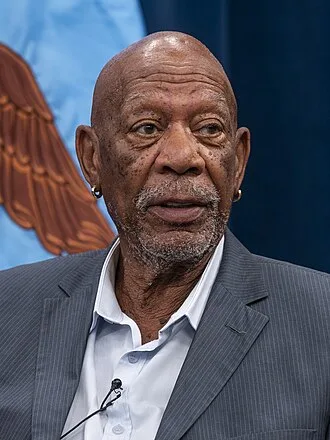
Born in Memphis, Tennessee, Freeman was raised in Mississippi, where he began acting in school plays. He studied theater arts in Los Angeles and appeared in stage productions in his early career. He rose to fame in the 1970s for his role in the children's television series The Electric Company. Freeman then appeared in the Shakespearean plays Coriolanus and Julius Caesar, the former of which earned him an Obie Award.
In 1978, he was nominated for the Tony Award for Best Featured Actor in a Play for his role as Zeke in the Richard Wesley play The Mighty Gents.
Freeman received the Academy Award for Best Supporting Actor playing a former boxer in Clint Eastwood's sports drama Million Dollar Baby (2004). He was Oscar-nominated for Street Smart (1987), Driving Miss Daisy (1989), The Shawshank Redemption (1994), and Invictus (2009). He also performed in Glory (1989), Lean on Me (1989), Robin Hood: Prince of Thieves (1991), Unforgiven (1992), Se7en (1995), Amistad (1997), Deep Impact (1998), Gone Baby Gone (2007), and The Bucket List (2007).
He also portrayed Lucius Fox in Christopher Nolan's Dark Knight trilogy (2005–2012) and acted in the action films Wanted (2008), Red (2010), Oblivion (2013), the Now You See Me films (2013–2025), and Lucy (2014).
Known for his distinctive voice, he has narrated numerous documentaries including The Long Way Home (1997), March of the Penguins (2005), Through the Wormhole (2010–2017), The Story of God with Morgan Freeman (2016–2019), Our Universe (2022) and Life on Our Planet (2023). He made his directorial debut with the drama Bopha! (1993).
He founded the film production company Revelations Entertainment with business partner Lori McCreary in 1996, under which they produced projects such as the CBS political drama Madam Secretary (2014–2019).
Early life and education
Freeman was born on June 1, 1937, in Memphis, Tennessee. He is the son of Mamie Edna (née Revere; 1912–2000), a teacher, and Morgan Porterfield Freeman (July 6, 1915 – April 27, 1961), a barber, who died of cirrhosis in 1961. He has three older siblings. Some of Morgan's great-great-grandparents were slaves who migrated from North Carolina to Mississippi.
He later discovered that his white maternal great-great-grandfather had lived with and was buried beside Freeman's black great-great-grandmother in the segregated South, as the two could not legally marry at the time. A DNA test suggested that among all of his African ancestors, a little over one-quarter came from the area that stretches from present-day Senegal to Liberia and three-quarters came from the Congo-Angola region.
As an infant, Freeman was sent to his paternal grandmother in Charleston, Mississippi. He moved frequently during his childhood, living in Greenwood, Mississippi, Gary, Indiana, and finally Chicago. He made his acting debut aged nine, playing the lead role in a school play. He then attended Broad Street High School, a building which serves today as Threadgill Elementary School in Greenwood.
At the age of 12, he won a statewide drama competition, and while settling into school, discovered music and theater. When Freeman was 16 years old, he contracted pneumonia.
Freeman graduated from high school in 1955, but turned down a partial drama scholarship from Jackson State University, opting instead to enlist in the United States Air Force. He served as an Automatic Tracking Radar repairman, rising to the rank of airman first class. After serving from 1955 to 1959, he moved to Los Angeles and took acting classes at the Pasadena Playhouse.
He also studied theater arts at Los Angeles City College, where a teacher encouraged him to embark on a dance career.
Career
1964–1988: Early work and rise to prominence
Freeman worked as a dancer at the 1964 World's Fair and was a member of the Opera Ring musical theater group in San Francisco. He acted in a touring company version of The Royal Hunt of the Sun, and also appeared as an extra in Sidney Lumet's 1965 drama film The Pawnbroker starring Rod Steiger. Between acting and dancing jobs, Freeman realized that acting was where his heart lay. "After The Royal Hunt of the Sun, my acting career just took off", he later recalled.
Freeman made his Off-Broadway debut in 1967, opposite Viveca Lindfors in The Niggerlovers, a show about the Freedom Riders during the American Civil Rights Movement, before debuting on Broadway in 1968's all-black version of Hello, Dolly! that also starred Pearl Bailey and Cab Calloway. In 1969, Freeman also performed on stage in The Dozens.
Beginning in 1971, Freeman starred in the PBS children's television show The Electric Company, which gave him financial stability and recognition among American audiences. His work on the show was tiring, so he quit in 1975. Television producer Joan Ganz Cooney said that Freeman loathed appearing in The Electric Company, saying "it was a very unhappy period in his life".
Freeman later acknowledged that he does not think about the show, but he was grateful to have been a part of it. His first credited appearance in a feature film was in 1971's Who Says I Can't Ride a Rainbow!, a family drama starring Jack Klugman. Also that year, Freeman performed in a theater production of Purlie. After a short career break, he returned to work in 1978, appearing in two stage productions: 1978's The Mighty Gents, winning a Drama Desk Award and a Clarence Derwent Award for his role as a wino, and White Pelicans. Freeman continued to work in theater and a year later, appeared in the Shakespearean tragedies Coriolanus, receiving the Obie Award in 1980 for the title role as well as Julius Caesar.
In 1980, he had a small role as Walter in the drama Brubaker, which starred Robert Redford as a prison warden. Freeman next appeared in the television film, Attica (1980), which is about the 1971 Attica Prison riot and its aftermath. A year later he had a lead role in Peter Yates' Eyewitness with co-stars William Hurt and Sigourney Weaver.
From 1982 to 1984, Freeman was a cast member of the soap opera Another World, playing architect Roy Bingham. After several small roles in dramas, he starred in Marie (1985), a film adaptation of Marie: A True Story by Peter Maas; he portrayed Charles Traughber. He also appeared in the miniseries The Atlanta Child Murders.
Freeman also had a small role in the drama That Was Then... This Is Now, based on the novel of the same name by S. E. Hinton. In the mid-1980s, he began accepting prominent supporting roles in feature films, earning him a reputation for depicting wise, fatherly characters.
In addition to television films, in 1987, Freeman played a violent street hustler, a role that diverged from his previous roles, in Street Smart co-starring Christopher Reeve and Kathy Baker. Freeman's performance was praised by film critics, including Roger Ebert who wrote: "Freeman has the flashier role, as a smart, very tough man who can be charming or intimidating-whatever's needed ...
Freeman creates such an unforgettable villain." Freeman's performance earned him an Academy Award nomination for Best Supporting Actor. He later said that he considered Street Smart to be his breakthrough role. In his next film, he played Craig in the drama Clean and Sober with co-stars Michael Keaton and Kathy Baker.
Although the film was not a box-office hit, it gained fair reviews; Roger Ebert gave the film 31⁄2 out of 4 stars and called the performances "superb". Freeman also received Obie Awards for his roles as a preacher in the musical The Gospel at Colonus, and as Hoke Colburn in the play Driving Miss Daisy, respectively.
1989–1996: Hollywood breakthrough
Freeman had four film releases in 1989. In the first, he starred as Sergeant Major John Rawlins in Glory, directed by Edward Zwick, about the 54th Massachusetts Infantry Regiment, the Union Army's second African-American regiment in the American Civil War. Writing for The Washington Post, Desson Thomson praised Freeman and co-star Denzel Washington for their "warming sense of fraternity". Glory was nominated for five Academy Awards and won three: Best Supporting Actor for Washington, Best Cinematography, and Best Sound.
Next, Freeman starred in the comedy-drama Driving Miss Daisy, alongside Jessica Tandy and Dan Aykroyd. Based on Alfred Uhry's play of the same name in which Freeman had appeared previously, he reprises his role of Hoke Colburn, chauffeur for a Jewish widow. The film was a commercial success and grossed US$145 million worldwide.
Film critics were mainly positive; Henry Sheehan from The Hollywood Reporter opined that Freeman and Tandy's performances complemented each other while retaining their "individual star-quality". The film was nominated for nine Academy Awards (and received four, Best Picture being one of them), including Best Actor for Freeman.
His third release was the biographical drama Lean on Me, in which he portrays the principal of an under-performing and drug- and crime-ridden New Jersey high school. Jane Galbraith of Variety magazine thought Freeman's casting was "wonderful". Lastly in 1989, he starred in Walter Hill's Johnny Handsome, a crime drama in which he plays a New Orleans police officer.
In a 1990 interview, Freeman said that Glory was one of his favorite releases—"The Black legacy is as noble, is as heroic, is as filled with adventure and conquest and discovery as anybody else's. It's just that nobody knows it." In 1990, Freeman provided the voice of Frederick Douglass in The Civil War, a television miniseries about the American Civil War.
In the same year he played a key role in the critically panned The Bonfire of the Vanities. According to the review aggregate site Rotten Tomatoes, the film has an approval rating of 16% based on 51 reviews. In the summer of 1990, he played Petruchio, a role he had been thinking about for six years, in Shakespeare's The Taming of the Shrew, which opened at Delacorte theater in New York City. "[Petruchio] seems to have a lot of fun in life", he said.
In 1991, Freeman had a supporting role in Robin Hood: Prince of Thieves, an action-adventure starring Kevin Costner. The film was a commercial success, but garnered mixed reviews from critics; The New York Times' Vincent Canby thought Freeman played Azeem with "wit and humor" despite the "muddled" plot.
Freeman also narrated The True Story of Glory Continues, a documentary about the 54th Massachusetts Infantry Regiment. In 1992, he appeared in Clint Eastwood's western Unforgiven, which won four Academy Awards including Best Picture. The film depicts William Munny (Eastwood), an aging outlaw and killer who takes on one more job with old friend Ned Logan (Freeman). Unforgiven was widely acclaimed, with one critic calling Freeman's performance "outstanding".
Also in 1992 Freeman starred in the John G. Avildsen directed drama The Power of One acting opposite Stephen Dorf and John Gielgud in a loose adaptation of Bryce Courtenay's 1989 novel of the same name, in which he plays boxing coach Geel Piet. In 1993, Freeman made his directorial debut with the drama Bopha!, which tells the story of a black policeman (Danny Glover) during South Africa's apartheid era. Bopha! was well-received, in particular for Freeman's directing.
Hal Hinson of The Washington Post wrote: "Freeman lays out the father-son dynamics with great skill and very little fuss. There's no hysteria in his approach; instead, he sticks to the facts, relying on his cast to provide the emotion. The result is a surprisingly powerful, insightful film." Kenneth Turan from Los Angeles Times also complimented Freeman's direction but thought the film was "more predictable than powerful".
In 1994, Freeman portrayed Red, the redeemed convict in Frank Darabont's acclaimed drama The Shawshank Redemption, with co-star Tim Robbins. It is based on the 1982 Stephen King novella Rita Hayworth and the Shawshank Redemption. Freeman was cast at the suggestion of producer Liz Glotzer, despite the novella's character of a white Irishman.
Filming proved to be challenging, mainly because of Darabont's need for multiple takes. Freeman said, "The answer [I'd give him] was no ... having to do something again and again for no discernible reason tends to be a bit debilitating to the energy." Nevertheless, his performance was described as "quietly impressive" and "moving" by The New York Times.
At the 67th Academy Awards the film received Academy Award nominations for Best Picture and a nomination for Freeman for Best Actor losing to Tom Hanks in Forrest Gump (1994). Since its release, The Shawshank Redemption has remained popular among audiences. In 1994, Freeman served as a member of the jury at the 44th Berlin International Film Festival.
Outbreak (1995), a medical thriller directed by Wolfgang Petersen, was Freeman's next film. He played General Billy Ford, a doctor dealing with an outbreak of a fictional virus in a small town. The film stars Dustin Hoffman, Rene Russo, and Donald Sutherland. Outbreak was a box-office success, grossing $189.8 million worldwide, but gained a mixed critics' response.
Mick LaSelle of the San Francisco Chronicle credited Freeman for his performance which may have been unappreciated by viewers. In 1995, Freeman starred with Brad Pitt in David Fincher's crime thriller Seven, the story of two detectives who attempt to identify a serial killer who bases his murders on the Christian seven deadly sins.
Freeman's performance generated a positive response; Owen Gleiberman of Entertainment Weekly wrote: "Freeman plays nearly every scene in a doleful hush; he makes you lean in to hear his words, to ferret out the hints of anger and regret that haunt this weary knight." The critic from Variety magazine called Freeman's acting "supremely nuanced".
While filming Outbreak, Freeman expressed an interest in starting a film production company. He turned to McCreary, the producer of Bopha!, to be his business partner. Freeman explained that he wanted to achieve representation on screen, explore challenging issues and reveal hidden truths, so they chose to name their firm Revelations Entertainment.
A year later, he appeared in Chain Reaction as Paul Shannon, a science-fiction thriller co-starring Keanu Reeves and Rachel Weisz. The film was a critical and commercial disappointment. Next, he was cast opposite Robin Wright in 1996's Moll Flanders, a period drama based on the novel of the same name. The film received a mixed reception; Greg Evans from Variety magazine said Freeman gave a "sweet" performance, while The New York Times critic thought he was miscast.
1997–2004: Critical success and established actor
In 1997, Freeman narrated the Academy Award-winning documentary The Long Way Home, about Jewish refugees' liberation after World War II and the establishment of Israel. He also appeared in Steven Spielberg's historical epic Amistad alongside Djimon Hounsou, Anthony Hopkins, and Matthew McConaughey. Based on the events in 1839 aboard the slave ship La Amistad, the film was mostly well-received and earned four nominations at the Academy Awards.
The critic from Salon magazine, however, thought the film lacked inspiration and Freeman's role was "utterly cryptic". In that same year, he was cast as psychologist Alex Cross in Kiss the Girls, a thriller based on James Patterson's 1995 novel of the same name. In a mixed review, Peter Stack of San Francisco Chronicle thought Freeman and co-star Ashley Judd gave strong performances despite the lengthy plot.