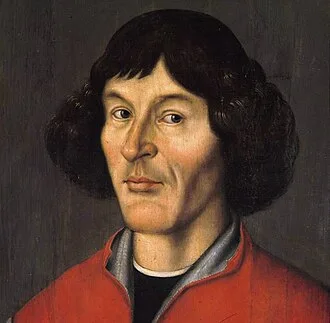
Copernicus was born and died in Royal Prussia, a semi-autonomous and multilingual region created within the Crown of the Kingdom of Poland from lands regained from the Teutonic Order after the Thirteen Years' War.
A polyglot and polymath, he obtained a doctorate in canon law and was a mathematician, astronomer, physician, classics scholar, translator, governor, diplomat, and economist. From 1497 he was a Warmian Cathedral chapter canon. In 1517 he derived a quantity theory of money—a key concept in economics—and in 1519 he formulated an economic principle that later came to be called Gresham's law.
Life
Nicolaus Copernicus was born on 19 February 1473 in the city of Thorn (Toruń), in the province of Royal Prussia, in the Crown of the Kingdom of Poland, to German-speaking parents.
His father was a merchant from Kraków and his mother was the daughter of a wealthy Thorn merchant. Nicolaus was the youngest of four children. His brother Andreas (Andrew) became an Augustinian canon at Frauenburg (Frombork). His sister Barbara, named after her mother, became a Benedictine nun and, in her final years, prioress of a convent in Kulm (Chełmno); she died after 1517.
His sister Katharina married the businessman and Thorn city councilor Barthel Gertner and left five children, whom Copernicus looked after to the end of his life. Copernicus never married and is not known to have had children, but from at least 1531 until 1539 his relations with Anna Schilling, a live-in housekeeper, were seen as scandalous by two bishops of Warmia who urged him over the years to break off relations with his "mistress".
Father's family
Copernicus's father's family originally migrated to Silesia in the thirteenth century. The family can be traced to a village between Nysa (Neiße) and Prudnik (Neustadt). The village's name has been variously spelled Kopernik, Copernik, Copernic, Kopernic, Coprirnik, and modern Koperniki.
In the 14th century, members of the family began moving to various other Silesian cities, to the Polish capital, Kraków (1367), and to Thorn (1400). In 1396, Niklas Koppernigk, the astronomer's great-great-grandfather, became a burgher of Kraków. The father, likewise named Niklas Koppernigk, likely the son of Jan (or Johann), was first recorded in Kraków in 1448.
Nicolaus was named after his father, who appears in records for the first time as a well-to-do merchant who dealt in copper, selling it mostly in Danzig (Gdańsk). He moved from Kraków to Thorn around 1458. Thorn, situated on the Vistula River, was at that time embroiled in the Thirteen Years' War, in which the Kingdom of Poland and the Prussian Confederation, an alliance of Prussian cities, gentry and clergy, fought the Teutonic Order over control of the region.
In this war, Hanseatic cities like Danzig and Thorn, Nicolaus Copernicus's hometown, chose to support the Polish King, Casimir IV Jagiellon, who promised to respect the cities' traditional vast independence, which the Teutonic Order had challenged. Nicolaus's father was actively engaged in the politics of the day and supported Poland and the cities against the Teutonic Order.
In 1454 he mediated negotiations between Poland's Cardinal Zbigniew Oleśnicki and the Prussian cities for repayment of war loans. In the Second Peace of Thorn (1466), the Teutonic Order formally renounced all claims to the conquered lands, which returned to Poland as Royal Prussia and remained part of it until the First (1772) and Second (1793) Partitions of Poland.
Copernicus's father married Barbara Watzenrode, the astronomer's mother, between 1461 and 1464. He died about 1483.
Mother's family
Nicolaus's mother, Barbara Watzenrode, was the daughter of a wealthy Thorn patrician and city councillor, Lucas Watzenrode the Elder (deceased 1462), and Katarzyna (widow of Jan Peckau), mentioned in other sources as Katarzyna Rüdiger gente Modlibóg (deceased 1476). The Modlibógs were a prominent Polish family who had been well known in Poland's history since 1271.
The Watzenrode family, like the Kopernik family, had come from Silesia from near Schweidnitz (Świdnica), and after 1360 had settled in Thorn. They soon became one of the wealthiest and most influential patrician families. Through the Watzenrodes' extensive family relationships by marriage, Copernicus was related to wealthy families of Thorn, Danzig and Elbing (Elbląg), and to prominent Polish noble families of Prussia: the Czapskis, Działyńskis, Konopackis and Kościeleckis.
Lucas and Katherine had three children: Lucas Watzenrode the Younger (1447–1512), who would become Bishop of Warmia and Copernicus's patron; Barbara, the astronomer's mother (deceased after 1495); and Christina (deceased before 1502), who in 1459 married the Thorn merchant and mayor, Tiedeman von Allen.
Lucas Watzenrode the Elder, a wealthy merchant and in 1439–62 president of the judicial bench, was a decided opponent of the Teutonic Knights. In 1453 he was the delegate from Thorn at the Graudenz (Grudziądz) conference that planned the uprising against them. During the ensuing Thirteen Years' War, he actively supported the Prussian cities' war effort with substantial monetary subsidies (only part of which he later re-claimed), with political activity in Thorn and Danzig, and by personally fighting in battles at Łasin (Lessen) and Marienburg (Malbork). He died in 1462.
Lucas Watzenrode the Younger, the astronomer's maternal uncle and patron, was educated at the University of Kraków and at the universities of Cologne and Bologna. He was a bitter opponent of the Teutonic Order, and its Grand Master once referred to him as "the devil incarnate". In 1489 Watzenrode was elected Bishop of Warmia (Ermeland, Ermland) against the preference of King Casimir IV, who had hoped to install his own son in that seat.
As a result, Watzenrode quarreled with the king until Casimir IV's death three years later. Watzenrode was then able to form close relations with three successive Polish monarchs: John I Albert, Alexander Jagiellon, and Sigismund I the Old. He was a friend and key advisor to each ruler, and his influence greatly strengthened the ties between Warmia and Poland proper.
Watzenrode came to be considered the most powerful man in Warmia, and his wealth, connections and influence allowed him to secure Copernicus's education and career as a canon at Frauenburg Cathedral.
Education
Early education
Copernicus's father died around 1483, when the boy was 10. His maternal uncle, Lucas Watzenrode the Younger (1447–1512), took Copernicus under his wing and saw to his education and career. Six years later, Watzenrode was elected Bishop of Warmia. Watzenrode maintained contacts with leading intellectual figures in Poland and was a friend of the influential Italian-born humanist and Kraków courtier Filippo Buonaccorsi.
There are no surviving primary documents on the early years of Copernicus's childhood and education. Copernicus biographers assume that Watzenrode first sent young Copernicus to St. John's School, at Thorn, where he himself had been a master. Later, according to Armitage, the boy attended the Cathedral School at Włocławek, up the Vistula River from Thorn, which prepared pupils for entrance to the University of Kraków.
University of Kraków 1491–1495
In the winter semester of 1491–92 Copernicus, as "Nicolaus Nicolai de Thuronia", matriculated together with his brother Andrew at the University of Kraków. Copernicus began his studies in the Department of Arts (from the fall of 1491, presumably until the summer or fall of 1495) in the heyday of the Kraków astronomical-mathematical school, acquiring the foundations for his subsequent mathematical achievements.
According to a later but credible tradition (Jan Brożek), Copernicus was a pupil of Albert Brudzewski, who by then (from 1491) was a professor of Aristotelian philosophy but taught astronomy privately outside the university; Copernicus became familiar with Brudzewski's widely read commentary to Georg von Peuerbach's Theoricæ novæ planetarum and almost certainly attended the lectures of Bernard of Biskupie and Wojciech Krypa of Szamotuły, and probably other astronomical lectures by Jan of Głogów, Michał of Wrocław (Breslau), Wojciech of Pniewy, and Marcin Bylica of Olkusz.
Mathematical astronomy
Copernicus's Kraków studies gave him a thorough grounding in the mathematical astronomy taught at the university (arithmetic, geometry, geometric optics, cosmography, theoretical and computational astronomy) and a good knowledge of the philosophical and natural-science writings of Aristotle (De coelo, Metaphysics) and Averroes, stimulating his interest in learning and making him conversant with humanistic culture.
Copernicus broadened the knowledge that he took from the university lecture halls with independent reading of books that he acquired during his Kraków years (Euclid, Haly Abenragel, the Alfonsine Tables, Johannes Regiomontanus' Tabulae directionum); to this period, probably, also date his earliest scientific notes, preserved partly at Uppsala University.
At Kraków Copernicus began collecting a large library on astronomy; it would later be carried off as war booty by the Swedes during the Deluge in the 1650s and has been preserved at the Uppsala University Library.
Contradictions in the systems of Aristotle and Ptolemy
Copernicus's four years at Kraków played an important role in the development of his critical faculties and initiated his analysis of logical contradictions in the two "official" systems of astronomy—Aristotle's theory of homocentric spheres, and Ptolemy's mechanism of eccentrics and epicycles—the surmounting and discarding of which would be the first step toward the creation of Copernicus's own doctrine of the structure of the universe.
Warmia, 1495–1496
Without taking a degree, probably in the fall of 1495, Copernicus left Kraków for the court of his uncle Watzenrode, who in 1489 had been elevated to Prince-Bishop of Warmia and soon (before November 1495) sought to place his nephew in the Warmia canonry vacated by the 26 August 1495 death of its previous tenant, Jan Czanow. For unclear reasons—probably due to opposition from part of the chapter, who appealed to Rome—Copernicus's installation was delayed, inclining Watzenrode to send both his nephews to study canon law in Italy, seemingly with a view to furthering their ecclesiastic careers and thereby also strengthening his own influence in the Warmia chapter.
On 20 October 1497, Copernicus, by proxy, formally succeeded to the Warmia canonry which had been granted to him two years earlier. To this, by a document dated 10 January 1503 at Padua, he would add a sinecure at the Collegiate Church of the Holy Cross and St. Bartholomew in Wrocław (at the time in the Crown of Bohemia).
Despite having been granted a papal indult on 29 November 1508 to receive further benefices, through his ecclesiastic career Copernicus not only did not acquire further prebends and higher stations (prelacies) at the chapter, but in 1538 he relinquished the Wrocław sinecure. It is unclear whether he was ever ordained a priest.
Edward Rosen asserts that he was not as does John Farrell writing for Forbes. Copernicus did take minor orders, which sufficed for assuming a chapter canonry. The Catholic Encyclopedia proposes that his ordination was probable, as in 1537 he was one of four candidates for the episcopal seat of Warmia, a position that required ordination.
Italy
University of Bologna, 1496–1501
Meanwhile, leaving Warmia in mid-1496—possibly with the retinue of the chapter's chancellor, Jerzy Pranghe, who was going to Italy—in the fall, possibly in October, Copernicus arrived in Bologna and a few months later (after 6 January 1497) signed himself into the register of the Bologna University of Jurists' "German nation", which included young Poles from Silesia, Prussia and Pomerania as well as students of other nationalities.
During his three-year stay at Bologna, which occurred between fall 1496 and spring 1501, Copernicus seems to have devoted himself less keenly to studying canon law (he received his doctorate in canon law only after seven years, following a second return to Italy in 1503) than to studying the humanities—probably attending lectures by Filippo Beroaldo, Antonio Urceo, called Codro, Giovanni Garzoni, and Alessandro Achillini—and to studying astronomy.
He met the famous astronomer Domenico Maria Novara da Ferrara and became his disciple and assistant. Copernicus was developing new ideas inspired by reading the "Epitome of the Almagest" (Epitome in Almagestum Ptolemei) by George von Peuerbach and Johannes Regiomontanus (Venice, 1496). He verified its observations about certain peculiarities in Ptolemy's theory of the Moon's motion, by conducting on 9 March 1497 at Bologna a memorable observation of the occultation of Aldebaran, the brightest star in the Taurus constellation, by the Moon.
Copernicus the humanist sought confirmation for his growing doubts through close reading of Greek and Latin authors (Pythagoras, Aristarchos of Samos, Cleomedes, Cicero, Pliny the Elder, Plutarch, Philolaus, Heraclides, Ecphantos, Plato), gathering, especially while at Padua, fragmentary historic information about ancient astronomical, cosmological and calendar systems.
Rome 1500
Copernicus spent the jubilee year 1500 in Rome, where he arrived with his brother Andrew that spring, doubtless to perform an apprenticeship at the Papal Curia. Here, too, however, he continued his astronomical work begun at Bologna, observing, for example, a lunar eclipse on the night of 5–6 November 1500. According to a later account by Rheticus, Copernicus also—probably privately, rather than at the Roman Sapienza—as a "Professor Mathematum" (professor of astronomy) delivered, "to numerous ... students and ... leading masters of the science", public lectures devoted probably to a critique of the mathematical solutions of contemporary astronomy.
University of Padua, 1501–1503
On his return journey doubtless stopping briefly at Bologna, in mid-1501 Copernicus arrived back in Warmia. After receiving a two-year extension of leave from the chapter on 28 July to study medicine (since "he may in future be a useful medical advisor to our Reverend Superior [Bishop Lucas Watzenrode] and the gentlemen of the chapter"), he returned to Italy in late summer or autumn, probably accompanied by his brother Andrew and by Canon Bernhard Sculteti.
This time he studied at the University of Padua, famous as a seat of medical learning, and—except for a brief visit to Ferrara in May–June 1503 to pass examinations for, and receive, his doctorate in canon law—he remained at Padua from fall 1501 to summer 1503.
Copernicus studied medicine probably under the direction of leading Padua professors—Bartolomeo da Montagnana, Girolamo Fracastoro, Gabriele Zerbi, Alessandro Benedetti—and read medical treatises that he acquired at this time, by Valescus de Taranta, Jan Mesue, Hugo Senensis, Jan Ketham, Arnold de Villa Nova, and Michele Savonarola, which would form the embryo of his later medical library.
Astrology
One of the subjects that Copernicus must have studied was astrology, since it was considered an important part of a medical education. However, unlike most other prominent Renaissance astronomers, he appears never to have practiced or expressed any interest in astrology.
Greek studies
As at Bologna, Copernicus did not limit himself to his official studies. It was probably the Padua years that saw the beginning of his Hellenistic interests. He familiarized himself with Greek language and culture with the aid of Theodorus Gaza's grammar (1495) and Johannes Baptista Chrestonius's dictionary (1499), expanding his studies of antiquity, begun at Bologna, to the writings of Bessarion, Lorenzo Valla, and others.
There also seems to be evidence that it was during his Padua stay that the idea finally crystallized, of basing a new system of the world on the movement of the Earth. As the time approached for Copernicus to return home, in spring 1503 he journeyed to Ferrara where, on 31 May 1503, having passed the obligatory examinations, he was granted the degree of Doctor of Canon Law (Nicolaus Copernich de Prusia, Jure Canonico ... et doctoratus). No doubt it was soon after (at latest, in fall 1503) that he left Italy for good to return to Warmia.
Planetary observations
Copernicus made three observations of Mercury, with errors of −3, −15 and −1 minutes of arc. He made one of Venus, with an error of −24 minutes. Four were made of Mars, with errors of 2, 20, 77, and 137 minutes. Four observations were made of Jupiter, with errors of 32, 51, −11 and 25 minutes. He made four of Saturn, with errors of 31, 20, 23 and −4 minutes.
Other observations
With Novara, Copernicus observed an occultation of Aldebaran by the Moon on 9 March 1497. Copernicus also observed a conjunction of Saturn and the Moon on 4 March 1500. He saw an eclipse of the Moon on 6 November 1500.
Work
Having completed all his studies in Italy, 30-year-old Copernicus returned to Warmia, where he would live out the remaining 40 years of his life, apart from brief journeys to Kraków and to nearby Prussian cities: Thorn, Danzig, Elbing, Graudenz, Marienburg, Königsberg (Królewiec).
The Prince-Bishopric of Warmia enjoyed substantial autonomy, with its own diet (parliament) and monetary unit (the same as in the other parts of Royal Prussia) and treasury.
Copernicus was his uncle's secretary and physician from 1503 to 1510 (or perhaps until his uncle's death on 29 March 1512) and resided in the Bishop's castle at Heilsberg (Lidzbark), where he began work on his heliocentric theory. In his official capacity, he took part in nearly all his uncle's political, ecclesiastic and administrative-economic duties.
From the beginning of 1504, Copernicus accompanied Watzenrode to sessions of the Royal Prussian diet held at Marienburg and Elbing and, write Dobrzycki and Hajdukiewicz, "participated ... in all the more important events in the complex diplomatic game that ambitious politician and statesman played in defense of the particular interests of Prussia and Warmia, between hostility to the [Teutonic] Order and loyalty to the Polish Crown."
In 1504–1512 Copernicus made numerous journeys as part of his uncle's retinue—in 1504, to Thorn and Danzig, to a session of the Royal Prussian Council in the presence of Poland's King Alexander Jagiellon; to sessions of the Prussian diet at Marienburg (1506), Elbing (1507) and Stuhm (Sztum) (1512); and he may have attended a Poznań (Posen) session (1510) and the coronation of Poland's King Sigismund I the Old in Kraków (1507). Watzenrode's itinerary suggests that in spring 1509 Copernicus may have attended the Kraków sejm.