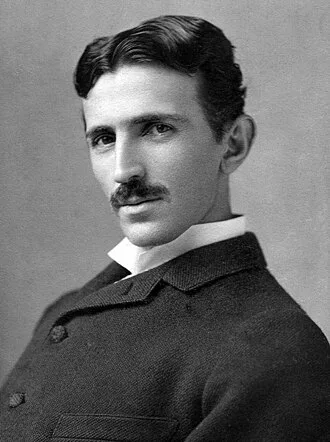
Born and raised in the Austro-Hungarian Empire, Tesla first studied engineering and physics in the 1870s without receiving a degree. He then gained practical experience in the early 1880s working in telephony and at Continental Edison in the new electric power industry. In 1884, he migrated to the United States, where he became a naturalized citizen.
He worked for a short time at the Edison Machine Works in New York City before he struck out on his own. With the help of partners to finance and market his ideas, Tesla set up laboratories and companies in New York to develop a range of electrical and mechanical devices. His AC induction motor and related polyphase AC patents, licensed by Westinghouse Electric in 1888, earned him a considerable amount of money and became the cornerstone of the polyphase system, which Westinghouse marketed.
Tesla conducted a range of experiments with mechanical oscillators/generators, electrical discharge tubes, and early X-ray imaging among other things, in an attempt to develop inventions he could patent and market. He built a wirelessly controlled boat, one of the first wirelessly controlled vehicles ever produced. Tesla became well known as an inventor and demonstrated his achievements to celebrities and wealthy patrons at his lab.
He was noted for his showmanship at public lectures. Throughout the 1890s, Tesla pursued his ideas for wireless lighting and worldwide wireless electric power distribution in his high-voltage, high-frequency power experiments in New York and Colorado Springs. In 1893, he made pronouncements on the possibility of wireless communication with his devices.
Tesla tried to put these ideas to practical use in his unfinished Wardenclyffe Tower project, an intercontinental wireless communication and power transmitter, but ran out of funding before he could complete it.
After Wardenclyffe, Tesla experimented with a series of inventions in the 1910s and 1920s with varying degrees of success. Having spent most of his money, Tesla lived in a series of New York hotels, leaving behind unpaid bills. He died in New York City in January 1943. Tesla's work fell into relative obscurity following his death, until 1960, when the General Conference on Weights and Measures named the International System of Units (SI) measurement of magnetic flux density the tesla in his honor.
There has been a resurgence in popular interest in Tesla since the 1990s. In 2013, Time magazine named him one of the 100 most significant figures of all time.
Early years
Childhood
Tesla was born on 10 July 1856 into a family of ethnic Serbs in Smiljan, a village then in the Military Frontier of the Austrian Empire and now in Croatia. His father, Milutin Tesla (1819–1879), was a priest of the Eastern Orthodox Church. His father's brother Josif was a lecturer at a military academy who wrote several textbooks on mathematics.
Tesla's mother, Georgina "Đuka" Mandić (1822–1892), whose father was also an Eastern Orthodox priest, had a talent for making home craft tools and mechanical appliances and the ability to memorize Serbian epic poems. Đuka had never received a formal education. Tesla credited his eidetic memory and creative abilities to his mother's genetics and influence.
Tesla was the fourth of five children. In 1861, Tesla attended primary school in Smiljan where he studied German, arithmetic, and religion. In 1862, the Tesla family moved to the nearby town of Gospić, where Tesla's father worked as parish priest. Nikola completed primary school, followed by middle school. Later in his patent applications, before he obtained American citizenship, Tesla would identify himself as "of Smiljan, Lika, border country of Austria-Hungary".
In 1870, Tesla moved to Karlovac to attend high school at the Higher Real Gymnasium where the classes were held in German. Tesla later wrote that he became interested in his physics professor's demonstrations of electricity. The "mysterious phenomena" made him want "to know more of this wonderful force". He was able to perform integral calculus in his head, prompting his teachers to believe that he was cheating. He studied three years at the gymnasium, graduating in 1873 at the age of 17.
After graduating, Tesla returned to Smiljan but soon contracted cholera, was bedridden for nine months and was near death several times. In a moment of despair, Tesla's father (who had originally wanted him to enter the priesthood), promised to send him to the best engineering school if he recovered from the illness. Tesla later said that he had read Mark Twain's earlier works while recovering from his illness.
Youth
The next year, Tesla evaded conscription into the Austro-Hungarian Army in Smiljan by running away to Tomingaj, a village in the southeast of Lika, near Gračac. There he explored the mountains wearing hunter's garb. Tesla said that this contact with nature made him stronger, both physically and mentally. He enrolled at the Imperial-Royal Technical College in Graz in 1875 on a Military Frontier scholarship.[citation needed] Tesla passed nine exams (nearly twice as many as required) and received a letter of commendation from the dean of the technical faculty to his father, which stated, "Your son is a star of first rank."[citation needed] At Graz, Tesla was fascinated by the lectures on electricity presented by professor Jakob Pöschl.
But by his third year, he was failing in school and never graduated, leaving Graz in December 1878. One biographer suggests Tesla was not studying and may have been expelled for gambling and womanizing.[citation needed]
Tesla's family did not hear from him after he left school.[citation needed] There was a rumor among his classmates that he had drowned in the nearby river Mur, but in January one of them ran into Tesla in the town of Maribor and reported that encounter to Tesla's family.
It turned out Tesla had been working there as a draftsman for 60 florins per month.[citation needed] In March 1879, Milutin finally located his son and tried to convince him to return home and take up his education in Prague.
Tesla returned to Gospić later that month when he was deported for not having a residence permit. Tesla's father died the next month, on 17 April 1879, at the age of 60 after an unspecified illness.
In January 1880, two of Tesla's uncles paid for him to leave Gospić for Prague, where he was to study.[citation needed] He arrived too late to enroll at Charles-Ferdinand University; he had never studied Greek, a required subject; and he was illiterate in Czech, another required subject.[citation needed] He attended lectures in philosophy at the university as an auditor, but he did not receive grades for the courses.
Tesla moved to Budapest, Hungary, in 1881 to work under Tivadar Puskás at a telegraph company, the Budapest Telephone Exchange.[citation needed] Upon arrival, Tesla realized that the company, then under construction, was not functional, so he worked as a draftsman in the Central Telegraph Office instead.[citation needed] Within a few months, the Budapest Telephone Exchange became functional, and Tesla was allocated the chief electrician position.[citation needed] Tesla later described how he made many improvements to the Central Station equipment including an improved telephone repeater or amplifier.
Working at Edison
In 1882, Tivadar Puskás got Tesla another job in Paris with the Continental Edison Company. Tesla began working in what was then a brand new industry, installing indoor incandescent lighting citywide in large scale electric power utility.[citation needed] The company had several subdivisions and Tesla worked at the Société Electrique Edison, the division in the Ivry-sur-Seine suburb of Paris, in charge of installing the lighting system.[citation needed] There he gained a great deal of practical experience in electrical engineering.
Management took notice of his advanced knowledge in engineering and physics, and soon had him designing and building improved versions of generating dynamos and motors.
Moving to the United States
In 1884, Edison manager Charles Batchelor, who had been overseeing the Paris installation, was brought back to the United States to manage the Edison Machine Works, a manufacturing division situated in New York City, and asked that Tesla be brought to the United States as well. In June 1884, Tesla emigrated and began working almost immediately at the Machine Works on Manhattan's Lower East Side, an overcrowded shop with a workforce of several hundred machinists, laborers, managing staff, and 20 "field engineers" struggling with the task of building the large electric utility in that city. As in Paris, Tesla was working on troubleshooting installations and improving generators.
Historian W. Bernard Carlson notes Tesla may have met company founder Thomas Edison only a couple of times. One of those times was noted in Tesla's autobiography where, after staying up all night repairing the damaged dynamos on the ocean liner SS Oregon, he ran into Batchelor and Edison, who made a quip about their "Parisian" being out all night.
After Tesla told them he had been up all night fixing the Oregon, Edison commented to Batchelor that "this is a damned good man". One of the projects given to Tesla was to develop an arc lamp–based street lighting system. Arc lighting was the most popular type of street lighting but it required high voltages and was incompatible with the Edison low-voltage incandescent system, causing the company to lose contracts in some cities.[citation needed] Tesla's designs were never put into production, possibly because of technical improvements in incandescent street lighting or because of an installation deal that Edison made with an arc lighting company.
Tesla had been working at the Machine Works for a total of six months when he quit. What event precipitated his leaving is unclear. It may have been over a bonus he did not receive, either for redesigning generators or for the arc lighting system that was shelved. Tesla had previous run-ins with the Edison company over unpaid bonuses he believed he had earned.
In his autobiography, Tesla stated the manager of the Edison Machine Works offered a $50,000 bonus to design "twenty-four different types of standard machines", "but it turned out to be a practical joke". Later versions of this story have Thomas Edison himself offering and then reneging on the deal, quipping: "Tesla, you don't understand our American humor".
The size of the bonus in either story has been noted as odd, since Machine Works manager Batchelor was stingy with pay, and the company did not have that amount of cash (equal to $1,791,667 today) on hand. Tesla's diary contains just one comment on what happened at the end of his employment, a note he scrawled across the two pages covering 7 December 1884, to 4 January 1885, saying "Good By to the Edison Machine Works".
Tesla Electric Light and Manufacturing
Soon after leaving the Edison company, Tesla was working on patenting an arc lighting system, possibly the same one he had developed at Edison. In March 1885, he met with patent attorney Lemuel W. Serrell, the same attorney used by Edison, to obtain help with submitting the patents. Serrell introduced Tesla to two businessmen, Robert Lane and Benjamin Vail, who agreed to finance an arc lighting manufacturing and utility company in Tesla's name, the Tesla Electric Light and Manufacturing Company.[citation needed] Tesla worked for the rest of the year obtaining the patents that included an improved DC generator, the first patents issued to Tesla in the US, and building and installing the system in Rahway, New Jersey.
The investors showed little interest in Tesla's ideas for new types of alternating current motors and electrical transmission equipment.[citation needed] After the utility was up and running in 1886, they decided that the manufacturing side of the business was too competitive and opted to simply run an electric utility.
They formed a new utility company, abandoning Tesla's company and leaving the inventor penniless. Tesla even lost control of the patents he had generated, since he had assigned them to the company in exchange for stock. He had to work at various electrical repair jobs and as a ditch digger for $2 per day. Later in life, Tesla recounted that part of 1886 as a time of hardship, writing "My high education in various branches of science, mechanics and literature seemed to me like a mockery".
AC and the induction motor
In late 1886, Tesla met Alfred S. Brown, a Western Union superintendent, and New York attorney Charles Fletcher Peck. The two men were experienced in setting up companies and promoting inventions and patents for financial gain. Based on Tesla's new ideas for electrical equipment, including a thermo-magnetic motor idea, they agreed to back the inventor financially and handle his patents.
Together they formed the Tesla Electric Company in April 1887, with an agreement that profits from generated patents would go 1⁄3 to Tesla, 1⁄3 to Peck and Brown, and 1⁄3 to fund development.
They set up a laboratory for Tesla at 89 Liberty Street in Manhattan, where he worked on improving and developing new types of electric motors, generators, and other devices.
In 1887, Tesla developed an induction motor that ran on alternating current (AC), a power system format that was rapidly expanding in Europe and the United States because of its advantages in long-distance, high-voltage transmission.[citation needed] The motor used polyphase current, which generated a rotating magnetic field to turn the motor (a principle that Tesla claimed to have conceived in 1882). This innovative electric motor, patented in May 1888, was a simple self-starting design that did not need a commutator, thus avoiding sparking and the high maintenance of constantly servicing and replacing mechanical brushes.
Along with getting the motor patented, Peck and Brown arranged to get the motor publicized, starting with independent testing to verify it was a functional improvement, followed by press releases sent to technical publications for articles to run concurrently with the issue of the patent. Physicist William Arnold Anthony (who tested the motor) and Electrical World magazine editor Thomas Commerford Martin arranged for Tesla to demonstrate his AC motor on 16 May 1888 at the American Institute of Electrical Engineers.
Engineers working for the Westinghouse Electric & Manufacturing Company reported to George Westinghouse that Tesla had a viable AC motor and related power system—something Westinghouse needed for the alternating current system he was already marketing. Westinghouse looked into getting a patent on a similar commutator-less, rotating magnetic field-based induction motor developed in 1885 and presented in a paper in March 1888 by Italian physicist Galileo Ferraris, but decided that Tesla's patent would probably control the market.
In July 1888, Brown and Peck negotiated a licensing deal with George Westinghouse for Tesla's polyphase induction motor and transformer designs for $60,000 in cash and stock and a royalty of $2.50 per AC horsepower produced by each motor. Westinghouse also hired Tesla for one year for the large fee of $2,000 ($71,700 in today's dollars) per month to be a consultant at the Westinghouse Electric & Manufacturing Company's Pittsburgh labs.
During that year, Tesla worked in Pittsburgh, helping to create an alternating current system to power the city's streetcars.[citation needed] He found it a frustrating period because of conflicts with the other Westinghouse engineers over how best to implement AC power.[citation needed] Between them, they settled on a 60-cycle AC system that Tesla proposed (to match the working frequency of Tesla's motor), but they soon found that it would not work for streetcars, since Tesla's induction motor could run only at a constant speed.[citation needed] They ended up using a DC traction motor instead.
Market turmoil
Tesla's demonstration of his induction motor and Westinghouse's subsequent licensing of the patent, both in 1888, came at the time of extreme competition between electric companies. The three big firms, Westinghouse, Edison, and Thomson-Houston Electric Company, were trying to grow in a capital-intensive business while financially undercutting each other.
There was even a "war of currents" propaganda campaign underway, with Edison Electric claiming their direct current system was better and safer than the Westinghouse alternating current system and Thomson-Houston sometimes siding with Edison. Competing in this market meant Westinghouse would not have the cash or engineering resources to develop Tesla's motor and the related polyphase system right away.[page needed]
Two years after signing the Tesla contract, Westinghouse Electric was in trouble. The near collapse of Barings Bank in London triggered the financial panic of 1890, causing investors to call in their loans to Westinghouse Electric. The sudden cash shortage forced the company to refinance its debts. The new lenders demanded that Westinghouse cut back on what looked like excessive spending on acquisition of other companies, research, and patents, including the per motor royalty in the Tesla contract.
At that point, the Tesla induction motor had been unsuccessful and was stuck in development.[page needed] Westinghouse was paying a $15,000-a-year guaranteed royalty even though operating examples of the motor were rare and polyphase power systems needed to run it were even rarer.
In early 1891, George Westinghouse explained his financial difficulties to Tesla in stark terms, saying that, if he did not meet the demands of his lenders, he would no longer be in control of Westinghouse Electric and Tesla would have to "deal with the bankers" to try to collect future royalties. The advantages of having Westinghouse continue to champion the motor probably seemed obvious to Tesla and he agreed to release the company from the royalty payment clause in the contract.
Six years later Westinghouse purchased Tesla's patent for a lump sum payment of $216,000 as part of a patent-sharing agreement signed with General Electric (a company created from the 1892 merger of Edison and Thomson-Houston).
New York laboratories
The money Tesla made from licensing his AC patents made him independently wealthy and gave him the time and funds to pursue his own interests. In 1889, Tesla moved out of the Liberty Street shop Peck and Brown had rented and for the next dozen years worked out of a series of workshop/laboratory spaces in Manhattan. These included a lab at 175 Grand Street (1889–1892), the fourth floor of 33–35 South Fifth Avenue (1892–1895), and sixth and seventh floors of 46 & 48 East Houston Street (1895–1902).
Tesla coil
In the summer of 1889, Tesla traveled to the 1889 Exposition Universelle in Paris and learned of Heinrich Hertz's 1886–1888 experiments that proved the existence of electromagnetic radiation, including radio waves. In repeating and then expanding on these experiments, Tesla tried powering a Ruhmkorff coil with a high speed alternator he had been developing as part of an improved arc lighting system but found that the high-frequency current overheated the iron core and melted the insulation between the primary and secondary windings in the coil.
To fix this problem, Tesla came up with his "oscillating transformer", with an air gap instead of insulating material between the primary and secondary windings and an iron core that could be moved to different positions in or out of the coil. Later called the Tesla coil, it would be used to produce high-voltage, low-current, high frequency alternating-current electricity. He would use this resonant transformer circuit in his later wireless power work.
Wireless lighting
After 1890, Tesla experimented with transmitting power by inductive and capacitive coupling using high AC voltages generated with his Tesla coil. He attempted to develop a wireless lighting system based on near-field inductive and capacitive coupling and conducted a series of public demonstrations where he lit Geissler tubes and even incandescent light bulbs from across a stage.
He spent most of the decade working on variations of this new form of lighting with the help of various investors but none of the ventures succeeded in making a commercial product out of his findings.
In 1893 at St. Louis, Missouri, the Franklin Institute in Philadelphia, Pennsylvania and the National Electric Light Association, Tesla told onlookers that he was sure a system like his could eventually conduct "intelligible signals or perhaps even power to any distance without the use of wires" by conducting it through the Earth.
On 30 July 1891, aged 35, Tesla became a naturalized citizen of the United States. In the same year, he patented his Tesla coil. He served as a vice-president of the American Institute of Electrical Engineers from 1892 to 1894, the forerunner of the modern-day Institute of Electrical and Electronics Engineers (IEEE) (along with the Institute of Radio Engineers).