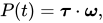
The output power of a motor is the product of the torque that the motor generates and the angular velocity of its output shaft. Likewise, the power dissipated in an electrical element of a circuit is the product of the current flowing through the element and of the voltage across the element.
Definition
Power is the rate at which work is done or energy is transferred. It is given by: where P is power, E is the energy transferred, and t is time.

In terms of work, power is also expressed as: where W is the work done on the system.

We will now show that the mechanical power generated by a force on a body moving at the velocity can be expressed as the product:


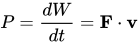
If a constant force is applied throughout a distance , the work done is defined as . In this case, power can be written as:



If instead the force is variable over a three-dimensional curve , then the work is expressed in terms of the line integral:


From the fundamental theorem of calculus, we know that Hence the formula is valid for any general situation.

In older works, power is sometimes called activity.
Units
The dimension of power is energy divided by time. In the International System of Units (SI), the unit of power is the watt (W), which is equal to one joule per second. Other common and traditional measures are horsepower (hp), comparing to the power of a horse; one mechanical horsepower equals about 745.7 watts.
Other units of power include ergs per second (erg/s), foot-pounds per minute, dBm, a logarithmic measure relative to a reference of 1 milliwatt, calories per hour, BTU per hour (BTU/h), and tons of refrigeration.
Average power and instantaneous power
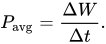
As a simple example, burning one kilogram of coal releases more energy than detonating a kilogram of TNT, but because the TNT reaction releases energy more quickly, it delivers more power than the coal. If ΔW is the amount of work performed during a period of time of duration Δt, the average power Pavg over that period is given by the formula It is the average amount of work done or energy converted per unit of time. Average power is often called "power" when the context makes it clear.
Instantaneous power is the limiting value of the average power as the time interval Δt approaches zero.

When power P is constant, the amount of work performed in time period t can be calculated as

In the context of energy conversion, it is more customary to use the symbol E rather than W.
Mechanical power
Power in mechanical systems is the combination of forces and movement. In particular, power is the product of a force on an object and the object's velocity, or the product of a torque on a shaft and the shaft's angular velocity.
Mechanical power is also described as the time derivative of work. In mechanics, the work done by a force F on an object that travels along a curve C is given by the line integral: where x defines the path C and v is the velocity along this path.

If the force F is derivable from a potential (conservative), then applying the gradient theorem (and remembering that force is the negative of the gradient of the potential energy) yields: where A and B are the beginning and end of the path along which the work was done.

The power at any point along the curve C is the time derivative:

In one dimension, this can be simplified to:
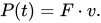
In rotational systems, power is the product of the torque τ and angular velocity ω, where ω is angular frequency, measured in radians per second. The represents scalar product.