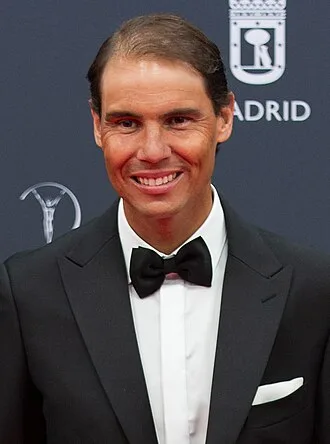
For nearly two decades, Nadal was a leading figure in men's tennis, alongside Roger Federer and Novak Djokovic, collectively known as the Big Three, and including Andy Murray, the Big Four, creating the Golden Era of men's tennis. Early in his career, Nadal became one of the most successful teenagers in ATP Tour history, reaching No. 2 in the world and winning 16 titles before turning 20, including his first major title at the 2005 French Open.
Nadal became the world No. 1 for the first time in 2008 after defeating Federer in a historic Wimbledon final, his first major championship off clay, which he followed with an Olympic singles gold at the 2008 Beijing Olympics. By defeating Djokovic in the 2010 US Open final, Nadal became the then–youngest man in the Open Era to complete a career Grand Slam at 24, and the first man to win majors on three different surfaces in the same year.
Nadal won major singles titles in 10 consecutive years from 2005 to 2014, and again in a four-year span from 2017 to 2020. He also won 11 doubles titles during his career, including an Olympic gold medal at the 2016 Rio Olympics. At the 2022 Australian Open, Nadal surpassed his joint record with Djokovic and Federer for the most Grand Slam men's singles titles, and became one of four men in history to complete the double career Grand Slam in singles. Nadal retired from the sport after playing for Spain in the 2024 Davis Cup Finals.
As a left-handed player, one of Nadal's main strengths was his forehand, delivered with heavy topspin. He frequently ranked among the tour leaders in return games, return points, and break points won. His game was especially well-suited for clay courts, on which came 63 of his 92 singles titles. Nadal won the Stefan Edberg Sportsmanship Award five times and was the Laureus World Sportsman of the Year in 2011 and 2021.
He was named one of Time's 100 most influential people in the world twice in 2009 and 2022. Representing Spain, he won two Olympic gold medals, and led the nation to five Davis Cup titles. Nadal has also opened a tennis academy in Mallorca, and is an active philanthropist.
Nadal was created Marquess of Llevant de Mallorca in 2025 by King Felipe VI of Spain.
Early life
Rafael Nadal Parera was born on 3 June 1986 in Manacor on the island of Mallorca, Spain, to Ana María Parera Femenías and Sebastián Nadal Homar. His father is a businessman who owns an insurance company, a glass and window company, and a restaurant. His mother owned a perfume shop but gave it up to raise Nadal and his younger sister, María Isabel.
One of his uncles, Miguel Ángel Nadal, is a retired professional footballer who played for RCD Mallorca, FC Barcelona, and the Spanish national team. As a child, he idolized Ronaldo, and was given access through his uncle to the Barcelona team dressing room to have a photo taken with the Brazilian. Another uncle, tennis coach Toni Nadal, introduced him to tennis when he was three years old.
Nadal started to play tennis at the Manacor Tennis Club, where Toni worked as a coach, hitting his first few shots with his uncle. At this stage Nadal's passion was football, which he often played on the streets of Manacor with his friends. He began to play tennis more regularly when he was five. Toni quickly realized that his young nephew had both the passion and talent to be a serious player.
Nadal often played tennis in a group, but Toni singled him out during sessions, shouting at him instead of the other kids, and making him pick up the balls and sweep the courts. In his 2011 autobiography, he admitted fearing Toni and dreading solo practice sessions with him. Nadal admitted he sometimes returned home from tennis lessons crying.
At age 8, Nadal won an under-12 regional tennis championship while also being a promising football player. This victory inspired Toni to train Nadal more intensively. After studying Nadal's two-handed forehand, Toni encouraged him to play left-handed for a natural advantage on the tennis court. The transition was purportedly difficult for Nadal, but he was coached through the change by his uncle, who instructed him to try it for 20 minutes per day before gradually increasing that time until he was fully adjusted.
Career
1997–2000: Juniors
Nadal won the Spanish junior championships in 1997 and 1998, beating Ricardo Villacorta and Marcel Granollers respectively. In 1998 Nadal reached the final of the U14 Spanish championship at the age of 12, a feat that remains unmatched, losing to Juan Sanchez de Luna in straight sets. In late 1998, Nadal won the season-ending U12 Junior Masters at Stuttgart, beating future world No. 5 Kevin Anderson in the final.
In February 1998, Nadal competed outside Spain for the first time and won the Open Super 12, an unofficial world championship for U12 players in Auray. He beat 1997 winner Jamie Murray in the final. At the time, Nadal was torn between football and tennis, partly because his uncle Miguel Ángel was preparing to compete in the 1998 FIFA World Cup with Spain.
Nadal said winning the Auray tournament helped him make the decision to "opt for tennis and try an international career". In 1998, when Nadal was runner-up in the U14 event Spanish championship, he was still playing football. Nadal's father insisted he choose between football and tennis to so his schoolwork wouldn't suffer, leading Nadal to quit football.
In 1999, the 12-year-old Nadal was playing in the U14 circuit of the ETA Junior Tour (now the Tennis Europe Junior Tour), winning the Tim Essonne, and finishing the year at No. 69. In 2000, Nadal dominated the U14 circuit, winning Les Petits As in Tarbes, beating Julien Gely in the final, and the European Junior Masters in Prato.
On the day he turned 14, Nadal won the Sport Goofy Trophy in Getxo, beating Granollers in the final. In July, Nadal won the U14 Spanish championships, beating his friend and training partner Tomeu Salvá in the final, despite breaking a finger on his left hand during the first round. As a member of the Spanish national team, Nadal won the 2000 ITF World Junior Championship for players under 14, winning his matches in both singles and doubles (paired with Marcel Granollers) in a 3–0 win over Russia. Nadal ended 2000 at No. 5 of the ETA rankings for U14s.
His junior results secured Nadal a tennis scholarship in Barcelona, and the Spanish tennis federation requested that Nadal move to Barcelona to continue his tennis training. His family turned down this request, partly because they feared his education would suffer, but also because Toni said, "I don't want to believe that you have to go to America or other places to be a good athlete.
You can do it from your home." Nadal already was by then practicing three times a week at Palma with former World No. 1 Carlos Moyá, who later became Nadal's mentor and confidant, and whom Nadal beat in 2000, at the time still a Top-10 player, in an exhibition match. The decision to stay home meant less financial support from the federation; instead, Nadal's father covered the costs.
2001–2002: Pro debut
Nadal turned professional at the beginning of 2001, at the age of 14. He reached the semi-finals of the junior singles event at Wimbledon and helped Spain defeat the US in the final of the Junior Davis Cup.
In early 2001, aged 14, Nadal began playing the qualifying draws of professional tournaments. In May 2001, he defeated former Grand Slam tournament champion Pat Cash in a clay-court exhibition match. Nadal made his pro debut in the main draw at the Futures in Madrid on 11 September 2001, wasting 13 match points against Guillermo Platel-Varas in the opening round.
He received a wild card into the main draw of the Challenger in Seville, his first Challenger tournament, and beat world No. 751 Israel Matos Gil 6–4 6–4 to claim his first pro win and earn the first five ATP points of his career to become world No. 1002. At age 15, Nadal ended 2001 as the world No. 811.
In 2002, Nadal, then ranked No. 762, received a wild card to the ATP 250 event on his home island of Mallorca, where on 29 April, Nadal won his first ATP match by defeating No. 81 Ramón Delgado, and became the ninth player in the Open Era to do so before the age of 16. He did not compete for two months as he studied for school exams and missed the junior French Open in June.
At junior Wimbledon, he reached the semi-finals before losing to Lamine Ouahab. Nadal then won six of the nine Futures events he entered from July until December, including 5 on clay and 1 on hard courts. Nadal finished 2002 with a Futures record of 40–9 in singles and 10–9 in doubles. In October, Nadal defeated No. 76 Albert Montañés in the quarterfinals of a Challenger at Barcelona, before losing to Albert Portas in the semi-finals. Nadal ended 2002 as the world No. 199.
2003: First ATP title, ascend to the top 50
Nadal continued his ascent in early 2003, reaching the finals of Challengers at Hamburg, Cherbourg and Cagliari, and winning at Barletta. He scored a total of 19 Challenger wins in the first three months of the season to find himself inside the Top 150. He then qualified for his second career ATP event, the Monte Carlo Masters, where in the second round he beat the 2002 French Open champion Albert Costa, then ranked No. 7 (his first top 10 career win) and he entered the world's top 100.
Nadal reached his fifth Challenger final of the year in Aix-en-Provence, which he lost to Mariano Puerta. In May, 16-year-old Nadal entered his second Masters event at Hamburg, where he upset No. 4 Carlos Moyá before losing to future French Open Champion Gaston Gaudio in round three. Nadal postponed his French Open debut after injuring his elbow in a fall while training.
He then qualified directly to Wimbledon, having never contested in a major qualifying event before. In his major main draw debut in Wimbledon, Nadal defeated Mario Ančić, and reached the third round to become the youngest man to do so since Boris Becker in 1984.
At Umag, Nadal lost to Moyá in the semi-finals. This was Nadal's only loss at a clay-court semi-final for the next 12 years, as he then began a streak of 52 consecutive wins in semi-final matches on clay that ended at the 2015 Rio Open. Nadal won his first ATP title (doubles or singles) at Umag, partnering Álex López Morón to beat Todd Perry and Thomas Shimada in the final.
Nadal won his second Challenger title of the year in August at Segovia, thus entering the top 50 and winning the ATP Newcomer of the Year Award.
At the US Open, Nadal lost in round two to Younes El Aynaoui. In September, Nadal entered the final Challenger event of his career, on hard courts in Saint-Jean-de-Luz, retiring with an injury against Richard Gasquet, who never defeated Nadal again. Nadal finished the year ranked as the world No. 49.
2004: Davis Cup title
Nadal won Chennai Open doubles, with Tommy Robredo defeating Jonathan Erlich and Andy Ram in the final; Nadal's second doubles title and first on hard courts. In singles, Nadal had his 5th consecutive loss after a first round exit to Thierry Ascione; this remains the worst losing streak of his career. At Auckland he reached the first ATP final of his career, which he lost to Dominik Hrbatý.
Nadal reached the third round of the Australian Open, where he lost in straight sets to former world No. 1 Lleyton Hewitt. Ranked No. 34, Nadal faced No. 1 Roger Federer for the first time in the third round of the Miami Open, winning in straight sets before losing to Fernando González in the fourth round.
At Estoril, Nadal suffered a stress fracture in his left ankle during his round of 16 victory over Richard Gasquet, causing him to miss 3 months of play, the French Open, and Wimbledon. He won his first ATP singles title at the Prokom Open by defeating No. 105 José Acasuso in the final, but won hardly any other match on the tour.
At the US Open, Nadal lost to defending champion Andy Roddick in the second round. In the doubles he and Robredo upset the No. 4 seeds in the third round and reached the semi-finals; Nadal's best performance in a grand slam doubles event.
In the 2004 Davis Cup final, 18-year-old Nadal beat world No. 2 Andy Roddick on clay in Spain to help his nation clinch the title over the United States. In doing so at 18 years and six months of age, he became the youngest player to register a singles victory in a Davis Cup final for a winning nation. Nadal finished the year ranked No. 51, mainly because he missed most of the clay court season.
2005: French Open champion
2005 started with a doubles title alongside Albert Costa at the Qatar Open, defeating Andrei Pavel and Mikhail Youzhny in the final. At the 2005 Australian Open, Nadal lost in the fourth round to eventual runner-up Lleyton Hewitt. Two months later, he reached the final of the 2005 Miami Masters, but was defeated by No. 1 Roger Federer.
He dominated the spring clay-court season. He won 24 consecutive singles matches, breaking Andre Agassi's Open Era record of consecutive match wins for a male teenager. Nadal won the Torneo Conde de Godó in Barcelona defeating the former world No. 1 Juan Carlos Ferrero in the final; which meant he was ranked in the top 10 for the first time in his career.
He then beat 2004 French Open runner-up Guillermo Coria in the finals of the 2005 Monte Carlo Masters and the 2005 Italian Open. These victories raised his ranking to world No. 5 and made him one of the favorites at his career-first French Open. On his 19th birthday, Nadal defeated Federer in the French Open semi-finals, being one of only four players to defeat him that year.
Then he defeated Mariano Puerta in the final, becoming the second man to win the French Open on his first attempt. He also became the first male teenager to win a major singles title since Pete Sampras won the 1990 US Open at age 19. His ranking rose to No. 3.
Three days later, Nadal's 24-match winning streak was snapped in the first round on grass at Halle, Germany, where he lost to No. 147 Alexander Waske. He then lost in the second round of 2005 Wimbledon to No. 69 Gilles Müller. Following his Wimbledon loss, Nadal won 16 consecutive matches and three consecutive tournaments, the Swedish Open, Stuttgart Open, and the Canada Masters, defeating Agassi in the final of the latter to win the first hardcourt title of his career and to bring his ranking to No. 2 on 25 July 2005, where he remained for the next three years behind Roger Federer.
His winning streak ended in the first round of the Cincinnati Open at the hands of Tomáš Berdych. Nadal was seeded second at the 2005 US Open, but was upset in the third round by No. 49 James Blake.
In September, he defeated Coria in the final of the China Open in Beijing and won both of his Davis Cup matches against Italy. In October, he won his fourth Masters title of the year, against Ivan Ljubičić at the 2005 Madrid Masters, his biggest indoor title to this day. A foot injury prevented him from competing in the year-ending Tennis Masters Cup.
Nadal (with 11 titles) broke Mats Wilander's previous teenage season record of nine in 1983. Nadal was awarded ATP Most Improved Player of the Year award.
2006: Back-to-back French Open titles
Nadal missed the Australian Open because of a foot injury. In February, he lost in the semi-finals of Marseille. Two weeks later, he handed Roger Federer his first loss of the year in the final of the Dubai Open, ending Federer's 56-match hard court winning streak. Nadal was then upset in the semi-finals of Indian Wells by James Blake, and in the second round of Miami by Carlos Moyá.
Nadal beat Federer in the final of the Monte Carlo Masters and Tommy Robredo in the Barcelona final. He won the Italian Open beating Federer in a fifth-set tiebreak in the final, after saving two match points, and equaled Björn Borg's tally of 16 ATP titles won as a teenager. At five hours and five minutes, this was the longest match Federer and Nadal ever contested and it is considered to be where their rivalry began in earnest. The New York Times compared it to the Muhammad Ali–Joe Frazier rivalry in boxing.
Nadal then broke Argentinian Guillermo Vilas's 29-year male record of 53 consecutive clay-court match victories by beating Robin Söderling in the first round of the French Open. Nadal beat Novak Djokovic in the quarterfinals, the first-ever meeting of their historic rivalry. He won the final over Federer to become the first player to beat Federer in a major final.
At Wimbledon, Nadal beat No. 20 Andre Agassi in Agassi's last ever match at Wimbledon. Nadal won his next three matches to reach his first Wimbledon final (the first Spanish man since Manuel Santana in 1966 to reach the Wimbledon final). Federer won the final and his fourth consecutive Wimbledon title.
Nadal was upset in the third round of the Rogers Cup in Toronto and in the quarterfinals of Cincinnati by Juan Carlos Ferrero. At the US Open he lost in the quarterfinals to No. 54 Mikhail Youzhny.
Nadal played only three tournaments for the remainder of the year. Joachim Johansson, ranked No. 690, upset Nadal in the second round of the Stockholm Open and he lost to Tomáš Berdych in the quarterfinals of the Madrid Masters. During the round-robin stage of the year-ending Tennis Masters Cup, Nadal lost to James Blake but defeated Nikolay Davydenko and Robredo.
Nadal qualified for the semi-finals, where he lost to Federer. This was Nadal's third loss in nine career matches with Federer.
2007: French Open Three-peat
At the Australian Open, Nadal lost in the quarterfinals to eventual runner-up Fernando González. After another quarterfinal loss at Dubai, he won Indian Wells after beating Novak Djokovic in the final, before losing to Djokovic in the quarterfinals of Miami.