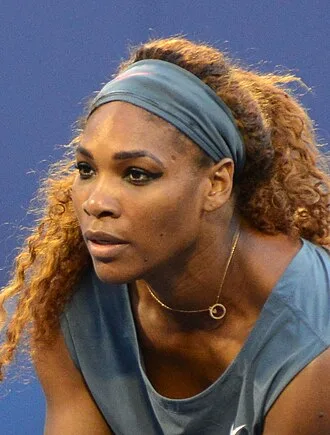
Along with her elder sister Venus, Serena Williams was coached by her parents Oracene Price and Richard Williams. Turning professional in 1995, she won her first major singles title at the 1999 US Open. From the 2002 French Open to the 2003 Australian Open she was dominant, winning all four major singles titles consecutively (each time over Venus in the final) to achieve a non-calendar year Grand Slam (nicknamed the "Serena Slam").
After injuries, Williams returned to dominance in 2012, claiming Olympic gold (completing the career Golden Slam in singles) and winning eight out of thirteen singles majors, including all four in a row in 2014–2015 to achieve a second "Serena Slam". At the 2017 Australian Open, she won her 23rd major singles title, surpassing Steffi Graf's Open Era record.
Williams also won 23 WTA Tour-level doubles titles, including 14 major women's doubles championships, all with her sister Venus. The pair was undefeated in major doubles finals, earning the best unbeaten record in major finals in any discipline of the sport. The sisters achieved a non-calendar year Grand Slam between the 2009 Wimbledon Championships and the 2010 French Open.
Williams won four Olympic gold medals, three in women's doubles—an all-time joint record in tennis, shared with her sister. The duo are the only women in the Open Era to win Olympic gold in both singles and doubles. Williams also won two mixed doubles majors, both in 1998. She is the only player, male or female, to complete three career Golden Slams—one in women's singles and two in women's doubles. In 2020, the Tennis Channel ranked her as the greatest women's tennis player of all time.
Early life
Williams was born on September 26, 1981, in Saginaw, Michigan, to Oracene Price and Richard Williams. She is the youngest of Price's five daughters, after half-sisters Yetunde, Lyndrea, and Isha Price, and full sister Venus. She also has at least seven paternal half-siblings. When Serena and Venus were young, Richard moved the family to Compton, California, over the objections of his wife.
Richard had studied sports success stories, and believed that the rough environment of Compton would toughen up Serena and Venus in preparation for their future tennis careers. Richard home-schooled Serena and Venus, and Serena started playing tennis at the age of four. While Serena's parents have been her official coaches, her other mentors have included Richard Williams, a Compton man who shared her father's name and subsequently founded The Venus and Serena Williams Tennis Tutorial Academy.
When Williams was nine, the family moved from Compton to West Palm Beach, Florida, so Serena and Venus could attend the tennis academy of Rick Macci, who provided her with additional coaching. Macci did not always agree with Richard's approach to coaching and training, but respected that "he treated his daughters like kids, allowed them to be little girls".
By 1991, Williams had a 46–3 record on the United States Tennis Association junior tour and was ranked No. 1 among under-10 players in Florida. When Williams was 10, Richard stopped sending his daughters to national junior tennis tournaments, as he wanted them to "go slowly" and focus on school, and because he wanted to ensure they would not burn out before turning professional.
Experiences of racism also influenced this decision, as he had heard white parents talk about his daughters in a derogatory manner during tournaments.
In 1995, when Williams was in the ninth grade, her father pulled his daughters out of Macci's academy and took over all coaching at their home.
Professional career
1995–1998: Professional debut
Williams's parents initially wanted their daughter to wait until she was 16 to participate in professional tournaments. In 1995, just after turning 14, Williams planned to make her professional debut as a wild-card entry in the Bank of the West Classic in Oakland, California, but was denied due to age-eligibility restrictions.
She subsequently filed an antitrust lawsuit against the WTA, but withdrew it at her parents' request. Her first professional event was in October 1995 at the Bell Challenge in Quebec, where she used a wild-card entry to circumvent age-eligibility rules. She lost in the first qualifying round to 18-year-old American Annie Miller.
After not playing in 1996, Williams won her first main-draw match at the Ameritech Cup Chicago in November 1997. Ranked No.304, she upset No.7 Mary Pierce and No.4 Monica Seles, recording her first career wins against top 10 players and becoming the lowest-ranked player in the Open Era to defeat two top-10 opponents in one tournament.
She ultimately lost in the semifinals to No.5 Lindsay Davenport. Her run in Chicago propelled Williams into the Top 100 for the first time in her career, and she finished 1997 ranked No.99 in the world.
At the 1998 Sydney International, Williams defeated No.3 Davenport in the quarterfinals, before losing to Arantxa Sánchez Vicario in the semifinals. Williams's first main draw of a Grand Slam tournament was at the Australian Open, where she defeated sixth-seeded Irina Spîrlea in the first round, before losing to Venus in the second round in the sisters' first professional face-off.
Williams reached six other quarterfinals during the year, but lost all of them, including her first match against No.1-ranked Martina Hingis. She lost in the fourth round of the French Open to Vicario, and in the third round of the US Open to Spîrlea. She withdrew from Wimbledon two games into a match after straining a calf muscle.
After losing the French Open mixed doubles final to Venus and Justin Gimelstob, Williams won the mixed doubles titles at Wimbledon and the US Open with Max Mirnyi. Williams won her first professional title in non-mixed doubles at the U.S. National Indoor Championships in Oklahoma City with Venus, which made them the third pair of sisters to win a WTA title.
Williams finished the year ranked No.20 in singles, the fastest achievement of that milestone in women's history.
1999: First major and becoming a top-5 player
In February 1999, Williams won her first professional singles title when she defeated Amélie Mauresmo in the final of the Open Gaz de France in Paris. In March, Williams won her first WTA 1000 event at the Evert Cup in California, defeating Steffi Graf in the final. At the Miami Masters, Williams had her 16-match winning streak ended by her sister in the first all-sister singles final in WTA history.
In the doubles event at the French Open, she and Venus won the title after defeating Hingis and Anna Kournikova in the final.
Williams missed Wimbledon in 1999 due to injury. When she returned to the tour two months later, she made her Fed Cup debut, defeating Rita Grande to send the United States to the final. She then won her third title at the JPMorgan Chase Open. At the US Open, Williams defeated Grand Slam champions Kim Clijsters, Conchita Martínez, Monica Seles, and defending champion Lindsay Davenport to reach the final, where she defeated No.1-ranked Hingis.
Williams became the second African-American woman to win a Grand Slam singles tournament, after Althea Gibson. The Williams sisters also won the doubles event at this tournament, making Serena the fifth woman in the Open Era to win both singles and doubles at the same major event. To complete her 1999 season, Williams won a doubles match against Russia in the Fed Cup final to help the US win the title.
Williams ended the year ranked at a career-high world No.4, in just her second full year on the main tour.
2000–2001: Olympic gold, US Open final, and Indian Wells boycott
In 2000, Williams failed to defend her titles in Paris and Indian Wells, although she did win the Faber Grand Prix in Germany. Soon afterwards, she missed the French Open due to injury. She recovered and played at the Wimbledon Championships, where she lost to Venus in the semifinals; however, the pair won the doubles title.
Her defense of the US Open title ended when she lost in the quarterfinals to Davenport. Williams and her sister won the gold medal in doubles at the Sydney Olympics that September, and Williams ended the year by winning the Toyota Princess Cup and finishing at No.6.
Williams began 2001 by losing to Hingis in the quarterfinals of both the Medibank International and the Australian Open. However, she and Venus won the doubles event at the Australian Open, becoming only the fifth doubles team in history to win all four Grand Slam women's doubles titles during their career, completing a "Career Grand Slam".
Williams's next event was the Pacific Life Open in Indian Wells, where she defeated Clijsters in the final. During the tournament, Richard Williams stated that racist comments were made to him by spectators. As a result, both Serena and Venus pledged to boycott the event, even though it was a mandatory stop on the WTA tour; Serena's boycott lasted until 2015.
Williams claimed her second title of the year at the Rogers Cup, defeating Jennifer Capriati in the final. In September, Williams lost to her sister in the final of the US Open, which was the first Grand Slam tournament final played by two sisters during the Open Era. Williams finished 2001 at No.6 for the second straight year.
2002–2003: "Serena Slam"
Early in 2002, Williams retired from the semifinal at the Medibank International Sydney due to injury, and later withdrew from the Australian Open. After recovering, Williams won her first title of the year in Scottsdale, Arizona, defeating No.2 Capriati, in the final. She then won the Miami Masters for the first time after beating No.3 Hingis in the quarterfinals, No.2 Venus in the semifinals, and No.1 Capriati in the final, becoming only the second player in the Open Era to defeat the world's top 3 ranked players at the same event.
In May, Williams won her first clay-court title at the Italian Open, which raised her ranking to a new high of No.3. She then claimed her first French Open title, which elevated her to No.2, second only to Venus. During the summer, Williams won Wimbledon for the first time, defeating Venus in the final. The victory propelled her to No.1, making her the third African American woman to hold the top ranking. The Williams sisters also won the doubles event at the tournament.
At the US Open, Williams reached the final where, for the third Grand Slam in a row, she defeated her sister to win the title. Williams won two consecutive singles titles in the fall, defeating Clijsters to win the Toyota Princess Cup in Tokyo, and Anastasia Myskina to win the Sparkassen Cup in Leipzig. She reached the final at the Home Depot Championships in Los Angeles, where she lost to Clijsters in straight sets.
Williams finished 2002 with a 56–5 win/lose record, eight singles titles, and the No.1 ranking. Her three consecutive Grand Slam titles in 2002 made her only the third player in history to win the "Surface Slam" after Martina Navratilova and Steffi Graf.
At the 2003 Australian Open, Williams faced Venus for the fourth consecutive Grand Slam tournament final. She defeated her sister and became the sixth woman in the Open Era to complete a Career Grand Slam, alongside Graf, Navratilova, Margaret Court, Chris Evert and Billie Jean King. She also became the fifth woman to hold all Grand Slam singles titles simultaneously, a feat which was dubbed the "Serena Slam" by the press. At this tournament, the Williams sisters also won their sixth Grand Slam doubles title as a team.
During the spring of 2003, Williams captured the singles titles at the Open Gaz de France and the Sony Ericsson Open. Her streak of 21 wins ended when she lost the final of the Family Circle Cup to Henin. She also lost to Mauresmo in the semifinals of the Internazionali BNL d'Italia in Rome. Despite these defeats, Williams was the top seed at the French Open, where she lost in the semifinals to eventual champion Henin; this was Williams's first loss in a Grand Slam tournament since 2001.
The match was controversial, with Williams questioning Henin's sportsmanship, and spectators applauding Williams's errors. Williams rebounded from this loss at Wimbledon, where she defeated Venus in the final. Wimbledon was her last tournament of 2003; she pulled out of three events and then underwent surgery on her knee.
2004–2007: Injuries and comeback
After eight months away from tennis, Williams began her comeback at the NASDAQ-100 Open in March 2004, where she won the title for the third consecutive year. Although ranked No.7, Williams was seeded second at the French Open, where she lost to Capriati in the quarterfinals. A few weeks later, Williams was seeded first at Wimbledon, even though her ranking had dropped to No.10.
She was defeated in the final by Maria Sharapova. The loss caused her to drop below No.10 for the first time since 1999.
Williams was seeded third at the 2004 US Open, where she faced Capriati in the quarterfinals. During the match, umpire Mariana Alves made a call that favored Capriati, but subsequent video review showed that her call was incorrect. Williams argued with Alves over several other calls during the match, which Capriati eventually won.
Williams acknowledged that her loss was primarily due to her 57 unforced errors, but she nevertheless felt "cheated" and accused Alves of temporary insanity. The controversy renewed calls for, and was widely given credit for, the adoption of new technology such as the MacCAM and Hawk-Eye systems.
Williams won her second title of the year at the China Open in September, defeating Svetlana Kuznetsova in the final. At the Tour Championships in Los Angeles, Williams suffered an abdominal injury in the finals, where she lost to Sharapova. Williams finished 2004 ranked No.7, but did not win a Grand Slam singles tournament for the first season since 2001.
Following Venus's early exit from the 2005 Australian Open, Serena rejected suggestions that she and her sister were a declining force in tennis. She defeated the top seed Davenport to win the tournament, claiming her second Australian Open trophy and seventh Grand Slam singles title. The victory moved her back to No.2.
She missed the French Open due to an ankle injury, but played at Wimbledon as the 4th-seed; she was eliminated in the third round. At the US Open, Williams lost to her sister in the fourth round. Williams failed to qualify for the WTA year-end championship for the first time since 1998, and she finished 2005 ranked No.11.
Williams made her 2006 debut at the Australian Open, defending her title. After she lost to Daniela Hantuchová in the third round, she told the press that she was injured. In her biography, Williams wrote that she was suffering from depression during this time. She stayed away from tennis for six months during the 2006 season, and began seeing a therapist daily.
After a chance meeting with a young girl who idolized Williams and believed in her, Williams signed up to play in Cincinnati in July, her first tournament since January. She had slipped to No.139, her lowest ranking since 1997. On her return, Williams defeated Anastasia Myskina and Bethanie Mattek, before losing in the semifinals to Vera Zvonareva.
She also reached the semifinals in Los Angeles, losing to Janković in straight sets. Williams was granted a wildcard to enter the US Open, where she lost to Amélie Mauresmo in the fourth round. Williams finished the year ranked No.95, her lowest year-end ranking since 1997.
Williams began 2007 with renewed confidence. She stated her intention to return to the top of the rankings, a goal that was labeled "deluded" by commentator Pat Cash. Leading up to the Australian Open, Williams was widely regarded as "out of shape", and at No.81 she was unseeded at the tournament. Shortly before her first match, a representative from Nike told her the company might cancel her sponsorship if she did not perform at her customary level. Williams claimed that Nike's ultimatum meant she would have to reach the quarterfinals at least.
The Nike situation did not distract Williams, as she lost just three games to Mara Santangelo and defeated Anne Kremer in straight sets. By this point, a blister had developed on her foot and she had contracted a cold. In the third round, Williams found herself two points away from losing to Nadia Petrova, but she fought back to win in three sets.
She then made it to the final, defeating Jelena Janković, Shahar Pe'er and Nicole Vaidišová along the way. Williams speculated that the players she defeated "didn't expect an overweight, out-of-shape, has-been champion ... to give them a game." Commentator Tracy Austin said she expected Sharapova to easily defeat Williams in the final.
Williams thought the commentary was mean, and it motivated her to triumph over Sharapova while losing just three games. It was Williams's first tournament title in two years, and she became the first player since Chris O'Neil to capture the Australian Open title without being seeded. The victory, which elevated her to No.14, was her third Australian Open title and eighth career Grand Slam singles title. Williams dedicated the achievement to her deceased half-sister Yetunde.
Her performance in the final was described in the press as one of the best performances of her career, and "arguably the most powerful display ever seen in women's tennis". Williams won the Sony Ericsson Open in Miami for the fourth time by defeating Henin, but then lost to Henin during the quarterfinals in three consecutive Grand Slam tournaments: the French Open, Wimbledon and the US Open.
Williams reached the final of the Kremlin Cup, but lost to Elena Dementieva. She qualified for the WTA Championships, but retired from her first match with a knee injury and subsequently withdrew from the event. Williams finished 2007 as No.7 and the top-ranked American for the first time since 2003.
2008–2010: Injuries, controversy, and return to No. 1
Williams started 2008 by winning the Hopman Cup for the US, with Mardy Fish. At the Australian Open, she lost in the quarterfinals to Janković, her fourth straight loss in the quarterfinals of a Grand Slam singles tournament. In the women's doubles event, she and Venus were defeated in the quarterfinals. Williams withdrew from her next three scheduled tournaments because of an urgent need for dental surgery.
She then won three consecutive singles titles at Bangalore and her fifth Miami title, tying Graf for the most singles titles at this tournament. She claimed victory at the Family Circle Cup, her first clay-court title since 2002. Her 17-match winning streak was ended by Dinara Safina in the quarterfinals in Berlin. Williams withdrew in Rome in the quarterfinals due to a back injury, and lost in the third round of the French Open to Katarina Srebotnik.
At Wimbledon, Williams reached the finals for the first time in four years, but lost to Venus in their first Grand Slam final since 2003. Serena and Venus teamed up and won the doubles title, however. Williams played at Stanford, but retired in the semifinals with a knee injury, which also forced her to withdraw from a tournament in Los Angeles.
During the Summer Olympics in Beijing, Williams lost to Dementieva in the singles quarterfinals, but she and Venus won the gold medal in doubles. In early September, Williams captured her third US Open title, which was also her ninth Grand Slam singles title. The victory returned her to No.1 for the first time since 2003.
At the year-end championships, she defeated Safina and lost to Venus in round-robin matches, but withdrew from a match against Dementieva, citing a stomach muscle injury. She ended 2008 ranked No.2 and with four singles titles, her strongest performance in both respects since 2003.
Williams began 2009 at the Medibank International, losing in the semifinals to Dementieva. At the Australian Open, she claimed her tenth Grand Slam singles title by defeating Safina. This win restored her No.1 ranking and made her the all-time career prize money leader in women's sports, a title previously held by golfer Annika Sörenstam.
Serena and Venus also won the doubles event at the Australian Open for the third time. At the Open GdF Suez, Williams withdrew before her semifinal match against Dementieva because of a knee injury. She then played in Dubai, losing to Venus in the semifinals.