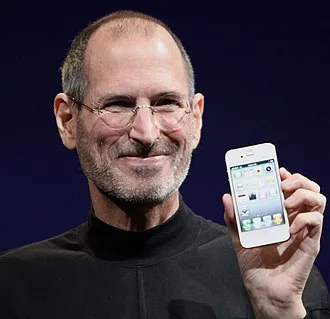
Jobs was born in San Francisco in 1955 and adopted shortly afterward. He attended Reed College in 1972 before withdrawing that same year. In 1974, he traveled through India, seeking enlightenment before later studying Zen Buddhism. He and Wozniak co-founded Apple in 1976 to further develop and sell Wozniak's Apple I personal computer.
Together, the duo gained fame and wealth a year later with the production and sale of the Apple II, one of the first highly successful mass-produced microcomputers.
Jobs saw the commercial potential of the Xerox Alto in 1979, which was mouse-driven and had a graphical user interface (GUI). This led to the development of the largely unsuccessful Apple Lisa in 1983, followed by the breakthrough Macintosh 128K in 1984, the first mass-produced computer with a GUI. The Macintosh launched the desktop publishing industry in 1985 (for example, the Aldus PageMaker) with the addition of the Apple LaserWriter, the first laser printer to feature vector graphics and PostScript.
In 1985, Jobs departed Apple after a long power struggle with the company's board and its then-CEO, John Sculley. That same year, Jobs took some Apple employees with him to found NeXT, a computer platform development company that specialized in computers for higher education and business markets, serving as its CEO. In 1986, he bought the computer graphics division of Lucasfilm, which was spun off independently as Pixar.
Pixar produced the first computer-animated feature film, Toy Story (1995), and became a leading animation studio, producing dozens of commercially successful and critically acclaimed films.
In 1997, Jobs returned to Apple as CEO after the company acquired NeXT. He was largely responsible for reviving Apple, which was on the verge of bankruptcy. He worked closely with British designer Jony Ive to develop a line of products and services that had larger cultural ramifications, beginning with the "Think different" advertising campaign and leading to the iMac, iTunes, Mac OS X, Apple Store, iPod, iTunes Store, iPhone, App Store, and iPad.
Jobs was also a member of the board of directors at Gap Inc. from 1999 to 2002. In 2003, Jobs was diagnosed with a pancreatic neuroendocrine tumor. He died of tumor-related respiratory arrest in 2011; in 2022, he was posthumously awarded the Presidential Medal of Freedom. Since his death, he has been granted 141 patents; Jobs holds over 450 patents in total.
Early life and education
Family
Steven Paul Jobs was born in San Francisco, California, on February 24, 1955, to Joanne Carole Schieble and Dr. Abdulfattah "John" Jandali (Arabic: عبد الفتاح الجندلي). Abdulfattah Jandali was born in Syria into a wealthy Muslim household, the youngest of nine siblings.
After obtaining his undergraduate degree at the American University of Beirut in Lebanon, Jandali pursued a PhD in political science at the University of Wisconsin. There, he met Joanne Schieble, an American Catholic of Swiss-German descent whose parents owned a mink farm and real estate in Green Bay. The two fell in love but faced opposition from Schieble's father due to Jandali's Muslim faith.
When Schieble became pregnant, she arranged for a closed adoption, and travelled to San Francisco to give birth.
Schieble requested that her son be adopted by college graduates. A lawyer and his wife were selected, but they withdrew after discovering that the baby was a boy, so Jobs was instead adopted by Paul Reinhold Jobs and his wife, Clara. Paul Jobs, an American of German descent, was the son of a dairy farmer from Washington County, Wisconsin.
After dropping out of high school, Paul Jobs worked as a mechanic, then joined the US Coast Guard. After he was discharged in San Francisco, Paul married Clara Hagopian, of Armenian descent, in February 1946, and they moved to Wisconsin, then to Indiana, where Paul worked as a machinist and later as a car salesman. Since Clara missed San Francisco, she convinced Paul to move back.
There, Paul worked as a repossession agent, and Clara became a bookkeeper. In 1955, after having an ectopic pregnancy, the couple looked to adopt a child. Since they lacked a college education, Schieble initially refused to sign the adoption papers and went to court to request that her son be removed from the Jobs household and placed with a different family but changed her mind after Paul and Clara promised to pay for their son's college tuition.
Infancy
In his youth, Jobs's parents took him to a Lutheran church. When Steve was in high school, Clara admitted to Steve's girlfriend, Chrisann Brennan, that she "was too frightened to love [Steve] for the first six months of his life ... I was scared they were going to take him away from me. Even after we won the case, Steve was so difficult a child that by the time he was two I felt we had made a mistake.
I wanted to return him." When Chrisann shared this comment with Steve, he stated that he was already aware, and later said that he had been deeply loved and indulged by Paul and Clara. Jobs would "bristle" when Paul and Clara were referred to as his "adoptive parents", and he regarded them as his parents "1,000%". Jobs referred to his biological parents as "my sperm and egg bank. That's not harsh, it's just the way it was, a sperm bank thing, nothing more."
Childhood
I always thought of myself as a humanities person as a kid, but I liked electronics... then I read something that one of my heroes, Edwin Land of Polaroid, said about the importance of people who could stand at the intersection of humanities and sciences, and I decided that's what I wanted to do.
Paul Jobs worked in several jobs that included a try as a machinist, several other jobs, and then "back to work as a machinist". Paul and Clara adopted Jobs's sister Patricia in 1957, and by 1959 the family had moved to the Monta Loma neighborhood in Mountain View, California. Paul built a workbench in his garage for his son in order to "pass along his love of mechanics".
Jobs, meanwhile, admired his father's craftsmanship "because he knew how to build anything. If we needed a cabinet, he would build it. When he built our fence, he gave me a hammer so I could work with him ... I wasn't that into fixing cars ... but I was eager to hang out with my dad."
Jobs had difficulty functioning in a traditional classroom, tended to resist authority figures, frequently misbehaved, and was suspended a few times. He frequently played pranks on others at Monta Loma Elementary School in Mountain View. His father Paul (who was abused as a child) never reprimanded him, however, and instead blamed the school for not challenging his brilliant son.
Jobs skipped the 5th grade and transferred to the 6th grade at Crittenden Middle School in Mountain View, where he became a "socially awkward loner". Jobs was often "bullied" at Crittenden Middle, and in the middle of 7th grade, he gave his parents an ultimatum: either they would take him out of Crittenden or he would drop out of school.
The Jobs family was not affluent, and only by expending all their savings were they able to buy a new home in 1967, allowing Steve to change schools. The new house (a three-bedroom home on Crist Drive in Los Altos, California) was in the better Cupertino School District, in Cupertino, California. The house was declared a historic site in 2013, as the first site of Apple Computer.
As of 2013[update], it was owned by Jobs's sister, Patty, and occupied by his stepmother, Marilyn. When he was 13, in 1968, Jobs was given a summer job by Bill Hewlett (of Hewlett-Packard) after Jobs cold-called him to ask for parts for an electronics project.
Homestead High
The location of the Los Altos home meant that Jobs would be able to attend nearby Homestead High School, which had strong ties to Silicon Valley. He began his first year there in late 1968 along with Bill Fernandez, who introduced Jobs to Steve Wozniak, and would become Apple's first employee. Neither Jobs nor Fernandez (whose father was a lawyer) came from engineering households and thus decided to enroll in John McCollum's Electronics I class.
Jobs had grown his hair long and become involved in the growing counterculture, and the rebellious youth eventually clashed with McCollum and lost interest in the class.
Jobs underwent a change during mid-1970. He later noted to his official biographer that "I started to listen to music a whole lot, and I started to read more outside of just science and technology — Shakespeare, Plato. I loved King Lear ... when I was a senior I had this phenomenal AP English class. The teacher was this guy who looked like Ernest Hemingway.
He took a bunch of us snowshoeing in Yosemite." During his last two years at Homestead High, Jobs developed two different interests: electronics and literature. These dual interests were particularly reflected during Jobs's senior year, as his best friends were Wozniak and his first girlfriend, the artistic Homestead junior Chrisann Brennan.
In 1971, after Wozniak began attending University of California, Berkeley, Jobs would visit him there a few times a week. This experience led him to study in nearby Stanford University's student union. Instead of joining the electronics club, Jobs put on light shows with a friend for Homestead's avant-garde jazz program.
He was described by a Homestead classmate as "kind of brain and kind of hippie ... but he never fit into either group. He was smart enough to be a nerd, but wasn't nerdy. And he was too intellectual for the hippies, who just wanted to get wasted all the time. He was kind of an outsider. In high school everything revolved around what group you were in, and if you weren't in a carefully defined group, you weren't anybody.
He was an individual, in a world where individuality was suspect." By his senior year in late 1971, he was taking a freshman English class at Stanford and working on a Homestead underground film project with Chrisann Brennan.
Around that time, Wozniak designed a low-cost digital "blue box" to generate the necessary tones to manipulate the telephone network, allowing free long-distance calls. He was inspired by an article titled "Secrets of the Little Blue Box" from the October 1971 issue of Esquire. Jobs decided then to sell them and split the profit with Wozniak.
The clandestine sales of the illegal blue boxes went well and perhaps planted the seed in Jobs's mind that electronics could be both fun and profitable. In a 1994 interview, he recalled that it took six months for him and Wozniak to design the blue boxes. Jobs later reflected that had it not been for Wozniak's blue boxes, "there wouldn't have been an Apple". He states it showed them that they could take on large companies and beat them.
By his senior year of high school, Jobs began using LSD. He later recalled that on one occasion he consumed it in a wheat field outside Sunnyvale, and experienced "the most wonderful feeling of my life up to that point". In mid-1972, after graduation and before leaving for Reed College, Jobs and Brennan rented a house from their other roommate, Al.
Reed College
In September 1972, Jobs enrolled at Reed College in Portland, Oregon. He insisted on applying only to Reed, although it was an expensive school that Paul and Clara could ill afford. Jobs soon befriended Robert Friedland, who was Reed's student body president at that time. Brennan remained involved with Jobs while he was at Reed.
I was interested in Eastern mysticism which hit the shores about then. At Reed there was a constant flow of people stopping by – from Timothy Leary and Richard Alpert, to Gary Snyder. There was a constant flow of intellectual questioning about the truth of life. That was the time when every college student in the country read Be Here Now and Diet for a Small Planet.
After just one semester, Jobs dropped out of Reed College without telling his parents. Jobs later explained this was because he did not want to spend his parents' money on an education that seemed meaningless to him. He continued to attend by auditing his classes, including a course on calligraphy that was taught by Robert Palladino.
In a 2005 commencement speech at Stanford University, Jobs stated that during this period, he slept on the floor in friends' dorm rooms, returned Coke bottles for food money, and got weekly free meals at the local Hare Krishna temple. In that same speech, Jobs said: "If I had never dropped in on that single calligraphy course in college, the Mac would have never had multiple typefaces or proportionally spaced fonts".
Business career
1974–1985
I was lucky to get into computers when it was a very young and idealistic industry. There weren't many degrees offered in computer science, so people in computers were brilliant people from mathematics, physics, music, zoology, whatever. They loved it, and no one was really in it for the money [...] There are people around here who start companies just to make money, but the great companies, well, that's not what they're about.
Pre-Apple
In February 1974, Jobs returned to his parents' home in Los Altos and began looking for a job. He was soon hired by Atari, Inc. in Los Gatos, California, as a computer technician. Back in 1973, Steve Wozniak designed his own version of the classic video game Pong and gave its electronics board to Jobs. According to Wozniak, Atari only hired Jobs because he brought the board to the company, and they thought he had built it himself.
Atari's cofounder Nolan Bushnell later described him as "difficult but valuable", pointing out that "he was very often the smartest guy in the room, and he would let people know that".
Jobs traveled to India in mid-1974 to visit Neem Karoli Baba at his Kainchi ashram with his Reed College friend and eventual Apple employee Daniel Kottke, searching for spiritual teachings. When they got to the Neem Karoli ashram, it was almost deserted because Neem Karoli Baba had died in September 1973. Then, they made a long trek up a dry riverbed to an ashram of Haidakhan Babaji.
After seven months, Jobs left India and returned to the US ahead of Daniel Kottke. Jobs had changed his appearance; his head was shaved, and he wore traditional Indian clothing. During this time, Jobs experimented with psychedelics, later calling his LSD experiences "one of the two or three most important things [he had] done in [his] life". He spent a period at the All One Farm, a commune in Oregon that was owned by Robert Friedland.
During this period, Jobs and Brennan both became practitioners of Zen Buddhism under the guidance of the Zen master Kōbun Chino Otogawa. Jobs engaged in lengthy meditation retreats at the Tassajara Zen Mountain Center, the oldest Sōtō Zen monastery in the US. He considered taking up monastic residence at Eihei-ji in Japan, and maintained a lifelong appreciation for Zen, Japanese cuisine, and artists such as Hasui Kawase.
Jobs returned to Atari in early 1975, and that summer, Bushnell assigned him to create a circuit board for the arcade video game Breakout in as few chips as possible, knowing that Jobs would recruit Wozniak for help. During his day job at HP, Wozniak drew sketches of the circuit design; at night, he joined Jobs at Atari and continued refining it, which Jobs implemented on a breadboard.
According to Bushnell, Atari offered $100 (equivalent to about $600 in 2025) for each TTL chip that was eliminated in the machine. Jobs made a deal with Wozniak to split the fee evenly between them if Wozniak could minimize the number of chips. Much to the amazement of Atari engineers, within four days, Wozniak reduced the TTL count to 45, far below the usual 100, though Atari later re-engineered it to make it easier to test and add a few missing features.
According to Wozniak, Jobs told him that Atari paid them only $750 (instead of the actual $5,000), and that Wozniak's share was thus $375. Wozniak did not learn about the actual bonus until ten years later but said that if Jobs had told him about it and explained that he needed the money, Wozniak would have given it to him.
Jobs and Wozniak attended meetings of the Homebrew Computer Club in 1975, which was a stepping stone to the development and marketing of the first Apple computer. According to a document released by the United States Department of Defense, Jobs claimed that in 1975, he was arrested in Eugene, Oregon, after being questioned for being a minor in possession of alcohol.
Jobs alleged that he "didn't have any alcohol", but police questioned him and subsequently determined that he had an outstanding arrest warrant for an unpaid speeding ticket. Jobs claimed he then paid the $50 fine. The arrest allegedly occurred "behind a store".
Apple (1976–1985)
Basically Steve Wozniak and I invented the Apple because we wanted a personal computer. Not only couldn't we afford the computers that were on the market, those computers were impractical for us to use. We needed a Volkswagen. The Volkswagen isn't as fast or comfortable as other ways of traveling, but the VW owners can go where they want, when they want and with whom they want. The VW owners have personal control of their car.
By March 1976, Wozniak completed the basic design of the Apple I computer and showed it to Jobs, who suggested that they sell it; Wozniak was at first skeptical of the idea but later agreed. In April of that same year, Jobs, Wozniak, and administrative overseer Ronald Wayne founded Apple Computer Company (now called "Apple Inc.") as a business partnership in Jobs's parents' Crist Drive home on April 1, 1976.
The operation originally started in Jobs's bedroom and later moved to the garage. Wayne stayed briefly, leaving Jobs and Wozniak as the active primary cofounders of the company.
The two decided on the name "Apple" after Jobs returned from the All One Farm commune in Oregon and told Wozniak about his time in the farm's apple orchard. Jobs originally planned to produce bare printed circuit boards of the Apple I and sell them to computer hobbyists for $50 (equivalent to about $280 in 2025) each.
To fund the first batch, Wozniak sold his HP scientific calculator and Jobs sold his Volkswagen van. Later that year, computer retailer Paul Terrell purchased 50 fully assembled Apple I units for $500 each. Eventually, about 200 Apple I computers were produced in total.
A neighbor on Crist Drive recalled Jobs as an odd individual who would greet his clients "with his underwear hanging out, barefoot and hippie-like". Another neighbor, Larry Waterland, who had just earned his PhD in chemical engineering at Stanford, recalled dismissing Jobs's budding business compared to the established industry of giant mainframe computers with big decks of punch cards: "Steve took me over to the garage.
He had a circuit board with a chip on it, a DuMont TV set, a Panasonic cassette tape deck and a keyboard. He said, 'This is an Apple computer.' I said, 'You've got to be joking.' I dismissed the whole idea." Jobs's friend from Reed College and India, Daniel Kottke, recalled that as an early Apple employee, he "was the only person who worked in the garage ...
Woz would show up once a week with his latest code. Steve Jobs didn't get his hands dirty in that sense." Kottke also stated that much of the early work took place in Jobs's kitchen, where he spent hours on the phone trying to find investors for the company.
They received funding from semi-retired Intel product marketing manager and engineer Mike Markkula. Scott McNealy, one of the cofounders of Sun Microsystems, said that Jobs broke a "glass age ceiling" in Silicon Valley because he'd created a very successful company at a young age. Markkula brought Apple to the attention of Arthur Rock, who, after looking at the crowded Apple booth at the Home Brew Computer Show, started with a $60,000 investment and went on the Apple board.
Jobs was not pleased when Markkula recruited Mike Scott from National Semiconductor in February 1977 to serve as the first president and CEO of Apple.
For what characterizes Apple is that its scientific staff always acted and performed like artists – in a field filled with dry personalities limited by the rational and binary worlds they inhabit, Apple's engineering teams had passion. They always believed that what they were doing was important and, most of all, fun.
Working at Apple was never just a job; it was also a crusade, a mission, to bring better computer power to people. At its roots, that attitude came from Steve Jobs. It was "Power to the People", the slogan of the sixties, rewritten in technology for the eighties and called Macintosh.
After Brennan returned from her own journey to India, she and Jobs fell in love again, as Brennan noted changes in him that she attributes to Kobun (whom she was also still following). It was also at this time that Jobs displayed a prototype Apple II computer to Brennan and his parents in their living room. Brennan notes a shift in this time period, where the two main influences on Jobs were Apple Inc. and Kobun.
In April 1977, Jobs and Wozniak introduced the Apple II at the West Coast Computer Faire. It is the first consumer product to have been sold by Apple Computer. Primarily designed by Wozniak, Jobs oversaw the development of its unusual case and Rod Holt developed the unique power supply. During the design stage, Jobs argued that the Apple II should have two expansion slots, while Wozniak wanted eight.
After a heated argument, Wozniak threatened that Jobs should "go get himself another computer". They later agreed on eight slots. The Apple II became one of the first highly successful mass-produced microcomputer products in the world.