















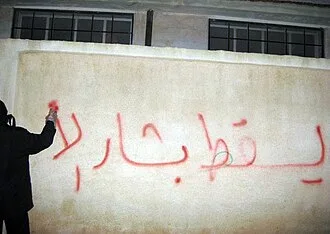
The Syrian opposition to Bashar al-Assad began as an insurgency, forming groups such as the Free Syrian Army (FSA). Anti-Assad forces received arms and training from Qatar, Turkey, a United States-led program, and others. Pro-Assad forces received financial and military support from Iran, Russia, and Hezbollah: Iran launched a military intervention in support of the Syrian government in 2013, and Russia followed in 2015.
By this time, rebels had established the Syrian Interim Government after capturing the regional capitals of Raqqa in 2013 and Idlib in 2015. Use of chemical weapons during the war, predominantly by Syrian government forces, was the deadliest since the Iran–Iraq War. The Ghouta sarin attack was followed by unsuccessful international attempts to eliminate Syria's chemical weapons through military action or diplomacy.
In 2014, the Islamic State (IS) seized control over Eastern Syria and Western Iraq, prompting a United States-led coalition to launch an aerial bombing campaign against the IS, while providing ground support and supplies to the Syrian Democratic Forces (SDF), a Kurdish-dominated coalition led by the People's Defense Units (YPG). In 2016, Turkey launched an invasion of northern Syria in response to the creation of the Kurdish-led Autonomous Administration of North and East Syria (Rojava), while also establishing the Syrian National Army (SNA) to help it fight ISIS and pro-Assad forces.
The 2016 victory of the Syrian Arab Army (SAA) and other pro-Assad forces in the four-year Battle of Aleppo marked the recapture of what had been Syria's largest city before the war. In Idlib Governorate, the Hay'at Tahrir al-Sham (HTS) militia formed the Syrian Salvation Government, a technocratic, Islamist administration that governed the region from 2017 until 2024.
Meanwhile, IS was territorially defeated in the Syrian Desert, Central Syria, Raqqa, and Deir ez-Zor campaigns. In December 2019, the SAA and its allies launched an offensive on Idlib province, which resulted in a ceasefire lasting from 2020 until November 2024. During this period, there were regular clashes between pro-Assad forces and HTS.
HTS launched a major offensive in November 2024, joined by the SNA. Aleppo fell in three days as the SAA began to collapse, giving momentum to revolutionaries across the country. HTS soon captured Hama and began to advance south towards Homs. Southern rebels and the Syrian Free Army launched their own offensive, capturing Daraa, Suwayda, and Palmyra.
On 8 December, Bashar al-Assad fled to Moscow as Homs fell to HTS while southern rebels entered Damascus. Assad's prime minister remained in Damascus and transferred power to a provisional government. Israel launched an invasion of Syria's Quneitra Governorate (including the UN buffer zone) from its 58-year occupation of the Syrian Golan Heights.
At the Syrian Revolution Victory Conference held at the Presidential Palace in Damascus in January 2025, the new government announced the dissolution of several armed militias and their integration into the Syrian Ministry of Defense, as well as the appointment of former HTS leader Ahmed al-Sharaa as president of Syria. Later that year, a Druze insurgency formed in the southern Suweida Governorate following clashes with the government and alleged sectarian violence.
Overview
The Syrian civil war was fought by several factions from 2011 to December 2024. The Syrian Arab Armed Forces, alongside its domestic and foreign allies, represented the Syrian Arab Republic ruled by Bashar al-Assad's Ba'athist government. As the civil war continued, alternative governments rose in opposition to Assad's rule, such as the Syrian Interim Government (SIG), a big-tent alliance of pro-democratic, nationalist opposition groups whose armed forces consisted of the Syrian National Army (SNA) and allied Free Syrian militias.
Another anti-Assad faction was the Syrian Salvation Government (SSG), whose armed wing was represented by a coalition of nationalist and Sunni Islamist militias led by Hay'at Tahrir al-Sham (HTS). Independent of the SIG and SSG was the Autonomous Administration of North and East Syria (AANES), also known as Rojava, whose military force is the Syrian Democratic Forces (SDF), a multi-ethnic, Arab-majority force led by the Kurdish People's Defense Units (YPG).
Other competing factions included jihadist organizations such as the Islamic State (IS) and al-Qaeda's Syrian branch Hurras al-Din (the successor of Al-Nusra Front).
The civil war also served as a proxy war as foreign countries–including Iran, Russia, Turkey and the United States–became directly involved in the conflict, providing support to opposing factions. Iran, Russia and Lebanese Hezbollah supported Assad's government militarily, with Iran intervening in 2013 and Russia conducting airstrikes and ground operations in the country beginning in September 2015.
In 2014, the US-led international coalition officially began conducting air and ground operations–primarily against the Islamic State, al-Qaeda elements such as Hurras al-Din and the Khorasan group and occasionally against pro-Assad forces–and militarily and logistically supporting factions such as the SDF and the Syrian Free Army.
Turkish forces occupied parts of northern Syria and fought the SDF, Assad government and Islamic State alike while actively supporting the SNA. Between 2011 and 2017, fighting from the Syrian civil war spilled over into neighboring Lebanon as opponents and supporters of the Syrian government traveled there to attack each other on Lebanese soil.
While officially neutral, Israel exchanged border fire and conducted repeated attacks against Hezbollah and Iranian elements inside Syria, whose presence in the country it viewed as a security threat.
Violence in the war peaked during 2012–2017 amid rebel and government ground offensives alongside sectarian and Islamist violence. By 2019 the Islamic State in Syria had been forced into an insurgency after years of territorial and personnel loss due to clashing with most other factions, including opposing jihadist groups, Assad's forces and allies, Kurdish conquest and US-led operations.
International organizations accused virtually all belligerents involved—the Assad government, the Islamic State, opposition groups, Iran, Russia, Turkey and the US-led coalition—of severe human rights violations and massacres. The conflict caused a major refugee crisis, with millions of people fleeing to neighboring countries such as Turkey, Lebanon and Jordan; however, a sizable minority also sought refuge in countries outside of the Middle East, with Germany alone accepting over half a million Syrians from 2011 to 2019.
Numerous peace initiatives were launched since the start of the war, including several led by the United Nations, but fighting continued.
After the 2020 Idlib ceasefire, frontline clashes between Syrian government and rebel forces mostly subsided and the war effectively became a stalemate, although sporadic clashes and minor skirmishes between opposing factions continued. From 2021 to late 2024, Assad was consolidating power and slowly reversing the diplomatic isolation resulting from the war, however this was halted after lightning offensives by opposition groups across the country successfully collapsed his regime and caused him to flee to Russia.
The civil war concluded with the creation of a new provisional government which integrated elements of both the SIG and SSG alternative governments. The transitional government, led by Ahmed al-Sharaa, would go on to experience lower-level fighting within the country in the aftermath of the war, while also overseeing reconstruction efforts and reinventing the country's diplomatic standing.
Background
Assad government
- Early life
- Family
- Assadism
- Foreign policy
- Presidential trips
- Tenth Five-Year Plan
- Occupation of Lebanon
- Cedar Revolution
- Damascus Spring
- Statement of 99
- Statement of 1000
- Damascus Declaration
- Operation Outside the Box
- Corruption
- Arab Spring
- Syrian revolution
- Arab–Israeli conflict
- War against ISIS
- COVID-19 pandemic
- Regime fall
- Fall of Damascus (2024)
- Proposed handover to Syria
- Mero I
- Mero II
- Al-Otari
- Safar
- Hijab
- Al-Halqi I
- Al-Halqi II
- Khamis
- Arnous I
- Arnous II
- Jalali
- 2000
- 2007
- 2014
- 2021


The Arab Socialist Ba'ath Party government came to power through a coup d'état in 1963 by overthrowing the Second Syrian Republic. A second coup in 1966 ousted the old Baathist leadership of Michel Aflaq, replacing it with a militaristic, hard-left, pro-Soviet regime led by Salah Jadid, causing a split between the Syrian branch of Ba'ath, which supported Jadid, and the Iraqi branch, which remained loyal to Aflaq.
Jadid was in turn removed in November 1970 by General Hafez al-Assad, an Alawite who declared himself President in March 1971. This marked the beginning of the domination of personality cults centred around the Assad family that pervaded all aspects of Syrian daily life and was accompanied by a systematic suppression of civil and political freedoms, becoming the central feature of state propaganda.
Authority in Ba'athist Syria was monopolised by three power-centres: Alawite loyalist clans, the Ba'ath Party and the Syrian Armed Forces. All three united by their allegiance to the Assad family.
The Syrian Regional Branch remained the dominant political authority in what had been a one-party state until the first multi-party election to the People's Council of Syria was held in 2012. On 31 January 1973, Hafez al-Assad implemented a new constitution, leading to a national crisis. The 1973 Constitution entrusted the Arab Socialist Ba'ath Party with the distinctive role as the "leader of the state and society", empowering it to mobilise the civilians for party programmes, issue decrees to ascertain their loyalty and supervise all legal trade unions.
Ba'athist ideology was imposed upon children as a compulsory part of school curricula as the Armed Forces became highly monitored by the Party. The constitution removed Islam from being recognised as the state religion and stripped existing provisions such as the requirement that the president of Syria be Muslim. These measures caused widespread furor amongst the public, leading to fierce demonstrations in Hama, Homs and Aleppo organized by the Muslim Brotherhood and the ulama.
The Assad regime violently crushed the Islamic revolts that occurred during 1976–1982, waged by revolutionaries from the Syrian Muslim Brotherhood.
The Ba'ath Party carefully constructed Assad as the guiding father figure of the party and modern Syrian nation, advocating the continuation of Assad dynastic rule of Syria. As part of the publicity efforts to brand the nation and Assad family as inseparable, slogans such as "Assad or we burn the country", "Assad or to hell with the country" and "Hafez Assad, forever" became an integral part of the state and party discourse during the 1980s.
Eventually the party organisation itself became a rubber stamp and the power structures became deeply dependent on sectarian affiliation to the Assad family and the central role of armed forces needed to crack down on dissent in the society. Critics of the regime have pointed out that deployment of violence is central to the rule of Ba'athist Syria and describe it as "a dictatorship with genocidal tendencies".
Hafez al-Assad's nearly three-decade rule was marked by its methods, ranging from censorship to violent measures of state terror such as mass murders, forced deportations and brutal practices such as torture, which were unleashed collectively upon the civilian population. Upon Hafez al-Assad's death in 2000, his son Bashar al-Assad succeeded him as the president of Syria.