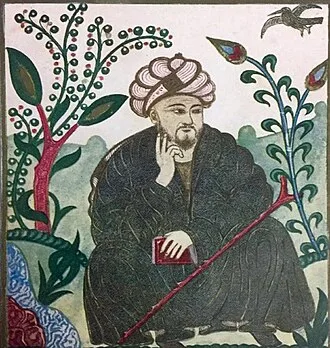
Al-Farabi's fields of philosophical interest included—but were not limited to—philosophy of society and religion; philosophy of language and logic; psychology and epistemology; metaphysics, political philosophy, and ethics. He was an expert in both practical musicianship and music theory, and although he was not intrinsically a scientist, his works incorporate astronomy, mathematics, cosmology, and physics.
Al-Farabi is credited as the first Muslim who presented philosophy as a coherent system in the Islamic world, and created a philosophical system of his own, which went far beyond the scholastic interests of his Greco-Roman Neoplatonism and Syriac Aristotelian precursors. That he was more than a pioneer in Islamic philosophy is evident from later writers calling him the "Second Master", with Aristotle as the first.
Philosophers influenced by Al-Farabi include Yahya ibn Adi, Abu Sulayman Sijistani, Abu al-Hassan al-Amiri, and Abu Hayyan al-Tawhidi; Avicenna, Suhrawardi, and Mulla Sadra; Avempace, Ibn Tufail, and Averroes; Maimonides, Albertus Magnus, and Leo Strauss. He was known in the Latin West, as well as the Islamic world.
Biography
The existing variations in the basic accounts of al-Farabi's origins and pedigree indicate that they were not recorded during his lifetime or soon thereafter by anyone with concrete information, but were based on hearsay or guesses (as is the case with other contemporaries of al-Farabi). Little is known about his life.
Early sources include an autobiographical passage where al-Farabi traces the history of logic and philosophy up to his time, and brief mentions by al-Masudi, Ibn al-Nadim and Ibn Hawqal. Said al-Andalusi wrote a biography of al-Farabi. Arabic biographers of the 12th–13th centuries thus had few facts to hand, and used invented stories about his life.
From incidental accounts it is known that he spent significant time (most of his scholarly life) in Baghdad with Syriac Christian scholars, including the cleric Yuhanna ibn Haylan, Yahya ibn Adi, and Abu Ishaq Ibrahim al-Baghdadi. He later spent time in Damascus and in Egypt before returning to Damascus where he died in 950–951.
His name was Abu Nasr Muhammad ibn Muhammad al-Farabi, sometimes with the family surname al-Tarkhani, i.e., the element Tarkhan appears in a nisba. His grandfather was not known among his contemporaries, but a name Awzalagh, in Arabic, suddenly appears later in the writings of Ibn Abi Usaybi'a, and of his great-grandfather in those of Ibn Khallikan.
His birthplace could have been any one of the many places in Central Asia—then known by the name of Khurasan. The word farab is a Persian term for a locale that is irrigated by effluent springs or flows from a nearby river. Thus, there are many places that carry the name (or various evolutions of that toponym) in that general area, such as Farab (Otrar) on the Jaxartes (Syr Darya) in modern Kazakhstan; Farab, an still-extant village in suburbs of the city of Chaharjuy/Amul (modern Türkmenabat) on the Oxus Amu Darya in Turkmenistan, on the Silk Road, connecting Merv to Bukhara, or Faryab in Greater Khorasan (modern day Afghanistan).
The older Persian Parab (in Hudud ul-'alam) or Faryab (also Paryab), is a common Persian toponym meaning "lands irrigated by diversion of river water".
Background
While some scholars claim that his ethnic background is not knowable, others describe him as being of either Persian or Turkic origin. Medieval Arab historian Ibn Abi Usaibia (died in 1270)—one of al-Farabi's oldest biographer—mentions in his Uyun that al-Farabi's father was of Persian descent. Al-Shahrazuri, who lived around 1288 and has written an early biography, also states that al-Farabi hailed from a Persian family.
According to Majid Fakhry, an Emeritus Professor of Philosophy at Georgetown University, al-Farabi's father "was an army captain of Persian extraction." A Persian origin has been stated by many other sources as well. Dimitri Gutas, Emeritus Professor at Yale University, notes that Farabi's works contain references and glosses in Persian, Sogdian, and even Greek, but not Turkish.
Sogdian has also been suggested as his native language and the language of the inhabitants of Farab. Muhammad Javad Mashkoor argues for an Iranian-speaking Central Asian origin. According to Christoph Baumer, he was probably a Sogdian.
According to Thérèse-Anne Druart, writing in 2020:
"Scholars have disputed his ethnic origin. Some claimed he was Turkish but more recent research points to him being a Persian."
The oldest known reference to a Turkic origin is given by the medieval historian Ibn Khallikan (died in 1282), who in his work Wafayat (completed in 669/1271) states that al-Farabi was born in the small village of Wasij near Farab (in what is today Otrar, Kazakhstan) of Turkic parents. Based on this account, some scholars say he is of Turkic origin.
Dimitri Gutas, an American Arabist, criticizes this, saying that Ibn Khallikan's account is aimed at the earlier historical accounts by Ibn Abi Usaybi'a, and serves the purpose to "prove" a Turkic origin for al-Farabi, for instance by mentioning the additional nisba (surname) "al-Turk" (arab. "the Turk")—a nisba al-Farabi never had.
However, Abu al-Feda, who copied Ibn Khallekan, changed al-Torkī to the phrase "wa-kana rajolan torkiyan", meaning "he was a Turkish man." In this regard, since works of such supposed Turks lack traces of Turkic nomadic culture, Oxford professor C.E. Bosworth notes that "great figures [such] as Farabi, Biruni, and Avicenna have been attached by over enthusiastic Turkish scholars to their race".
Life and education
Al-Farabi spent most of his scholarly life in Baghdad. In the autobiographical passage preserved by Ibn Abi Usaybi'a, al-Farabi stated that he had studied logic, medicine and sociology with Yuhanna ibn Haylan up to and including Aristotle's Posterior Analytics, i.e., according to the order of the books studied in the curriculum, al-Farabi was claiming that he had studied Porphyry's Eisagoge and Aristotle's Categories, De Interpretatione, Prior and Posterior Analytics.
His teacher, Yuhanna bin Haylan, was a Nestorian cleric. This period of study was probably in Baghdad, where al-Mas'udi records that Yuhanna died during the reign of al-Muqtadir (295-320/908-32). In his Appearance of Philosophy (Fī Ẓuhūr al-Falsafa), al-Farabi tells us:
Philosophy as an academic subject became widespread in the days of the Ptolemaic kings of the Greeks after the death of Aristotle in Alexandria until the end of the woman’s reign [i.e., Cleopatra’s]. The teaching of it continued unchanged in Alexandria after the death of Aristotle through the reign of thirteen kings ...
Thus it went until the coming of Christianity. Then the teaching came to an end in Rome while it continued in Alexandria until the king of the Christians looked into the matter. The bishops assembled and took counsel together on which parts of [philosophy] teaching were to be left in place and which were to be discontinued.
They formed the opinion that the books on logic were to be taught up to the end of the assertoric figures [Prior Analytics, I.7] but not what comes after it, since they thought that would harm Christianity. Teaching the rest [of the logical works] remained private until the coming of Islam when the teaching was transferred from Alexandria to Antioch.
There it remained for a long time until only one teacher was left. Two men learned from him, and they left, taking the books with them. One of them was from Harran, the other from Merw. As for the man from Marw, two men learned from him..., Ibrahim al-Marwazi and Yuhanna ibn Haylan. [Al-Farabi then says he studied with Yuhanna ibn Haylan up to the end of the Posterior Analytics].
He was in Baghdad at least until the end of September 942, as recorded in notes in his Mabādeʾ ārāʾ ahl al-madīna al-fāżela. He finished the book in Damascus the following year (331), i.e., by September 943). He also lived and taught for some time in Aleppo. Al-Farabi later visited Egypt, finishing six sections summarizing the book Mabādeʾ, in Egypt in 337/July 948 – June 949 when he returned to Syria, where he was supported by Sayf al-Dawla, the Hamdanid ruler.
Al-Mas'udi, writing barely five years after the fact (955-6, the date of the composition of the Tanbīh), says that al-Farabi died in Damascus in Rajab 339 (between 14 December 950 and 12 January 951).
Religious beliefs
Al-Farabi's religious affiliation within Islam is disputed by scholars. While some historians identify him as Sunni, some others assert he was Shia or influenced by Shia. Fauzi Najjar argues that al-Farabi's political philosophy was influenced by Shiite sects. Giving a positive account, Nadia Maftouni describes Shi'ite aspects of al-Farabi's writings.
As she put it, al-Farabi in his al-Millah, al-Siyasah al-Madaniyah, and Tahsil al-Sa’adah believes in a utopia governed by Prophet and his successors: the Imams.
Works and contributions
Al-Farabi made contributions to the fields of logic, mathematics, music, philosophy, psychology, and education.
Alchemy
Al-Farabi wrote The Necessity of the Art of the Elixir on alchemy. Al-Farabi lived during the time when alchemy was at its peak, with alchemists seeking to turn cheap metals into gold or silver whilst seeking the Philosopher's stone. Al-Farabi himself tried to prove that alchemy was a significant science and a necessity for societal advancement: he believed in the "significant benefit in revealing the essence of certain chemical processes and compounds, if it is guided by scientific principles and does not pretend to be impossible." However, al-Farabi diverged from the previous alchemist's way of thinking, claiming that there are no analogs of gold and silver:
There are common gold and silver that we all know about, no more gold and silver exists. If we find any other gold, it will not look like the gold we see. We need some simple logic here. The ignorant person believes that gold and silver can make from ordinary stone. However, an educated person would never believe such a lie.
According to Farabi, to better understand the craft of alchemy, it is necessary to study it completely, and first of all better start from studying mineralogy. Before studying mineralogy, you need to study Philosophy. A comprehensive study of all aspects of philosophy reveals the true nature of things and leads to absolute wisdom. He believes that only a philosopher can achieve absolute wisdom.
Al-Farabi studies the treatises of Aristotle and other scientists and provided two new ideas for the time: firstly, al-Farabi said that gold, silver, and other precious metal were melt rather than burnt, and secondly, the difference between substances of the identical type is based on accidents, meaning any two different materials of the same kind differ in accidents and any of them can merge into each other. Al-Farabi therefore concluded that the views of prior alchemists were wrong.
Logic
Though he was mainly an Aristotelian logician, he included a number of non-Aristotelian elements in his works. He discussed the topics of future contingents, the number and relation of the categories, the relation between logic and grammar, and non-Aristotelian forms of inference. He is also credited with categorizing logic into two separate groups, the first being "idea" and the second being "proof".
Al-Farabi also considered the theories of conditional syllogisms and analogical inference, which were part of the Stoic tradition of logic rather than the Aristotelian. Another addition al-Farabi made to the Aristotelian tradition was his introduction of the concept of "poetic syllogism" in a commentary on Aristotle's Poetics.
Music
Al-Farabi wrote a book on music titled Kitab al-Musiqi al-Kabir (The Great Book of Music). In it, he presents philosophical principles about music, its cosmic qualities, and its influences, and discusses the therapeutic effects of music on the soul.
He moreover talks about its impact on speech, clarifying how actually to fit music to speech, i.e., poetry, in arrange to upgrade the meaning of a text. Al-Farabi determined that different kinds of music produce different effects on the soul. He details these effects across multiple chapters, ranging from music's origins itself to the effects of instruments played.
The Great Book of Music has been recognized as being of "utmost importance" for the Middle East, due its coverage of diverse aspects of musical arts, its description of the construction of maqams prevalent in al-Farabi's time, the various philosophical principles introduced regarding Islamic musical culture, and the cosmic qualities of music.
Al-Farabi notes that music borrows principles from mathematics, theorizing that music performance and the art of hearing were ideal judges for determining the validity of certain theoretical propositions. This applies even if, in some instances, the musical outcome contradicts more concrete mathematical calculations.
Philosophy
As a philosopher, al-Farabi was a founder of his own school of early Islamic philosophy known as "Farabism" or "Alfarabism", though it was later overshadowed by Avicennism. Al-Farabi's school of philosophy "breaks with the philosophy of Plato and Aristotle [... and ...] moves from metaphysics to methodology, a move that anticipates modernity", and "at the level of philosophy, Farabi unites theory and practice [... and] in the sphere of the political he liberates practice from theory".
His Neoplatonic theology is also more than just metaphysics as rhetoric. In his attempt to think through the nature of a First Cause, Farabi discovers the limits of human knowledge". However, both the Greeks (Plato & Aristotle) and Al-Farabi share the common concern with truth in their philosophical approach. The difference is that Plato and Aristotle ground their metaphysical worldview with the understanding of human life as it related to ultimate philosophical truths, while al-Farabi pursuits the truth as the ultimate goal in itself.
Al-Farabi's philosophy is a broader trend within Islamic philosophy, evident in the ontological and epistemological outlooks of the tradition.
Al-Farabi had great influence on science and philosophy for several centuries, and was widely considered second only to Aristotle in knowledge (alluded to by his title of the "Second Teacher"), in his time. His work, aimed at synthesis of philosophy and Sufism, paved the way for the work of Avicenna.
Al-Farabi also wrote a commentary on Aristotle's work, and one of his most notable works is Ara Ahl al-Madina al-Fadila. Al-Farabi argued that religion rendered truth through symbols and persuasion, and, like Plato, saw it as the duty of the philosopher to provide guidance to the state. He incorporated the Platonic view to create a theoretical model of an ideal state ruled by an abstract "Prophet-Imam" or "First Ruler." It is crucial to note that Al-Farabi never explicitly claimed in his philosophical writings that the historical figure of Muhammad was this perfect leader, nor did he ever state that the city of Medina was the ideal state.
While traditional commentators often assume he was implicitly referring to Muhammad and Medina, scholars emphasize that his deliberate omission of these specific historical names was intended to establish a universal philosophical ideal, leaving it open to interpretation whether any historical figure actually met his strict philosophical criteria.
In the absence of the Prophet-Imam, al-Farabi considered democracy as the closest to the ideal state, regarding the order of the Sunni Rashidun Caliphate as an example of such a republican order within early Muslim history. However, he also maintained that it was from democracy that imperfect states emerged, noting how the order of the early Islamic Caliphate of the Rashidun caliphs, which he viewed as republican, was later replaced by a form of government resembling a monarchy under the Umayyad and Abbasid dynasties.
Physics
Al-Farabi wrote a short treatise On Vacuum, where he thought about the nature of the existence of void. His final conclusion was that air's volume can expand to fill available space, and he suggested that the concept of perfect vacuum was incoherent.
Psychology
In his Opinions of the People of the Ideal City, al-Farabi expressed that a separated person may not accomplish all the idealizations by himself, without the help of other people. It is the intrinsic mien of each man to connect to another human being or to other men within the labor he has to perform. Consequently, to realize what he can of that flawlessness, each man must remain within the neighborhood of others and relate with them.
In chapter 24 of aforementioned text—On the Cause of Dreams— he distinguished between dream interpretation and the nature and causes of dreams.
Influences and transmission
The main influence on al-Farabi's philosophy was the Aristotelian tradition of Alexandria. A prolific writer, he is credited with over one hundred works. Amongst these are a number of prolegomena to philosophy, commentaries on important Aristotelian works (such as the Nicomachean Ethics) as well as his own works.
His ideas are marked by their coherency, despite drawing together of many different philosophical disciplines and traditions. Some other significant influences on his work were the planetary model of Ptolemy and elements of Neo-Platonism, particularly metaphysics and practical (or political) philosophy—which bears more resemblance to Plato's Republic than Aristotle's Politics.
Al-Farabi played an essential part in the handing down of Aristotle's thought to the Christian West during the Middle Ages, as appears in the translation of al-Farabi's Commentary and Short Treatise on Aristotle's de Interpretatione that F. W. Zimmermann published in 1981. Al-Farabi had a great influence on Maimonides, the most important Jewish thinker of the Middle Ages.
Maimonides wrote the celebrated Treatise on Logic in Arabic. The work treats of the essentials of Aristotelian logic in the light of comments made by Avicenna and al-Farabi; Rémi Brague emphasises the fact that al-Farabi is the only philosopher mentioned by name within the text.
Al-Farabi, as well as Avicenna and Averroes, have been recognized as Peripatetics (al-Mashsha’iyun) or rationalists (Estedlaliun) among Muslims. However, he tried to gather together the ideas of Plato and Aristotle in his book Harmonization of the Opinion of the Two Sage.
According to Reisman, his work was singularly directed towards the goal of simultaneously reviving and reinventing the Alexandrian philosophical tradition, to which his Christian teacher, Yuhanna ibn Haylan belonged. His success should be measured by the honorific title of the "Second Master" of philosophy, Aristotle being the first, by which he was known.
Reisman also says that he does not make any reference to the ideas of either al-Kindi or his contemporary, Rhazes, which clearly indicates that he did not consider their approach to philosophy as a correct or viable one.
Thought
Metaphysics and cosmology
In contrast to al-Kindi, who considered the subject of metaphysics to be God, al-Farabi believed that it was concerned primarily with being qua being (that is, being in and of itself), and this is related to God only to the extent that God is a principle of absolute being. Al-Kindi's view was, however, a common misconception regarding Greek philosophy amongst Muslim intellectuals at the time, and it was for this reason that Avicenna remarked that he did not understand Aristotle's Metaphysics properly until he had read a prolegomenon written by al-Farabi.