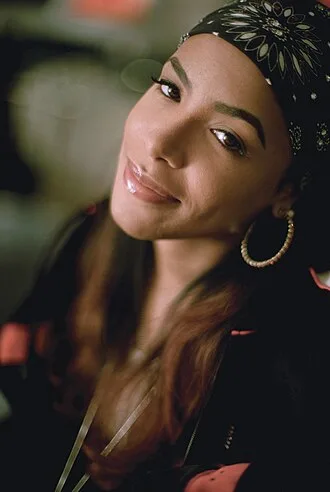
Born in Brooklyn but raised in Detroit, Aaliyah first gained recognition at the age of 10, when she appeared on the television show Star Search and performed in concert alongside Gladys Knight. At the age of 12, she signed with Jive Records and her uncle Barry Hankerson's Blackground Records. Hankerson introduced her to R.
Kelly, who became her mentor, as well as lead songwriter and producer of her debut album, Age Ain't Nothing but a Number (1994). The album sold three million copies in the US and was certified double Platinum by the Recording Industry Association of America (RIAA). Her first single, "Back & Forth", rose to number five on the Billboard Hot 100.
After allegations of an illegal marriage with Kelly, she ended her contract with Jive and signed with Atlantic Records.
Aaliyah worked with record producers Timbaland and Missy Elliott for her second album, One in a Million (1996), which sold three million copies in the US and more than eight million copies worldwide. She made her acting debut in the action film Romeo Must Die. Its soundtrack was supported by her single "Try Again", the first song to top the Billboard Hot 100 solely through airplay.
She subsequently filmed her starring role in Queen of the Damned (2002; released posthumously) and released her third album, Aaliyah (2001), which topped the Billboard 200. The album spawned the singles "We Need a Resolution", "Rock the Boat", and "More Than a Woman".
On August 25, 2001, at the age of 22, Aaliyah was killed in a plane crash along with eight other people on board, when the overloaded aircraft she was traveling in crashed shortly after takeoff. The pilot was later found to have traces of cocaine and alcohol in his body and was not qualified to fly the aircraft designated for the flight.
Her family filed a wrongful death lawsuit against the aircraft's operator, which was settled out of court. After her death, her music has continued to achieve commercial success, aided by several posthumous releases, including the compilation albums I Care 4 U (2002) and Ultimate Aaliyah (2005). She has sold 8.1 million albums in the US and an estimated 24 to 32 million albums worldwide.
Early life
Aaliyah Dana Haughton was born on January 16, 1979, in Brooklyn, New York, the younger child of Diane (née Hankerson) and Michael "Miguel" Haughton, a warehouse worker. She was of African-American, Jamaican, and Native American descent. Her name is the feminine form of the Arabic "Ali", meaning "highest, most exalted one, the best." She was fond of her name, calling it "beautiful" and saying she was "very proud of it" and strove to live up to her name every day.
When she was five years old, her family moved to Detroit, Michigan, where she was raised along with her older brother, Rashad. In Detroit, her father began working in the warehouse business, one of his brother-in-law Barry Hankerson's widening interests. Her mother stayed home and raised her and her brother. Her mother enrolled her in voice lessons at an early age.
Eventually, she started performing at weddings, church choir, and charity events. She attended a Catholic school, Gesu Elementary, where in first grade she was cast in the stage play Annie, which inspired her to become an entertainer.
Aaliyah's mother was a vocalist, and her uncle Hankerson was an entertainment lawyer who had been married to Gladys Knight. As a child, she traveled with Knight and worked with an agent in New York City to audition for commercials and television programs, including Family Matters. After failing to land a role on the show, she continued her acting through the Gesu Players.
In 1989, at age ten, she appeared on Star Search, where she performed "My Funny Valentine". She chose to begin auditioning, while her mother made the decision to drop her surname. She auditioned for several record labels and at age 11 appeared in concerts alongside Knight. After attending a Gladys Knight concert with music executive Suge Knight, and seeing Aaliyah perform on stage, rapper Tupac Shakur wanted to sign her to a record deal.
Aaliyah attended Detroit schools and believed she was well-liked, but she was teased for her short stature. By age 15, however, she came to love her height. Her mother told her to be happy she was small and complimented her. Although some children disliked her, she determined that "you always have to deal with people who are jealous, but there were so few it didn't even matter.
The majority of kids supported me, which was wonderful." Even in her adult life, she considered herself small. She "learned to accept and love" herself and added that "the most important thing is to think highly of yourself because if you don't, no one else will."
During Aaliyah's audition for acceptance to the Detroit High School for the Fine and Performing Arts, she sang "Ave Maria" in Latin. She held a 4.0 grade-point average when graduating from high school, stating that "I wanted to keep that 4.0. Being in the industry, you know, I don't want kids to think, 'I can just sing and forget about school.' I think it's very important to have an education, and even more important to have something to fall back on." She considered a future career teaching music, music history or drama if she did not make a living as a recording artist because "when you pick a career it has to be something you love."
Career
1991–1995: Age Ain't Nothing but a Number
After Hankerson signed a distribution deal with Jive Records, he signed Aaliyah to his Blackground Records label at the age of 12. Hankerson later introduced her to recording artist and producer R. Kelly, who became her mentor, as well as lead songwriter and producer of her first album, recorded when she was 14. Her debut album, Age Ain't Nothing but a Number, was released under her mononym "Aaliyah", by Jive and Blackground Records on May 24, 1994; it debuted at number 24 on the Billboard 200 chart, selling 38,000 copies in its first week.
It peaked at number 18 on the Billboard 200 and it was certified two times Platinum by the RIAA. To date, the album has sold over 3 million copies in the US. In Canada, the album was certified gold by Music Canada for 50,000 copies in shipments. In 2014, Vibe magazine estimated that the album had sold six million copies globally.
Upon its release, Age Ain't Nothing But a Number received generally favorable reviews from music critics. Some writers noted that Aaliyah's "silky vocals" and "sultry voice" blended with Kelly's new jack swing helped define R&B in the 1990s. Her sound was also compared to that of female quartet En Vogue. Christopher John Farley of Time magazine called the album a "beautifully restrained work", noting that her "girlish, breathy vocals rode calmly on R.
Kelly's rough beats." Stephen Thomas Erlewine of AllMusic felt that the album had its "share of filler", but described the singles as "slyly seductive." He also wrote that the songs on the album were "frequently better" than that of Kelly's second studio album, 12 Play. Billboard criticized the single "At Your Best (You Are Love)" for being out of place on the album and for its length.
Aaliyah's debut single, "Back & Forth", peaked at number 5 on the Hot 100 and topped the Hot R&B/Hip-Hop Songs chart for three weeks. Two more singles charted: a cover of the Isley Brothers' "At Your Best (You Are Love)" peaked at number 6 on the Billboard Hot 100, and the album's title track, "Age Ain't Nothing but a Number", peaked at number 75.
Additionally, she released "The Thing I Like" as part of the soundtrack to the 1994 film A Low Down Dirty Shame. In August 1995, she was featured on the single remix to Junior M.A.F.I.A.'s song "I Need You Tonight."
1996–2000: One in a Million and Romeo Must Die
Problems playing this file? See media help.
In February 1996, Aaliyah was featured on the Kris Kross single "Live and Die for Hip Hop", which also featured Jermaine Dupri (the song's producer) and rapper Da Brat. That year, she left Jive Records and signed with Atlantic Records. She worked with record producers Timbaland and Missy Elliott, who contributed to her second studio album, One in a Million.
Elliott recalled Timbaland and herself being nervous to work with Aaliyah, since the latter had already released her successful debut album while Elliott and Timbaland were just starting out. Elliott also feared that Aaliyah would be a diva, but reflected that she "came in and was so warming; she made us immediately feel like family." The album yielded the lead single "If Your Girl Only Knew", which peaked at number 11 on the Billboard Hot 100 and topped the Billboard Hot R&B/Hip-Hop Songs for two weeks.
It also generated the singles "Hot Like Fire" and "4 Page Letter". One in a Million peaked at number 18 on the Billboard 200, and was certified double platinum by the RIAA on June 16, 1997, denoting shipments of two million copies. The album went on to sell 3 million copies in the US and over eight million copies worldwide.
The year after her album was released, she was featured on Timbaland & Magoo's debut single, "Up Jumps da Boogie".
In 1997, Aaliyah graduated with a 4.0 GPA from the Detroit High School for the Fine and Performing Arts, where she majored in drama. The same year, she began her acting career, playing herself in the police drama television series New York Undercover. During this time, she participated in the Children's Benefit Concert, a charity concert at the Beacon Theatre in New York.
She also became the spokesperson for the Tommy Hilfiger Corporation. During her campaign with Tommy Hilfiger, the company sold over 2,400 pairs of the red, white and blue baggy jeans she wore in their advertisements. In December 1997, she performed the Christmas carol "What Child Is This?" at the annual Christmas in Washington television special.
She also contributed to the soundtrack album for the animated film Anastasia, performing a cover version of "Journey to the Past" that earned songwriters Lynn Ahrens and Stephen Flaherty a nomination for the Academy Award for Best Original Song. She performed the song at the 70th Academy Awards, becoming the youngest singer to perform at the event.
Also in 1998, she released the song "Are You That Somebody?", which was featured on the Dr. Dolittle soundtrack. The song peaked at number 21 on the Billboard Hot 100 and earned her her first Grammy Award nomination.
In 1999, Aaliyah landed her first big-screen acting role in Romeo Must Die. She starred opposite martial artist Jet Li, playing a couple who fall in love amid their warring families. Released on March 24, 2000, the movie grossed US$18.6 million in its first weekend, ranking number two at the box office. She purposely stayed away from reviews of the film to "make it easier on" herself, but heard "that people were able to get into me, which is what I wanted." In contrast, some critics felt there was no chemistry between her and Li, as well as viewing the film as too simplistic.
This was echoed by Elvis Mitchell of The New York Times, who wrote that while she was "a natural" and the film was conceived as a spotlight for both her and Li, "they have so little chemistry together you'd think they're putting out a fire instead of shooting off sparks. In addition to acting, she served as an executive producer of the film's soundtrack, for which she contributed four songs. "Try Again" was released as a single from the soundtrack; the song topped the Billboard Hot 100, making her the first artist to top the chart based solely on airplay; this led the song to be released in a 12-inch vinyl and 7-inch single.
The music video won the Best Female Video and Best Video from a Film awards at the 2000 MTV Video Music Awards. It also earned her a Grammy Award nomination for Best Female R&B Vocalist. The soundtrack went on to sell 1.5 million copies in the United States.
2001: Aaliyah and Queen of the Damned
After completing Romeo Must Die, Aaliyah began to work on her second film, Queen of the Damned. She played the role of an ancient vampire, Queen Akasha, which she described as a "manipulative, crazy, sexual being". Filming both Romeo Must Die and Queen of the Damned delayed the release of her next album.
She had not intended for her albums to have such a gap between them: "I wanted to take a break after One in a Million to just relax, think about how I wanted to approach the next album. Then, when I was ready to start back up, Romeo happened, and so I had to take another break and do that film and then do the soundtrack, then promote it.
The break turned into a longer break than I anticipated." Ultimately, she filmed Queen of the Damned and recorded her third album at the same time, so that the album could be released in 2001. She enjoyed balancing her singing and acting careers. Though she called music a "first" for her, she also had been acting since she was young and had wanted to begin acting "at some point in my career", but "wanted it to be the right time and the right vehicle" and felt Romeo Must Die "was it".
Connie Johnson of the Los Angeles Times argued that Aaliyah's focus on her film career may have caused her to not give the album "the attention it merited."
During the recording stages for the album, Aaliyah's publicist disclosed that the album's release date would most likely be October 2000. Aaliyah finished recording the album in March 2001 after a year of recording tracks that began in March 2000. Aaliyah was released five years after One in a Million on July 17, 2001, and debuted at number two on the Billboard 200, selling 187,000 copies in its first week.
The first single from the album, "We Need a Resolution", peaked at number 59 on the Billboard Hot 100. The week after her death, the album rose from number 19 to number 1 on the Billboard 200. "Rock the Boat" was released as a posthumous single. The music video premiered on BET's Access Granted, and it became the most viewed and highest rated episode in the history of the show.
The song peaked at number 14 on the Billboard Hot 100. Promotional posters for Aaliyah that had been put up in major cities such as New York and Los Angeles became makeshift memorials for grieving fans. In February 2002, the album was certified double Platinum by the RIAA.
Aaliyah's songs "More than a Woman" and "I Care 4 U" were released as posthumous singles and peaked within the top 25 of the Billboard Hot 100. "More than a Woman" reached number one on the UK singles chart, making her the first female deceased artist to reach number one on the UK singles chart. "More than a Woman" was replaced by George Harrison's "My Sweet Lord", which is the only time in the UK singles chart's history that a dead artist has replaced another dead artist at number one.
Aaliyah was signed to appear in several future films, including a romantic film titled Some Kind of Blue and a Whitney Houston-produced remake of the 1976 film Sparkle. Houston recalled Aaliyah being "so enthusiastic" about the film; the project was shelved after she died. Before her death, Aaliyah filmed some scenes for the sequels of The Matrix as the character Zee.
A portion of her role in The Matrix Reloaded was filmed; these unused scenes were included in the tribute section of the Matrix Ultimate Collection series.
Artistry
Voice
Problems playing this file? See media help.
Aaliyah had a soprano vocal range. With the release of her debut album Age Ain't Nothing but a Number, writer Dimitri Ehrlich of Entertainment Weekly compared her style and sound to R&B group En Vogue. Ehrlich also stated that her "silky vocals are more agile than those of self-proclaimed queen of hip-hop soul Mary J.
Blige." In her review for her second studio album One in a Million in Vibe magazine, music critic Dream Hampton said that her "deliciously feline" voice had the same "pop appeal" as Janet Jackson's. According to Rolling Stone, "the most remarkable thing about Aaliyah's voice, besides its flexibility and crisp range, was its almost preternatural poise — she always seemed to be holding her power in reserve, to know every side of the scenarios she described".
Siân Pattenden from Mixmag stated that "she doesn't try to toss the caber with vocal athleticism. There's no shouting, screeching, wailing or jazz-style noodling. Everything is underplayed: Ms Haughton's range is displayed by the slightest high-octave backing and tiniest harmonies".
Aaliyah said that her vocal styling consisted of singing softly while utilizing her falsetto. She further explained that "my signature style is breathy, tone-y, airy. It's simple but I can ride a crazy track." Although she frequently sang in a softer tone, there were moments when she utilized other facets of her voice.
Daryl Simmons, the producer of her song "The One I Gave My Heart To", recalled her doing opera vocal warm-up exercises in preparation for recording, stating that "it was the furthest thing I would have ever thought that she could do. It just blew my mind." The song's writer, Diane Warren, praised Aaliyah's vocals on the song, saying that "it showed her vocal range, and I know a couple of people thought she wouldn't be able to do that song.
I thought, 'No, she'll be able to do that.'" Variety expressed a similar sentiment as Warren, saying that "The One I Gave My Heart To" "showcased Aaliyah's ability to hit higher notes." Discussing her approach on "Never Givin' Up", producer Craig King said that "lyrically and vocally she just took you to places that you didn't know she could go".