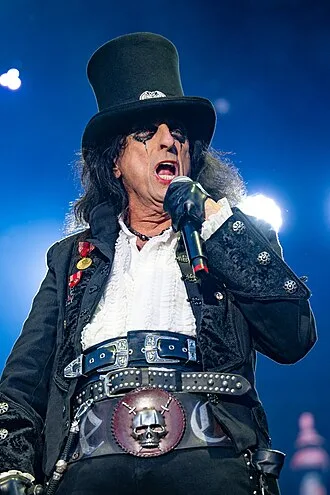
Originating in Phoenix, Arizona in 1964, Alice Cooper was originally a band consisting of Furnier, guitarists Glen Buxton and Michael Bruce, bassist Dennis Dunaway, and drummer Neal Smith. The band released seven studio albums from 1969 to 1973 and hit singles such as "I'm Eighteen", "School's Out", and "No More Mr. Nice Guy".
Following their disbandment in 1975, Furnier legally changed his name to Alice Cooper and began a solo career with the concept album Welcome to My Nightmare (1975). His hit singles as a solo artist include "Only Women Bleed", "You and Me", and "Poison". Over the course of his career, Cooper has released 30 studio albums and sold over 50 million records worldwide. The original Alice Cooper band was inducted into the Rock and Roll Hall of Fame in 2011.
Cooper has experimented with various musical styles, mainly hard rock, glam rock, heavy metal, and glam metal, as well as new wave, art rock, and industrial rock. He helped shape the sound and look of heavy metal, and he has been described as the artist who "first introduced horror imagery to rock'n'roll, and whose stagecraft and showmanship have permanently transformed the genre".
Cooper is also known for his wit offstage, with The Rolling Stone Album Guide calling him the world's most "beloved heavy metal entertainer". His philanthropic work includes his Solid Rock Foundation, which provides free music, art, and vocational programs for at-risk youth in Phoenix, Arizona.
Early life
Vincent Damon Furnier was born on February 4, 1948, in Detroit, Michigan, the son of Ether Moroni Furnier (1924–1987) and his wife Ella Mae (née McCart; 1925–2022). He was named after his uncle, Vincent Collier Furnier, and the short-story writer Damon Runyon. His father was an evangelist in The Church of Jesus Christ, and his paternal grandfather Thurman Sylvester Furnier was a leader and later president (1963–1965) of that church organization.
The Furnier family resided in East Detroit on Lincoln Avenue near Kelly Road, a few blocks from Eastland Mall. Cooper attended Kantner Elementary School, recalled watching horror movies at the Eastown Theatre (where he would later perform), and local neighborhood trick-or-treating on Halloween, the "biggest night of the year", which he took "very seriously".
Cooper was active in his church at ages 11 to 12. Following a series of childhood illnesses, he moved with his family to Phoenix, Arizona, where he attended Cortez High School.
Career
1960s
The Spiders and Nazz
In 1964, 16-year-old Furnier was eager to participate in Cortez High School's annual Letterman's talent show, so he gathered four fellow cross country teammates to form a group for the show: Glen Buxton, Dennis Dunaway, John Tatum, and John Speer. They named themselves the Earwigs. They dressed up in costumes and wigs to resemble the Beatles and performed several parodies of Beatles songs, with the lyrics modified to refer to the track team: in their rendition of "Please Please Me", for example, the line "Last night I said these words to my girl" was replaced with "Last night I ran four laps for my coach".
Of the group, only Buxton knew how to play an instrument—the guitar—so Buxton played guitar while the rest mimed on their instruments. The group got an overwhelming response from the audience and won the talent show. As a result of their positive experience, the group decided to try to turn into a real band. They acquired musical instruments from a local pawn shop and learned to play them, with Buxton doing most of the teaching and much of the early songwriting.
They soon renamed themselves the Spiders, featuring Furnier on lead vocals, Buxton on lead guitar, Tatum on rhythm guitar, Dunaway on bass guitar, and Speer on drums.
In 1966, the Spiders graduated from Cortez High School and, after North High School football player Michael Bruce replaced John Tatum on rhythm guitar, the band released their second single, "Don't Blow Your Mind", an original composition which became a local No. 1 hit, backed by "No Price Tag".
By 1967, the band had begun to make regular road trips to Los Angeles to play shows. They soon renamed themselves Nazz and released the single "Wonder Who's Lovin' Her Now", backed with future Alice Cooper track "Lay Down and Die, Goodbye". Around this time, drummer John Speer was replaced by Neal Smith. By the end of the year, the band relocated to Los Angeles.
Name change to Alice Cooper
In 1968, the band learned that Todd Rundgren also had a band called Nazz, which was signed to a major label, and found themselves in need of another name. Furnier also believed that the group needed a gimmick to succeed, and that other bands were not exploiting the showmanship potential of the stage. They chose the name "Alice Cooper" largely because it sounded innocuous and wholesome, in humorous contrast to the band's image and music.
In his 2007 book Alice Cooper, Golf Monster, Cooper stated that his look was inspired in part by films. One of the band's all-time favorite movies was What Ever Happened to Baby Jane? (1962) starring Bette Davis: "In the movie, Bette wears disgusting caked makeup smeared on her face and underneath her eyes, with deep, dark, black eyeliner." Another movie the band watched over and over was Barbarella (1968): "When I saw Anita Pallenberg playing the Great Tyrant in that movie in 1968, wearing long black leather gloves with switchblades coming out of them, I thought, 'That's what Alice should look like.' That, and a little bit of Emma Peel from The Avengers."
The classic Alice Cooper group lineup consisted of Furnier, lead guitarist Glen Buxton, rhythm guitarist Michael Bruce, bassist Dennis Dunaway, and drummer Neal Smith. With the exception of Smith, who graduated from Camelback High School (which is referred to in the song "Alma Mater" on the band's fifth studio album School's Out), all of the band members were on the Cortez High School cross-country team.
Furnier, Buxton, and Dunaway were also art students, and their admiration for the works of surrealist artists such as Salvador Dalí further inspired their stage antics.
One night after an unsuccessful gig at the Cheetah club in Venice, Los Angeles, where the band emptied the entire room of patrons after playing just ten minutes, they were approached and enlisted by music manager Shep Gordon, who saw the band's negative impact that night as a force that could be turned in a more productive direction.
Shep then arranged an audition for the band with composer and renowned record producer Frank Zappa, who was looking to sign bizarre music acts to his new record label, Straight Records. For the audition Zappa told them to come to his house "at 7 o'clock." The band mistakenly assumed he meant 7 o'clock in the morning. Being woken up by a band willing to play that particular brand of psychedelic rock at seven in the morning impressed Zappa enough for him to sign them to a three-album deal.
Another Zappa-signed act, the all-female GTOs, who liked to "dress the Cooper boys up like full size Barbie dolls," played a major role in developing the band's early onstage look.
The band's debut studio album, Pretties for You (1969), was eclectic and featured an experimental presentation of their songs in a psychedelic context.
Alice Cooper's "shock rock" reputation apparently developed almost by accident at first. An unrehearsed stage routine involving a feather pillow and a live chicken garnered attention from the press; the band decided to capitalize on the tabloid sensationalism, creating in the process a new subgenre, shock rock. Cooper claims that the infamous "Chicken Incident" at the Toronto Rock and Roll Revival concert in September 1969 was an accident.
A chicken somehow made its way onto the stage into the feathers of a feather pillow that was opened during Cooper's performance and, not having any experience with farm animals, Cooper presumed that, because the chicken had wings, it would be able to fly. He picked it up and threw it out over the crowd, expecting it to fly away.
The chicken instead plummeted into the first few rows occupied by wheelchair users, who reportedly proceeded to tear the bird to pieces. The next day the incident made the front page of national newspapers, and Zappa phoned Cooper and asked if the story, which reported that he had bitten off the chicken's head and drunk its blood on stage, was true.
Cooper denied the rumor, whereupon Zappa told him, "Well, whatever you do, don't tell anyone you didn't do it."
The band later claimed that this period was highly influenced by Pink Floyd, especially their debut studio album The Piper at the Gates of Dawn (1967), the only Pink Floyd album made under the leadership of founding member Syd Barrett (lead vocals and guitar). Glen Buxton said he could listen to Barrett's guitar for hours at a time.
1970–1974
Despite the publicity from the chicken incident, the band's second studio album, Easy Action, produced by David Briggs and released in June 1970, fared even worse than its predecessor, entirely failing to chart within the Billboard Top 200. Around this time, fed up with Californians' indifference to their act, they relocated to Pontiac, Michigan, where their bizarre stage act was much better received by Midwestern crowds accustomed to the proto-punk styles of local bands such as the Stooges and the MC5.
Despite this, Cooper still managed to receive a cream pie in the face when performing at the Cincinnati Pop Festival. Michigan remained their steady home base until 1972. "L.A. just didn't get it," Cooper stated. "They were all on the wrong drug for us. They were on acid and we were basically drinking beer. We fit much more in Detroit than we did anywhere else."
Alice Cooper appeared at the Woodstock-esque Strawberry Fields Festival near Toronto, Ontario, in August 1970. The band's mix of glam and increasingly violent stage theatrics stood out in stark contrast to the bearded, denim-clad hippie bands of the time. As Cooper himself stated: "We were into fun, sex, death and money when everybody was into peace and love.
We wanted to see what was next. It turned out we were next, and we drove a stake through the heart of the Love Generation".
In autumn 1970, the Alice Cooper group teamed with producer Bob Ezrin for the recording of their third studio album, Love It to Death. This was the final album in their Straight Records contract and the band's last chance to create a hit. That first success came with the single "I'm Eighteen", released in November 1970, which reached number 21 on the Billboard Hot 100 in early 1971.
Not long after the album's release in January 1971, Warner Bros. Records purchased Alice Cooper's contract from Straight and re-issued the album, giving the group a higher level of promotion.
Love It to Death proved to be their breakthrough studio album, reaching number 35 on the U.S. Billboard 200 album charts. It was the first of 11 Alice Cooper group and solo albums produced by Ezrin, who is widely seen as being pivotal in helping to create and develop the band's definitive sound.
The group's 1971 tour featured a stage show involving mock fights and gothic torture modes being imposed on Cooper, climaxing in a staged execution by electric chair, with the band sporting tight, sequined, color-contrasting glam rock-style costumes made by prominent rock-fashion designer Cindy Dunaway (sister of band member Neal Smith, and wife of band member Dennis Dunaway).
Cooper's androgynous stage role had developed to present a villainous side, portraying a potential threat to modern society. The success of the band's single and album, and their tour of 1971, which included their first tour of Europe (audience members reportedly included Elton John and a pre-Ziggy Stardust David Bowie), provided enough encouragement for Warner Bros. to offer the band a new multi-album contract.[citation needed]
Their follow-up studio album Killer, released in November 1971, continued the commercial success of Love It to Death and included further single success with "Under My Wheels", "Be My Lover" in early 1972, and "Halo of Flies", which became a Top 10 hit in the Netherlands in 1973. Thematically, Killer expanded on the villainous side of Cooper's androgynous stage role, with its music becoming the soundtrack to the group's morality-based stage show, which by then featured a boa constrictor hugging Cooper on stage, the murderous axe chopping of bloodied baby dolls, and execution by hanging at the gallows.
In January 1972, Cooper was again asked about his peculiar name, and told talk show hostess Dinah Shore that he took the name from a "Mayberry RFD" character.[citation needed]
The summer of 1972 saw the release of the single "School's Out". It went Top 10 in the U.S. and to number 1 in the UK, and remains a staple on classic rock radio to this day. The studio album School's Out reached No. 2 on the US charts and sold over a million copies. The band relocated to their new mansion in Greenwich, Connecticut.
With Cooper's on stage androgynous persona completely replaced with brattiness and machismo, the band solidified their success with subsequent tours in the United States and Europe, and won over devoted fans in droves while at the same time horrifying parents and outraging the social establishment.[citation needed] In the United Kingdom, Mary Whitehouse, a Christian morality campaigner, persuaded the BBC to ban the video for "School's Out", although Whitehouse's campaign did not prevent the single also reaching number one in the UK.
Cooper sent her a bunch of flowers in gratitude for the publicity. Meanwhile, British Labour Member of Parliament Leo Abse petitioned Home Secretary Reginald Maudling to have the group banned altogether from performing in the country.
In February 1973, Billion Dollar Babies was released worldwide and became the band's most commercially successful studio album, reaching No. 1 in both the US and UK. "Elected", a late-1972 Top 10 UK hit from the album, which inspired one of the first MTV-style story-line promo videos ever made for a song (three years before Queen's promotional video for "Bohemian Rhapsody"), was followed by two more UK Top 10 singles, "Hello Hooray" and "No More Mr.
Nice Guy", the latter of which was the last UK single from the album; it reached No. 25 in the US. The title track, featuring guest vocals by Donovan, was also a US hit single. Around this time Glen Buxton left Alice Cooper briefly because of waning health.
With a string of successful concept albums and several hit singles, the band continued their grueling schedule and toured the United States again. Continued attempts by politicians and pressure groups to ban their shocking act only served to fuel the legend of Alice Cooper further and generate even greater public interest.[citation needed] Their 1973 US tour broke box office records previously set by the Rolling Stones and raised rock theatrics to new heights; the multi-level stage show by then featured numerous special effects, including Billion Dollar Bills, decapitated baby dolls and mannequins, a dental psychosis scene complete with dancing teeth, and the ultimate execution prop and highlight of the show: the guillotine.
The guillotine and other stage effects were designed for the band by magician James Randi, who appeared on stage during some of the shows as executioner. In 2012 at Dragon Con, Randi and Cooper discussed their working relationship during this period. The Alice Cooper group had now reached its peak and it was among the most visible and successful acts in the industry.
Beneath the surface, however, the repetitive schedule of recording and touring had begun to take its toll on the band.[citation needed]
Muscle of Love, released at the end of 1973, was to be the last studio album from the classic lineup, and marked Alice Cooper's last UK Top 20 single of the 1970s with "Teenage Lament '74". An unsolicited theme song was recorded for the James Bond spy film The Man with the Golden Gun (1974), but a different song of the same name by Lulu was chosen instead.
By 1974, the Muscle of Love album still had not matched the top-charting success of its predecessor, and the band began to have constant disagreements. For various reasons, the members agreed to take what was expected to be a temporary hiatus. "Everyone decided they needed a rest from one another", said manager Shep Gordon at the time. "A lot of pressure had built up, but it's nothing that can't be dealt with.
Everybody still gets together and talks." Journalist Bob Greene spent several weeks on the road with the band during the Muscle of Love Christmas Tour in 1973. His book Billion Dollar Baby, released in November 1974, painted a less-than-flattering picture of the band, showing a group in total disharmony. Cooper later wrote an autobiography with Steven Gaines called Me, Alice (1976) which gave Cooper's version of that era of his career, among other things.
During this time, Cooper relocated back to Los Angeles and started appearing regularly on television shows such as The Hollywood Squares, and Warner Bros. released the Greatest Hits compilation album. It featured classic-style artwork and reached the US Top 10, performing better than Muscle of Love.
However, the band's 1974 feature film Good to See You Again, Alice Cooper (consisting mainly of 1973 concert footage with 'comedic' sketches woven throughout to a faint storyline), released on a minor cinematic run mostly to drive-in theaters, saw little box office success. On March 5, 1974, Cooper appeared on episode 3 of The Snoop Sisters playing a Satanic cult singer.
The final shows by Alice Cooper as a group were in Brazil in March and April 1974, including the record indoor attendance estimated as high as 158,000 fans in São Paulo on March 30, at the Anhembi Exposition Hall at the start of the first ever South American rock tour.
1975–1979
In 1975, Alice Cooper returned as a solo artist with the release of Welcome to My Nightmare. To avoid legal complications over ownership of the group name, "Alice Cooper" had by then become Furnier's new legal name. Speaking on the subject of Alice Cooper continuing as a solo project as opposed to the band it once was, Cooper stated in 1975, "It got very basically down to the fact that we had drawn as much as we could out of each other.
After ten years, we got pretty dry together." Manager Gordon added, "What had started in a sense as a pipe-dream became an overwhelming burden." The success of Welcome to My Nightmare marked the final breakup of the original members of the band, with Cooper collaborating with their producer Bob Ezrin, who recruited Lou Reed's backing band, including guitarists Dick Wagner and Steve Hunter, to play on the album.
Spearheaded by the US Top 20 hit ballad "Only Women Bleed", the album was released by Atlantic Records in March of that year and became a Top 10 hit for Cooper. It was a concept album that was based on the nightmare of a child named Steven, featuring narration by classic horror movie film star Vincent Price, and serving as the soundtrack to Cooper's new stage show, which now showcased more theatrics than ever, including an 8-foot-tall (2.4 m) furry Cyclops which Cooper decapitated and killed.[citation needed]
Accompanying the album and stage show was the television special Alice Cooper: The Nightmare, starring Cooper and Vincent Price, which aired on US prime-time TV in April 1975. The Nightmare (which was later released on home video in 1983 and gained a Grammy Award nomination for Best Long Form Music Video) was regarded as another groundbreaking moment in rock history.
Adding to it all, a concert film, Welcome to My Nightmare, produced, directed, and choreographed by West Side Story cast member David Winters and filmed live at London's Wembley Arena in September 1975, was released to theaters in 1976. The film was released in a special edition DVD in 2017.
Such was the immense success of Cooper's solo project that he decided to continue as a solo artist, and the original band became officially defunct. Bruce, Dunaway, and Smith went on to form the short-lived band Billion Dollar Babies, producing one studio album—Battle Axe—in 1977. While occasionally performing with one another and Glen Buxton, they did not reunite with Alice until October 23, 1999, at the second Glen Buxton Memorial Weekend for a show at CoopersTown in Phoenix.
They reunited for another show, with Steve Hunter on guitar, on December 16, 2010, at the Dodge Theatre in Phoenix. This lineup performed together again (televised) on March 14, 2011, at the induction of the original Alice Cooper group into the Rock and Roll Hall of Fame, as well as on May 11, 2011, at London's Battersea Power Station at the Jägermeister Ice Cold 4D event (webcast).
In 2011, Bruce, Dunaway, and Smith appeared on three tracks they co-wrote on Alice's solo studio album Welcome 2 My Nightmare. In 2017, they appeared on two tracks they co-wrote on Alice's solo studio album Paranormal, released in July, and in November they joined his current live band for five tour dates in the United Kingdom.[citation needed]