Presley was born in Tupelo, Mississippi; his family moved to Memphis, Tennessee, when he was 13. He began his music career in 1954 at Sun Records with the producer Sam Phillips, who wanted to bring the sound of African-American music to a wider audience. Presley, on guitar and accompanied by the guitarist Scotty Moore on lead and the bassist Bill Black, was a pioneer of rockabilly, an uptempo, backbeat-driven fusion of country music and rhythm and blues.
In 1955, the drummer D. J. Fontana joined to complete the lineup of Presley's classic quartet and RCA Victor acquired his contract in a deal arranged by Colonel Tom Parker, who managed him for the rest of his career. Presley's first RCA Victor single, "Heartbreak Hotel", was released in January 1956 and became a number-one hit in the US.
Within a year, RCA Victor sold ten million Presley singles. With a series of successful television appearances and chart-topping records, Presley became the leading figure of the newly popular rock and roll, though his performing style and promotion of the then-marginalized sound of African Americans led to his being widely considered a threat to the moral well-being of white American youth.
In November 1956, Presley made his film debut in Love Me Tender. Drafted into military service in 1958, he relaunched his recording career two years later with some of his most commercially successful work. Presley held few concerts, and, guided by Parker, devoted much of the 1960s to making Hollywood films and soundtrack albums, most of them critically derided.
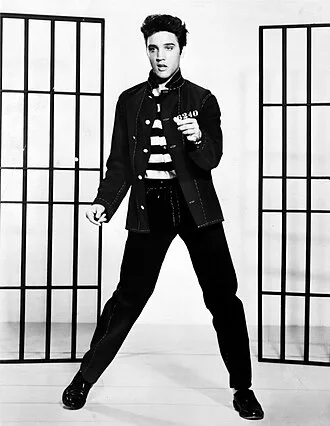
Some of Presley's most famous films included Jailhouse Rock (1957), Blue Hawaii (1961), and Viva Las Vegas (1964). In 1968, he returned to the stage in the acclaimed NBC television comeback special Elvis, which led to an extended Las Vegas concert residency and several highly profitable tours.
In 1973, Presley gave the first concert by a solo artist to be broadcast around the world, Aloha from Hawaii. Many years of substance abuse and unhealthy eating severely compromised his health, and Presley died in August 1977 at his Graceland estate at the age of 42.
Presley is one of the best-selling music artists in history, having sold an estimated 500 million records worldwide. He was commercially successful in many genres, including pop, country, rock and roll, rockabilly, rhythm and blues, adult contemporary, and gospel. Presley won three Grammy Awards, received the Grammy Lifetime Achievement Award at age 36, and has been posthumously inducted into multiple music halls of fame.
He holds several records, including the most Recording Industry Association of America (RIAA)-certified gold and platinum albums, the most albums charted on the Billboard 200, the most number-one albums by a solo artist on the UK Albums Chart, and the most number-one singles by any act on the UK Singles Chart. In 2018, Presley was posthumously awarded the Presidential Medal of Freedom.
Life and career
1935–1953: Early years
Elvis Aaron Presley was born on January 8, 1935, in Tupelo, Mississippi, to Gladys Love (née Smith) and Vernon Presley. Elvis' twin Jesse Garon was stillborn 35 minutes earlier. Presley became close to both parents, especially his mother. The family attended an Assembly of God church, where he found his initial musical inspiration.
Vernon moved from one odd job to the next, and the family often relied on neighbors and government food assistance. In 1938, they lost their home after Vernon was found guilty of altering a check and was jailed for eight months.
In September 1941, Presley entered first grade at East Tupelo Consolidated, where his teachers regarded him as "average". His first public performance was a singing contest at the Mississippi–Alabama Fair and Dairy Show on October 3, 1945, when he was 10; he sang "Old Shep" and recalled placing fifth. A few months later, Presley received his first guitar for his birthday; he received guitar lessons from two uncles and a pastor at the family's church.
Presley recalled, "I took the guitar, and I watched people, and I learned to play a little bit. But I would never sing in public. I was very shy about it."
In September 1946, Presley entered a new school, Milam, for sixth grade. The following year, he began singing and playing his guitar at school. He was often teased as a "trashy" kid who played hillbilly music. Presley was a devotee of Mississippi Slim's radio show. He was described as "crazy about music" by Slim's younger brother, one of Presley's classmates.
Slim showed Presley chord techniques. When his protégé was 12, Slim scheduled him for two on-air performances. Presley was overcome by stage fright the first time but performed the following week.
In November 1948, the family moved to Memphis, Tennessee. Enrolled at L. C. Humes High School, Presley received a grade of C in music in eighth grade. When his music teacher said he had no aptitude for singing, he brought in his guitar and sang "Keep Them Cold Icy Fingers Off Me". He was usually too shy to perform openly and was occasionally bullied by classmates for being a "mama's boy".
In 1950, Presley began practicing guitar under the tutelage of Lee Denson, a neighbor. They and three other boys, including two future rockabilly pioneers, brothers Dorsey and Johnny Burnette—formed a loose musical collective.
During his junior year, Presley began to stand out among his classmates, largely because of his appearance: he grew his sideburns and styled his hair. He would head down to Beale Street, the heart of Memphis' thriving blues scene, and admire the wild, flashy clothes at Lansky Brothers. By his senior year, he was wearing those clothes.
He competed in Humes' Annual "Minstrel" Show in 1953, singing and playing "Till I Waltz Again with You", a song by Teresa Brewer. Presley recalled that the performance did much for his reputation:
I wasn't popular in school ... I failed music—only thing I ever failed. And then they entered me in this talent show ... when I came onstage, I heard people kind of rumbling and whispering and so forth, 'cause nobody knew I even sang. It was amazing how popular I became in school after that.
Presley, who could not read music, played by ear and frequented record stores that provided jukeboxes and listening booths. He knew all of Hank Snow's songs, and he loved records by other country singers such as Roy Acuff, Ernest Tubb, Ted Daffan, Jimmie Rodgers, Jimmie Davis, and Bob Wills. The Southern gospel singer Jake Hess, one of his favorite performers, was a significant influence on his ballad-singing style.
Presley regularly attended the monthly all-night singings downtown, where white gospel groups performed music influenced by African American spirituals. Presley listened to regional radio stations, such as WDIA, that played what were then called "race records": spirituals, blues, and the modern, backbeat-heavy rhythm and blues.
Like some of his peers, he may have attended blues venues only on nights designated for exclusively white audiences. Many of his future recordings were inspired by local African-American musicians such as Arthur Crudup and Rufus Thomas. By the time he graduated from high school in June 1953, Presley had singled out music as his future.
1953–1956: First recordings
Sam Phillips and Sun Records
In 1953, Presley checked into Memphis Recording Service, the company run by Sam Phillips before he started Sun Records. He aimed to pay to record a two-sided acetate disc: "My Happiness" and "That's When Your Heartaches Begin". He later claimed that he intended the record as a birthday gift for his mother, or that he was merely interested in what he "sounded like".
Biographer Peter Guralnick argued that Presley chose Sun in the hope of being discovered. In January 1954, Presley cut a second acetate at Sun—"I'll Never Stand in Your Way" and "It Wouldn't Be the Same Without You"—but again nothing came of it. Not long after, he failed an audition for a local vocal quartet, the Songfellows, and another for the band of Eddie Bond.
Problems playing this file? See media help.
Phillips, meanwhile, was always on the lookout for someone who could bring to a broader audience the sound of the black musicians on whom Sun focused. In June, he acquired a demo recording by Jimmy Sweeney of a ballad, "Without You", that he thought might suit Presley. The teenaged singer came by the studio but was unable to do it justice.
Despite this, Phillips asked Presley to sing other numbers and was sufficiently affected by what he heard to invite two local musicians, guitarist Winfield "Scotty" Moore and upright bass player Bill Black, to work with Presley for a recording session. The session, held the evening of July 5, proved entirely unfruitful until late in the night.
As they were about to give up and go home, Presley launched into a 1946 blues number, Arthur Crudup's "That's All Right". Moore recalled, "All of a sudden, Elvis just started singing this song, jumping around and acting the fool, and then Bill picked up his bass, and he started acting the fool, too, and I started playing with them." Phillips quickly began taping; this was the sound he had been looking for.
Three days later, popular Memphis disc jockey Dewey Phillips played "That's All Right" on his Red, Hot, and Blue show. Listener interest was such that Phillips played the record repeatedly during the remaining two hours of his show. Interviewing Presley on-air, Phillips asked him what high school he attended to clarify his color for the many callers who had assumed that he was black.
During the next few days, the trio recorded a bluegrass song, Bill Monroe's "Blue Moon of Kentucky", again in a distinctive style and employing a jury-rigged echo effect that Sam Phillips dubbed "slapback". A single was pressed with "That's All Right" on the A-side and "Blue Moon of Kentucky" on the reverse.
Early live performances and RCA Victor contract
The trio played publicly for the first time at the Bon Air club on July 17, 1954. Later that month, they appeared at the Overton Park Shell, with Slim Whitman headlining. Here Elvis pioneered "Rubber legs", his signature dance movement. A combination of his strong response to rhythm and nervousness led Presley to shake his legs as he performed: His wide-cut pants emphasized his movements, causing young women in the audience to start screaming.
Moore recalled, "During the instrumental parts, he would back off from the mic and be playing and shaking, and the crowd would just go wild."
Soon after, Moore and Black left their old band to play with Presley regularly, and disc jockey/promoter Bob Neal became the trio's manager. From August through October, they played frequently at the Eagle's Nest club, a dance venue in Memphis. When Presley played, teenagers rushed from the pool to fill the club, then left again as the house western swing band resumed.
Presley quickly grew more confident on stage. According to Moore, "His movement was a natural thing, but he was also very conscious of what got a reaction. He'd do something one time and then he would expand on it real quick." Amid these live performances, Presley returned to Sun studio for more recording sessions. Presley made what would be his only appearance on Nashville's Grand Ole Opry on October 2; Opry manager Jim Denny told Phillips that his singer was "not bad" but did not suit the program.
Louisiana Hayride, radio commercial, and first television performances
In November 1954, Presley performed on Louisiana Hayride—the Opry's chief, and more adventurous, rival. The show aired on 198 radio stations in 28 states. His nervous first set drew a muted reaction. A more composed and energetic second set inspired an enthusiastic response.
Soon after the show, the Hayride engaged Presley for a year's worth of Saturday-night appearances. Trading in his old guitar for $8, he purchased a Martin instrument for $175 (equivalent to $2,100 in 2025) and his trio began playing in new locales, including Houston, Texas, and Texarkana, Arkansas. Presley made his first television appearance on the KSLA-TV broadcast of Louisiana Hayride.
Soon after, he failed an audition for Arthur Godfrey's Talent Scouts on the CBS television network. By early 1955, Presley's regular Hayride appearances, constant touring, and well-received record releases had made him a regional star.
In January, Neal signed a formal management contract with Presley and brought him to the attention of Colonel Tom Parker, whom he considered the best promoter in the music business. Having successfully managed the top country star Eddy Arnold, Parker was working with the new number-one country singer, Hank Snow. Parker booked Presley on Snow's February tour.
By August, Sun had released 10 sides credited to "Elvis Presley, Scotty and Bill"; the latest recordings included a drummer. Some of the songs, like "That's All Right", were in what one Memphis journalist described as the "R&B idiom of negro field jazz"; others, like "Blue Moon of Kentucky", were "more in the country field", "but there was a curious blending of the two different musics in both".
This blend of styles made it difficult for Presley's music to find radio airplay. According to Neal, many country-music disc jockeys would not play it because Presley sounded too much like a black artist and none of the R&B stations would touch him because "he sounded too much like a hillbilly." The blend came to be known as "rockabilly".
At the time, Presley was billed as "The King of Western Bop", "The Hillbilly Cat", and "The Memphis Flash".
Presley renewed Neal's management contract in August 1955, simultaneously appointing Parker as his special adviser. The group maintained an extensive touring schedule. Neal recalled, "It was almost frightening, the reaction that came to Elvis from the teenaged boys. So many of them, through some sort of jealousy, would practically hate him.
There were occasions in some towns in Texas when we'd have to be sure to have a police guard because somebody'd always try to take a crack at him." The trio became a quartet when Hayride drummer Fontana joined as a full member. In mid-October, they played a few shows in support of Bill Haley, whose "Rock Around the Clock" track had been a number-one hit the previous year. Haley observed that Presley had a natural feel for rhythm, and advised him to sing fewer ballads.
At the Country Disc Jockey Convention in early November, Presley was voted the year's most promising male artist. After three major labels made offers of up to $25,000, Parker and Phillips struck a deal with RCA Victor on November 21 to acquire Presley's Sun contract for an unprecedented $40,000. Presley, aged 20, was legally still a minor, so his father signed the contract.
Parker arranged with the owners of Hill & Range Publishing, Jean and Julian Aberbach, to create two entities, Elvis Presley Music and Gladys Music, to handle all the new material recorded by Presley. Songwriters were obliged to forgo one-third of their customary royalties in exchange for having Presley perform their compositions.
By December, RCA had begun to heavily promote its new singer, and before month's end had reissued many of his Sun recordings.
1956–1958: Commercial breakout and controversy
First national TV appearances and debut album
On January 10, 1956, Presley made his first recordings for RCA Victor in Nashville. Extending his by-now customary backup of Moore, Black, Fontana, and Hayride pianist Floyd Cramer—who had been performing at live club dates with Presley—RCA Victor enlisted guitarist Chet Atkins and three background singers, including Gordon Stoker of the popular Jordanaires quartet.
The session produced the moody "Heartbreak Hotel", released as a single on January 27. Parker brought Presley to national television, booking him on CBS' Stage Show for six appearances over two months. The program, produced in New York City, was hosted on alternate weeks by big band leaders and brothers Tommy and Jimmy Dorsey.
After his first appearance on January 28, Presley stayed in town to record at RCA Victor's New York studio. The sessions yielded eight songs, including a cover of Carl Perkins' rockabilly anthem "Blue Suede Shoes". In February, Presley's "I Forgot to Remember to Forget", a Sun recording released the previous August, reached the top of the Billboard country chart. Neal's contract was terminated and Parker became Presley's manager.
RCA Victor released Presley's self-titled debut album on March 23. Joined by five previously unreleased Sun recordings, its seven recently recorded tracks included two country songs, a bouncy pop tune, and what would centrally define the evolving sound of rock and roll: "Blue Suede Shoes"—"an improvement over Perkins' in almost every way", according to critic Robert Hilburn—and three R&B numbers that had been part of Presley's stage repertoire, covers of Little Richard, Ray Charles, and The Drifters. As described by Hilburn, these
were the most revealing of all. Unlike many white artists ... who watered down the gritty edges of the original R&B versions of songs in the '50s, Presley reshaped them. He not only injected the tunes with his own vocal character but also made guitar, not piano, the lead instrument in all three cases.
It became the first rock and roll album to top the Billboard chart, a position it held for ten weeks. While Presley was not an innovative guitarist like Moore or contemporary African American rockers Bo Diddley and Chuck Berry, cultural historian Gilbert B. Rodman argued that the album's cover image, "of Elvis having the time of his life on stage with a guitar in his hands played a crucial role in positioning the guitar ... as the instrument that best captured the style and spirit of this new music."
Milton Berle Show and "Hound Dog"
On April 3, Presley made the first of two appearances on NBC's The Milton Berle Show. His performance, on the deck of the USS Hancock in San Diego, California, prompted cheers and screams from an audience of sailors and their dates. A few days later, Presley and his band were flying to Nashville, Tennessee, for a recording session when an engine died and the plane almost went down over Arkansas.
Twelve weeks after its original release, "Heartbreak Hotel" became Presley's first number-one pop hit. In late April, Presley began a two-week residency at the New Frontier Hotel and Casino on the Las Vegas Strip. The shows were poorly received by the conservative, middle-aged hotel guests, "like a jug of corn liquor at a champagne party", a Newsweek critic wrote.
Amid his Vegas tenure, Presley, who had acting ambitions, signed a seven-year contract with Paramount Pictures. He began a tour of the Midwest in mid-May, covering 15 cities in as many days. He had attended several shows by Freddie Bell and the Bellboys in Vegas and was struck by their cover of "Hound Dog", a hit in 1953 for blues singer Big Mama Thornton by songwriters Jerry Leiber and Mike Stoller. It became his new closing number.
After a show in La Crosse, Wisconsin, an urgent message on the letterhead of the local Catholic diocese's newspaper was sent to FBI director J. Edgar Hoover. It warned that
Presley is a definite danger to the security of the United States. ... [His] actions and motions were such as to rouse the sexual passions of teenaged youth. ... After the show, more than 1,000 teenagers tried to gang into Presley's room at the auditorium. ... Indications of the harm Presley did just in La Crosse were the two high school girls ... whose abdomen and thigh had Presley's autograph.
Presley's second Milton Berle Show appearance came on June 5 at NBC's Hollywood studio, amid another hectic tour. Milton Berle persuaded Presley to leave his guitar backstage. During the performance, Presley abruptly halted an up-tempo rendition of "Hound Dog" and launched into a slow, grinding version accentuated with exaggerated body movements. His gyrations created a storm of controversy. Jack Gould of The New York Times wrote,