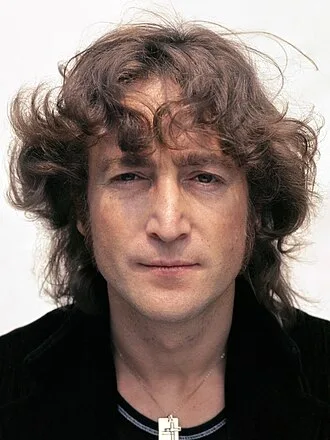
Born in Liverpool, Lennon became involved in the skiffle craze as a teenager. In 1956, he formed the Quarrymen, which evolved into the Beatles in 1960. He initially was the group's de facto leader, a role he gradually seemed to cede to McCartney. In the mid-1960s, Lennon authored In His Own Write and A Spaniard in the Works, both collections of nonsense writings and line drawings.
Starting with "All You Need Is Love" in 1967, his songs were adopted as anthems by the counterculture and anti-war movement. In 1969, he started the Plastic Ono Band with his second wife, multimedia artist Yoko Ono, held the two-week-long anti-war demonstration bed-in for peace, and left the Beatles to embark on a solo career.
Lennon and Ono collaborated on many works, including a trilogy of avant-garde albums and several films. From 1969 to 1972, he achieved four UK top-10 singles with "Give Peace a Chance", "Instant Karma!", "Imagine", and "Happy Xmas (War Is Over)".
In 1970, Lennon released his debut solo album John Lennon/Plastic Ono Band, his first of four LPs co-produced with Phil Spector. Moving to New York City in 1971, Lennon's criticism of the Vietnam War resulted in a three-year deportation attempt by the Nixon administration. Lennon and Ono separated from 1973 to 1975, during which time he produced Harry Nilsson's album Pussy Cats and had chart-topping collaborations with Elton John ("Whatever Gets You thru the Night") and David Bowie ("Fame").
Following a five-year hiatus from his solo career, during which he continued to write and record intermittently, Lennon returned in 1980 with the Ono collaboration Double Fantasy. He was shot and killed by Mark David Chapman three weeks after the album's release.
As a performer, writer or co-writer, Lennon had 25 number-one singles in the Billboard Hot 100 chart. As a solo artist, he had five singles reach the top 10 in both the UK and U.S.: "Instant Karma", "Imagine", "(Just Like) Starting Over", "Woman", and "Nobody Told Me". Double Fantasy, his second-best-selling non-Beatles album, won the 1981 Grammy Award for Album of the Year and a Brit Award for Outstanding Contribution to Music.
In 2002, he was voted eighth in a BBC history poll of the 100 Greatest Britons. Rolling Stone ranked him the fifth-greatest singer and 38th-greatest artist of all time. He was posthumously inducted into the Songwriters Hall of Fame in 1997 and the Rock and Roll Hall of Fame twice (first as a member of the Beatles in 1988 and as a solo artist in 1994).
Early years: 1940–1956
John Winston Lennon was born on 9 October 1940 at Liverpool Maternity Hospital, the only child of Alfred and Julia Lennon (née Stanley). Alfred was a merchant seaman of Irish descent who was away at the time of his son's birth, and Lennon had Welsh ancestry on his mother's side. His parents named him John Winston Lennon after his paternal grandfather, John "Jack" Lennon, and Prime Minister Winston Churchill.
His father was often away from home but sent regular pay cheques to 9 Newcastle Road, Liverpool, where Lennon lived with his mother; the cheques stopped when he went absent without leave in February 1944. When he eventually came home six months later, he offered to look after the family, but Julia, by then pregnant with another man's child, rejected the idea. After her sister Mimi complained to Liverpool's Social Services twice, Julia gave her custody of Lennon.
In July 1946, Lennon's father visited her and took his son to Blackpool, secretly intending to emigrate to New Zealand with him. Julia followed them – with her partner at the time, Bobby Dykins – and after a heated argument, his father forced the five-year-old to choose between them. In one account of this incident, Lennon twice chose his father, but as his mother walked away, he began to cry and followed her.
According to author Mark Lewisohn, however, Lennon's parents agreed that Julia should take him and give him a home. Billy Hall, who witnessed the incident, has said that the dramatic portrayal of a young Lennon being forced to make a decision between his parents is inaccurate. He had no further contact with Alfred for close to 20 years.
Throughout the rest of his childhood and adolescence, Lennon lived at Mendips, 251 Menlove Avenue, Woolton, with Mimi and her husband George Toogood Smith, who had no children of their own. His aunt purchased volumes of short stories for him, and his uncle, a dairyman at his family's farm, bought him a mouth organ and engaged him in solving crossword puzzles.
Julia visited Mendips on a regular basis, and Lennon often visited her at 1 Blomfield Road, Liverpool, where she played him Elvis Presley records, taught him the banjo, and showed him how to play "Ain't That a Shame" by Fats Domino. In September 1980, Lennon commented about his family and his rebellious nature:
A part of me would like to be accepted by all facets of society and not be this loudmouthed lunatic poet/musician. But I cannot be what I am not [...] I was the one who all the other boys' parents – including Paul's father – would say, "Keep away from him" [...] The parents instinctively recognised I was a troublemaker, meaning I did not conform and I would influence their children, which I did.
I did my best to disrupt every friend's home [...] Partly out of envy that I didn't have this so-called home [...] but I did [...] There were five women that were my family. Five strong, intelligent, beautiful women, five sisters.
One happened to be my mother. [She] just couldn't deal with life. She was the youngest and she had a husband who ran away to sea and the war was on and she couldn't cope with me, and I ended up living with her elder sister. Now those women were fantastic [...] And that was my first feminist education [...] I would infiltrate the other boys' minds. I could say, "Parents are not gods because I don't live with mine and, therefore, I know."
He regularly visited his cousin Stanley Parkes, who lived in Fleetwood and took him on trips to local cinemas. During the school holidays Parkes often visited Lennon with Leila Harvey, another cousin, and the three often travelled to Blackpool two or three times a week to watch shows. They would visit the Blackpool Tower Circus and see artists such as Dickie Valentine, Arthur Askey, Max Bygraves and Joe Loss, with Parkes recalling that Lennon particularly liked George Formby.
After Parkes's family moved to Scotland, the three cousins often spent their school holidays together there. Parkes recalled, "John, cousin Leila and I were very close. From Edinburgh we would drive up to the family croft at Durness, which was from about the time Lennon was nine years old until he was about 16." His uncle George died of a liver haemorrhage on 5 June 1955, aged 52.
Lennon was raised as an Anglican and attended Dovedale Primary School. He passed the eleven-plus examination, later calling it "the only exam I ever passed, because I was terrified". He attended Quarry Bank High School in Liverpool from September 1952 to 1957, and was described by Harvey at the time as a "happy-go-lucky, good-humoured, easy going, lively lad".
However, he was also known to frequently engage in fights, bully and disrupt classes. Despite this, he quickly built a reputation as the class clown and often drew comical cartoons that appeared in his self-made school magazine, the Daily Howl. According to school teacher Tom Barry, Lennon was historically viewed by his former school as a bully and nuisance, the administration hid traces of him during the Beatles rise to fame because they did not consider him a good role model.
In 1956, Julia bought Lennon his first guitar. The instrument was an inexpensive Gallotone Champion acoustic for which she lent her son five pounds and ten shillings on the condition that the guitar be delivered to her own house and not Mimi's, knowing well that her sister was not supportive of her son's musical aspirations.
Mimi was sceptical of his claim that he would be famous one day, and she hoped that he would grow bored with music, often telling him, "The guitar's all very well, John, but you'll never make a living out of it."
Lennon and Pete Shotton were initially placed in Quarry Bank's top "A" stream but were soon moved down to the "C" stream. Former classmate Rod Davis later recalled Lennon as at least as intelligent as his peers, but unwilling to conform to the school system. Lennon's severe shortsightedness was another contributing factor: he disliked wearing glasses and, from the back of the classroom, often could not make out what was written on the blackboard.
Teachers at Quarry Bank High School described him thus: "He has too many wrong ambitions and his energy is often misplaced", and "His work always lacks effort. He is content to 'drift' instead of using his abilities." Lennon's misbehaviour created a rift in his relationship with his aunt.
Away from compulsory schoolwork, Lennon read widely and spent considerable time writing and drawing. An English exercise book containing poetry and Lennon's illustrations was kept by his teacher Lancelot Burrows to show later pupils as an example of good work. His spelling remained poor, however, and Lewisohn has suggested that he may have had dyslexia, while noting that he displayed no other obvious symptoms of the condition.
Lennon failed his O-level examinations and was accepted into the Liverpool College of Art after his aunt and headmaster intervened.
On 15 July 1958, at the age of 44, Julia Lennon was struck and killed by a car while she was walking home after visiting the Smiths' house. His mother's death traumatised the teenage Lennon, who, for the next two years, drank heavily and frequently got into fights, consumed by a "blind rage". Julia's memory would later serve as a major creative inspiration for Lennon, inspiring songs such as the 1968 Beatles song "Julia".
At the college he began to wear Teddy Boy clothes and was threatened with expulsion for his behaviour. According to Cynthia Powell, Lennon's fellow student and subsequently his wife, he was "thrown out of the college before his final year".
The Quarrymen to the Beatles: 1956–1970
Formation, fame and touring: 1956–1966
At the age of 15, Lennon formed a skiffle group, the Quarrymen. Named after Quarry Bank High School, the group was established by Lennon in September 1956. By the summer of 1957, the Quarrymen played a "spirited set of songs" made up of half skiffle and half rock and roll. Lennon first met Paul McCartney at the Quarrymen's second performance, which was held in Woolton on 6 July at the St Peter's Church garden fête. Lennon then asked McCartney to join the band.
McCartney said that Aunt Mimi "was very aware that John's friends were lower class", and would often patronise him when he arrived to visit Lennon. According to McCartney's brother Mike, their father similarly disapproved of Lennon, declaring that Lennon would get his son "into trouble". McCartney's father nevertheless allowed the fledgling band to rehearse in the family's front room at 20 Forthlin Road.
During this time Lennon wrote his first song, "Hello Little Girl", which became a UK top 10 hit for the Fourmost in 1963.
McCartney recommended that his friend George Harrison become the lead guitarist. Lennon thought that Harrison, then 14 years old, was too young. McCartney engineered an audition on the upper deck of a Liverpool bus, where Harrison played "Raunchy" for Lennon and was asked to join. Stuart Sutcliffe, Lennon's friend from art school, later joined as bassist.
Lennon, McCartney, Harrison and Sutcliffe became "The Beatles" in early 1960. In August that year, the Beatles were engaged for a 48-night residency in Hamburg, in West Germany, and were desperately in need of a drummer. They asked Pete Best to join them. Lennon's aunt, horrified when he told her about the trip, pleaded with Lennon to continue his art studies instead.
After the first Hamburg residency, the band accepted another in April 1961, and a third in April 1962. As with the other band members, Lennon was introduced to Preludin while in Hamburg, and regularly took the drug as a stimulant during their long, overnight performances.
Brian Epstein managed the Beatles from 1962 until his death in 1967. He had no previous experience managing artists, but he had a strong influence on the group's dress code and attitude on stage. Lennon initially resisted his attempts to encourage the band to present a professional appearance, but eventually complied, saying "I'll wear a bloody balloon if somebody's going to pay me." McCartney took over on bass after Sutcliffe decided to stay in Hamburg, and Best was replaced with drummer Ringo Starr; this completed the four-piece line-up that would remain until the group's break-up in 1970.
The band's first single, "Love Me Do", was released in October 1962 and reached No. 17 on the British charts. They recorded their debut album, Please Please Me, in under 10 hours on 11 February 1963, a day when Lennon was suffering the effects of a cold, which is evident in the vocal on the last song to be recorded that day, "Twist and Shout".
The Lennon–McCartney songwriting partnership yielded eight of its fourteen tracks. With a few exceptions, one being the album title itself, Lennon had yet to bring his love of wordplay to bear on his song lyrics, saying: "We were just writing songs ... pop songs with no more thought of them than that – to create a sound.
And the words were almost irrelevant". In a 1987 interview, McCartney said that the other Beatles idolised Lennon: "He was like our own little Elvis ... We all looked up to John. He was older and he was very much the leader; he was the quickest wit and the smartest."
The Beatles achieved mainstream success in the UK early in 1963. Lennon was on tour when his first son, Julian, was born in April. During their Royal Variety Show performance, which was attended by the Queen Mother and other British royalty, Lennon poked fun at the audience: "For our next song, I'd like to ask for your help.
For the people in the cheaper seats, clap your hands ... and the rest of you, if you'll just rattle your jewellery." After a year of Beatlemania in the UK, the group's historic February 1964 US debut appearance on The Ed Sullivan Show marked their breakthrough to international stardom.
A two-year period of constant touring, filmmaking, and songwriting followed, during which Lennon wrote two books, In His Own Write and A Spaniard in the Works. The Beatles received recognition from the British establishment when they were appointed Members of the Order of the British Empire (MBE) in the 1965 Queen's Birthday Honours.
Lennon grew concerned that fans who attended Beatles concerts were unable to hear the music above the screaming of fans, and that the band's musicianship was beginning to suffer as a result. Lennon's "Help!" expressed his own feelings in 1965: "I meant it ... It was me singing 'help'".
He had put on weight (he would later refer to this as his "Fat Elvis" period), and felt he was subconsciously seeking change. A hurtful comment from a reporter would lead him to undergo several bouts with weight loss and appearance changes throughout the rest of his life. In March of that year, he and Harrison were unknowingly introduced to LSD when a dentist, hosting a dinner party attended by the two musicians and their partners, spiked the guests' coffee with the drug.
When they wanted to leave, their host revealed what they had taken, and strongly advised them not to leave the house because of the likely effects. Later, in a lift at a nightclub, they all believed it was on fire; Lennon recalled: "We were all screaming ... hot and hysterical."
In March 1966, during an interview with Evening Standard reporter Maureen Cleave, Lennon remarked, "Christianity will go. It will vanish and shrink ... We're more popular than Jesus now – I don't know which will go first, rock and roll or Christianity." The comment went virtually unnoticed in England but caused great offence in the US when quoted by a magazine there five months later.
The furore that followed, which included the burning of Beatles records, Ku Klux Klan activity and threats against Lennon, contributed to the band's decision to stop touring.
Studio years, break-up and solo work: 1966–1970
After the band's final concert on 29 August 1966, Lennon filmed the anti-war black comedy How I Won the War – his only appearance in a non-Beatles feature film – before rejoining his bandmates for an extended period of recording, beginning in November. Lennon had increased his use of LSD and, according to author Ian MacDonald, his continuous use of the drug in 1967 brought him "close to erasing his identity".
The year 1967 saw the release of "Strawberry Fields Forever", hailed by Time magazine for its "astonishing inventiveness", and the group's landmark album Sgt. Pepper's Lonely Hearts Club Band, which revealed lyrics by Lennon that contrasted strongly with the simple love songs of the group's early years.
In late June, the Beatles performed Lennon's "All You Need Is Love" as Britain's contribution to the Our World satellite broadcast, before an international audience estimated at up to 400 million. Intentionally simplistic in its message, the song formalised his pacifist stance and provided an anthem for the Summer of Love.
After the Beatles were introduced to the Maharishi Mahesh Yogi, the group attended an August weekend of personal instruction at his Transcendental Meditation® seminar in Bangor, Wales. During the seminar, they were informed of Epstein's death. "I knew we were in trouble then", Lennon said later. "I didn't have any misconceptions about our ability to do anything other than play music.
I was scared – I thought, 'We've fucking had it now.'" McCartney organised the group's first post-Epstein project, the self-written, -produced and -directed television film Magical Mystery Tour, which was released in December that year. While the film itself proved to be their first critical flop, its soundtrack release, featuring Lennon's Lewis Carroll-inspired "I Am the Walrus", was a success.
Led by Harrison and Lennon's interest, the Beatles travelled to the Maharishi's ashram in India in February 1968 for further guidance. While there, they composed most of the songs for their double album The Beatles, but the band members' mixed experience with the Transcendental Meditation® technique signalled a sharp divergence in the group's camaraderie.
On their return to London, they became increasingly involved in business activities with the formation of Apple Corps, a multimedia corporation composed of Apple Records and several other subsidiary companies. Lennon described the venture as an attempt to achieve "artistic freedom within a business structure". Released amid the Protests of 1968, the band's debut single for the Apple label included Lennon's B-side "Revolution", in which he called for a "plan" rather than committing to Maoist revolution.
The song's pacifist message led to ridicule from political radicals in the New Left press. Adding to the tensions at the Beatles' recording sessions that year, Lennon insisted on having his new girlfriend, the Japanese artist Yoko Ono, beside him, thereby contravening the band's policy regarding wives and girlfriends in the studio.
He was especially pleased with his songwriting contributions to the double album and identified it as a superior work to Sgt. Pepper. At the end of 1968, Lennon participated in The Rolling Stones Rock and Roll Circus, a television special that was not broadcast. Lennon performed with the Dirty Mac, a supergroup composed of Lennon, Eric Clapton, Keith Richards and Mitch Mitchell. The group also backed a vocal performance by Ono. A film version was released in 1996.
By late 1968, Lennon's increased drug use and growing preoccupation with Ono, combined with the Beatles' inability to agree on how to run the company, left Apple in need of professional management. Lennon asked Lord Beeching to take on the role but he declined, advising Lennon to go back to making records. Lennon was approached by Allen Klein, who had managed the Rolling Stones and other bands during the British Invasion.
In early 1969, Klein was appointed as Apple's chief executive by Lennon, Harrison and Starr, but McCartney never signed the management contract.
Lennon and Ono were married on 20 March 1969 and soon released a series of 14 lithographs called "Bag One" depicting scenes from their honeymoon, eight of which were deemed indecent and most of which were banned and confiscated. Lennon's creative focus continued to move beyond the Beatles, and between 1968 and 1969 he and Ono recorded three albums of experimental music together: Unfinished Music No. 1: Two Virgins (known more for its cover than for its music), Unfinished Music No. 2: Life with the Lions and Wedding Album.
In 1969, they formed the Plastic Ono Band, releasing Live Peace in Toronto 1969. Between 1969 and 1970, Lennon released the singles "Give Peace a Chance", which was widely adopted as an anti-Vietnam War anthem, "Cold Turkey", which documented his withdrawal symptoms after he became addicted to heroin, and "Instant Karma!".