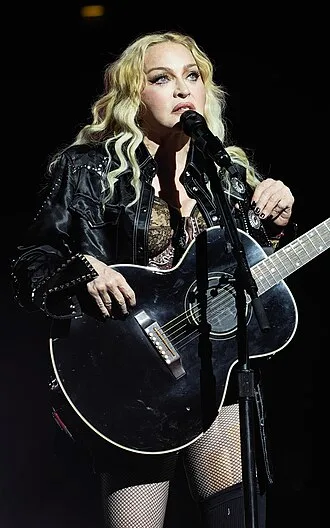
Born and raised in Michigan, Madonna moved to New York City in 1978 to pursue a career in dance. After performing as a drummer, guitarist, and vocalist in the rock bands Breakfast Club and Emmy, she rose to stardom with her debut album, Madonna (1983). She has scored eighteen multi-platinum albums globally, including Like a Virgin (1984), True Blue (1986), and The Immaculate Collection (1990)—among the best-selling albums of all time—and Confessions on a Dance Floor (2005), her 21st-century bestseller. Like a Prayer (1989), Ray of Light (1998), and Music (2000) were ranked among Rolling Stone's greatest albums of all time.
Madonna's top-charting singles include "Like a Virgin", "Papa Don't Preach", "La Isla Bonita", "Like a Prayer", "Vogue", "Take a Bow", "Frozen", "Music", "Hung Up", and "4 Minutes".
Madonna has starred in films such as Desperately Seeking Susan (1985), Dick Tracy (1990), A League of Their Own (1992), and Evita (1996). Although many of her films were not well-received, she won the Golden Globe Award for Best Actress for portraying Eva Perón in Evita. Her business endeavors encompass the entertainment company Maverick (1992–2009), which included Maverick Records—one of the most successful artist-run labels.
Madonna has also pursued fashion brands, written works, health clubs, and filmmaking. She contributes to various charities, having founded the Ray of Light Foundation in 1998 and Raising Malawi in 2006, and advocates for gender equality and LGBTQ rights.
Madonna is the best-selling female music artist of all time, and the first female performer to accumulate US$1 billion from her concerts. She is the only solo act to have at least ten US and UK number-one albums and singles, and holds the record for the most chart-toppers on a singular Billboard chart. Her accolades include seven Grammy Awards, two Golden Globe Awards, twenty MTV Video Music Awards, and an induction into the Rock and Roll Hall of Fame in her first year of eligibility.
Madonna was the world's highest-paid female musician for a record eleven years across four decades (1980s–2010s). She has become the subject of various scholarly, literary, and artistic works, giving rise to an academic subfield known as Madonna studies.
Life and career
1958–1978: Early life
Madonna Louise Ciccone was born in Bay City, Michigan, on August 16, 1958. Her father, Silvio "Tony" Ciccone, worked as an optical and military engineer, as well as a physicist, for Chrysler Defense and later General Dynamics Land Systems; her mother, Madonna Louise (née Fortin), was an X-ray technician. Tony's parents were Italian emigrants from Pacentro, while her mother was of French-Canadian descent.
Since Madonna shared her name with her mother, family members referred to her as "Little Nonnie". Madonna was raised in the Detroit suburbs of Pontiac and Avon Township (now Rochester Hills), alongside her two older brothers, Anthony and Martin, and her three younger siblings, Paula, Christopher, and Melanie.
When Madonna was five years old, her mother died of breast cancer on December 1, 1963. In 1966, she adopted Veronica as a confirmation name upon receiving the sacrament in the Catholic Church. That same year, Tony married the family's housekeeper, Joan Gustafson. They had three children: Joey (who died shortly after his birth in 1967 from a heart defect), Jennifer, and Mario.
Madonna attended St. Frederick's and St. Andrew's Catholic elementary schools, as well as West Middle School. She earned high grades—her father gave her a quarter for every A—and was notorious for her unconventional behavior. Madonna performed cartwheels and handstands in the hallways between classes, hung upside down from the monkey bars during recess, and lifted her skirt in class to amuse the boys.
In retrospect, Madonna described herself as a "lonely girl who was searching for something", explaining: "I wasn't rebellious in a certain way. I cared about being good at something. I didn't shave under my arms and I didn't wear makeup like normal girls do. But I studied and I got good grades [...] I wanted to be somebody." Her father initially enrolled her in classical piano lessons, but she eventually persuaded him to let her study ballet instead.
Her ballet teacher, Christopher Flynn, inspired her to pursue a career in dance, remarking that she was the best student in the class. While attending Rochester Adams High School, Madonna was a straight-A student and a member of the cheerleading squad. After graduating in January 1976, she received a dance scholarship to the University of Michigan and spent the summer studying at the American Dance Festival in Durham, North Carolina.
In 1978, Madonna left college and moved to New York City. She called the decision "the bravest thing [she'd] ever done"; it was the first time she had ever flown or taken a taxi, and she arrived with "$35 in [her] pocket". She settled in the Alphabet City area of the East Village and supported herself with limited means by working various jobs—including as a hatcheck girl at the Russian Tea Room, an elevator operator at Terrace on the Park, and a member of dance troupes.
Madonna took classes at the Alvin Ailey American Dance Theater, performed with the Pearl Lang Dance Theater, and studied under dancer and choreographer Martha Graham. One night, while returning from a rehearsal, two men held her at knifepoint and forced her to perform fellatio. She later found the incident to be "a taste of my weakness, it showed me that I still could not save myself in spite of all the strong-girl show.
I could never forget it." She was also raped at knifepoint after accepting an offer to use someone's phone in their apartment in New York.
1979–1983: Career beginnings, rock bands, and Madonna
In 1979, Madonna entered a romantic relationship with musician Dan Gilroy. During this period, she searched for job opportunities in publications such as Variety, Backstage, and Show Business, leading to a successful audition as a backup singer and dancer in Paris for French disco artist Patrick Hernandez.
With Hernandez's troupe, she traveled to Tunisia and several disco-oriented European countries before returning to New York that same year. Madonna relocated to an abandoned synagogue in Corona, Queens, where Gilroy and his brother Ed resided and practiced. The group slept in the basement and used its meeting space both to rehearse and record music for their band, Breakfast Club, for which Madonna sang and played drums and guitar.
Madonna made her acting debut in the low-budget indie film A Certain Sacrifice, which was shot in two parts between 1979 and 1981. She unsuccessfully attempted to block its 1985 release through legal action against director Stephen Jon Lewicki. The film was primarily criticized for its explicit sexual and violent content.
In 1980, after leaving the Breakfast Club and ending her relationship with Gilroy, Madonna reunited with drummer Stephen Bray, whom she had previously dated in Michigan, and together they formed the band Emmy. She and Bray lived and rehearsed at the Music Building in Manhattan, where they wrote songs and recorded a four-track demo tape.
After Madonna left Emmy, Camille Barbone, who ran Gotham Records in the Music Building, signed her to a contract with the label in March 1981, working as her manager until February 1982. Her creative partnership with Bray continued for many years.
In 1982, Madonna visited nightclubs to persuade disc jockeys (DJs) to play her demo, leading Mark Kamins at Danceteria to take an interest in her music and begin a romance with her. He arranged a meeting with Seymour Stein, president of Sire Records—a subsidiary of Warner Bros. Records—after which she signed a two-single deal.
Kamins produced her debut single, "Everybody", which was released in October 1982 and promoted with television and nightclub performances. Her second single, the double A-side "Burning Up" / "Physical Attraction", was released in March 1983. Both "Everybody" and "Burning Up" / "Physical Attraction" reached number three on the Billboard Hot Dance Club Songs chart.
During this period, Madonna was in a relationship with artist Jean-Michel Basquiat and living in his SoHo loft. Basquiat introduced her to art curator Diego Cortez, who had managed several punk bands. Cortez declined to manage Madonna when she requested that he do so.
Warner hired Reggie Lucas to produce her debut studio album, Madonna. Madonna was dissatisfied with many of the tracks, prompting her to seek additional support. She enlisted DJ John "Jellybean" Benitez to help complete the album, and the two began a brief romantic relationship. Benitez remixed most of the songs and produced "Holiday", her breakthrough song. Madonna was released on July 27, 1983, to generally favorable reviews, and peaked at number eight on the US Billboard 200.
The album generated two US Billboard Hot 100 top-ten singles: "Borderline" and "Lucky Star". In late 1983, Madonna's new manager, Freddy DeMann, arranged a meeting with film producer Jon Peters, who offered her the role of a club singer in the romantic drama Vision Quest (1985).
1984–1987: Like a Virgin, first marriage, True Blue, and Who's That Girl
In January 1984, Madonna gained further exposure with performances on American Bandstand and Top of the Pops. Wanting the material on her second studio album, Like a Virgin, to be "stronger" than that of her debut, she selected all of the songs herself, five of which she wrote or co-wrote. Like a Virgin was released on November 12, 1984, and became her first number-one album in Germany, Italy, the Netherlands, New Zealand, Spain, the UK and the US.
In the lattermost nation, the album remained atop the Billboard 200 for three weeks and is the first album by a woman to sell over five million copies. Like a Virgin has sold over 21 million copies worldwide, making it one of the best-selling albums.
The album's title track, "Like a Virgin", was selected as its lead single. It was her first number-one on the Billboard Hot 100, topping the chart for six consecutive weeks. "Like a Virgin" attracted the attention of conservative organizations, who complained that the song and its accompanying video promoted premarital sex and undermined family values; moralists sought to have the song and video banned.
Madonna attracted significant media attention for her performance of the song at the inaugural MTV Video Music Awards in 1984. Dressed in a wedding gown and white gloves, she appeared atop a large wedding cake before moving across the stage in a provocative manner. MTV News later described the performance as one of the most iconic in pop music history.
"Material Girl" was Like a Virgin's second single and peaked at number two in the US. While filming its music video, Madonna began a relationship with actor Sean Penn and they married on her twenty-seventh birthday in 1985. In Vision Quest (1985), Madonna appears as a nightclub singer and performs "Crazy for You"—her second Billboard Hot 100 number-one single.
That same year, she starred as the titular character in the comedy Desperately Seeking Susan, depicting a free-spirited bohemian drifter whose path intersects with a bored housewife through personal ads. The film included the song "Into the Groove", her first number-one single on the UK singles chart. Desperately Seeking Susan was named one of the ten best films of 1985 by Vincent Canby, a The New York Times film critic.
In April 1985, Madonna began her first North American concert series, the Virgin Tour. It coincided with the height of the Madonna wannabe phenomenon, as many of her young female fans adopted her fashion style. Styled by Maripol, her look—which included lace tops, skirts over capri pants, fishnet stockings, crucifix jewelry, stacked bracelets, and bleached hair—became widely associated with 1980s female fashion trends.
Around this time, Madonna released two additional singles for Like a Virgin, "Angel" and "Dress You Up", both of which reached the top five of the Billboard Hot 100. In July 1985, Penthouse and Playboy published nude photographs of Madonna taken in 1978, when she worked as an art model. She had posed for the images for modest pay, reportedly $25 per session; the photographs were later sold for up to $100,000. The publication caused significant media attention, though Madonna remained unapologetic.
Madonna co-wrote and co-produced every track on her third studio album, True Blue. Inspired by and dedicated to her husband Penn, the album was released on June 30, 1986, to critical acclaim. It topped the charts in an unprecedented 28 countries worldwide, including the US, where it remained at number one on the Billboard 200 for five weeks.
All five singles released from the album reached the top five on the Billboard Hot 100; "Live to Tell", "Papa Don't Preach", and "Open Your Heart" made Madonna the second female artist to have three songs from a single album top the chart. "True Blue" and "La Isla Bonita" also topped the European singles chart; the latter became the continent's biggest single of 1987. True Blue was the best-selling album of 1986, the best-selling album of the 1980s by a female artist, and one of the best-selling albums in history, with 25 million copies sold globally.
Madonna appeared in the film Shanghai Surprise (1986) alongside Penn, which was critically unsuccessful and earned her the Golden Raspberry Award for Worst Actress. She made her stage debut the same year in David Rabe's Goose and Tom-Tom, which also starred Penn. In 1987, she starred in the film Who's That Girl and contributed four songs to its soundtrack, including "Who's That Girl" and "Causing a Commotion", which peaked at numbers one and two on the Billboard Hot 100, respectively.
In June, she embarked on the Who's That Girl World Tour, which broke several attendance records, including a performance near Paris attended by over 130,000 people—the highest for a female artist at the time. In 1987, she released You Can Dance, a remix album with reworked versions of songs from her earlier releases.
After a turbulent two-year marriage, Madonna filed for divorce from Penn on December 4, 1987, though she later withdrew the petition.
1988–1991: Like a Prayer, Dick Tracy, and The Immaculate Collection
Madonna made her Broadway theatre debut in the play Speed-the-Plow at the Royale Theatre, running from May to August 1988. According to the Associated Press, she filed an assault report against Penn following an alleged incident at their Malibu residence over New Year's weekend. Madonna filed for divorce on January 5, 1989, and reportedly requested the following week that no criminal charges be pursued.
That month, Madonna signed an endorsement agreement with soft-drink company Pepsi. In a commercial for the company, she premiered the song "Like a Prayer", whose accompanying music video featured Catholic imagery such as stigmata and cross burning, as well as a dream sequence depicting intimacy with a saint, prompting condemnation from the Vatican.
Religious organizations called for a boycott of Pepsi products, leading the company to withdraw the commercial and terminate her sponsorship deal.
"Like a Prayer" was released as the lead single from her fourth studio album, also titled Like a Prayer. The song became her seventh number-one single on the Billboard Hot 100 and spent three weeks atop the chart. Madonna co-wrote and co-produced it alongside Patrick Leonard, Stephen Bray, and Prince. In the US, Like a Prayer was released on March 21, 1989, to universal acclaim from critics. Rolling Stone's J.
D. Considine described it as "proof not only that Madonna should be taken seriously as an artist but that hers is one of the most compelling voices of the Eighties". Like a Prayer spent six weeks atop the Billboard 200—the longest of any of her albums—and eventually sold 15 million copies worldwide. The singles "Express Yourself" and "Cherish" both reached number two in the US, while "Keep It Together" peaked within the top ten. Billboard and MTV named Madonna "Artist of the Decade" (1980s).
In April 1990, she launched the Blond Ambition World Tour. Rolling Stone described it as an "elaborately choreographed, sexually provocative extravaganza" and named it the best tour of 1990. It drew criticism from religious organizations, particularly for her performance of "Like a Virgin", in which she simulated masturbation while being caressed by two male dancers.
Madonna defended the show, stating that it was intended for "open minds" and encouraged audiences to view sexuality differently. The live recording of the tour earned Madonna the Grammy Award for Best Long Form Music Video. Her first documentary film, Truth or Dare (titled In Bed with Madonna outside North America), was released in May 1991.
Chronicling her Blond Ambition World Tour, it became the highest-grossing documentary ever at the time, a record it held until it was surpassed eleven years later.