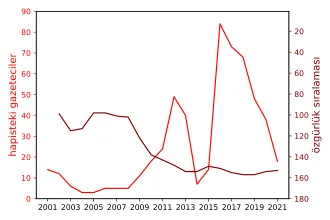
In reaction to the failed coup d'état on 15 July 2016, over 150 media organisations, including newspapers, television and radio channels, news agencies, magazines and publishing houses, have been closed down by the government of Turkey, and 160 journalists have been jailed.
By circulation, the most popular daily newspapers are Sabah, Sözcü, Hürriyet, Posta, and Milliyet. The broadcast media have a very high penetration as satellite dishes and cable systems are widely available. The "Radio and Television Supreme Council" (RTÜK) is the government body overseeing the broadcast media. Aside from Turkish, the state television network offers some programs in Arabic and Kurdish.
Turkish consumers are the second-most media illiterate when compared to countries in Europe, leaving them especially vulnerable to fake news, according to a 2018 study. A combination of low education levels, low reading scores, low media freedom and low societal trust went into making the score, which saw Turkey being placed second lowest only to North Macedonia.
Conspiracy theories are a prevalent phenomenon in Turkish media. According to the Reuters Institute Digital News Report 2018, Turkey was the country where people complained the most about completely made-up stories.
According to polling in 2024 by the Pew Research Center, 33% of adult Turks believe that media in Turkey have somewhat good or very good influence on the country, which is a decline from 57% who said so in 2017, while 63% stated that they had a very bad or somewhat bad influence on the country. People with a favorable view of Recep Tayyip Erdoğan viewed the media more positively with 47% saying that it had a good influence on the country, compared to 23% of people who viewed Erdoğan unfavorably.
Legislative framework
The Constitution of Turkey, at art. 28, states that the press is free and shall not be censored. Yet, Constitutional guarantees are undermined by restrictive provisions in the Criminal Code, Criminal Procedure Code, and anti-terrorism laws, effectively leaving prosecutors and judges with ample discretion to repress ordinary journalistic activities.
The Turkish judiciary can and do censure media outlets under other constitutional provisions and loosely interpreted laws, such as “protecting basic characteristics of the Republic” and “safeguarding the indivisible integrity of the State with its territory and nation.”
Freedom of information principles have been introduced with the April 2004 Right to Information Act, affording to citizens and legal persons the right to request information from public institutions and private organizations that qualify as public institutions, although the implementation of the law is lacking.
The 2007 Press Law was coupled with a “Regulation of Publications on the Internet and Suppression of Crimes Committed Through Such Publications”, authorising the Telecommunications Communication Presidency (TIB) to execute court orders to block websites and to issue blocking orders for the content providers in or outside Turkey for committing crimes such as child pornography, encouraging drug use and, especially, crimes against Atatürk. Between 2007 and 2010 around 3,700 websites and platforms including YouTube, MySpace, and GeoCities have been blocked.
Status and self-regulation of journalists
Media professionals in Turkey face job insecurity and lack of social security, being often forced to work without contract and outside the protection provided by the Law 212 on the rights of journalists. Without a contact under Law 212 media workers in Turkey cannot obtain a press badge and cannot take part in the Turkish Journalists Union (Türkiye Gazeteciler Sendikası, TGS)
Turkey's 2001 financial crisis further strengthened media owners' hands, as 3–5,000 journalists were fired, and the most troublesome ones targeted first.
Some themes have long remained quasi-taboo in the Turkish media, including the role of the Army, the Cyprus issue and the rights of the Kurdish and Armenian minorities. The interests of media owners in the major media conglomerates inevitably cast a shadow over the objectivity and independence of the controlled media outlets.
Ethics in Turkish journalism is based on a couple of documents: the “Declaration of Rights and Responsibilities” by Turkish Journalists Association (1998) and the “Code of Professional Ethics of the Press” by Turkish Press Council (1989).
In 2006 RTÜK introduced a voluntary ombudsman mechanism that media outlets can introduce in order to evaluate their audience's reactions. Yet, ombudsmen lack independence, as they are high-ranking employees of the same media groups.
Media outlets
Turkey hosts thousands of registered newspapers, including around 150–200 national titles, although only a fraction maintain significant circulation. A relatively small percentage are nationwide daily newspapers, while the majority consist of local or regional publications. Turkish print media traditionally places strong emphasis on opinion columns and commentary, and outlets are often characterised by pronounced political polarisation.
Broadcast media includes hundreds of television channels and thousands of radio stations, including outlets broadcasting in minority languages. The expansion of Kurdish-language media in the 2000s was regarded as a significant development in minority rights, though such outlets have faced regulatory and financial constraints.
The principal structural issues affecting mainstream media in Turkey include high concentration of ownership, widespread self-censorship among journalists, and the presence of nationalist rhetoric and hate speech. A large share of national newspapers and television channels are owned by conglomerates active in construction, energy, finance, and tourism, increasing their economic dependence on state contracts and public procurement.
Following the 2016 Turkish coup d'état attempt, numerous media outlets were closed by emergency decrees and dozens of journalists were detained as part of what has been described as a broad media purge. Public protests by journalists against arrests and newsroom closures were widely reported.
By the mid-2000s, three major media groups dominated advertising revenues in Turkey: the Doğan Media Group and the Sabah group together controlled approximately 80% of newspaper advertising, while Doğan, Sabah and the Çukurova Group accounted for around 70% of television advertising revenues.
In the Turkish context, highly concentrated corporate media power (such as Doğan’s) is even more significant when three additional factors are considered: (1) the willingness of corporate owners to ‘instrumentalize’ reporting in order to fit the wider political-economic interests of the parent company; (2) the weakness of journalists and other employees in the face of the power of corporate owners; and (3) the fact that corporate power is combined with restrictive state regulation on issues of freedom of speech.
Since 2018, the structure of media ownership has changed significantly. The sale of the Doğan Group’s media assets to the Demirören Group marked a major consolidation of mainstream media under ownership widely regarded as close to the government. As a result, a substantial portion of national print and broadcast media became concentrated within pro-government conglomerates.
Major cross-media groups active in Turkey in the 2020s include:
- Demirören Group (owner of Hürriyet, Posta, Milliyet, Fanatik, and formerly CNN Türk and Kanal D in partnership structures).
- Turkuvaz Media Group of Çalık Holding (publisher of Sabah and operator of ATV).
- Doğuş Media Group (owner of NTV and Star TV; Star TV was acquired from Doğan in 2011).
- Ciner Media Group (owner of Habertürk TV and related outlets).
- Former assets of the Çukurova Group were transferred through interventions by the Savings Deposit Insurance Fund of Turkey (TMSF) and subsequently sold to pro-government businessmen in the 2010s.
Observers have noted that while ownership concentration was already significant in the 2000s, the post-2016 and especially post-2018 restructuring further reduced pluralism in terms of ownership diversity, even as the number of outlets remained high.
In 2018, the sale of the Doğan Group’s media assets to the Demirören Group marked a major shift in ownership concentration. The acquisition consolidated a substantial portion of mainstream media under ownership widely perceived as aligned with President Recep Tayyip Erdoğan and the ruling AKP.
Several outlets formerly owned by the Çukurova Holding were transferred through state intervention involving the Savings Deposit Insurance Fund of Turkey (TMSF) before being sold to pro-government businessmen.
Television accounts for roughly half of advertising revenues in Turkey, while print media’s share has steadily declined. Given the relatively limited size of the advertising market compared to the number of outlets, smaller and independent organisations face financial vulnerability, contributing to further consolidation.
The broadcast sector is regulated by the Radio and Television Supreme Council (RTÜK), the state authority responsible for licensing and content oversight. Critics argue that regulatory enforcement has disproportionately affected opposition and independent broadcasters.
Overall, although Turkey’s media landscape remains numerically diverse, observers frequently describe it as highly concentrated in ownership, politically polarised, and constrained in terms of independent journalism.
Print media
Until 2017 and into mid-2018, a significant portion of Turkey’s print media was widely regarded as maintaining a relatively independent editorial line, with much of the mainstream press adopting a critical stance toward the government. However, during this period, the government of Turkey, the Erdoğan government intensified financial and regulatory pressure on major media conglomerates.
Large tax fines and legal proceedings were imposed on prominent media owners, while the state-controlled Savings Deposit Insurance Fund of Turkey (TMSF) was used to seize and subsequently reassign several media assets.
These developments paved the way for pro-government business groups to acquire major media outlets. One of the most notable examples was the purchase of the Doğan Media Group by the Demirören Group, a conglomerate widely perceived as close to President Recep Tayyip Erdoğan. The consolidation of media ownership under companies aligned with the government was viewed by observers and international watchdogs as a turning point.
The total number of readers of print media in Turkey is low, when compared to the big population of the country (95 newspapers per 1000 inhabitants). Circulating newspapers where estimated at 2,450 in 2010, of which 5 national, 23 regional and other local ones.
The media hubs of the country are Istanbul and Ankara. By circulation, the most popular daily newspapers are Hürriyet (330,000 daily sales in 2016), Sabah (300,000), Posta (290,000), Sözcü and Habertürk. Major Turkish daily newspapers are published every day of the year, including Sundays, religious and secular public holidays.
Big media conglomerates, with substantial interests in other economic sectors, dominate the media market and own all the major print and broadcast media. These are the Doğan Group, Turkuvaz Media Group, Ciner Group, Çukurova Group and Demirören Group:
- The Demirören Group is currently one of the largest Turkish media conglomerates, having acquired major assets of the former Doğan Group in 2018. It owns the mainstream daily Hürriyet, the boulevard daily Posta, the sports daily Fanatik (190,000), the business daily Referans (11,000), and the English-language daily Hürriyet Daily News (5,500).
- The Turkuvaz Group, owned by Çalık Holding, maintains close ties with the ruling AKP. It publishes the mainstream daily Sabah, the boulevard daily Takvim (approx. 120,000), the sports daily Fotomaç (approx. 200,000), and the prominent regional daily Yeni Asır (approx. 40,000).
- The Ciner Group launched Gazete Habertürk in March 2009.
- The Çukurova Group owns several nationalist-oriented publications, including Akşam (approx. 150,000), Tercüman (approx. 15,000), and the boulevard paper Güneş (approx. 110,000).
- The Albayrak group publishes the conservative Islamic daily Yeni Şafak (approx. 100,000), known for its pro-government editorial stance.
- Milli Gazete (approx. 50,000) continues as the voice of Milli Görüş, the ideology of religious-conservative parties, historically including Necmettin Erbakan’s National Salvation Party in the 1970s and the Welfare Party in the 1990s.
- Vakit (approx. 50,000) is a radical and sensationalist Islamic daily, which has faced multiple legal prosecutions.
- Cumhuriyet (approx. 55,000), historically linked to leftist movements, now serves as a reference for Kemalist and nationalist readers associated with the opposition CHP.
- Star (approx. 100,000) was launched by businessman Ethem Sancak as an Islamic-liberal daily and continues to maintain a pro-government editorial line.
- Yeni Akit (approx. 70,000) is a far-right Islamist daily known for strong pro-government positions and controversial coverage on social issues.
- BirGün (approx. 25,000) represents left-wing opposition perspectives, often critical of the AKP and Erdoğan government, and is considered one of the few remaining independent newspapers.
Magazines and periodicals too have a low circulation when compared with Turkey's population. The main ones are Tempo, Turkuvaz Group's Yeni Aktüel (8,000), and Newsweek Türkiye (5,000). Business magazines include Ekonomist and Para (around 9,000 copies each). Birikim is a well-reputed liberal-left journal, publishing elaborate articles on social and political issues. Satirical magazines have a long tradition in Turkey, with the first magazine (Diyojen) published in 1869.
There are currently around 20 satirical magazines; the leading ones are Penguen (70,000 weekly circulation), LeMan (50,000) and Uykusuz. Historical examples include Oğuz Aral's magazine Gırgır (which reached a circulation of 500,000 in the 1970s) and Marko Paşa (launched 1946). Others include L-Manyak and Lombak.
Minority newspapers include IHO and Apoyevmatini in Greek language; Agos, Jamanak and Nor Marmara in Armenian language; and Şalom by the Jewish community. Their survival is often at stake.
Distribution networks are in the hands of Doğan Group’s Yay-Sat and Turkuvaz Group’s Turkuvaz Dağıtım Pazarlama.
Radio broadcasting
Radio enjoys a large number of listeners in the Turkey.[citation needed] There are more than 1000 radio stations in the country. The first attempts at radio broadcasting began in 1921 in Istanbul, Turkey.
The first radio broadcast in Turkey began on May 6, 1927. In 1927, New York City, London, Berlin, Vienna, Moscow and Tehran connection was established. In 1945, Turkey's first university radio with ITU Radio was established. First state radio, on May 1, 1964 TRT Radio began broadcasts, holding monopoly in radio broadcasting until 1994.
Establishment of private radio stations began in the early 1990s by young visionary entrepreneurs. The first comers were Energy FM founded by Vedat Yelkenci who also launched the first Music Television TV channels Genc TV < and thereafter the Number One-MTV under licence by MTV Europe, Number one FM, launched by Omer Karacan and Ali Karacan, Genc Radyo launched by Osman Ataman, Power FM launched by Cem Hakko, Super FM and Kral FM launched by Cem Uzan, Capital Radio launched by Kalafatoglu. Internet radio in the late 1990s began to be established.
In 2010 Turkey had around 1,100 private radio stations, of which 100 available on cable - 36 national ones, 102 regional ones, and 950 local ones. TRT four radio channels include Radyo 1 (general), Radyo 2 (TRT-FM) (Turkish classical, folk and pop music), Radyo 3 (primarily classical music and also jazz, polyphonic and western pop music, broadcasts news in English, French and German), and Radyo 4 (Turkish Music).
TRT's international radio service Türkiye‘nin Sesi / Voice of Turkey broadcasts in 26 languages. TRT also has 10 regional radio stations.
Private radio stations offer mainly music programmes; the most popular ones are Kral FM (Turkish pop music), Süper FM (Western pop music), Metro FM (Western pop music), Power Türk (Turkish pop music), and Best FM (Turkish pop music). Several independent radio stations also broadcast in Turkey, including Istanbul's Açık Radyo (Open Radio), the first to be financially supported by listeners, and encouraging listeners to participate in public discussions on sensitive issues to promote open dialogue.
An Armenian-language internet radio, Nor Radio, started broadcasting in 2009.
Television broadcasting
Television is the primary source of information and entertainment in Turkey. According to surveys by the Radio and Television Supreme Council (RTÜK), average daily television viewing time has historically been around 3–4 hours per person.
Television broadcasting in Turkey was introduced in 1968 by the state broadcaster Turkish Radio and Television Corporation (TRT), preceded by experimental broadcasts by ITU TV in 1952. Color television was introduced in 1981. TRT maintained a state monopoly for approximately two decades. On 26 May 1989, Turkey’s first private television channel, Star TV, began broadcasting from Germany, effectively bypassing domestic restrictions.
The constitutional amendment of August 1993 formally ended TRT’s monopoly and liberalised private broadcasting.
Throughout the 1990s and 2000s, the number of broadcasters expanded rapidly. By 2010, Turkey had 24 national, 16 regional and more than 200 local television stations. The market came to be dominated by a handful of major national channels, including Kanal D, ATV, Show TV and Star TV.
Ownership concentration increased significantly after 2018. The sale of the Doğan Group’s media assets to the Demirören Group transferred ownership of major outlets including Kanal D and CNN Türk to a conglomerate widely regarded as close to President Recep Tayyip Erdoğan and the ruling AKP. The Turkuvaz Media Group (owned by Çalık Holding) controls ATV, while the Ciner Group operates Habertürk TV.
The Doğuş Media Group owns NTV and previously acquired Star TV in 2011. Several outlets formerly owned by the Çukurova Group were transferred via the Savings Deposit Insurance Fund of Turkey (TMSF) before being sold to pro-government businessmen.
The public broadcaster TRT operates multiple national and thematic channels, including TRT 1, TRT 2, TRT Haber, TRT Spor, TRT Müzik, and the Kurdish-language TRT Kurdi (launched in 2009 as part of reforms related to minority broadcasting). TRT also operates international channels such as TRT World, TRT Türk and TRT Avaz.
Thematic and 24-hour news channels include NTV, CNN Türk (a joint venture with CNN International), Habertürk TV, TGRT Haber and A Haber. Music channels include Kral TV and Number One TV. Observers have noted a tendency toward content homogenisation, with popular formats frequently replicated across competing networks.
Reception platforms are primarily terrestrial, satellite and cable. By the late 2000s, nearly half of Turkish households used satellite reception, including pay-TV services. The main multi-channel platforms include Digiturk, D-Smart and the cable provider Türksat.
The broadcast sector is regulated by RTÜK, which oversees licensing and content compliance. Critics argue that regulatory decisions and financial penalties have disproportionately affected opposition broadcasters, contributing to further consolidation and reduced pluralism in the television market.