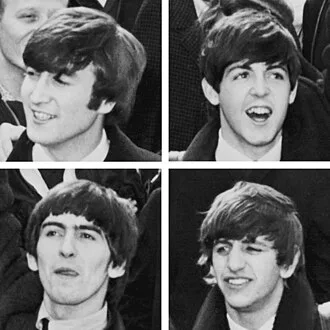
Led by primary songwriters Lennon and McCartney, the Beatles evolved from Lennon's previous group, the Quarrymen, and built their reputation by playing clubs in Liverpool and in Hamburg, West Germany, starting in 1960. Lennon, McCartney and Harrison, together since 1958, went through a succession of drummers before Starr joined in 1962.
Manager Brian Epstein moulded them into a professional act, and producer George Martin developed their recordings, greatly expanding their domestic success after they signed with EMI and achieved their first hit, "Love Me Do", in late 1962. As their popularity grew into the fan frenzy dubbed "Beatlemania", the band acquired the nickname "the Fab Four".
By early 1964, the Beatles were international stars and had achieved unprecedented levels of critical and commercial success. They became a leading force in Britain's cultural resurgence, ushering in the British Invasion of the United States pop market. They made their film debut with A Hard Day's Night (1964).
A growing desire to refine their studio efforts, coupled with the challenging nature of their concert tours, led to the Beatles' retirement from live performances in 1966. During this time, they produced albums of greater sophistication, including Rubber Soul (1965), Revolver (1966) and Sgt. Pepper's Lonely Hearts Club Band (1967).
They enjoyed further commercial success with The Beatles (also known as "the White Album", 1968) and Abbey Road (1969). The success of these records heralded the album era, increased public interest in psychedelic drugs and Eastern spirituality, and furthered advancements in electronic music, album art and music videos.
In 1968, the Beatles founded Apple Corps, a multi-armed multimedia corporation that continues to oversee projects related to their legacy. After the Beatles' break-up in 1970, all former members enjoyed success as solo artists. While some partial reunions occurred over the next decade, the members never fully reunited.
Lennon was murdered in 1980 and Harrison died of lung cancer in 2001; McCartney and Starr remain musically active.
The Beatles are the best-selling music act of all time, with estimated sales of over 600 million units worldwide. They are the most successful act in the history of the US Billboard charts, with the most number-one singles on the Billboard Hot 100 (20) and most number-one albums on the Billboard 200 (19).
They hold the record for most singles sold in the UK (21.9 million), and held the record for most number-one albums on the UK Albums Chart (15) until Robbie Williams surpassed them in 2026. The Beatles' accolades include nine Grammy Awards, four Brit Awards, an Academy Award (for Best Original Song Score for the 1970 documentary film Let It Be) and fifteen Ivor Novello Awards.
They were inducted into the Rock and Roll Hall of Fame in their first year of eligibility, 1988, and each principal member was individually inducted between 1994 and 2015. In 2004 and 2011, the Beatles topped Rolling Stone's lists of the greatest artists in history. Time named them among the 20th century's 100 most important people.
History
1956–1963: Formation
The Quarrymen and name changes
In November 1956, sixteen-year-old John Lennon formed a skiffle group with several friends from Quarry Bank High School in Liverpool. They were called the Quarrymen, a reference to their school song "Quarry men old before our birth". Fifteen-year-old Paul McCartney met Lennon on 6 July 1957 and joined as a rhythm guitarist shortly after.
In February 1958, McCartney invited his friend George Harrison, then aged fifteen, to watch the band. Harrison auditioned for Lennon, impressing him with his playing, but Lennon initially thought Harrison was too young. After a month's persistence, during a second meeting (arranged by McCartney), Harrison performed the lead guitar part of the instrumental song "Raunchy" on the upper deck of a Liverpool bus, and they enlisted him as lead guitarist.
By January 1959, Lennon's Quarry Bank friends had left the group and he began his studies at the Liverpool College of Art. The three guitarists, billing themselves as Johnny and the Moondogs, were playing rock and roll whenever they could find a drummer. They also performed as the Rainbows. Paul McCartney later told New Musical Express that they called themselves that "because we all had different coloured shirts and we couldn't afford any others!"
Lennon's art school friend Stuart Sutcliffe, who had just sold one of his paintings and was persuaded to purchase a bass guitar with the proceeds, joined in January 1960. He suggested changing the band's name to Beatals, as a tribute to Buddy Holly and the Crickets. They used this name until May, when they became the Silver Beetles, before undertaking a brief tour of Scotland as the backing group for pop singer and fellow Liverpudlian Johnny Gentle.
By early July, they had refashioned themselves as the Silver Beatles and by the middle of August simply the Beatles.
Early residencies and UK popularity
Allan Williams, the Beatles' unofficial manager, arranged a residency for them in Hamburg. They auditioned and hired drummer Pete Best in mid-August 1960. The band, now a five-piece, departed Liverpool for Hamburg four days later, contracted to club owner Bruno Koschmider for what would be a 3+1⁄2-month residency.
Beatles historian Mark Lewisohn writes: "They pulled into Hamburg at dusk on 17 August, the time when the red-light area comes to life ... flashing neon lights screamed out the various entertainment on offer, while scantily clad women sat unabashed in shop windows waiting for business opportunities."
Koschmider had converted a couple of strip clubs in the red light Reeperbahn district of St. Pauli into music venues and initially placed the Beatles at the Indra Club. After closing Indra due to noise complaints, he moved them to the Kaiserkeller in October. When he learned they had been performing at the rival Top Ten Club in breach of their contract, he gave them one month's termination notice, and reported the underage Harrison, who had obtained permission to stay in Hamburg by lying to the German authorities about his age.
The authorities arranged for Harrison's deportation in late November. One week later, Koschmider had McCartney and Best arrested for arson after they set fire to a condom in a concrete corridor; the authorities deported them. Lennon returned to Liverpool in early December, while Sutcliffe remained in Hamburg until late February with his German fiancée Astrid Kirchherr, who took the first semi-professional photos of the Beatles.
During the next two years, the Beatles were resident for periods in Hamburg, where they used Preludin both recreationally and to maintain their energy through all-night performances. In 1961, during their second Hamburg engagement, Kirchherr cut Sutcliffe's hair in the "exi" (existentialist) style, later adopted by the other Beatles.
Sutcliffe decided to leave the band early that year and resume his art studies in Germany. McCartney took over bass. Producer Bert Kaempfert contracted what was now a four-piece group until June 1962, and he used them as Tony Sheridan's backing band on a series of recordings for Polydor Records. As part of the sessions, the Beatles were signed to Polydor for one year.
Credited to "Tony Sheridan & the Beat Brothers", the single "My Bonnie", recorded in June 1961 and released four months later, reached number 32 on the Musikmarkt chart.
After the Beatles completed their second Hamburg residency, they enjoyed increasing popularity in Liverpool with the growing Merseybeat movement. However, they were growing tired of the monotony of numerous appearances at the same clubs night after night. In November 1961, during one of the group's frequent performances at the Cavern Club, they encountered Brian Epstein, a local record-store owner and music columnist.
He later recalled: "I immediately liked what I heard. They were fresh, and they were honest, and they had what I thought was a sort of presence ... [a] star quality."
First EMI recordings
Epstein courted the band over the next couple of months, and they appointed him as their manager in January 1962. Epstein began negotiations with record labels for a recording contract. After a New Year's Day audition, Decca Records rejected the band, saying, "Guitar groups are on the way out, Mr. Epstein." However, three months later, producer George Martin signed the Beatles to EMI's Parlophone label.
Throughout early and mid-1962, to secure a UK record contract, Epstein sought to free the Beatles from their contractual obligations to Polydor and Bert Kaempfert Productions. He eventually negotiated a one-month early release in exchange for one last recording session in Hamburg backing Tony Sheridan. On their return to Germany in April, a distraught Kirchherr met them at the airport with news of Sutcliffe's death the previous day from a brain haemorrhage.
Martin's first recording session with the Beatles took place at EMI Recording Studios (later Abbey Road Studios) in London on 6 June 1962. He immediately complained to Epstein about Best's drumming and suggested they use a session drummer in his place. Already contemplating Best's dismissal, the Beatles replaced him in mid-August with Ringo Starr, who left Rory Storm and the Hurricanes to join them.
A 4 September session at EMI yielded a recording of "Love Me Do" featuring Starr on drums, but Martin hired drummer Andy White for the band's third session a week later, as he was already booked for them as a replacement, which produced recordings of "Love Me Do", "Please Please Me" and "P.S. I Love You".
Martin initially selected the Starr version of "Love Me Do" for the band's first single, though subsequent re-pressings featured the White version, with Starr on tambourine. Released in early October, "Love Me Do" peaked at number 17 on the Record Retailer chart. Their television debut came later that month with a live performance on the regional news programme People and Places.
After Martin suggested rerecording "Please Please Me" at a faster tempo, a studio session in late November yielded that recording, of which Martin accurately predicted, "You've just made your first No. 1".
In December 1962, the Beatles concluded their fifth and final Hamburg residency at the Star-Club. By 1963, they had agreed that all four band members would contribute vocals to their albums – including Starr, despite his restricted vocal range, to validate his standing in the group. Lennon and McCartney had established a songwriting partnership, and as the band's success grew, their dominant collaboration limited Harrison's opportunities as a lead vocalist.
Epstein, to maximise the Beatles' commercial potential, encouraged them to adopt a professional approach to performing. Lennon recalled him saying, "Look, if you really want to get in these bigger places, you're going to have to change – stop eating on stage, stop swearing, stop smoking ...".
1963–1966: Beatlemania and touring years
Please Please Me and With the Beatles
On 11 February 1963, the Beatles recorded ten songs during a single studio session for their debut LP, Please Please Me. It was supplemented by the four tracks already released on their first two singles. Martin considered recording the LP live at The Cavern Club, but after deciding that the building's acoustics were inadequate, he elected to simulate a "live" album with minimal production in "a single marathon session at Abbey Road".
After the moderate success of "Love Me Do", the single "Please Please Me" was released in January 1963, two months ahead of the album. It reached number one on every UK chart except Record Retailer, where it peaked at number two.
Recalling how the Beatles "rushed to deliver a debut album, bashing out Please Please Me in a day", AllMusic critic Stephen Thomas Erlewine wrote: "Decades after its release, the album still sounds fresh, precisely because of its intense origins." Lennon said little thought went into composition at the time; he and McCartney were "just writing songs à la Everly Brothers, à la Buddy Holly, pop songs with no more thought of them than that – to create a sound. And the words were almost irrelevant."
Problems playing this file? See media help.
Released in March 1963, Please Please Me was the first of eleven consecutive Beatles albums released in the United Kingdom to reach number one. The band's third single, "From Me to You", came out in April and began an almost unbroken string of seventeen British number-one singles, including all but one of the eighteen they released over the next six years.
Issued in August, their fourth single, "She Loves You", achieved the fastest sales of any record in the UK up to that time, selling three-quarters of a million copies in under four weeks. It became their first single to sell a million copies and remained the biggest-selling record in the UK until 1978.
The success brought increased media exposure, to which the Beatles responded with an irreverent and comical attitude that defied the expectations of pop musicians at the time, inspiring even more interest. The band toured the UK three times in the first half of the year: a four-week tour that began in February, the Beatles' first nationwide, preceded three-week tours in March and May–June.
As their popularity spread, a frenzied adulation of the group took hold. On 13 October, the Beatles starred on Sunday Night at the London Palladium, the UK's top variety show. Their performance was televised live and watched by 15 million viewers. One national paper's headlines in the following days coined the term "Beatlemania" to describe the riotous enthusiasm by screaming fans who greeted the band – and it stuck.
Although not billed as tour leaders, the Beatles overshadowed American acts Tommy Roe and Chris Montez during the February engagements and assumed top billing "by audience demand", something no British act had previously accomplished while touring with artists from the US. A similar situation arose during their May–June tour with Roy Orbison.
In late October, the Beatles began a five-day tour of Sweden, their first time abroad since the final Hamburg engagement of December 1962. On their return to the UK on 31 October, several hundred screaming fans greeted them in heavy rain at Heathrow Airport. Around 50 to 100 journalists and photographers, as well as representatives from the BBC, also joined the airport reception, the first of more than 100 such events.
The next day, the band began its fourth tour of Britain within nine months, this one scheduled for six weeks. In mid-November, as Beatlemania intensified, police resorted to using high-pressure water hoses to control the crowd before a concert in Plymouth. On 4 November, they played in front of The Queen Mother and Princess Margaret during the Royal Variety Performance at the Prince of Wales Theatre.
Please Please Me maintained the top position on the Record Retailer chart for 30 weeks, only to be displaced by its follow-up, With the Beatles, which EMI released on 22 November to record advance orders of 270,000 copies. The LP topped a half-million albums sold in one week. Recorded between July and October, With the Beatles made better use of studio production techniques than its predecessor.
It held the top spot for 21 weeks with a chart life of 40 weeks. Erlewine described the LP as "a sequel of the highest order – one that betters the original".
In a reversal of then standard practice, EMI released the album ahead of the impending single "I Want to Hold Your Hand", with the song excluded to maximise the single's sales. The album caught the attention of music critic William Mann of The Times, who suggested that Lennon and McCartney were "the outstanding English composers of 1963".
The newspaper published a series of articles in which Mann offered detailed analyses of the music, lending it respectability. With the Beatles became the second album in UK chart history to sell a million copies, a figure previously reached only by the 1958 South Pacific soundtrack. When writing the sleeve notes for the album, the band's press officer, Tony Barrow, used the superlative the "fabulous foursome", which the media widely adopted as "the Fab Four".
First visit to the United States and the British Invasion
EMI's American subsidiary, Capitol Records, hindered the Beatles' releases in the United States for more than a year by initially declining to issue their music, including their first three singles. Concurrent negotiations with the independent US label Vee-Jay led to the release of some, but not all, of the songs in 1963.
Vee-Jay finished preparation for the album Introducing... The Beatles, comprising most of the songs of Parlophone's Please Please Me, but a management shake-up led to the album not being released. After it emerged that the label did not report royalties on their sales, the licence that Vee-Jay had signed with EMI was voided.
A new licence was granted to the Swan label for the single "She Loves You". The record received some airplay in the Tidewater area of Virginia from Gene Loving of radio station WGH and was featured on the "Rate-a-Record" segment of American Bandstand, but it failed to catch on nationally.
Epstein brought a demo copy of "I Want to Hold Your Hand" to Capitol's Brown Meggs, who signed the band and arranged for a $40,000 US marketing campaign. American chart success began after disc jockey Carroll James of AM radio station WWDC, in Washington, DC, obtained a copy of the British single "I Want to Hold Your Hand" in mid-December 1963 and began playing it on-air.
Taped copies of the song soon circulated among other radio stations throughout the US. This caused an increase in demand, leading Capitol to bring forward the release of "I Want to Hold Your Hand" by three weeks. Issued on 26 December, with the band's previously scheduled debut there just weeks away, "I Want to Hold Your Hand" sold a million copies, becoming a number-one hit in the US by mid-January.
In its wake Vee-Jay released Introducing... The Beatles along with Capitol's debut album, Meet the Beatles!, while Swan reactivated production of "She Loves You". The Odeon label, an EMI subsidiary, pressed Beatles LPs to be shipped out and distributed abroad. After the Beatles' US trip, MGM Records released the single "My Bonnie" backed with "The Saints" in the US on 27 January 1964 as a Beatles single, and Atco followed in issuing the recordings the Beatles had made in Germany with Tony Sheridan in 1961 and 1962.
On 7 February 1964, the Beatles departed from Heathrow with an estimated 4,000 fans waving and screaming as the aircraft took off. Upon landing at New York's John F. Kennedy Airport, an uproarious crowd estimated at 3,000 greeted them. They gave their first live US television performance two days later on The Ed Sullivan Show, watched by approximately 73 million viewers in over 23 million households, or 34 per cent of the American population.
Biographer Jonathan Gould writes that, according to the Nielsen rating service, it was "the largest audience that had ever been recorded for an American television program". The next morning, the Beatles awoke to a largely negative critical consensus in the US, but a day later at their first US concert, Beatlemania erupted at the Washington Coliseum.
Back in New York the following day, the Beatles met with another strong reception during two shows at Carnegie Hall. The band then flew to Florida, where they appeared on The Ed Sullivan Show a second time, again before 70 million viewers, before returning to the UK on 22 February.
The Beatles' first visit to the US took place when the nation was still mourning the assassination of President John F. Kennedy the previous November. Commentators often suggest that for many, particularly the young, the Beatles' performances reignited the sense of excitement and possibility that had momentarily faded in the wake of the assassination and helped pave the way for the revolutionary social changes to come later in the decade.
Their hairstyle, unusually long for the era and mocked by many adults, became an emblem of rebellion to the burgeoning youth culture.