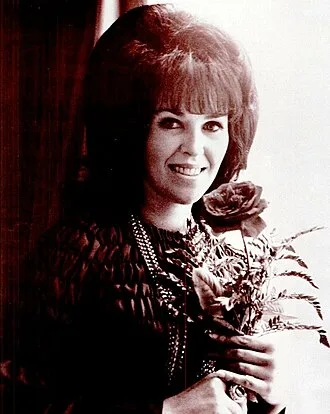
Jackson began performing as a child and later had her own radio show in Oklahoma City. She was then discovered by country singer Hank Thompson, who helped her secure a recording contract with Decca Records in 1954. At Decca, Jackson had her first hit single with the country song "You Can't Have My Love". She began touring the following year with Elvis Presley.
The two briefly dated and Presley encouraged her to record in the rockabilly style. In 1956, Jackson signed with Capitol Records where she was given full permission to record both country and rockabilly. The label released a string of Jackson's rock singles, including "Fujiyama Mama", "Mean Mean Man" and the top 40 hit "Let's Have a Party".
In the 1960s, Jackson moved back to the country genre and had several charting singles during the decade. This included "Right or Wrong", "In the Middle of a Heartache", "Tears Will Be the Chaser for Your Wine" and "A Woman Lives for Love". In addition, she also recorded several selections for the German language market overseas.
In 1965, the German single "Santo Domingo" reached number one on the Austrian pop chart. After re-discovering Christianity in 1971, Jackson made gospel music a priority in her career. She left Capitol Records in 1973 and signed with Word Records to focus more on the gospel circuit. Over the next two decades, she released a series of gospel records.
In 1984, Jackson was sought out by European promoters to tour overseas. The same year, she released her first rock album in two decades and launched a new career in the genre. In the 1990s, her rock records were noticed again by American audiences and she began touring alongside fellow Rockabilly artist Rosie Flores. During this period, she released several commercially acclaimed albums in the rock and roll style, including Heart Trouble (2003) and I Remember Elvis (2006).
Following her 2009 induction into the Rock and Roll Hall of Fame, Jackson collaborated with musician Jack White to record the commercially successful The Party Ain't Over. For several years, she kept a busy touring schedule before announcing her retirement from performing in 2019. She released her 32nd and final studio project, Encore, in 2021.
Early life
Jackson was the only child of Tom and Nellie Jackson in Maud, Oklahoma. Her father worked multiple jobs, including a gas station attendant and delivery truck driver. He also played music in a local band alongside his brother. Because of limited opportunities in Maud, the family moved to Los Angeles, California, in 1941.
Jackson often sang alongside her parents at home. Nellie Jackson often had Jackson sing while she was out of sight, to ensure her daughter was accounted for. In Los Angeles, Jackson was introduced to western swing music. She enjoyed hearing music by popular western acts like Bob Wills and Rose Maddox. When she was six years old, her father introduced Jackson to the guitar. She also took guitar lessons and was soon skillful enough to play it alongside her father.
In the mid-1940s, the family relocated to Bakersfield, California, where Tom Jackson took a job as a barber. She also took piano lessons and continued to play the guitar. During this period, she began having trouble with academics. Jackson recalled the experience in her autobiography: "All I wanted to do was sing and play music, and it was impossible for me to sit still." When Jackson was nine, the family moved back to their home state, this time living in Oklahoma City. Her father found employment as a taxi cab driver and her mother worked on an air force base.
In Oklahoma City, Jackson sang in the local Baptist church and engaged in more performance opportunities. She auditioned for the local radio station, KLPR, after being pressured by peers. She was featured on one program, which impressed the station's disc jockey, who encouraged her to audition for a second KLPR contest.
Jackson won the second contest at KLPR, which allotted Jackson her own 15-minute radio segment. On the show, Jackson performed a set of country songs and recalled having little understanding of how to host a radio show. "I was flying by the seat of my pants, but it didn't scare me to get out on a limb and try something brand new. I liked it," she explained in her biography.
As a teenager, Jackson attended Capitol Hill High School in Oklahoma City and continued her radio show. She also dated fellow student Leonard Sipes, who would later go by the name Tommy Collins. In 1952, Jackson was heard on the air by country singer and local resident, Hank Thompson. The singer invited Jackson to perform with him at the Trianon Ballroom in Oklahoma City.
On Thompson's show, Jackson sang "Blue Yodel No. 6" backed by his band, the Brazos Valley Boys. The performance led to a regular gig singing alongside Merl Lindsay's country band. Jackson was always performing, and at times neglected her social life. "[Wanda] never had time for dates, nothing like that. Just that guitar – that's all she thought about," a high school friend recalled.
Career
1953–1955: Country beginnings
Jackson also continued working with Hank Thompson. In 1953, she appeared with him regularly on his local television program and on a similar program for 30 minutes hosted by KLPR. Thompson also recorded Jackson on several demonstration tapes in hopes they would be heard by major record labels. Thompson was also attempting to get his band member Billy Gray a recording contract and had the pair sing several duets.
Jackson was supposed to be signed by Thompson's label, Capitol Records, but was rejected by producer Ken Nelson. "Girls don't sell records!" he told Thompson. In her book, Jackson recalled hearing Nelson's statement: "I recognize that Ken wasn't being sexist, so much as he was thinking about business. But it still gave me a little nudge to prove him wrong!"
Instead, Thompson contacted Paul Cohen of Decca Records, who was interested in signing Jackson and Billy Gray. In 1954, while still high school, Jackson signed with the label. In March 1954, the Jackson family traveled to Hollywood, California, where she recorded her first Decca sessions backed by Thompson's band. She cut several solo sides, along with the Billy Gray duet, "You Can't Have My Love".
Jackson disliked the song, but Thompson convinced her to record it. It was soon released as Jackson's debut single on Decca and reached the top-10, climbing to number eight on the US country songs chart. Upon Decca's encouragement, Jackson and Gray recorded a second duet, titled "If You Don't Somebody Else Will". Released as a single, the song was a commercial failure due to a competing version by Jimmy & Johnny that reached the charts.
Instead of touring, Jackson started her senior year in fall 1954 and finished high school. She was part of the school band and acted in the musical Anything Goes. In March 1955, she returned to the recording studio, this time working with Paul Cohen at the Decca studio in Nashville, Tennessee. Jackson also did her first performance on the Grand Ole Opry while in town.
For the performance, her mother made a dress fitted with spaghetti straps and a sweetheart neckline. Host Ernest Tubb told her it was unacceptable, so she covered it with a fringe jacket. She later recalled hearing fellow Opry members making negative comments about her while she was onstage. "I decided that night that the Grand Ole Opry scene was not for me," she recounted.
In 1955, Jackson graduated from Capitol Hill High School in Oklahoma City and began touring. Jackson's father quit his job to become her full-time manager, and he hired Bob Neal to book her engagements. Jackson's first concert dates included up-and-coming performer Elvis Presley. Together, the pair worked multiple shows alongside several other country performers in the United States that year.
Jackson's father chaperoned her during the shows and drove her from one date to the next. Presley encouraged her to perform rock and roll music. He played her several rhythm and blues records and informed her of rock's growing popularity. Jackson also joined the cast of the Ozark Jubilee in 1955.
1956–1960: Rock and roll years
In 1956, Decca Records released Jackson from her contract. With Hank Thompson's help, she secured a new contract with Capitol Records the same year. At her first Capitol recording session, Jackson cut two country songs and one rock and roll selection. One song, "I Gotta Know", incorporated elements of both country and rock.
According to Jackson, the song's mixture of rock allowed her to get acquainted with the genre. Released as a single in 1956, "I Gotta Know" became Jackson's second commercially successful release, peaking at number 15 on the US country chart. Jackson continued recording rock and roll music under her Capitol contract and was given full permission to do so by producer Ken Nelson.
Jackson also composed several of her Capitol recordings, including "Baby Loves Him", "Cool Love" and "Mean Mean Man". She continued recording country music as well, often putting each style on either side of a single release.
Writers and critics have remarked positively about Jackson's recordings from the 1950s and noted their take on women's sexuality. Mary A. Bufwack and Robert K. Oermann described songs like "Baby Loves Him" as "rockabilly classics". In addition, they commented that Jackson's rock records were "sexually aggressive" and demonstrated "almost frightening savagery".
Bruce Eder added that Jackson's material was at times "astonishingly raucous and even raunchy". Meanwhile, Kurt Wolff found that Jackson's rock material was also mixed with traditional country elements, which added to her musical individuality: "Jackson mixed straight country material and hot-to-the-core rockabilly numbers almost right from the beginning...Songs like 'Fujiyama Mama' and 'Mean Mean Man' were hard and fast, giving her plenty of reason to shimmy around in her glamorous fringe dresses".
In 1957, Jackson began working under a new booking agent, who arranged several tours in 1957 and 1958. Fellow performers included Johnny Cash, Jerry Lee Lewis, and Carl Perkins. With her new management, Jackson was making more money, sometimes as much as $500 per gig. Meanwhile, her follow-up singles proved unsuccessful in the United States.
According to Jackson, Capitol was unsure how to market her. "Capitol was still trying to figure out what to do with me, but they maintained faith that I could have strong potential in the teen market," she recalled in 2017. To promote her material, the label chose to release Jackson's eponymous debut album in 1958. The record mixed both rock and country selections.
Included were her covers of the rock songs "Money Honey" and "Long Tall Sally". Also included were the country songs "Heartbreak Ahead" and "Making Believe". Produced by Ken Nelson, it was released on Capitol in July 1958 with six tracks on either side of the record.
Also in 1958, Jackson saw success overseas with the rock and roll single, "Fujiyama Mama". Ken Nelson was reluctant to release the song, with its references to the Hiroshima and Nagasaki bombings. Yet, the disc found commercial appeal with Japanese fans, reaching number one on the nation's music chart. The song's success led Jackson to a Japanese tour in 1959.
She played venues in major cities including Tokyo and Okinawa. Upon her return to America, Jackson played in Las Vegas with Bob Wills and did additional concerts with her newly formed touring band. At different points, the band lineup included Roy Clark and black pianist Big Al Downing. She recalled touring alongside Downing, who was sometimes denied entrance into venues because of his race.
In response, Jackson would refuse to work a show unless Downing performed with her. "Look, he's part of our band. If he's not welcome, then none of us are," she once told a club owner.
In 1960, Jackson's album cover of "Let's Have a Party" was discovered by an Iowa disc jockey, which led to an increased interest in it by radio listeners. Upon the encouragement of Capitol Records, "Let's Have a Party" was issued as a single the same year. By July 1960, it had reached number 37 on the US Hot 100. It also found commercial success in Australia and the United Kingdom.
The success of "Let's Have a Party" led to Jackson to rename her band "The Party Timers" and prompted her label to release the compilation, Rockin' with Wanda (1960). The album included her previously recorded rock songs from the 1950s. It would later be reviewed positively by AllMusic, which gave it four and a half stars.
Her third studio album for Capitol, as noted, came along in early 1961, titled There's a Party Goin' On, which included more rock and roll material. Richie Unterberger of AllMusic described the LP as a "pretty solid and energetic set" despite not having "most of Wanda's best rockabilly sides".
1961–1971: New languages and return to country music
In the early 1960s, old school rock and roll musicians lost favor as the "Big Beat" of the British Invasion grew in popularity. Feeling pressure from Capitol, Ken Nelson met with Jackson to discuss which genre she should fit. Because she had her greatest commercial success with country music, it was ultimately decided to invest Jackson there. "I wanted to record whatever I wanted to record, but I also understood that Capitol Records had made an investment in me," she recalled in her book.
In 1961, Jackson returned with the self-penned track "Right or Wrong". She initially intended to pitch it to Brenda Lee, but Nelson believed Jackson could have success with her own version. The single climbed to number nine on the US country chart, the top 30 of the US Hot 100 and number nine on the US adult contemporary survey.
An album of the same name followed in 1961 that split country selections on "side A" and rockabilly selections on "side B". Her next single release, "In the Middle of a Heartache", was also a top-10 hit, reaching number six on the same country chart and number 27 on the Hot 100.
In August 1962, Jackson's fourth studio album was released titled Wonderful Wanda. The album included "In the Middle of a Heartache", along with the country-pop crossover tunes "If I Cried Every Time You Hurt Me" and "A Little Bitty Tear". The latter single had been released following Burl Ives's version, which became more commercially successful than hers. Wonderful Wanda received a positive review from critics, including Billboard magazine, which described her vocal performance as being "in fine form".
Jackson and The Party Timers then toured the southwestern United States for a series of one-night concert engagements. Now newly married, husband Wendell Goodman quit his job with IBM to become her full-time manager in 1962. Capitol continued releasing further country-flavored recordings by Jackson. In 1963, the label issued a Nashville Sound-inspired album of pop covers called Love Me Forever.
It was followed in 1964 by her sixth studio album titled Two Sides of Wanda, which was another split disc of rockabilly and country selections.
In 1965, Jackson partnered with Capitol's German record distributor named Electrola Records. The label arranged for her to record music in the German language because her singing voice was "very pleasing to the German ear". That year, she flew to Cologne, Germany where she cut several selections in German. Material was written especially for Jackson and she was coached through singing in German with the help of a vocal instructor.
Following the sessions, Capitol released "Santo Domingo" as a single to the German market in 1965. The song became her first number one single in her career, climbing to the top of the Austrian pop chart and the top five of the German pop list. In Germany and Austria, Jackson had several more charting songs, including the top ten "Doch dann kam Johnny".
Jackson's foreign-language success led to several European tours during the 1960s, including a package show with Roy Orbison. Upon her return to the United States, Jackson recorded for Capitol Records in Dutch as well as Japanese.
In the US, Jackson became increasingly identified with the country genre as the 1960s progressed. Between 1965 and 1967, she hosted her own syndicated country television program titled Music Village. In 1965, Blues in My Heart became her first album to reach the US country albums chart. In 1966, Jackson had her first US country hit in several years with the top 20 tune "The Box It Came In".
It was followed by the number 11 chart single, "Tears Will Be the Chaser for Your Wine". They were issued on her tenth studio album titled Reckless Love Affair (1967). The album became her third chart entry on the US country albums list, peaking at number 17. Jackson had eleven more charting US country songs during the 1960s, including the top 40 hits "A Girl Don't Have to Drink to Have Fun", "Both Sides of the Line", "My Baby Walked Right Out on Me" and "Two Separate Bar Stools".
In 1969, "My Big Iron Skillet", reached the top-20 there. Other singles including an answer song to Glen Campbell's "By the Time I Get to Phoenix" titled "By the Time You Get to Phoenix" that made the US country top-50. Her three studio albums, You'll Always Have My Love (1967), Cream of the Crop (1968) and The Many Moods of Wanda Jackson (1968) made the Billboard country LP's list.
Jackson's country recordings also received attention from music critics and journalists. Billboard magazine described a 1965 studio album as both "poetic and tearful". Mary A. Bufwack and Robert K. Oermann gave the music a mixed review in their 2003 book: "Of Wanda's many country hits between 1961 and 1972, none recaptured her rockabilly zing, although several were self-assertive about women's issues." Meanwhile, Kurt Wolff described her mid-1960s singles as "deeply bitter and vengeful", while also having "genuine honky-tonk emotion".
In reviewing a 2006 country compilation album, AllMusic's Thom Jurek found Jackson to be "a solid, original country singer".
In 1969, Jackson recorded her first live record in Phoenix, Arizona titled Wanda Jackson in Person. Following the album, Capitol Records started replacing Ken Nelson with different producers to record Jackson. This included a two-album stint with producer George Richey, which ended in creative differences, according to Jackson.
Richey and Jackson's recordings led to her next major hit called "A Woman Lives for Love" (1970). The single reached number 17 on the US country chart. In 1971, Jackson was assigned Larry Butler to produce her next studio album titled I've Gotta Sing. The project made the top 20 on the US country LP's list, and was her first charting album since 1968. It also featured the single, "Fancy Satin Pillows", which made it to number 13 on the US country survey.
1972–1983: Gospel and christian music transition
In the early 1970s, Jackson and her husband became born-again Christians. The shift in her personal life prompted Jackson to concentrate more on Gospel music. "Wendell and I both felt like God was calling us to stop working in nightclubs and bars in order to dedicate ourselves to the ministry," her autobiography recounted.
Jackson's husband started removing her concerts from the country music night club circuit (which accounted for eighty percent of her income). She also began giving her testimony on stage, and played various tent show revivals. In 1972, Capitol released her first Gospel studio project called Praise the Lord. The LP featured vocal harmonies from The Oak Ridge Boys and included Jackson's first self-penned track. The record was well received by Billboard magazine, who called it "a beautiful spiritual album".
To fulfill her obligations with Capitol, Jackson continued releasing country LP's. In 1972, the company released I Wouldn't Want You Any Other Way, a ten-track collection of traditional country songs. It included the top 40 country selections, "Back Then" and "I Already Know (What I'm Getting for My Birthday)".
In her next studio sessions, Jackson asked Ken Nelson to record another gospel record, which he did not support. At the same time, Word Records offered a contract that would allow her the freedom to record more spiritual material. Knowing she was unhappy, Nelson allowed Jackson to accept Word's offer and she was released from her Capitol contract.
Capitol released her last studio album in 1973 titled Country Keepsakes. The disc peaked at number 43 on the US country chart.
Jackson's signing with Word allowed her to also record with their imprint label Myrrh Records. In her autobiography, Jackson explained that Word issued her gospel records while Myrrh issued her country records. In 1973, Word distributed her second gospel album titled Country Gospel. The project featured covers of the hymn "Farther Along" and Kris Kristofferson's Christian tune "Why Me, Lord".
In 1974, Myrrh released the country record When It's Time to Fall in Love Again. Spawned from the album was the single, "Come on Home (To This Lonely Heart)". Billboard described it as "a beautiful love song" that hinted at her Christian "inner spirits". The single was Jackson's last to chart, peaking at number 98 on the US country survey.
Jackson later claimed that Word lost interest in her country recordings after being bought out by Dot Records. She was then left to only record gospel. "I was stuck, once again, being pigeonholed," Jackson commented in her book.
Word and Myrrh released three more studio gospel albums by Jackson during the decade: Now I Have Everything (1975), Make Me Like a Child Again (1976), and Closer to Jesus (1977) Reflecting on the LP's in her autobiography, Jackson commented that none of them were "particularly memorable" to her. In 1979, her contract with the labels ended.
In need of a change, the Jackson family temporarily moved to Texas where she became a stay-at-home mother. Yet, the family was unhappy with the move. In 1980, they relocated to Oklahoma City where they built a house and she continued her entertainment career. The same year, she released a new country disc on the UK-based Deep Sea Music company titled Good Times.
The album spawned one single, a cover of Melba Montgomery's "Don't Let the Good Times Fool You". In 1982, K-tel released a studio album of re-recordings titled Let's Have a Party. With limited commercial attention to her music, Jackson felt professionally-stuck. "I wasn't even fifty yet, but I felt like I'd been forced into an early retirement as time had passed me by," she recalled in her 2017 book.
1984–2006: Rock and roll revival
In the mid-1980s, rockabilly music increased in popularity in Europe, as did rock and roll. Jackson's Capitol rock recordings received interest from European fans and she was soon sought out by overseas promoters. Jackson and her husband saw the opportunity as a message from God. "Wendell and I both realized that God was going to use our testimony in places that needed it", her autobiography explained.
In 1984, her husband received a phone call from Swedish businessman, Harry Holmes, who was interested in recording her. Jackson then traveled to Scandinavia to record her first album of rock material in two decades. In 1984, Tab Records released Rockabilly Fever. The album was later released in the United States as Rock 'N' Roll Away Your Blues.
The project featured covers of rockabilly numbers like "Stupid Cupid" and "It's Only Make Believe". The album received a three-star rating from Allmusic, while writers Mary Bufwack and Robert Oermann positively described it as "rockabilly fire".