Ebû Saîd Gürgânî
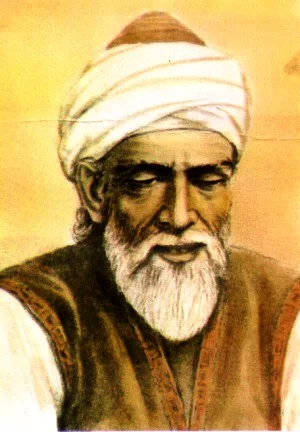
Ebû Saîd Darîr Gürgânî is an Iranian mathematician and astronomy scholar who lived in the 9th century. As can be understood from its name, it is located in the Gürgân (Cürcân) region in the southeast of the Caspian Sea. The word "Darîr" in its name is an Arabic nickname used for visually impaired people.
Little is known about his life; His birth date is not recorded, but his death is usually placed in 845. It is also controversial among historians of science who his teacher was: While George Sarton considered him a student of the linguist İbnü'l-A'râbî, Carl Brockelmann did not accept this connection.
works
Two works from Gürgani have survived to the present day. One of these is Mesâil-i Hendesiyye, which deals with geometry problems. The other is a treatise on how to determine the noon line, that is, the meridian, of a place using geometric methods; This work is based on Ptolemy's work Analemma and includes the proof of the method.
The manuscripts of both works are in Cairo. The Meridian treatise was translated into German by the German science historian Carl Schoy.
Gürgani is one of the lesser-known names of the first generation in which the Greek mathematics and astronomy heritage was developed and developed during the Abbasid period. Although the information about him is limited, the treatise he wrote on meridian determination is considered one of the early examples of applied astronomy in the Islamic world.
📚 Source: Wikipedia