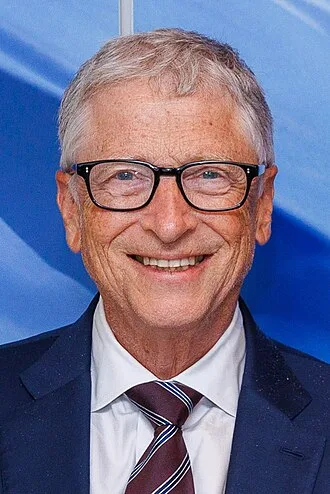
Born and raised in Seattle, Washington, Gates was privately educated at Lakeside School, where he befriended Allen and developed his computing interests. In 1973, he enrolled at Harvard University, where he took classes including Math 55 and graduate-level computer science courses, but he dropped out in 1975 to co-found and lead Microsoft.
He served as its CEO for the next 25 years and also became president and chairman of the board when the company was incorporated in 1981. Succeeded as CEO by Steve Ballmer in 2000, he transitioned to chief software architect, a position he held until 2008. He stepped down as chairman of the board in 2014 and became technology adviser to CEO Satya Nadella and other Microsoft leaders, a position he still holds. He resigned from the board in 2020.
Over time, Gates reduced his role at Microsoft to focus on his philanthropic work with the Bill & Melinda Gates Foundation, the world's largest private charitable organization, which he and his then-wife, Melinda French Gates, co-chaired from 2000 until 2024. Focusing on areas including health, education, and poverty alleviation, Gates became known for his efforts to combat transmissible diseases such as tuberculosis, malaria, and polio.
After French Gates resigned as co-chair following the couple's divorce, the foundation was renamed the Gates Foundation, with Gates as its sole chair.
Gates is the founder and chairman of several other companies, including BEN, Cascade Investment, TerraPower, Gates Ventures, and Breakthrough Energy. In 2010, he and Warren Buffett founded the Giving Pledge, whereby they and other billionaires pledged to give at least half their wealth to philanthropy. Named as one of the 100 most influential people of the 20th century by Time magazine in 1999, he has received numerous other honors and accolades, including a Presidential Medal of Freedom, awarded jointly to him and French Gates in 2016 for their philanthropic work.
The subject of several documentary films, he published the first of three planned memoirs, Source Code: My Beginnings, in 2025.
Early life and education
William Henry Gates III was born on October 28, 1955, in Seattle, Washington, as the only son of Bill Gates Sr. (1925–2020) and his first wife, Mary Maxwell Gates (1929–1994). His ancestry includes English, German, and Irish/Scots-Irish. His father was a prominent lawyer, and his mother served on the board of directors of First Interstate BancSystem and United Way of America.
Gates's maternal grandfather, J. W. Maxwell, was a national bank president. Gates also has an older sister, Kristi (Kristianne), and a younger sister, Libby. He is the fourth of his name in his family, but is known as William Gates III or "Trey" (i.e., three) because his father had the "II" suffix. The family lived in the Sand Point area of Seattle in a home that was damaged by a rare tornado when Gates was 7.
When Gates was young, his parents wanted him to pursue a career in law. During his childhood, his family regularly attended a church of the Congregational Christian Churches, a Protestant Reformed denomination.
Gates was small for his age and was bullied as a child. The family encouraged competition; one visitor reported that "it didn't matter whether it was hearts or pickleball or swimming to the dock; there was always a reward for winning, and there was always a penalty for losing".
At age 13, Gates enrolled in the private Lakeside Prep School. When he was in the eighth grade, the Mothers' Club at the school used proceeds from Lakeside School's rummage sale to buy a Teletype Model 33 ASR terminal and a block of computer time on a General Electric (GE) computer for the students. Gates took an interest in programming the GE system in BASIC, and he was excused from math classes to pursue his interest.
He wrote his first computer program on this machine, an implementation of tic-tac-toe that allowed users to play games against the computer. Gates was fascinated by the machine and how it would always execute software code perfectly.
After the Mothers Club donation was exhausted, Gates and other students sought time on systems, including DEC PDP minicomputers. One of these systems was a PDP-10 belonging to Computer Center Corporation (CCC), which banned Gates, Paul Allen, Ric Weiland, and Gates's best friend and first business partner, Kent Evans, for the summer after it caught them exploiting bugs in the operating system to obtain free computer time.
The four students formed the Lakeside Programmers Club to make money. At the end of the ban, they offered to find bugs in CCC's software in exchange for extra computer time. Rather than using the system remotely via Teletype, Gates went to CCC's offices and studied source code for various programs that ran on the system, including Fortran, Lisp, and machine language. The arrangement with CCC continued until 1970, when the company went out of business.
In 1971, a Lakeside teacher enlisted Gates and Evans to automate the school's class-scheduling system, providing them computer time and royalties in return. The duo worked diligently in order to have the program ready for their senior year. Towards the end of their junior year, Evans was killed in a mountain climbing accident, which Gates described as one of the saddest days of his life. He then turned to Allen, who helped him finish the system for Lakeside.
At age 17, Gates formed a venture with Allen called Traf-O-Data to make traffic counters based on the Intel 8008 processor. In 1972, he served as a congressional page in the House of Representatives. He was a national merit scholar when he graduated from Lakeside School in 1973. He scored 1590 out of 1600 on the SAT and enrolled at Harvard University in the autumn of 1973.
Gates did not stay at Harvard long enough to choose a concentration, but took mathematics (including Math 55) and graduate-level computer science courses. While at Harvard, he met fellow student and future Microsoft CEO Steve Ballmer. Gates left Harvard after two years while Ballmer stayed and graduated magna cum laude. Years later, Ballmer succeeded Gates as Microsoft's CEO and maintained that position from 2000 until his resignation in 2014.
Gates devised an algorithm for pancake sorting as a solution to one of a series of unsolved problems presented in a combinatorics class by Professor Harry Lewis. His solution held the record as the fastest version for over 30 years, and its successor is faster by only 2%. His solution was formalized and published in collaboration with Harvard computer scientist Christos Papadimitriou.
Gates remained in contact with Paul Allen and joined him at Honeywell during the summer of 1974. In 1975, the MITS Altair 8800 was released based on the Intel 8080 CPU, and Gates and Allen saw the opportunity to start their own computer software company. Gates dropped out of Harvard that same year. His parents were supportive of him after seeing how much he wanted to start his own company.
He explained his decision to leave Harvard: "If things hadn't worked out, I could always go back to school. I was officially on leave."
Business career
Microsoft
BASIC
Gates read the January 1975 issue of Popular Electronics, which demonstrated the Altair 8800, and contacted Micro Instrumentation and Telemetry Systems (MITS) to inform them that he and others were working on a BASIC interpreter for the platform. In reality, Gates and Allen did not have an Altair and had not written code for it; they merely wanted to gauge MITS's interest.
MITS president Ed Roberts agreed to meet them for a demonstration, and over the course of a few weeks, they developed an Altair emulator that ran on a minicomputer and then the BASIC interpreter.
The demonstration was held at MITS's offices in Albuquerque, New Mexico. It was a success and resulted in a deal with MITS to distribute the interpreter as Altair BASIC. MITS hired Allen, and Gates took a leave of absence from Harvard to work with him at MITS in November 1975. Allen named their partnership "Micro-Soft", a combination of "microcomputer" and "software".
Their first office was in Albuquerque. The first employee Gates and Allen hired was their high school collaborator Ric Weiland. They dropped the hyphen within a year and officially registered the trade name "Microsoft" with the Secretary of the State of New Mexico on November 26, 1976. Gates never returned to Harvard to complete his studies.
Microsoft's Altair BASIC was popular with computer hobbyists, but Gates discovered that a pre-market copy had leaked out and was being widely copied and distributed. In February 1976, he wrote An Open Letter to Hobbyists in the MITS newsletter in which he asserted that more than 90% of the users of Microsoft Altair BASIC had not paid Microsoft for it, and the Altair "hobby market" was in danger of eliminating the incentive for any professional developers to produce, distribute, and maintain high-quality software.
This letter was unpopular with many computer hobbyists, but Gates persisted in his belief that software developers should be able to demand payment. Microsoft became independent of MITS in late 1976, and it continued to develop programming language software for various systems. The company moved from Albuquerque to Bellevue, Washington, on January 1, 1979.
Gates said he personally reviewed and often rewrote every line of code that the company produced in its first five years. As the company grew, he transitioned into a manager role, then an executive. His ideas about programming and memories of the Altair BASIC project are described in the book Programmers at Work, a collection of interviews published by Microsoft Press in 1986.
IBM partnership
IBM, the leading supplier of computer equipment to commercial enterprises at the time, approached Microsoft in July 1980 concerning software for its upcoming personal computer, the IBM PC, after Gates's mother mentioned Microsoft to John Opel, IBM's then CEO. IBM first proposed that Microsoft write the BASIC interpreter.
IBM's representatives also mentioned that they needed an operating system, and Gates referred them to Digital Research (DRI), makers of the widely used CP/M operating system. IBM's discussions with Digital Research went poorly, and they did not reach a licensing agreement. IBM representative Jack Sams mentioned the licensing difficulties during a subsequent meeting with Gates and asked if Microsoft could provide an operating system.
A few weeks later, Gates and Allen proposed using 86-DOS, an operating system similar to CP/M, that Tim Paterson of Seattle Computer Products (SCP) had made for hardware similar to the PC. Microsoft made a deal with SCP to be the exclusive licensing agent of 86-DOS, and later the full owner. Microsoft employed Paterson to adapt the operating system for the PC and delivered it to IBM as PC DOS for a one-time fee of $50,000.
The contract itself only earned Microsoft a relatively small fee. It was the prestige brought to Microsoft by IBM's adoption of its operating system that would be the origin of Microsoft's transformation from a small business to the leading software company in the world. Gates had not offered to transfer the copyright on the operating system to IBM because he believed that other personal computer makers would clone IBM's PC hardware.
They did, making the IBM-compatible PC, running DOS, a de facto standard. The sales of MS-DOS (the version of DOS sold to customers other than IBM) made Microsoft a major player in the industry. The press quickly identified Microsoft as being very influential on the IBM PC. PC Magazine asked if Gates was "the man behind the machine?".
Gates oversaw Microsoft's company restructuring on June 25, 1981, which re-incorporated the company in Washington state and made Gates the president and chairman of the board, with Paul Allen as vice president and vice chairman. In early 1983, Allen left the company after receiving a Hodgkin lymphoma diagnosis, effectively ending the formal business partnership between Gates and Allen, which had been strained months prior due to a contentious dispute over Microsoft equity.
Later in the decade, Gates repaired his relationship with Allen, and together the two donated millions to their childhood school, Lakeside. They remained friends until Allen's death in October 2018.
Windows
Microsoft and Gates launched their first retail version of Microsoft Windows on November 20, 1985, in an attempt to fend off competition from Apple's Macintosh GUI, which had captivated consumers with its simplicity and ease of use. In August 1986, the company struck a deal with IBM to develop a separate operating system called OS/2.
Although the two companies successfully developed the first version of the new system, the partnership deteriorated due to mounting creative differences. The operating system grew out of DOS in an organic fashion over a decade until Windows 95, which hid the DOS prompt by default. Windows XP was released one year after Gates stepped down as Microsoft CEO.
Windows 8.1 was the last version of the OS released before Gates left the chair of the firm to John W. Thompson on February 5, 2014.
Antitrust litigation
During his tenure as CEO of Microsoft, Gates approved of many decisions that led to antitrust litigation over Microsoft's business practices. In 1998's United States v. Microsoft Corp., Gates gave deposition testimony that several journalists characterized as evasive. He argued with examiner David Boies over the contextual meaning of words such as "compete", "concerned", and "we".
Later in the year, when portions of the videotaped deposition were played back in court, the judge was seen laughing and shaking his head. BusinessWeek reported:
Early rounds of his deposition show him offering obfuscatory answers and saying "I don't recall" so many times that even the presiding judge had to chuckle. Worse, many of the technology chief's denials and pleas of ignorance were directly refuted by prosecutors with snippets of e-mail that Gates both sent and received.
Gates later said that he had simply resisted attempts by Boies to mischaracterize his words and actions. "Did I fence with Boies? ... I plead guilty ... rudeness to Boies in the first degree." Despite Gates's denials, the judge ruled that Microsoft had committed monopolization, tying and blocking competition, each in violation of the Sherman Antitrust Act.
Management style
Some Microsoft employees, including key executives, have begun to act, speak, and sometimes look a bit like Gates. They may rock in their chairs, as if they were ready to go somewhere, or end each sentence by elongating the last word.
— Computerworld, 1987
In my [early 1990s] BillG review meeting, the whole reporting hierarchy was there, along with their cousins, sisters, and aunts, and a person who came along from my team whose whole job during the meeting was to keep an accurate count of how many times Bill said the F word. The lower the f*-count, the better ... [After the meeting] "Four," announced the f* counter, and everyone said, "wow, that's the lowest I can remember. Bill is getting mellow in his old age." He was, you know, 36.
— Joel Spolsky, 2006
During Microsoft's early years, Gates was an active software developer, particularly in the company's programming language products, but his primary role in most of the company's history was as a manager and executive. He has not officially been on a development team since working on the TRS-80 Model 100, but he wrote code that shipped with the company's products as late as 1989.
Gates gained a reputation for being distant from others; an industry executive complained in 1981 that "Gates is notorious for not being reachable by phone and for not returning phone calls". He saw competition in personal terms; when Borland's Turbo Pascal performed better than Microsoft's own tools, he yelled at programming director Greg Whitten "for half an hour" because, Gates believed, Borland's Philippe Kahn had surpassed Gates.
An Atari executive recalled that he showed Gates a game and defeated him 35 of 37 times. When they met again a month later, Gates "won or tied every game. He had studied the game until he solved it. That is a competitor".
In the early 1980s, while business partner Paul Allen was undergoing treatments for cancer, Gates—according to Allen—conspired to reduce Allen's share in Microsoft by issuing himself stock options. In his autobiography, Allen would later recall that Gates was "scheming to rip me off. It was mercenary opportunism plain and simple". Gates says he remembers the episode differently. Allen would also recall that Gates was prone to shouting episodes.
Jerry Pournelle wrote in 1985 when Gates announced Microsoft Excel: "Bill Gates likes the program, not because it's going to make him a lot of money (although I'm sure it will do that), but because it's a neat hack." During the late 1990s, he was criticized for his business tactics, which were considered anti-competitive. This opinion has been upheld by numerous court rulings.
By 1987, Computerworld quoted an industry observer who said "Bill personifies Microsoft, and hotshots want to work for him". Joel Spolsky recalled how, when presenting Visual Basic for Applications for approval in the early 1990s, Gates had in one night read the technical specification of 500 pages and written notes on every page: "You couldn't bullshit him for a minute because he was a programmer. A real, actual, programmer".
Gates has often been accused of bullying Microsoft employees. He met regularly with Microsoft's senior managers and program managers, and the managers described him as being verbally combative, berating them for perceived holes in their business strategies or proposals that placed the company's long-term interests at risk.
Gates interrupted presentations with such comments as "that's the stupidest thing I've ever heard" and "why don't you just give up your options and join the Peace Corps?" The target of his outburst would then have to defend the proposal in detail until Gates was fully convinced. Spolsky recalled being told after his presentation to Gates:
Bill doesn't really want to review your spec, he just wants to make sure you've got it under control. His standard M.O. is to ask harder and harder questions until you admit that you don't know, and then he can yell at you for being unprepared.
Not all harsh language was criticism; a manager recalled that "You're full of shit. That's the stupidest fucking thing I've ever heard" meant that Gates was amazed. "In the lore of Microsoft, if Bill says that to you, you're made". When subordinates appeared to be procrastinating, he was known to remark sarcastically, "I'll do it over the weekend".
In June 2006, Gates announced that he would transition out of his role at Microsoft to dedicate more time to philanthropy. He gradually divided his responsibilities between two successors when he placed Ray Ozzie in charge of management and Craig Mundie in charge of long-term product strategy. The process took two years to fully transfer his duties to Ozzie and Mundie, and was completed on June 27, 2008.
Business ventures and investments (partial list)
Gates has a multi-billion dollar investment portfolio with stakes in companies in multiple sectors and has participated in several entrepreneurial ventures beyond Microsoft, including: