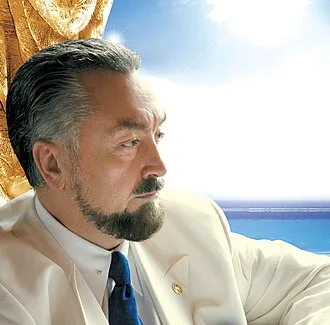
Between the 2000s and late 2010s, he was engaged in "a massive campaign" of proselytizing Westerners to Islam, producing dozens of vividly illustrated books. On 17 November 2022, he was sentenced to 8,658 years in prison for leading a criminal organization, engaging in political and military espionage, sexual abuse of minors, and other charges.
Prior to his arrest, Oktar established and ran two organizations: Bilim Araştırma Vakfı (BAV), which promoted creationism, and Millî Değerleri Koruma Vakfı which worked domestically on a variety of moral issues.
In the West, before his arrest and trial, Oktar sent thousands of unsolicited copies of his creationist book, The Atlas of Creation, to French schools and universities in January 2007, and several months later to American scientists, members of Congress, science museums, and schools.
Oktar has advocated a version of Islam that rejects both Sunni and Shia traditions, focusing instead on Quranism. He has preached "the true Islam" based on the Quran on his television channel, A9 TV. Oktar filed more than 5,000 lawsuits against individuals for defamation from 2005 to 2015, which led to the blocking of a number of prominent websites in Turkey.
Life and career
Early life and education
Adnan Oktar was born in Ankara, Turkey, in 1956, and grew up there through his high school years. While in high school he studied the works of Islamic scholars like Said Nursî, a Kurdish scholar who wrote Risale-i Nur, an extensive tafsir (Qur'anic commentary) that includes a comprehensive political and religious ideology. According to Oktar biographer Anne Ross Solberg, he grew up in a "relatively affluent secular family".
In 1979, Oktar moved to Istanbul and entered Mimar Sinan Fine Arts University to study architecture. It was here, according to Solberg, that he became fully engaged in religious activism. Following the Turkish coup e'tat in September 1980, Oktar began regularly attending the Molla Çelebi Mosque in nearby Fındıklı. Edip Yüksel, who knew Oktar during those years, described him as a "Sunni zealot."
Sect beginnings
By the early 1980s, Oktar had begun disseminating his views on Islam to young university students from socially-connected, wealthy Istanbul families. Between twenty and thirty of these followers formed a group around Oktar between 1982 and 1984, soon thereafter joined by newly converted private high school students who also came from affluent backgrounds.
Yüksel said Oktar presented "a refined and urbanized version" of Nursi's teachings "to the children of the privileged class", avoiding a high pressure or traditional, old fashioned approach. Like Nursi, Oktar argued against Marxism, communism and materialistic philosophy, but attached special importance to refuting evolution and Darwinism, as he believed they were being used to promote materialism and atheism.
Oktar personally put money into a pamphlet entitled the Theory of Evolution, which promoted pseudoscientific arguments against evolution.
In 1986 Oktar enrolled in the philosophy department of Istanbul University and began holding lectures, in which many students, mostly from neighboring Boğaziçi University, sought to participate. Oktar's name also began to appear regularly in the press, including a cover story in Nokta magazine. Later that year he published a 550-page book titled Judaism and Freemasonry, based on the antisemitic canard that state offices, universities, political groups and media were influenced by a "hidden group" seeking to undermine "the spiritual, religious, and moral values of the Turkish people and make them like animals."
Oktar was arrested on the grounds of promoting a theocratic revolution and was detained for nineteen months, though he was never formally charged. He spent ten months in a mental hospital, where he was diagnosed with schizophrenia and obsessive-compulsive personality disorder, but he maintains that he was a political prisoner who was punished because of the publication of Judaism and Freemasonry and not mentally ill.
Oktar continued building up his community for the remainder of the 1980s and into the 1990s. His followers were especially active recruiting at summer resorts along the Sea of Marmara. Two themes one ex-follower remembered from this period were a strong hatred of Jews and Freemasons and, in a move away from orthodox Islam, abandoning belief in hadith:
"Suddenly Adnan Hodja repudiated all oral traditions relating to the words and deeds of Muhammad (hadith) and decided that the Koran would be the only point of reference. Henceforth, he reduced the five daily prayers to three, and he dropped the veiling of women. He told us the Mehdi would emerge from Turkey, and he would come with an army of youth. He never said that he was the Mehdi himself, but we all believed that he was."
Oktar claims that, due to the political upheaval in Turkey during this period, he was unable to continue his studies and so devoted his energy to writing books upon leaving school.
In 1990, Oktar founded the Science Research Foundation (Bilim Araştırma Vakfı, or BAV). (Oktar ran and also served as honorary president of both BAV and the later Millî Değerleri Koruma Vakfı)[citation needed] As reported by Solberg, members of the BAV discarded their "overtly Islamic garments" in favor of "designer clothing" and "proclaimed themselves supporters of the ideals" of the founder of modern Turkey, Mustafa Kemal Atatürk, despite the fact that Atatürk was secularist.
The BAV held conferences and seminars in which Oktar blamed political and social problems on Darwinism and materialism. Based his own experiences and conversations with ex-members of the BAV, Yüksel characterizes the group as "a complete cult" with "all the criteria of a cult as you would define it today ... isolation, entire control of the lives of the cult members".
Later career
In 1994, the Islamist Welfare Party (Refah Partisi) won control of the municipalities of Istanbul and Ankara. The new mayors – one of whom was future president Recep Tayyip Erdoğan – made business agreements with Oktar in exchange for political support. The following year, Oktar founded the Foundation for Protection of National Values (Millî Değerleri Koruma Vakfı, or MDKV), through which he networked with other Turkish nationalist organizations and individuals on shared issues.
Following the 1997 Turkish military memorandum, the Welfare Party disbanded and the new government, headed by Erdoğan, distanced itself from Oktar going forward.
In 1998 Oktar distributed a new book, The Evolution Deceit. The following year he was arrested and charged with extortion and forming a criminal enterprise. He was convicted and sentenced to three years in prison, but the verdict was appealed and in May 2010 it was overturned. During his imprisonment Oktar engaged in numerous libel suits.
In some cases he was successful in blocking high-profile websites such Ekşi Sözlük in Turkey for slander, also that of Richard Dawkins and the entirety of WordPress.com.
Between that time and the present, BAV has organized hundreds of conferences on creationism in Turkey and worldwide. He built a large publishing enterprise with publications sold though Islamic bookstores worldwide. He is one of the most widely distributed authors in the Muslim world.
In 2007 he sent out thousands of unsolicited copies of his Atlas of Creation advocating Islam and creationism to schools and colleges in several European countries and the US.
His television show is viewed by many in the Arab world. According to Middle East Eye, his TV programs were known for featuring him discussing Islamic principles, while (somewhat incongruously), "scantily clad women with bleached blonde hair danced around him to popular music. These women Oktar referred to as his 'kittens'".
In 2010, Oktar was selected as one of the top fifty of The 500 Most Influential Muslims in the World by the Royal Islamic Strategic Studies Centre of Jordan for his dissemination of creationism in an Islamic context, and other extensively distributed publications on Islamic topics.
July 2018 arrest and criminal charges
On 11 July 2018, the financial crimes section of the Turkish police detained Oktar and over 160 of his associates on charges including forming a criminal enterprise, financial fraud and sexual abuse. Other charges Oktar faces range from sexual intercourse with minors and kidnapping children to holding people captive, political and military espionage, money laundering and torture.
According to the Istanbul chief prosecutor's office, Oktar was apprehended while attempting to run away from the arresting police officers.
On 19 July 2018, Adnan Oktar was remanded into custody pending trial along with 168 of his associates. In addition, after Oktar's initial arrest, over 45 people from over six countries, including two children, have pressed charges against him. Multiple "kittens" alleged in their statements to police that they were beaten, subjected to physical abuse, and forced to have sexual intercourse with Oktar.
When asked why he was arrested before being questioned by the police, Oktar stated: "It's a British plot." On 19 July 2019, an Istanbul high court approved the indictment of Oktar for the charges. The first hearing was scheduled for 17 September in Silivri Prison.
On 11 January 2021, Oktar was sentenced to 1,075 years in prison after being tried for charges including forming a criminal enterprise, financial fraud, and sexual abuse. Along with thirteen others detained in the case, sentences totalled 9,803 years. An international trial observation report written by Lionel Blackman heavily criticised the conduct of the trial, and on 15 March 2022, his verdict was overturned by the Turkish Court of Appeal "due to incomplete prosecution and erroneous assessment," with the court asking for "the retrial of all defendants".
As of 17 March, taking into account time spent in jail, the appeal court has "decided to release 68 defendants", but not "16 high-profile defendants, including Oktar". Oktar was subsequently sentenced to 8,658 years in prison on 17 November 2022 as a result of his retrial.