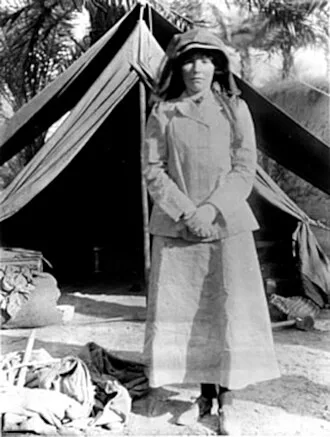
Bell was raised in a privileged environment that allowed her an education at Oxford University, to travel the world, and to make the acquaintance of people who would become influential policy-makers later. In her travels, she became an accomplished mountain climber and equestrian. She expressed great affection for the Middle East, visiting Qajar Iran, Syria-Palestine, Mesopotamia, Asia Minor, and Arabia.
She participated in archaeological digs during a time period of great ferment and new discoveries, and personally funded a dig at Binbirkilise in Asia Minor. She travelled through the Ha'il region in the northern part of the Arabian Peninsula during an extensive trip in 1913–1914, and was one of very few Westerners to have seen the area at the time.
The outbreak of World War I in August 1914, and the Ottoman Empire's entry into the war a few months later on the side of Germany, upended the status quo in the Middle East. She briefly joined the Arab Bureau in Cairo, where she worked with T. E. Lawrence. At the request of family friend Lord Hardinge, Viceroy of India, she joined the British administration in Ottoman Mesopotamia in 1917, where she served as a political officer and as the Oriental Secretary to three High Commissioners: the only woman in such high-ranking civil roles in the British Empire. Bell also supported the cause of the largely urban Sunni population in their attempts to modernise Iraq.
She spent much of the rest of her life in Baghdad and was a key player in the nation-building of what would eventually become the Kingdom of Iraq. She met and befriended a large number of Iraqis in both the cities and the countryside, and was a confidante and ally of Iraq's new King Faisal. Toward the end of her life, she was sidelined from Iraqi politics.
Perhaps seeing that she still needed something to occupy her, Faisal appointed her the Honorary Director of Antiquities of Iraq, where she returned to her original love of archaeology. In that role, she helped modernise procedures and catalogue findings, all of which helped prevent unauthorized looting of artifacts.
She supported education for Iraqi women, served as president of the Baghdad library (the future Iraq National Library), and founded the Iraq Museum as a place to display the country's archaeological treasures. She died in 1926 of an overdose of sleeping pills in what was possibly a suicide, although she was in ill health regardless.
Bell wrote extensively. She translated a book of Persian poetry; published multiple books describing her travels, adventures, and excavations; and sent a steady stream of letters back to England during World War I that influenced government thinking in an era when few English people were familiar with the contemporary Middle East.
Early life
Gertrude Bell was born on 14 July 1868 in Washington New Hall—now known as Dame Margaret Hall—in Washington, County Durham, England. Her family was wealthy, which enabled both her higher education and her travels. Her grandfather was the ironmaster Sir Isaac Lowthian Bell, an industrialist and a Liberal Member of Parliament between 1875 and 1880.
Mary Bell (née Shield), the daughter of John Shield of Newcastle-on-Tyne and Gertrude's mother, died in 1871 while giving birth to a son, Maurice Bell (later the 3rd Baronet). Gertrude Bell was just three at the time, and the death led to a lifelong close relationship with her father, Sir Hugh Bell, 2nd Baronet, a progressive capitalist and mill owner who made sure his workers were well paid.
Throughout her life, Gertrude consulted on matters great and small with her father, her personal role model. In particular, Hugh shared his knowledge of government and access to highly placed officials with Gertrude.
When Gertrude was seven years old, her father remarried, providing her a stepmother, Florence Bell (née Olliffe), and eventually, three half-siblings. Florence Bell was a playwright and author of children's stories, as well as the author of a study of Bell factory workers. She instilled concepts of duty and decorum in Gertrude.
She also recognized her intelligence and contributed to her intellectual development by ensuring she received an excellent schooling. Florence Bell's activities with the wives of Bolckow Vaughan ironworkers in Eston, near Middlesbrough, may have helped influence her step-daughter's later promotion of education for Iraqi women.
Some biographies suggest the loss of her mother Mary caused underlying childhood trauma, revealed through periods of depression and risky behaviour. While this loss surely marked her, Gertrude and Florence had a positive and lifelong relationship.
From 1883 to 1886, Gertrude Bell attended Queen's College in London, a prestigious school for girls. At the age of 17, she then studied at Lady Margaret Hall, Oxford University. History was one of the few subjects women were allowed to study, due to the many restrictions imposed on them at the time. She specialised in modern history, and she was the first woman to graduate in Modern History at Oxford with a first class honours degree, a feat she achieved in only two years.
Eleven people graduated that year. Nine were recorded because they were men, and the other two were Bell and Alice Greenwood. However, the two women were not awarded degrees. It was not until decades later that Oxford treated women equally with men in this respect, retroactively awarding degrees to Bell and others in 1920.
Personal life
Bell never married or had children. After graduating from Oxford, she spent two and a half years, from 1890 to 1892, attending the London social rounds of balls and banquets where eligible young men and women paired off, but failed to find a match. After arriving in Persia in 1892, she courted Henry Cadogan, a mid-ranking British diplomat in Tehran, but was refused permission to marry him after her father discovered that Cadogan was deeply in debt and not her social equal.
Cadogan died in 1893; Bell received the news via telegram. She befriended British colonial administrator Sir Frank Swettenham on a visit to Singapore with her brother Hugo in 1903 and maintained a correspondence with him until 1909. She had a "brief but passionate affair" with Swettenham following his retirement to England in 1904.
She had an unconsummated affair with Major Charles Doughty-Wylie, a married man, with whom she exchanged love letters from 1913 to 1915. Doughty-Wylie died in April 1915 during the Gallipoli Campaign, a loss which devastated Bell.
Travels and writings
Bell's uncle, Sir Frank Lascelles, was British minister (similar to ambassador) at Tehran, Persia. Bell travelled to Persia to visit him, arriving in May 1892. She stayed for around six months and loved the experience; she called Persia "paradise" in a letter home. She described her experiences in her book Persian Pictures, which was published in 1894.
She spent much of the next decade travelling around the world, mountaineering in Switzerland, and developing a passion for archaeology and languages. She became fluent in Arabic, Persian (Farsi), French, German, Italian, and Turkish. In 1897, she published a well-regarded translation from Persian into English of the poems of The Divān of Hafez; her work was later praised by Edward Denison Ross, E.
Granville Browne, and others. Her horse riding skills, practised from a young age, would aid her in her travels.
In 1899, Bell again went to the Middle East. She visited historic Palestine and Syria that year and in 1900, on a trip from Jerusalem to Damascus, she became acquainted with the Druze living in Jabal al-Druze.
Between 1899 and 1904, she climbed a number of mountains, including the La Meije and Mont Blanc, and recorded 10 new paths or first ascents in the Bernese Alps in Switzerland. One Alpine peak in the Bernese Oberland, the 2,632 m (8,635 ft) Gertrudspitze, was named after her after she and her guides, Ulrich and Heinrich Fuhrer, first traversed it in 1901.
However, she failed in an attempt of the Finsteraarhorn in August 1902, when inclement weather including snow, hail and lightning forced her to spend "forty eight hours on the rope" with her guides, clinging to the rock face in terrifying conditions that nearly cost her her life. She did some further climbing in the Rocky Mountains during a trip through North America in 1903, but eased up on her mountaineering in later years.
In 1905, she returned to the region of Syria. She met Mark Sykes, then a British traveller. The two quarrelled and shared a mutual dislike of each other that would last until 1912, when they made up. She concluded her trip visiting archaeological sites in Asia Minor and visiting Constantinople. She published her observations of the Middle East in the 1907 book Syria: The Desert and the Sown.
In it she vividly described, photographed, and detailed her trip to Greater Syria including Damascus, Jerusalem, Beirut, Antioch, Alexandretta, and the lands of the Druze and of the Bedouin. The Desert and the Sown was well received in the western world; the book received positive reviews and was a success. A notable epithet of Bell's came from her trip to Syria, where one particular compliment from a Bani Sakher tribesman she recorded became part of her later public image: "Mashallah!
Bint aarab." Literally, it meant "As God wills it, a daughter of the Arabs," but she translated it as being called a "daughter of the desert."
In March 1907, Bell journeyed back to Asia Minor (Anatolia) and began to work with Sir William M. Ramsay, an archaeologist and New Testament scholar. The pair and their staff performed excavations of destroyed buildings and churches that dated from the Byzantine era in Binbirkilise, which she funded and planned. The results were chronicled in the book A Thousand and One Churches.
In January 1909, Bell left for Mesopotamia. She visited the Hittite city of Carchemish, photographed the relief carvings in Halamata Cave, mapped and described the ruin of Ukhaidir, and travelled on to Babylon and Najaf. In Carchemish, she consulted with the two archaeologists on site, T. E. Lawrence and Reginald Campbell Thompson.
She struck up a friendship with Lawrence, and the two would trade letters in the following years. Both Bell and Lawrence had attended Oxford and earned a First Class Honours in Modern History, both spoke fluent Arabic, and both travelled extensively in the Arabian desert and established ties with the local tribes. In 1910, Bell visited the Munich exhibition Masterpieces of Muhammadan Art.
In a letter to her stepmother, she recounts how she had the research room to herself and spoke to some Syrians from Damascus who were part of the ethnographic section of the exhibition. She wrote a book on her journey and the archaeological work, Amurath to Amurath, as well as a journal article.
In 1913, she completed her last and most arduous Arabian journey, travelling about 1800 miles from Damascus to the politically volatile Ha'il, back up across the Arabian peninsula to Baghdad and from there back to Damascus. She was only the second foreign woman to visit Ha'il (Lady Anne Blunt was the first). Unbeknownst to outsiders, the Rashidi dynasty had been ravaged by both war with Ibn Saud's forces and internecine rivalries; the Emir and oldest dynasty member was only 16 years old; assassinations and disputes had killed others of the bloodline.
Bell was held prisoner in the city for eleven days before being released. She wrote afterward that "In Hayil, murder is like the spilling of milk." At the conclusion of her trip in Baghdad, Bell met the influential Naqib, Abd Al-Rahman Al-Gillani, who would be an important political figure later after the end of Ottoman rule.
Bell's travels resulted in her being elected a Fellow of the Geographical Society in 1913; she was awarded a medal from them in 1914, then another in 1918.
Throughout her travels Bell established close relations with local inhabitants and tribes across the Middle East. While she could meet with the wives and daughters of local notables without it being a breach of propriety, a possibility denied male travellers, she did not take advantage of this much; she was only mildly curious about the lives of Arab women. Her main focus was on meeting and knowing the influential in Arab society, the male shaikhs and leaders.
War and political career
Outbreak of war
The British entered World War I in August 1914, and the Ottoman Empire entered the war in late October to early November. At the suggestion of Wyndham Deedes, the British War Office asked Bell for her assessment of the situation in Ottoman Syria, Mesopotamia, and Arabia. In response she wrote a letter detailing her thoughts on the degree of British sympathies in the region.
Bell volunteered with the Red Cross, serving from November 1914–November 1915; first in Boulogne, France, and then later back in London. She was part of the Wounded & Missing Enquiry Department (W&MED) that attempted to coordinate information between the British Army, French hospitals, and worried families about the status of soldiers and casualties of the war.
Coincidentally, Judith Doughty-Wylie, the wife of the man with whom Bell was having an unconsummated affair, was also stationed in Boulogne in this period. The two met and exchanged pleasantries. Bell asked Charles Doughty-Wylie in a letter to discourage his wife from any further meetings.
Cairo, Delhi, and Basra
In November 1915, Bell was summoned to Cairo in the British protectorate of Egypt; she arrived on 30 November. The Cairo detachment of British officials, headed by Colonel (later Brigadier General) Gilbert Clayton and renowned archaeologist and historian Lt. Cmdr. David Hogarth, was called the Arab Bureau. Here she met T.
E. Lawrence again, who had joined the Arab Bureau in December 1914. The Bureau set about organising and processing Bell's own, Lawrence's, and Capt. W. H. I. Shakespear's data about the location and disposition of Arab tribes of the Sinai and Gulf region. They also mapped the region, including its sources of water. This information would later be of use to Lawrence during the Arab Revolt as to which tribes could be encouraged to join the British against the Ottoman Empire.
Bell's stay in Cairo was short; she was soon sent to British India, arriving in February 1916, likely at the suggestion of journalist-turned-diplomat Valentine Chirol. Her task in Delhi was to better coordinate the Arab Bureau with the Government of India and mediate their differences; according to Bell, "there was no kind of touch between us except rather bad tempered written telegrams!" Lord Hardinge, Viceroy of India and family friend of the Bells, was skeptical of the Arab Bureau's recent moves and promises of an independent Arab state, fearing that directly challenging the Ottoman Sultan's religious role as caliph could stir up unrest among India's substantial minority of Muslims.
Bell's knowledge of the issues impressed Lord Hardinge, and she was soon sent on to Basra (captured by the British at the start of the war in November 1914) in March 1916 to act as a liaison between India and Cairo. At the time, the British were still recovering from recent setbacks in the Mesopotamian campaign. She joined the staff of Chief Political Officer Percy Cox as one of the few Westerners who knew the area.
Cox found her an office in his headquarters, and she split her time between there and the Military GHQ Basra. She travelled in the region between Basra and Baghdad, assessed the stance and opinions of the local inhabitants, and wrote reports and drew maps that would aid the British Army in their eventual advance on Baghdad.
Bell was unpaid at first, but Lord Chelmsford arranged for her to be given a formal paid position in June 1916. She became the only female political officer in the British forces and received the title of Percy Cox's Oriental Secretary. During her Basra work, she struck up close working relationships with fellow political officers Reader Bullard and the young St. John Philby.
Bell met Ibn Saud in Basra in late November–December 1916, as Cox and India were courting his support against the Ottoman-supporting Ibn Rashid. She was impressed with him and wrote an article in the Arab Bulletin extolling his abilities as a "politician, ruler, and raider." Ibn Saud was apparently less impressed with her; according to a later account by Philby, he mimicked her feminine and higher-pitched speech as an impression and joke to later Nejd audiences.
She would later, in 1920, presciently warn Lawrence that he was overestimating Sharif Hussein's position after war with Ibn Saud broke out, and that Ibn Saud was likely to defeat the Hejaz if the struggle continued.
Armenian genocide
While in the Middle East, Gertrude Bell reported on the Armenian genocide. Contrasting the killings with previous massacres, she wrote that earlier killings "were not comparable to the massacres carried out in 1915 and the succeeding years." Bell also reported that in Damascus, "Ottomans sold Armenian women openly in the public market." In an intelligence report, Bell quoted a statement by a Turkish prisoner-of-war:
The battalion left Aleppo on 3 February and reached Ras al-Ain in twelve hours....some 12,000 Armenians were concentrated under the guardianship of some hundred Kurds...These Kurds were called gendarmes, but in reality mere butchers; bands of them were publicly ordered to take parties of Armenians, of both sexes, to various destinations, but had secret instructions to destroy the males, children and old women...One of these gendarmes confessed to killing 100 Armenian men himself...the empty desert cisterns and caves were also filled with corpses...No man can ever think of a woman's body except as a matter of horror, instead of attraction, after Ras al-Ain."
Creation of Iraq
After British troops took Baghdad, on 11 March 1917, Bell was summoned by Cox to the city. She was also given the honour of Commander of the Order of the British Empire. After Cox left Mesopotamia in 1918 for England and then Persia, control fell to Arnold Wilson, the Acting British Civil Commissioner in Mesopotamia.
Initially, Bell and Wilson got along; a memorandum Bell wrote in February 1919, "Self-Determination in Mesopotamia", did not show major differences with Wilson. Cox and Wilson's wartime provisional government drew on British India for inspiration, replicating its legal code and bureaucratic structure, and Bell's assessment was that this was keeping the Iraqi people content.
Bell visited France and England in 1919, attending the Paris Peace Conference for a short time in Wilson's stead. At Paris, plans for the dismantling of the Ottoman Empire came into shape, as negotiations over which territories should be distributed to who took place. Famously, the Sykes–Picot Agreement, negotiated by the same Mark Sykes whom Bell had met 15 years earlier, allocated northern Syria to French influence, although the French were persuaded to withdraw their claims on Mosul vilayet to Syria's east. This left the British and Arabs with southern Syria, Mosul, Baghdad, and Basra to divide.
Bell spent September–October 1919 visiting Egypt, Palestine, and Hashemite-ruled Syria before returning to Baghdad in November 1919. In 1919, Mesopotamia was still under a provisional military government that largely reported to the government of British India. Over the course of 1919, Bell became convinced that an independent Arab government in Mesopotamia backed by British advisors was the correct path to follow.
She saw the provisional Hashemite government in Syria, while corrupt, seemingly return life to a peaceful normal state; meanwhile, affairs in Egypt saw the Egyptian Revolution of 1919 against the British. Bell believed that the "spirit of 1919" would spread to Mesopotamia as well if the British dawdled in honouring the promise of self-determination.
She spent nearly a year writing what was later considered a masterly official report, "Review of the Civil Administration of Mesopotamia". Civil Commissioner Wilson disagreed with Bell on the topic, and the two had a falling out. Wilson, of the India school, preferred an Arab government to be under direct influence of British officials who would retain real control, as he felt, from experience, that Mesopotamian populations were not yet ready to govern and administer the country efficiently and peacefully.
Troubles arose; Shia tribes in central Iraq rose in revolt in the summer of 1920, and made common cause with Sunnis. Wilson blamed Sharifan anti-British propaganda for the revolt. Bell blamed Wilson for the unrest in the region, saying his approach was insufficiently deferential to local wishes.
On 11 October 1920, Percy Cox returned to Baghdad, replacing the discredited Wilson. Cox asked Bell to continue as his Oriental Secretary and to act as liaison with the forthcoming Arab government. Cox promptly restored much of the earlier Ottoman government structure and began to appoint more Iraqis to lead in the local provincial governments, albeit backed by powerful British advisors.
Back in the British Isles, the British public was weary of constant war, the Irish War of Independence was being fought, and the British Empire was deeply in debt following the ruinous Great War. British officials in London, in particular the new Secretary of State for War and Air, Winston Churchill, wanted to reduce expenses in the colonies, including the cost of quashing revolts.
British officials realised that their policy of direct governance was adding to costs. While the revolt of 1920 was successfully suppressed, it had cost 50 million pounds, hundreds of British and Indian lives, and thousands of Arab lives to do so. It was clear that Iraq would be cheaper as a self-governing state. Churchill convened a conference in Cairo to resolve the future of British administration of the region now that the war was finished.
1921 Cairo Conference
Bell, Cox, and Lawrence were among a select group of "Orientalists" convened by Churchill to attend the conference in Cairo to determine the internal boundaries of the British mandates from within the territory Britain had claimed during the Partitioning of the Ottoman Empire. Few British officials had any experience in Arab or Kurdish affairs; Cox trusted Bell, and Bell was thus unusually influential and gave significant input in these discussions.
The British government had reluctantly allowed France to take control of Syria as part of negotiations of the Treaty of Sèvres, leading to the creation of the French Mandate for Syria and Lebanon. This complicated earlier British promises to its allies in the Arab Revolt against the Ottomans, as they had presumed they would lead a new pan-Arab state centred in Damascus; but the French saw the Hashemites and their allies as potential rivals for power, and thus had no interest in allowing a Hashemite monarchy in Syria.