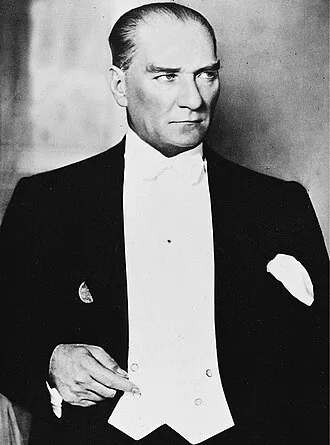
Born in Salonica in the Ottoman Empire, he was early on persecuted for agitating against Sultan Abdul Hamid II's autocracy, joining opposition movements like the Committee of Union and Progress and the Young Turks. He participated in the Young Turk Revolution and the 31 March Incident. Atatürk denounced CUP leadership for encouraging a politicised military –and was subsequently sidelined– as they established a new authoritarian regime.
His early military career saw him involved in the Italo-Turkish and Balkan Wars. He rose to prominence with his role in the Defence of Gallipoli during World War I. Following his country's defeat after the war, in the Turkish War of Independence he directed the Turkish National Movement in a nationalist resistance against Turkey's partition among the victorious Allied powers.
Establishing the provisional "Ankara government", he achieved a Turkish victory against Greece, Armenia, France, and the United Kingdom, confirmed in the Treaty of Lausanne. During and after the war, the ethnic cleansing of Armenians and Greeks from Anatolia outside of Istanbul, including the Kars region invaded by the Kemalist armies, was largely completed via large-scale massacres, flight, expulsions, and the population exchange between Greece and Turkey.
His government subsequently proceeded to abolish the Ottoman sultanate in 1922 and proclaimed the Republic of Turkey in 1923.
As the president of the newly formed Turkish Republic, Atatürk introduced far reaching reforms to build a republican and secular nation-state with a modern, Western facing society. By the mid-1920s, opponents to Atatürk's rule were suppressed as a one-party regime was cemented around him. This included abolishing the Ottoman Caliphate and curtailing religion as part of a larger secularist campaign.
The semi-secular Mecelle was replaced by a fully secular civil code. Western cultural mores were encouraged: such as the banning of the fez and certain men's clothing. State-owned enterprises were established, foreign industrial assets were nationalised, and the first five-year plan was implemented. He opened thousands of schools and introduced the Latin-based Turkish alphabet.
Turkish women received equal civil and political rights during his presidency. His government carried out a policy of Turkification, trying to create a homogeneous, unified, and above all secular nation under the Turkish banner. Atatürk attempted rapprochement with Iran, Yugoslavia, Iraq, Romania, and Greece, as well as the creation of the Balkan Pact that resisted the expansionist aggressions of Italy and Bulgaria during the interwar period of the 1930s.
He died on 10 November 1938 at Dolmabahçe Palace in Istanbul, at the age of 57; he was succeeded as president by his long-time prime minister İsmet İnönü.
Atatürk has been praised for his military accomplishments, nation-building efforts, social and economic reforms, and diplomatic successes, serving as an inspiration to anti-colonial and anti-imperialist movements. He has been condemned for instituting a dictatorship, introducing assimilationist policies that targeted minorities like the Kurds, and continuing a persecution of Christian minorities started by the CUP, while conservative Muslims have criticised his secular agenda.
The Turkish Parliament granted him the surname Atatürk in 1934, meaning "Father of the Turks" or "Turk like his ancestors", in recognition of the role he played in building the Turkish Republic.
Early life
Mustafa Kemal was born in Salonica (Selanik), Ottoman Empire. His parents were Ali Rıza Efendi, a military officer originally from Kodžadžik (Kocacık), title deed clerk and lumber trader, and Zübeyde Hanım.
Only one of Mustafa's siblings, a sister named Makbule (Atadan) survived childhood; she died in 1956. According to information obtained from Mustafa Kemal Atatürk, Makbule Atadan, other family members, and childhood friends who knew Atatürk's family, Ali Rıza Efendi was originally from Salonica, and his wife, Zübeyde Hanım, was born to a farming family in Langaza, west of Salonica, in 1857.
Name
Atatürk was born Mustafa. The origin of his second name Kemal (meaning 'perfection' or 'maturity' in Arabic) is speculated; some claim that this name was given to him by his mathematics teacher, possibly "in admiration of [Atatürk's] capability and maturity"; while some others claim that his teacher gave him this name to distinguish him from himself, since his name was also Mustafa.
Andrew Mango suggests that he may have chosen the name himself as a tribute to the nationalist poet Namık Kemal.
After receiving the surname Atatürk on his ID in 1934, he appeared as Kemal Atatürk, while the given name Mustafa had disappeared altogether. He used the Old Turkic name Kamâl from 1935 to 1937, which means 'fortification', 'fortress', 'army', or 'shield'.
Ancestry
Claims and theories about Mustafa Kemal's ancestry are strikingly varied and contrasting. According to Andrew Mango, his family was Muslim, Turkish-speaking and precariously middle-class. His father Ali Rıza is thought to have been of Albanian or Slavic origin by some authors; however, according to H. C. Armstrong, Falih Rıfkı Atay, Vamık D.
Volkan, Norman Itzkowitz, Müjgân Cunbur, Numan Kartal and Hasan İzzettin Dinamo, Ali Rıza's ancestors were Turks, ultimately descending from Söke in Aydın Province of Anatolia. According to the claims by the Torbeš community, he descended from the Muslim Slavs: Pomaks (Bulgarian Muslims) or Torbeši (Macedonian Muslims).
His mother Zübeyde is thought to have been of Turkish origin, and according to other sources, she was of Turkic Yörük ancestry. It was also claimed that she had Albanian or Macedonian ancestors. Due to the large Jewish community alongside Muslim (mainly Turks), Greek, Bulgarian, and other communities of Salonica vilayet in the Ottoman period, many of his Islamist opponents who were disturbed by his reforms claimed that Mustafa Kemal had Jewish Dönme ancestors.
Education
In his early years, his mother encouraged Mustafa Kemal to attend a religious school, something he did reluctantly and only briefly. Later, he attended the Şemsi Efendi School (a private school with a more secular curriculum) at the direction of his father. When he was seven years old, his father died. His mother wanted him to learn a trade, but without consulting them, Mustafa Kemal took the entrance exam for the Salonica Military School (Selanik Askeri Rüştiyesi) in 1893.
In 1896, he enrolled in the Monastir Military High School (in modern Bitola, North Macedonia) where he excelled at mathematics. On 14 March 1899, he enrolled at the Ottoman Military Academy in the neighbourhood of Pangaltı within the Şişli district of the Ottoman capital city Constantinople (modern Istanbul) and graduated in 1902. He later graduated from the Ottoman Military College in Constantinople on 11 January 1905.
Military career
Early years
Shortly after graduation, he was arrested by the police for his activities against Abdul Hamid II's regime. Following confinement for several months he was released only with the support of Rıza Pasha, his former school director. After his release, Mustafa Kemal was assigned to the Fifth Army based in Damascus as a Staff Captain in the company of Ali Fuat (Cebesoy) and Lütfi Müfit (Özdeş).
He joined a small secret revolutionary society of reformist officers led by a merchant Mustafa Elvan (Cantekin) called Vatan ve Hürriyet ('Motherland and Liberty'). On 20 June 1907, he was promoted to the rank of Senior Captain (Kolağası) and on 13 October 1907, was assigned to the headquarters of the Third Army in Manastır.
He joined the Committee of Union and Progress, with membership number 322, although in later years he became known for his opposition to, and frequent criticism of, the policies pursued by the CUP leadership. On 22 June 1908, he was appointed the Inspector of the Ottoman Railways in Eastern Rumelia (Doğu Rumeli Bölgesi Demiryolları Müfettişi), though this did not translate into a major role in the Young Turk Revolution of 1908.
He proposed depoliticization in the army, a proposal which was disliked by the leaders of the CUP. As a result, he was sent away to Tripolitania Vilayet (present Libya, then an Ottoman territory) under the pretext of suppressing a tribal rebellion towards the end of 1908. According to Mikush however, he volunteered for this mission. He suppressed the revolt and returned to Constantinople in January 1909.
In April 1909 in Constantinople, a group of soldiers began a counter-revolution (see 31 March Incident). Mustafa Kemal was instrumental in suppressing the revolt, and deposing Sultan Abdul Hamid II.
In 1910, he was called to the Ottoman provinces in Albania. At that time Isa Boletini was leading Albanian uprisings in Kosovo, and there were revolts in Albania as well. In 1910, Mustafa Kemal met with Eqrem Vlora, the Albanian lord, politician, writer, and one of the delegates of the Albanian Declaration of Independence.
Later, in the autumn of 1910, he was among the Ottoman military observers who attended the Picardie army manoeuvres in France, and in 1911, served at the Ministry of War (Harbiye Nezareti) in Constantinople for a short time.
Italo-Turkish War (1911–1912)
In 1911, he volunteered to fight in the Italo-Turkish War in the Ottoman Tripolitania Vilayet (present-day Libya). He served mainly in the areas near Derna and Tobruk. The invading Italian army had a strength of 150,000 men; it was opposed by 20,000 Bedouins and 8,000 Turks. A short time before Italy declared war, many of the Ottoman troops in Libya were sent to the Ottoman province of Yemen Vilayet to put down the rebellion there, so the Ottoman government was caught with inadequate resources to counter the Italians in Libya.
Britain, which controlled the Ottoman provinces of Egypt and Sudan, did not allow additional Ottoman troops to reach Libya through Egypt. Ottoman soldiers like Mustafa Kemal went to Libya either dressed as Arabs (risking imprisonment if noticed by the British authorities in Egypt) or by the very few available ferries (the Italians, who had superior naval forces, effectively controlled the sea routes to Tripoli).
However, despite all the hardships, Mustafa Kemal's forces in Libya managed to repel the Italians on a number of occasions, such as at the Battle of Tobruk on 22 December 1911.
During the Battle of Derna on 16–17 January 1912, while Mustafa Kemal was assaulting the Italian-controlled fortress of Kasr-ı Harun, two Italian planes dropped bombs on the Ottoman forces; a limestone splinter from a damaged building's rubble struck Mustafa Kemal's left eye, causing permanent tissue damage, but not total loss of sight.
He received medical treatment for nearly a month; he attempted to leave the Red Crescent's health facilities after only two weeks, but when his eye's situation worsened, he had to return and resume treatment. On 6 March 1912, Mustafa Kemal became the Commander of the Ottoman forces in Derna. He managed to defend and retain the city and its surrounding region until the end of the Italo-Turkish War on 18 October 1912.
Mustafa Kemal, Enver Bey, Fethi Bey, and the other Ottoman military commanders in Libya had to return to Ottoman Europe following the outbreak of the Balkan Wars on 8 October 1912. Having lost the war, the Ottoman government had to surrender Tripolitania, Fezzan, and Cyrenaica (three provinces forming present-day Libya) to the Kingdom of Italy in the Treaty of Lausanne (1912) signed ten days later, on 18 October 1912.
Since 1923, historians have preferred to name this treaty as the "Treaty of Ouchy", after the Château d'Ouchy in Lausanne where it was signed, to distinguish it from the later Treaty of Lausanne (1923) signed between the Allies of World War I and the Grand National Assembly of Turkey in Ankara.
Balkan Wars (1912–1913)
On 1 December 1912, Mustafa Kemal arrived at his new headquarters on the Gallipoli peninsula and, during the First Balkan War, he took part in the amphibious landing at Bulair on the coast of Thrace under Fethi Bey, but this offensive was repulsed during the Battle of Bulair by Georgi Todorov's 7th Rila Infantry Division under the command of Stiliyan Kovachev's Bulgarian Fourth Army.
In June 1913, during the Second Balkan War, he took part in the Ottoman Army forces commanded by Kaymakam Enver Bey that recovered Dimetoka and Edirne (Adrianople, the capital city of the Ottoman Empire between 1365 and 1453, thus of utmost historic importance for the Turks) together with most of eastern Thrace from the Bulgarians.
In 1913, he was appointed the Ottoman military attaché to all Balkan states (his office was in Sofia, Bulgaria) and promoted to the rank of Kaymakam (Lieutenant Colonel / Colonel) on 1 March 1914. While in Bulgaria, he met with Dimitrina Kovacheva, the daughter of Bulgarian general Stiliyan Kovachev (against whose forces he had fought during the Balkan Wars), who had recently completed her education in Switzerland, during a New Year's Eve ball in Sofia and fell in love with her.
The two danced at the ball and started to secretly date in the following days. Mustafa Kemal twice asked Dimitrina's parents for their permission to marry her (the second time was in 1915, during World War I) and was twice refused, which left him with a lifelong sadness.
First World War (1914–1918)
In 1914, the Ottoman Empire entered the European and Middle Eastern theatres of World War I allied with the Central Powers. Within the factionalism between the Three Pashas, Mustafa Kemal navigated the turbulent CUP governments and the politicised military apolitically—though he privately expressed confidence in Talaat Bey, who controlled the civilian government.
Among the many cliques formed around the many newly promoted Young Turk officers, Mustafa Kemal found a patron in Cemal Pasha. He did not respect his old classmate, and now War Minister, Enver Pasha, who was promited to the position from a junior colonelcy, and who orchestrated Turkey's entrance into a war Mustafa Kemal thought was a fatal mistake.
Mustafa Kemal was given the task of organizing and commanding the 19th Division attached to the Fifth Army during the Battle of Gallipoli. He became the front-line commander after correctly anticipating where the Allies would attack, and held his position until they retreated. Following the Battle of Gallipoli, Mustafa Kemal served in Edirne until 14 January 1916.
He was then assigned to the command of the XVI Corps of the Second Army and sent to the Caucasus campaign after the massive Russian offensive had reached key Anatolian cities. On 7 August, he rallied his troops and mounted a counteroffensive. Two of his divisions captured Bitlis and Muş, upsetting the calculations of the Russian Command.
Following this victory, the CUP government in Constantinople proposed to establish a new army in Hejaz known as the Hejaz Expeditionary Force (Hicaz Kuvve-i Seferiyesi) and appoint Mustafa Kemal to its command, but he refused the proposal and this army was never established. Instead, on 7 March 1917, Mustafa Kemal was promoted from the command of the XVI Corps to the overall command of the Second Army, although the Czar's armies were soon withdrawn when the Russian Revolution erupted.