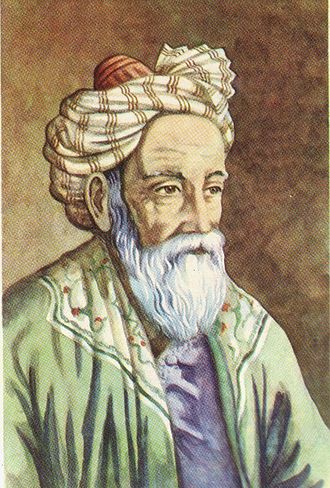
As a mathematician, Omar Khayyam was the first to provide a general solution for all third-degree polynomials by using the intersection of two conic sections, a method often later attributed to Descartes. Unlike Descartes, Khayyam performed these geometric calculations by selecting a unit length while strictly adhering to the rule of homogeneity.
Additionally, in his work On the Division of a Quarter of a Circle, he attempted to derive approximate numerical solutions for cubic equations using trigonometric tables. He also contributed to a deeper understanding of Euclid's parallel axiom. The Saccheri quadrilateral is sometimes called a Khayyam–Saccheri quadrilateral to credit Omar Khayyam who described it in his 11th century book Risāla fī šarḥ mā aškala min muṣādarāt kitāb Uqlīdis (Explanations of the difficulties in the postulates of Euclid).
As an astronomer, he calculated the duration of the solar year with remarkable precision and accuracy, and designed the Jalali calendar, a solar calendar with a very precise 33-year intercalation cycle which provided the basis for the Persian calendar that is still in use after nearly a millennium.
There is a tradition of attributing poetry to Omar Khayyam, written in the form of quatrains (rubāʿiyāt رباعیات). This poetry became widely known to the English-reading world in a translation by Edward FitzGerald (Rubaiyat of Omar Khayyam, 1859), which enjoyed great success in the Orientalism of the fin de siècle.
Life
Ghiyāth al-Dīn Abū al-Fatḥ ʿUmar ibn Ibrāhīm Nīshāpūrī was born in Nishapur—a metropolis in Khorasan province of the Seljuk Empire, of Persian stock, in 1048. In medieval Persian texts he is usually simply called Omar Khayyam. Although open to doubt, it has often been assumed that his forebears followed the trade of tent-making, since Khayyam means 'tent-maker' in Arabic.
The historian Bayhaqi, who was personally acquainted with Khayyam, provides the full details of his horoscope: "he was Gemini, the sun and Mercury being in the ascendant[...]". This was used by modern scholars to establish his date of birth as 18 May 1048.
Khayyam's boyhood was spent in Nishapur, a leading metropolis in the Seljuk Empire, which had earlier been a major center of the Zoroastrian religion. His full name, as it appears in Arabic sources, was Abu’l Fath Omar ibn Ibrahim al-Khayyam. Having memorized much of the Quran at a young age, Khayyam studied religious sciences, Arabic grammar, and literature under Mawlana Qadi Muhammad.
He later transferred to the tutelage of Khawjah Abu’l-Hasan al-Anbari to pursue mathematics, astronomy, and cosmological doctrines, including Ptolemy's major work, the Almagest. His gifts were recognized by his early tutors, who sent him to study under Imam Muwaffaq Nishaburi, the greatest teacher of the Khorasan region, who tutored the children of the highest nobility, and Khayyam developed a firm friendship with him through the years.
Khayyam might have met and studied with Bahmanyar, a disciple of Avicenna. After studying science, philosophy, mathematics and astronomy at Nishapur, about the year 1068 he traveled to the province of Bukhara, where he frequented the renowned library of the Ark. In about 1070 he moved to Samarkand, where he started to compose his famous Treatise on Algebra under the patronage of Abu Tahir Abd al-Rahman ibn ʿAlaq, the governor and chief judge of the city.
Khayyam was kindly received by the Karakhanid ruler Shams al-Mulk Nasr, who according to Bayhaqi, would "show him the greatest honour, so much so that he would seat [Khayyam] beside him on his throne".
In 1073–4 peace was concluded with Sultan Malik-Shah I, who had made incursions into Karakhanid dominions. Khayyam entered the service of Malik-Shah in 1074 when he was invited by the Grand Vizier Nizam al-Mulk to meet Malik-Shah in the city of Marv. Khayyam was subsequently commissioned to set up an observatory in Isfahan and lead a group of scientists in carrying out precise astronomical observations aimed at the revision of the Persian calendar.
The undertaking probably began with the opening of the observatory in 1074 and ended in 1079, when Omar Khayyam and his colleagues concluded their measurements of the length of the year, reporting it as 365.24219858156 days. Given that the length of the year is changing in the sixth decimal place over a person's lifetime, this is outstandingly accurate.
For comparison, the length of the year at the end of the 19th century was 365.242196 days, while today it is 365.242190 days.
After the death of Malik-Shah and his vizier (murdered, it is thought, by the Ismaili order of Assassins), Khayyam fell from favor at court, and as a result, he soon set out on his pilgrimage to Mecca. A possible ulterior motive for his pilgrimage reported by Al-Qifti, was a public demonstration of his faith with a view to allaying suspicions of skepticism and confuting the allegations of unorthodoxy (including possible sympathy or adherence to Zoroastrianism) levelled at him by a hostile clergy.
He was then invited by the new Sultan Sanjar to Marv, possibly to work as a court astrologer. He was later allowed to return to Nishapur owing to his declining health. Upon his return, he seems to have lived the life of a recluse.
Omar Khayyam died at the age of 83 in his hometown of Nishapur on 4 December 1131, and he is buried in what is now the Mausoleum of Omar Khayyam. One of his disciples Nizami Aruzi relates the story that sometime during 1112–3 Khayyam was in Balkh in the company of Isfizari (one of the scientists who had collaborated with him on the Jalali calendar) when he made a prophecy that "my tomb shall be in a spot where the north wind may scatter roses over it".
Four years after his death, Aruzi located his tomb in a cemetery in a then large and well-known quarter of Nishapur on the road to Marv. As it had been foreseen by Khayyam, Aruzi found the tomb situated at the foot of a garden-wall over which pear trees and apricot trees had thrust their heads and dropped their flowers so that his tombstone was hidden beneath them.
Mathematics
Khayyam was famous during his life as a mathematician. His surviving mathematical works include
- (i) Commentary on the Difficulties Concerning the Postulates of Euclid's Elements (Risāla fī Sharḥ mā Ashkal min Muṣādarāt Kitāb Uqlīdis), completed in December 1077,
- (ii) Treatise On the Division of a Quadrant of a Circle (Risālah fī Qismah Rub‘ al-Dā’irah), undated but completed prior to the Treatise on Algebra, and
- (iii) Treatise on Algebra (Risālah fi al-Jabr wa'l-Muqābala), most likely completed in 1079.
He furthermore wrote a treatise on the binomial theorem and extracting the nth root of natural numbers, which has been lost.
Theory of parallels
Part of Khayyam's Commentary on the Difficulties Concerning the Postulates of Euclid's Elements deals with the parallel axiom. The treatise of Khayyam can be considered the first treatment of the axiom not based on petitio principii, but on a more intuitive postulate. Khayyam refutes the previous attempts by other mathematicians to prove the proposition, mainly on grounds that each of them had postulated something that was by no means easier to admit than the Fifth Postulate itself.
Drawing upon Aristotle's views, he rejects the usage of movement in geometry and therefore dismisses the different attempt by Ibn al-Haytham. Unsatisfied with the failure of mathematicians to prove Euclid's statement from his other postulates, Khayyam tried to connect the axiom with the Fourth Postulate, which states that all right angles are equal to one another.
Khayyam was the first to consider the three distinct cases of acute, obtuse, and right angle for the summit angles of a Khayyam-Saccheri quadrilateral. After proving a number of theorems about them, he showed that Postulate V follows from the right angle hypothesis, and refuted the obtuse and acute cases as self-contradictory.
His elaborate attempt to prove the parallel postulate was significant for the further development of geometry, as it clearly shows the possibility of non-Euclidean geometries. The hypotheses of acute, obtuse, and right angles are now known to lead respectively to the non-Euclidean hyperbolic geometry of Gauss-Bolyai-Lobachevsky, to that of elliptic geometry, and to Euclidean geometry.
Tusi's commentaries on Khayyam's treatment of parallels made their way to Europe. John Wallis, professor of geometry at Oxford, translated Tusi's commentary into Latin. Jesuit geometer Girolamo Saccheri, whose work (euclides ab omni naevo vindicatus, 1733) is generally considered the first step in the eventual development of non-Euclidean geometry, was familiar with the work of Wallis.
The American historian of mathematics David Eugene Smith mentions that Saccheri "used the same lemma as the one of Tusi, even lettering the figure in precisely the same way and using the lemma for the same purpose". He further says that "Tusi distinctly states that it is due to Omar Khayyam, and from the text, it seems clear that the latter was his inspirer."
Real number concept
This treatise on Euclid contains another contribution dealing with the theory of proportions and with the compounding of ratios. Khayyam discusses the relationship between the concept of ratio and the concept of number and explicitly raises various theoretical difficulties. In particular, he contributes to the theoretical study of the concept of irrational number.
Displeased with Euclid's definition of equal ratios, he redefined the concept of a number by the use of a continued fraction as the means of expressing a ratio. Youschkevitch and Rosenfeld argue that "by placing irrational quantities and numbers on the same operational scale, [Khayyam] began a true revolution in the doctrine of number." Likewise, it was noted by D.
J. Struik that Omar was "on the road to that extension of the number concept which leads to the notion of the real number."
Geometric algebra
Rashed and Vahabzadeh (2000) have argued that because of his thoroughgoing geometrical approach to algebraic equations, Khayyam can be considered the precursor of Descartes in the invention of analytic geometry. In the Treatise on the Division of a Quadrant of a Circle Khayyam applied algebra to geometry. In this work, he devoted himself mainly to investigating whether it is possible to divide a circular quadrant into two parts such that the line segments projected from the dividing point to the perpendicular diameters of the circle form a specific ratio.
His solution, in turn, employed several curve constructions that led to equations containing cubic and quadratic terms.
Solution of cubic equations
Khayyam seems to have been the first to conceive a general theory of cubic equations, and the first to geometrically solve every type of cubic equation, so far as positive roots are concerned. The Treatise on Algebra contains his work on cubic equations. It is divided into three parts: (i) equations which can be solved with compass and straight edge, (ii) equations which can be solved by means of conic sections, and (iii) equations which involve the inverse of the unknown.
Khayyam produced an exhaustive list of all possible equations involving lines, squares, and cubes. He considered three binomial equations, nine trinomial equations, and seven tetranomial equations. For the first and second degree polynomials, he provided numerical solutions by geometric construction. He concluded that there are fourteen different types of cubics that cannot be reduced to an equation of a lesser degree.
For these he could not accomplish the construction of his unknown segment with compass and straight edge. He proceeded to present geometric solutions to all types of cubic equations using the properties of conic sections. The prerequisite lemmas for Khayyam's geometrical proof include Euclid VI, Prop 13, and Apollonius II, Prop 12.
The positive root of a cubic equation was determined as the abscissa of a point of intersection of two conics, for instance, the intersection of two parabolas, or the intersection of a parabola and a circle, etc. However, he acknowledged that the arithmetic problem of these cubics was still unsolved, adding that "possibly someone else will come to know it after us".
This task remained open until the sixteenth century, where an algebraic solution of the cubic equation was found in its generality by Cardano, Del Ferro, and Tartaglia in Renaissance Italy.
Whoever thinks algebra is a trick in obtaining unknowns has thought it in vain. No attention should be paid to the fact that algebra and geometry are different in appearance. Algebras are geometric facts which are proved by propositions five and six of Book two of Elements.
In effect, Khayyam's work is an effort to unify algebra and geometry. This particular geometric solution of cubic equations was further investigated by M. Hachtroudi and extended to solving fourth-degree equations. Although similar methods had appeared sporadically since Menaechmus, and further developed by the 10th-century mathematician Abu al-Jud, Khayyam's work can be considered the first systematic study and the first exact method of solving cubic equations.
The mathematician Woepcke (1851) who offered translations of Khayyam's algebra into French praised him for his "power of generalization and his rigorously systematic procedure."
Binomial theorem and extraction of roots
From the Indians one has methods for obtaining square and cube roots, methods based on knowledge of individual cases – namely the knowledge of the squares of the nine digits 12, 22, 32 (etc.) and their respective products, i.e. 2 × 3 etc. We have written a treatise on the proof of the validity of those methods and that they satisfy the conditions.
In addition we have increased their types, namely in the form of the determination of the fourth, fifth, sixth roots up to any desired degree. No one preceded us in this and those proofs are purely arithmetic, founded on the arithmetic of The Elements.
In his algebraic treatise, Khayyam alludes to a book he had written on the extraction of the th root of natural numbers using a law he had discovered which did not depend on geometric figures.

This book was most likely titled the Difficulties of Arithmetic (Mushkilāt al-Ḥisāb), and is not extant. Based on the context, some historians of mathematics such as D. J. Struik, believe that Omar must have known the formula for the expansion of the binomial , where n is a positive integer.

The case of power 2 is explicitly stated in Euclid's elements and the case of at most power 3 had been established by Indian mathematicians. Khayyam was the mathematician who noticed the importance of a general binomial theorem. The argument supporting the claim that Khayyam had a general binomial theorem is based on his ability to extract roots.
One of Khayyam's predecessors, al-Karaji, had already discovered the triangular arrangement of the coefficients of binomial expansions that Europeans later came to know as Pascal's triangle; Khayyam popularized this triangular array in Iran, so that it is now known as Omar Khayyam's triangle.
Astronomy
In 1074–5, Omar Khayyam was commissioned by Sultan Malik-Shah to build an observatory at Isfahan and reform the Persian calendar. There was a panel of eight scholars working under the direction of Khayyam to make large-scale astronomical observations and revise the astronomical tables. Recalibrating the calendar fixed the first day of the year at the exact moment of the passing of the Sun's center across vernal equinox.
This marks the beginning of spring or Nowrūz, a day in which the Sun enters the first degree of Aries before noon. The resultant calendar was named in Malik-Shah's honor as the Jalālī calendar, and was inaugurated on 15 March 1079. The observatory itself was disused after the death of Malik-Shah in 1092.
The Jalālī calendar was a true solar calendar where the duration of each month is equal to the time of the passage of the Sun across the corresponding sign of the Zodiac. The calendar reform introduced a unique 33-year intercalation cycle. As indicated by the works of Khazini, Khayyam's group implemented an intercalation system based on quadrennial and quinquennial leap years.
Therefore, the calendar consisted of 25 ordinary years that included 365 days, and 8 leap years that included 366 days. The calendar remained in use across Greater Iran from the 11th to the 20th centuries. In 1911, the Jalali calendar became the official national calendar of Qajar Iran. In 1925, this calendar was simplified and the names of the months were modernised, resulting in the modern Iranian calendar.
The Jalali calendar is more accurate than the Gregorian calendar of 1582, with an error of one day accumulating over 5,000 years, compared to one day every 3,330 years in the Gregorian calendar. Moritz Cantor considered it the most perfect calendar ever devised.
One of his pupils, Nizami Aruzi, relates that Khayyam apparently did not have a belief in astrology and divination: "I did not observe that he (scil. Omar Khayyam) had any great belief in astrological predictions, nor have I seen or heard of any of the great [scientists] who had such belief." While working for Sultan Sanjar as an astrologer he was asked to predict the weather – a job that he apparently did not do well.
George Saliba explains that the term ‘ilm al-nujūm, used in various sources in which references to Khayyam's life and work could be found, has sometimes been incorrectly translated to mean astrology. He adds: "from at least the middle of the tenth century, according to Farabi's Enumeration of the Sciences, that this science, ‘ilm al-nujūm, was already split into two parts, one dealing with astrology and the other with theoretical mathematical astronomy."
Other works
Khayyam has a short treatise devoted to Archimedes' principle (in full title, On the Deception of Knowing the Two Quantities of Gold and Silver in a Compound Made of the Two). For a compound of gold adulterated with silver, he describes a method to measure more exactly the weight per capacity of each element. It involves weighing the compound both in air and in water, since weights are easier to measure exactly than volumes.
By repeating the same with both gold and silver one finds exactly how much heavier than water gold, silver and the compound were. This treatise was extensively examined by Eilhard Wiedemann who believed that Khayyam's solution was more accurate and sophisticated than that of Khazini and Al-Nayrizi who also dealt with the subject elsewhere.
Another short treatise is concerned with music theory in which he discusses the connection between music and arithmetic. Khayyam's contribution was in providing a systematic classification of musical scales, and discussing the mathematical relationship among notes, minor, major and tetrachords.
Poetry
The earliest allusion to Omar Khayyam's poetry is from the historian Imad al-Din al-Isfahani, a younger contemporary of Khayyam, who explicitly identifies him as both a poet and a scientist (Kharidat al-qasr, 1174). One of the earliest specimens of Omar Khayyam's Rubiyat is from Fakhr al-Din al-Razi.
In his work al-Tanbih ‘ala ba‘d asrar al-maw‘dat fi’l-Qur’an (c. 1160), he quotes one of his poems (corresponding to quatrain LXII of FitzGerald's first edition). Daya in his writings (Mirṣād al-‘Ibad, c. 1230) quotes two quatrains, one of which is the same as the one already reported by Razi.
An additional quatrain is quoted by the historian Juvayni (Tarikh-i Jahangushay, c. 1226–1283). In 1340 Jajarmi includes thirteen quatrains of Khayyam in his work containing an anthology of the works of famous Persian poets (Mu’nis al-ahrār), two of which have hitherto been known from the older sources.
A comparatively late manuscript is the Bodleian MS. Ouseley 140, written in Shiraz in 1460, which contains 158 quatrains on 47 folia. The manuscript belonged to William Ouseley (1767–1842) and was purchased by the Bodleian Library in 1844.
There are occasional quotes of verses attributed to Khayyam in texts attributed to authors of the 13th and 14th centuries, but these are of doubtful authenticity, so that skeptical scholars point out that the entire tradition may be pseudepigraphic. Hans Heinrich Schaeder in 1934 commented that the name of Omar Khayyam "is to be struck out from the history of Persian literature" due to the lack of any material that could confidently be attributed to him.
De Blois presents a bibliography of the manuscript tradition, concluding pessimistically that the situation has not changed significantly since Schaeder's time.:307
Five of the quatrains later attributed to Omar Khayyam are found as early as 30 years after his death, quoted in Sindbad-Nameh. While this establishes that these specific verses were in circulation in Omar's time or shortly later, it does not imply that the verses must be his. De Blois concludes that at the least the process of attributing poetry to Omar Khayyam appears to have begun already in the 13th century.:305 Edward Granville Browne (1906) notes the difficulty of disentangling authentic from spurious quatrains: "while it is certain that Khayyam wrote many quatrains, it is hardly possible, save in a few exceptional cases, to assert positively that he wrote any of those ascribed to him".