Pelé
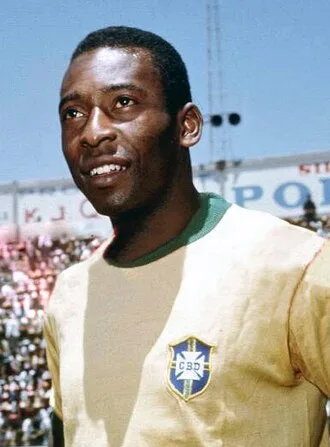
Pelé began playing for the Brazilian club Santos at age 15, and for the Brazil national team at 16. During his international career, he won three FIFA World Cup titles – in 1958, 1962, and 1970 – becoming the only player to do so and the youngest to win a World Cup, at just 17 years old. He was nicknamed O Rei (the King) following the 1958 World Cup.
With 77 goals in 92 games for Brazil, Pelé held the record as the national team's top goalscorer for over fifty years. At club level, Pelé is Santos' all-time top goalscorer with 643 goals in 659 games. In a golden era for Santos, Pelé led the club to victory at the 1962 and 1963 Copa Libertadores and at the 1962 and 1963 Intercontinental Cup.
Credited with connecting the phrase "The Beautiful Game" with football, Pelé's tremendous skill and penchant for spectacular goals made him a global star, and his teams toured internationally to take full advantage of his popularity. During his playing days, Pelé was for a period the highest-paid athlete in the world.
After retiring in 1977, he was a worldwide ambassador for football and undertook acting and commercial ventures. In 2010, he was named the honorary president of the New York Cosmos.
Pelé averaged almost a goal per game throughout his career and could strike the ball with either foot. While predominantly a striker, he could also be a playmaker, providing assists with his vision and passing ability. In Brazil, he was hailed as a national hero for his accomplishments in football and for his outspoken support of policies to benefit the poor.
His emergence at the 1958 World Cup, where he became a Black global sporting star, was a source of inspiration. Throughout his career and in his retirement, Pelé received numerous individual and team awards for his performance on the field, his record-breaking achievements, and his legacy in the sport.
Early life
Pelé was born Edson Arantes do Nascimento on 23 October 1940 in Três Corações, Minas Gerais, Brazil. He was the son of Fluminense footballer Dondinho (born João Ramos do Nascimento) and Celeste Arantes. He had a younger brother, Zoca, who would also play for Santos. Pelé was named after the American inventor Thomas Edison.
His parents decided to remove the "i" and call him "Edson", but there was an error on his birth certificate, leading many documents to show his name as "Edison". He was called "Edson" by his family, who also gave him the nickname "Dico". On the origin of his nickname "Pelé", he said it probably emerged after he mispronounced the name of his favourite player, Bilé, a goalkeeper for Vasco da Gama. In his 2006 autobiography, Pelé said he had no idea what the name meant, nor did his school friends.
Pelé grew up in poverty in Bauru in the state of São Paulo. He earned money by working in tea shops as a server. Taught to play football by his father, he could not afford a proper ball and usually played with either a grapefruit or a sock stuffed with newspaper. He played for several amateur teams in his youth, including Sete de Setembro, Canto do Rio, São Paulinho, and Ameriquinha.
Pelé led Bauru Atlético Clube juniors (coached by Waldemar de Brito) to two São Paulo state youth championships. In his mid-teens, a type of indoor football called futsal was becoming popular in Bauru, and Pelé played for a futsal team called Radium. He played in the first futsal competition in the region, and he and his team won the first championship and several others.
According to Pelé, the gameplay of futsal was much quicker than football on grass, and players had to think faster because everyone was close to each other on the pitch. He credits futsal for helping him think better on the spot. In addition, futsal allowed him to play with adults when he was about 14 years old. In one of the tournaments he played in, he was initially considered too young to play, but ultimately became the top scorer with 14 or 15 goals. "That gave me a lot of confidence", Pelé said. "I knew then not to be afraid of whatever might come". Pelé named Brazilian playmaker Zizinho among his inspirations growing up.
Club career
Santos
1956–1962: Early years with Santos and being declared a national treasure
In 1956, Waldemar de Brito took Pelé to Santos, an industrial port city located near São Paulo, to try out for the professional club Santos FC. He told the club's directors that the 15-year-old would be "the greatest football player in the world". Pelé impressed Santos coach Lula during his trial at the Estádio Vila Belmiro, and he signed a professional contract with the club in June 1956.
Pelé was highly promoted in the local media as a future superstar. He made his senior team debut on 7 September 1956 at the age of 15 against Corinthians de Santo André and had an impressive performance in a 7–1 victory, scoring the first goal in his prolific career during the match.
When the 1957 season started, Pelé was given a starting place on the Santos senior team. At the age of 16, he became the top scorer in their league, the Campeonato Paulista. In 1958, Pelé helped the team win the Campeonato Paulista trophy, his first major title with the team. He again finished the season as the league's top scorer, with 58 goals, a record that still stands today.
A year later, he helped Santos earn their first victory in the Torneio Rio-São Paulo. Ten months after signing professionally, Pelé was called up to the Brazil national team. After the 1958 World Cup, wealthy European clubs, such as Real Madrid, Juventus and Manchester United, tried to sign him in vain. In 1958, Inter Milan managed to get him a contract, but the club's owner Angelo Moratti tore it up at the request of Santos's chairman following a revolt by Santos's fans.
Valencia CF arranged an agreement that would have brought Pelé to the club after the 1958 World Cup, but after his performances at the tournament, Santos declined to let him leave.
During the 1960 season, Pelé scored 34 goals as Santos regained the Campeonato Paulista trophy. During the 1961 season, Pelé scored 47 goals as his team won both the Campeonato Paulista and the Taça Brasil. The Taça victory allowed Santos to participate in the Copa Libertadores, the most prestigious club tournament in the Western hemisphere.
In 1961, the government of Brazil under President Jânio Quadros declared Pelé an "official national treasure" to prevent him from being transferred out of the country.
1962–1965: Copa Libertadores success
Santos's most successful Copa Libertadores season started in 1962. They defeated Universidad Católica in the semi-finals and triumphed 3–0 over defending champions Peñarol in the finals. Pelé scored twice in the final match, and was the second top scorer of the competition with four goals. That same year, Santos successfully defended the Campeonato Paulista with 37 goals from Pelé, as well as the Taça Brasil.
Santos also won the 1962 Intercontinental Cup against Benfica. Pelé produced one of the best performances of his career, scoring a hat-trick in Lisbon as Santos won 5–2. Following the match, Benfica goalkeeper Costa Pereira remarked, "I arrived hoping to stop a great man, but I went away convinced I had been undone by someone who was not born on the same planet as the rest of us."
Pelé said his most memorable goal was scored against Clube Atlético Juventus on 2 August 1959. As there is no video footage of this match, Pelé asked that a computer animation be made of this specific goal. In March 1961, Santos played against Fluminense at the Maracanã stadium. Near the end of the first half, Pelé received the ball on the edge of his own penalty area, then ran the length of the field, eluding opposing players with feints, before striking the ball beyond the goalkeeper.
According to the newspaper O Globo, Pelé's goal earned him a two-minute standing ovation from the crowd, including Fluminense fans. Several days later, a plaque was mounted on the wall of the stadium with a dedication to "the most beautiful goal in the history of the Maracanã". The goal became known as the gol de placa, "the goal of the plaque".
Over the years, this phrase found its way into Brazilian footballing vocabulary as a way to describe a remarkable goal worthy of commemoration.
As the defending champions, Santos qualified automatically to the semi-final stage of the 1963 Copa Libertadores. They overcame a Botafogo team that featured the Brazilian superstars Garrincha and Jairzinho, and with five goals from Pelé throughout the tournament, Santos claimed the title once again. Santos lost the Campeonato Paulista after finishing in third place, but went on to win the Rio-São Paulo tournament. Pelé also helped Santos retain the Intercontinental Cup and the Taça Brasil.
Santos was eliminated from the 1964 Copa Libertadores in the semi-finals by Independiente, but managed to win the 1964 Campeonato Paulista, with Pelé scoring 34 goals. The club won the Taça Brasil for the fourth consecutive year and shared the 1964 Rio-São Paulo title with Botafogo. Pelé was the top scorer of the 1965 Copa Libertadores with eight goals, although Santos was eliminated by Peñarol.
1965–1974: O Milésimo and final years with Santos
In December 1965, Santos won the Taça Brasil, their fifth straight Brazilian league title. The following year, the club failed to retain the Taça Brasil, but won the Campeonato Paulista in 1967, 1968, and 1969. On 19 November 1969, Pelé scored his 1,000th goal in all competitions, in what was a highly anticipated moment in Brazil.
The goal, dubbed O Milésimo, "The Thousandth", occurred when Pelé scored from a penalty kick against Vasco da Gama at the Maracanã Stadium.
Various sources have said that the 2 factions involved in the Nigerian Civil War agreed to a 48-hour ceasefire in 1969 so they could watch Pelé play an exhibition game in Lagos. An early source for this story was Ebony magazine in 1975. Santos played to a 2–2 draw with the Lagos team Stationary Stores FC, with Pelé scoring his team's goals; the civil war continued for another year after the game.
In his autobiography, Pelé said he was unsure if there was a ceasefire, but said there was increased security at the game. Some sources, including Santos's website, say that the ceasefire was instead for an exhibition game in Benin City. Local researchers have not found any contemporary reports of the Lagos ceasefire.
During his time with Santos, Pelé played alongside many celebrated players, including Zito, Pepe, and Coutinho. He partnered with Coutinho in numerous one-two plays, attacks, and goals. During international tours with Santos, Pelé played exhibition games in various countries. He played in Spain against Real Madrid and Barcelona, in Italy against Juventus, Inter Milan, AC Milan and AS Roma, in Egypt against Al Ahly, and in Kuwait against Qadsia.
In Kuwait, he met the Egyptian film star Zubaida Tharwat, and reportedly wanted to marry her and take her back with him to Brazil. In 1971, Pelé declined an offer to sign with Paris Saint-Germain, an emerging club in France at the time.
At the end 1974, Pelé retired from Brazilian club football during his 19th season with Santos, after declining requests to represent Brazil in the 1974 World Cup. Afterwards, he would occasionally play for Santos in friendly and commemorative matches. His 643 goals for Santos were the most goals scored for a single club until the record was surpassed by Lionel Messi of Barcelona in December 2020.
New York Cosmos
Pelé came out of semi-retirement to sign with the New York Cosmos of the North American Soccer League for the 1975 season. At a chaotic press conference at New York's 21 Club, the Cosmos unveiled Pelé. John O'Reilly, the club's media spokesman, stated, "We had superstars in the United States but nothing at the level of Pelé.
Everyone wanted to touch him, shake his hand, get a photo with him." Though well past his prime at this point, Pelé was credited with significantly increasing public interest in football in the US.
Pelé opened the door for many other stars to play in North America. Giorgio Chinaglia followed him to the Cosmos, then Franz Beckenbauer and his former Santos teammate Carlos Alberto. Over the next few years other players came to the league, including Johan Cruyff, Eusébio, Bobby Moore, George Best and Gordon Banks.
During Pelé's first public appearance in Boston, he was injured by a crowd of fans who had surrounded him, and was evacuated on a stretcher. Pelé made his debut for the Cosmos on 15 June 1975 against the Dallas Tornado at Downing Stadium, scoring one goal in a 2–2 draw. A week before the outbreak of the Lebanese Civil War, Pelé played a friendly game for the Lebanese club Nejmeh against a team of Lebanese Premier League stars.
The 1977 NASL season was Pelé's third and final season with New York, and the final season of his career. In June, the Cosmos won 3–0 over the Tampa Bay Rowdies, with the 37-year-old Pelé scoring a hat-trick. In the first leg of the league quarter-finals, Pelé's team attracted a league-record crowd of 77,891 as they achieved an 8–3 victory over the Fort Lauderdale Strikers.
In the second leg of the semi-finals against the Rochester Lancers, the Cosmos won 4–1. Pelé finished his official playing career on 28 August, after leading the Cosmos to their second Soccer Bowl title with a 2–1 win over the Seattle Sounders.
On 1 October 1977, Pelé closed out his career with an exhibition match between the Cosmos and Santos. The match was played in front of a sold-out crowd at Giants Stadium and was televised on ABC's Wide World of Sports. Pelé's father and wife attended the match, as well as Muhammad Ali and Bobby Moore. Pelé played the first half of the match with the Cosmos, during which he scored a 30-yard free kick, which was the final goal of his career.
He played the second half with Santos, and the Cosmos won the game 2–1. It started to rain during the second half, prompting a Brazilian newspaper to print the headline the following day: "Even The Sky Was Crying."
International career
Pelé played his first match for the Brazilian national team on 7 July 1957, at the age of 16. During the 2–1 loss to Argentina, he scored his first goal for Brazil, and he remains the youngest goalscorer for his country.
1958 FIFA World Cup
Pelé arrived in Sweden for the 1958 World Cup with a knee injury, which caused him to sit out the first two matches. A team psychologist told Brazil's coach Vicente Feola that the 17-year-old Pelé was "infantile" and not fit to play the next match against the USSR. Feola chose to play Pelé, who provided an assist during Brazil's 2–0 victory.
Pelé was at the time the youngest player to participate in a World Cup, and he became the tournament's youngest goalscorer after scoring against Wales in the quarter-finals. During the semi-final against France, Pelé scored a hat-trick during the second half.
On 29 June 1958, Pelé scored two goals as Brazil defeated Sweden 5–2 in the final. His first goal, in which he flicked the ball over a defender before volleying it into the corner of the net, was selected as one of the best goals in the history of the World Cup. When the match ended, Pelé passed out on the field. He was revived by his teammate Garrincha, and he wept while being congratulated by his team.
He finished the World Cup with six goals in four matches played, and was named the best young player of the tournament. Sigvard Parling of the Swedish team would later comment, "When Pelé scored the fifth goal in that Final, I have to be honest and say I felt like applauding".
It was during the 1958 World Cup that Pelé began wearing a shirt with the number 10, which was the result of disorganization: the Brazilian Federation did not allocate shirt numbers for players, so FIFA chose the number 10 for him. In 2026, the shirt he wore during the 1958 World Cup final sold for $4.9 million at a Sotheby's auction in New York.
1959 South American Championship
Pelé was the top scorer at the 1959 South American Championship with eight goals, and was named the best player of the tournament. Brazil finished second despite being undefeated in the tournament.
1962 World Cup and 1963 Roca Cup
When the 1962 FIFA World Cup in Chile started, Pelé was considered the best player in the world. In Brazil's first match of the tournament, he assisted the first goal and scored the second one, leading his team to a 2–0 victory over Mexico. He was injured during the next game while attempting a long-range shot against Czechoslovakia, which kept him out of the rest of the tournament.
Brazil won the World Cup after defeating Czechoslovakia in the final. At the time, only players who appeared in the final were eligible for a medal; FIFA regulations were changed in 1978 to include the entire squad, and in 2007 Pelé received a winner's medal for the 1962 World Cup.
In his first appearances for Brazil since his return from injury, Pelé scored a hat-trick against Argentina in the second leg of the 1963 Roca Cup as Brazil won the trophy 7–5 on aggregate. The team then played five games in Europe which included another hat-trick for Pelé against France in Paris.
1966 World Cup
There were high expectations for Brazil in the 1966 FIFA World Cup, held in England. In addition to Pelé, the Brazilian squad featured the stars Djalma Santos, Garrincha, Gérson, Gilmar, Jairzinho and Tostão. Pelé scored in the first match against Bulgaria, becoming the first player to score in three successive FIFA World Cups.
However, he was injured due to persistent fouling by the Bulgarians, and had to miss the second game against Hungary. After witnessing the fouls, Brazil's coach Vicente Feola expected that other teams would treat Pelé in a similar manner. Brazil lost to Hungary, and Pelé, although still recovering, was brought back for the last crucial match against Portugal.
During the game, Portugal defender João Morais fouled Pelé twice, but was not sent off by referee George McCabe, a decision retrospectively viewed as being among the worst refereeing errors in World Cup history. Pelé had to stay on the field limping for the rest of the game since substitutes were not allowed in football at that time.
Brazil lost the match and were eliminated from the tournament. After the game, Pelé vowed he would never play again in the World Cup.
1970 World Cup
When Pelé was called to the national team in early 1969, he refused at first, but then accepted and scored six goals in six World Cup qualifying matches. The 1970 FIFA World Cup in Mexico was expected to be Pelé's last. Brazil's squad for the tournament was markedly different than the 1966 team. Star players Garrincha, Nilton Santos, Valdir Pereira, Djalma Santos, and Gilmar had retired.
However, Brazil's 1970 World Cup squad, which included Pelé, Rivellino, Jairzinho, Gérson, Carlos Alberto Torres, Tostão and Clodoaldo, has often been considered the greatest football team in history.
The front five of Jairzinho, Pelé, Gerson, Tostão, and Rivellino together created an attacking momentum, with Pelé playing a key role in Brazil's road to the final. In the first group stage match, a 4–1 win over Czechoslovakia, Pelé became the second player after Uwe Seeler to score in four different editions of the tournament.
Later in the game, he narrowly missed scoring from the halfway line. During Brazil's next match, a 1–0 victory over England, Pelé's header was blocked by goalkeeper Gordon Banks; the moment has been referred to as the "save of the century". Years later, Pelé would comment on Banks' save: "I have scored more than a thousand goals in my life and the thing people always talk to me about is the one I didn't score."
Pelé scored two goals during Brazil's final group stage match, a 3–2 win over Romania. During the semi-final against Uruguay, he set up Rivellino's goal and later performed a "run around" move against goalkeeper Ladislao Mazurkiewicz, which became one of his most famous plays. Tostão made a pass to Pelé, and Mazurkiewicz ran to intercept the ball.
Pelé got there first and fooled Mazurkiewicz with a feint; as the ball rolled to the goalkeeper's left, Pelé went around him without touching the ball, then took a shot while turning towards the goal. He turned too far as he shot, and the ball drifted just wide of the far post.
📚 Source: Wikipedia