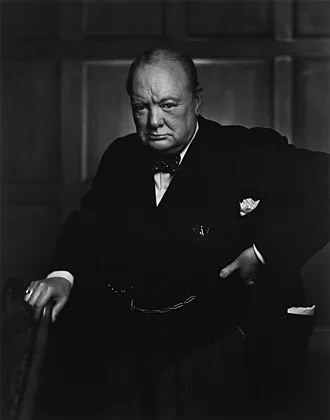
Of mixed English and American parentage, Churchill was born in Oxfordshire into the wealthy, aristocratic Spencer family. He joined the British Army in 1895 and saw action in British India, the Mahdist War and the Second Boer War, gaining fame as a war correspondent and writing books about his campaigns. Elected a Conservative MP in 1900, he defected to the Liberals in 1904.
In H. H. Asquith's Liberal government, Churchill was president of the Board of Trade and later Home Secretary, championing prison reform and workers' social security. As First Lord of the Admiralty before and during the First World War he oversaw the disastrous naval attack on the Dardanelles (a prelude to the Gallipoli campaign) and was demoted to Chancellor of the Duchy of Lancaster.
He resigned in November 1915 and joined the Royal Scots Fusiliers on the Western Front for six months. In 1917, he returned to government under David Lloyd George and served successively as Minister of Munitions, Secretary of State for War, Secretary of State for Air, and Secretary of State for the Colonies, overseeing the Anglo-Irish Treaty and British foreign policy in the Middle East.
After two years out of Parliament, he was Chancellor of the Exchequer in Stanley Baldwin's Conservative government, returning sterling in 1925 to the gold standard, depressing the UK economy.
Out of government during his so-called "wilderness years" in the 1930s, Churchill took the lead in calling for rearmament to counter the threat of militarism in Nazi Germany. At the outbreak of the Second World War he was re-appointed First Lord of the Admiralty. In May 1940, he became prime minister, succeeding Neville Chamberlain.
Churchill formed a national government and oversaw British involvement in the Allied war effort against the Axis powers, resulting in victory in 1945. After the Conservatives' defeat in the 1945 general election, he became Leader of the Opposition. Amid the developing Cold War with the Soviet Union, he publicly warned of an "iron curtain" of Soviet influence in Europe and promoted European unity.
Between his terms, he wrote several books recounting his experience during the war. He was awarded the Nobel Prize in Literature in 1953. He lost the 1950 election but was returned to office in 1951. His second term was preoccupied with foreign affairs, especially Anglo-American relations and preservation of what remained of the British Empire, with India no longer a part of it.
Domestically, his government's priority was their extensive and successful housebuilding programme. In declining health, Churchill resigned in 1955, remaining an MP until 1964. Upon his death in 1965, he was given a state funeral.
One of the 20th century's most significant figures, Churchill remains popular in the UK. He is generally viewed as a victorious wartime leader who played an integral role in defending liberal democracy against the spread of fascism. A staunch imperialist, he has sometimes been criticised for comments on race, in addition to some wartime decisions such as area bombing. Historians rank Churchill as one of the greatest British prime ministers.
Early life
Childhood and schooling: 1874–1895
Winston Leonard Spencer Churchill was born on 30 November 1874 at his family's ancestral home, Blenheim Palace in Oxfordshire. On his father's side, he was a member of the aristocracy as a descendant of John Churchill, 1st Duke of Marlborough. His father, Lord Randolph Churchill, representing the Conservative Party, had been elected member of parliament (MP) for Woodstock in February 1874. His mother was Jennie, Lady Randolph Churchill, a daughter of Leonard Jerome, an American businessman.
In 1876, Churchill's paternal grandfather, John Spencer-Churchill, 7th Duke of Marlborough, was appointed Viceroy of Ireland. Randolph became his private secretary and the family relocated to Dublin. Winston's brother, Jack, was born there in 1880. For much of the 1880s, Randolph and Jennie were effectively estranged, and the brothers were cared for by their nanny, Elizabeth Everest.
When she died in 1895, Churchill wrote "she had been my dearest and most intimate friend during the whole of the twenty years I had lived".
Churchill began boarding school at St George's in Ascot, Berkshire, aged 7, but he was not academic and his behaviour was poor. In 1884, he transferred to Brunswick School in Hove, where his academic performance improved. In April 1888, aged 13, he passed the entrance exam for Harrow School. His father wanted him to prepare for a military career, so his last three years at Harrow were in the army form.
After two unsuccessful attempts to gain admittance to the Royal Military College, Sandhurst, he succeeded. He was accepted as a cadet in the cavalry, starting in September 1893. His father died in January 1895.
Cuba, India, and Sudan: 1895–1899
In February 1895, Churchill was commissioned as a second lieutenant in the 4th Queen's Own Hussars regiment of the British Army, based at Aldershot. Eager to witness military action, he used his mother's influence to get posted to a war zone. In the autumn, he and friend Reggie Barnes, went to observe the Cuban War of Independence and became involved in skirmishes after joining Spanish troops attempting to suppress independence fighters.
Churchill sent reports to the Daily Graphic in London. He proceeded to New York and wrote to his mother about "what an extraordinary people the Americans are!" With the Hussars, he went to Bombay in October 1896. Based in Bangalore, he was in India for 19 months, visiting Calcutta and joining expeditions to Hyderabad and the North West Frontier.
In India, Churchill began a self-education project, reading widely including Plato, Edward Gibbon, Charles Darwin and Thomas Babington Macaulay. The books were sent by his mother, with whom he shared frequent correspondence. To learn about politics, he asked her to send him copies of The Annual Register, the political almanack.
In an 1898 letter, he referred to his beliefs, saying: "I do not accept the Christian or any other form of religious belief". Churchill had been christened in the Church of England but underwent a virulently anti-Christian phase in his youth, and as an adult was an agnostic. In another letter to a cousin, he referred to religion as "a delicious narcotic" and expressed a preference for Protestantism over Roman Catholicism because he felt it "a step nearer Reason".
Interested in parliamentary affairs, Churchill declared himself "a Liberal in all but name", adding he could never endorse the Liberal Party's support for Irish home rule. Instead, he allied himself to the Tory democracy wing of the Conservatives and on a visit home, gave his first speech for the party's Primrose League at Claverton Down.
Mixing reformist and conservative perspectives, he supported the promotion of secular, non-denominational education while opposing women's suffrage.
Churchill volunteered to join Bindon Blood's Malakand Field Force in its campaign against Mohmand rebels in the Swat Valley of north-west India. Blood accepted on condition he was assigned as a journalist, the beginning of Churchill's writing career. He returned to Bangalore in October 1897 and wrote his first book, The Story of the Malakand Field Force, which received positive reviews.
He wrote his only work of fiction, Savrola, a Ruritanian romance. To keep occupied, Churchill embraced writing as what Roy Jenkins calls his "whole habit", especially through his career when he was out of office. Writing was his safeguard against recurring depression, which he referred to as his "black dog".
Using London contacts, Churchill got attached to General Herbert Kitchener's campaign in the Sudan as a 21st Lancers subaltern, while working as a journalist for The Morning Post. After participating in one of the British Army's last cavalry charges in the Battle of Omdurman in September 1898, the 21st Lancers were stood down.
In October, Churchill returned to England and began writing The River War about the campaign; it was published in 1899. He decided to leave the army as he was critical of Kitchener's actions, particularly the unmerciful treatment of enemy wounded and his desecration of Muhammad Ahmad's tomb.
On 2 December 1898, Churchill embarked for India to settle his military business and complete his resignation. He spent much time playing polo, the only ball sport in which he was ever interested. Having left the Hussars, he sailed from Bombay on 20 March 1899, determined to launch a career in politics.
Politics and South Africa: 1899–1901
Churchill spoke at Conservative meetings and was selected as one of the party's two candidates for the June 1899 Oldham by-election. While campaigning, he referred to himself as "a Conservative and a Tory Democrat". Although the seats had been held by the Conservatives, the result was a narrow Liberal victory.
As a journalist for the Morning Post, Churchill anticipated the outbreak of the Second Boer War between Britain and the Boer republics, leading him to sail to South Africa. In October, he travelled to the conflict zone near Ladysmith, which was under siege by Boer troops, and then headed to Colenso. At the Battle of Chieveley, his train was derailed by Boer artillery shelling, and he was captured as a prisoner of war (POW) and interned in a POW camp in Pretoria.
Churchill made a formal protest about his internment to the Transvaal Secretary of State, asserting his status as a non-combatant journalist, but he was told he had invalidated that by carrying a revolver. In December, Churchill escaped and evaded his captors by stowing aboard freight trains and hiding in a mine. He made it to safety in Portuguese East Africa. His escape attracted much publicity.
In January 1900, Churchill briefly rejoined the army as a lieutenant in the South African Light Horse regiment, joining Redvers Buller's fight to relieve the Siege of Ladysmith and take Pretoria. He was among the first British troops into both places. With his cousin Charles Spencer-Churchill, 9th Duke of Marlborough, he demanded and received the surrender of 52 Boer prison camp guards.
Throughout the war, he publicly chastised anti-Boer prejudices, calling for them to be treated with "generosity and tolerance", and afterwards urged the British to be magnanimous in victory. In July, having resigned his lieutenancy, he returned to Britain. His Morning Post dispatches had been published as London to Ladysmith via Pretoria and sold well.
Churchill rented a flat in London's Mayfair, using it as his base for six years. He stood again as a Conservative candidate at Oldham in the October 1900 general election, securing a narrow victory to become a Member of Parliament aged 25. In the same month, he published Ian Hamilton's March, a book about his South African experiences, which became the focus of a lecture tour in November through Britain, America, and Canada.
Members of Parliament were unpaid and the tour was a financial necessity. In America, Churchill met Mark Twain, William McKinley, and Theodore Roosevelt, who he did not get on with. In spring 1901, he gave lectures in Paris, Madrid, and Gibraltar.
Early political career: 1901–1908
Conservative MP: 1901–1904
In February 1901, Churchill took his seat in the House of Commons, where his maiden speech gained widespread coverage. He associated with a group of Conservatives known as the Hughligans, but was critical of the Conservative government on various issues, especially increases in army funding. He believed additional military expenditure should go to the navy.
This upset the Conservative front bench but was supported by Liberals, with whom he increasingly socialised, particularly Liberal Imperialists like H. H. Asquith. Churchill later wrote that he "drifted steadily to the left". He privately considered "the gradual creation by an evolutionary process of a Democratic or Progressive wing to the Conservative Party", or alternately a "Central Party" to unite the Conservatives and Liberals.
By 1903, there was division between Churchill and the Conservatives, largely because he opposed their promotion of protectionism. As a free trader, he helped found the Free Food League. Churchill sensed that the animosity of party members would prevent him gaining a Cabinet position under a Conservative government. The Liberal Party was attracting growing support, and so his defection in 1904 may have been influenced by ambition.
He increasingly voted with the Liberals. For example, he opposed an increase in military expenditure, supported a Liberal bill to restore legal rights to trade unions, and opposed the introduction of import tariffs. Arthur Balfour's government announced protectionist legislation in October 1903. Two months later, incensed by Churchill's criticism of the government, the Oldham Conservative Association informed him it would not support his candidature at the next election.
In May 1904, Churchill opposed the government's proposed Aliens Bill, designed to curb Jewish immigration. He stated that the bill would "appeal to insular prejudice against foreigners, to racial prejudice against Jews, and to labour prejudice against competition" and expressed himself in favour of "the old tolerant and generous practice of free entry and asylum to which this country has so long adhered and from which it has so greatly gained". On 31 May 1904, he crossed the floor to sit as a member of the Liberal Party.
Liberal MP: 1904–1908
As a Liberal, Churchill attacked government policy and gained a reputation as a radical under the influences of John Morley and David Lloyd George. In December 1905, Balfour resigned as prime minister and King Edward VII invited the Liberal leader Henry Campbell-Bannerman to replace him. Hoping to secure a working majority, Campbell-Bannerman called a general election in January 1906, which the Liberals won in a massive landslide.
Churchill won the Manchester North West seat, and his biography of his father was published, for which he received an advance payment of £8,000. It was generally well received. The first biography of Churchill himself, written by the Liberal MacCallum Scott, was also published around this time.
In the new government, Churchill became Under-Secretary of State for the Colonial Office, a junior ministerial position he had requested. He worked beneath the Secretary of State for the Colonies, Victor Bruce, 9th Earl of Elgin, and took Edward Marsh as his secretary; Marsh remained his secretary for 25 years. Churchill's first task was helping to draft a constitution for the Transvaal; and he helped oversee the formation of a government in the Orange River Colony.
In dealing with southern Africa, he sought to ensure equality between the British and Boers. He announced a gradual phasing out of the use of Chinese indentured labourers in South Africa; he and the government decided a sudden ban would cause too much upset and might damage the colony's economy. He expressed concerns about the relations between European settlers and the black African population; after the Zulu launched their Bambatha Rebellion in Natal, Churchill complained about the "disgusting butchery of the natives" by Europeans.
Asquith government: 1908–1915
President of the Board of Trade: 1908–1910
With Campbell-Bannerman terminally ill, Asquith became prime minister in April 1908. He appointed Churchill as President of the Board of Trade. Aged 33, Churchill was the youngest Cabinet member since 1866. Newly appointed Cabinet ministers were legally obliged to seek re-election at a by-election. On 24 April, Churchill lost the Manchester North West by-election to the Conservative candidate by 429 votes. On 9 May, the Liberals stood him in the safe seat of Dundee, where he won comfortably.
Churchill proposed marriage to Clementine Hozier; they were married on 12 September 1908 at St Margaret's, Westminster and honeymooned in Baveno, Venice, and Veveří Castle in Moravia. They lived at 33 Eccleston Square, London, and their first daughter, Diana, was born in 1909. The success of their marriage was important to Churchill's career as Clementine's unbroken affection provided him with a secure and happy background.
One of Churchill's first tasks as a minister was to arbitrate in an industrial dispute among ship-workers and employers, on the River Tyne. He afterwards established a Standing Court of Arbitration to deal with industrial disputes, establishing a reputation as a conciliator. He worked with Lloyd George to champion social reform. He promoted what he called a "network of State intervention and regulation" akin to that in Germany.
Continuing Lloyd George's work, Churchill introduced the Mines Eight Hours Bill, which prohibited miners from working more than an eight-hour day. In 1909, he introduced the Trade Boards Bill, creating Trade Boards which could prosecute exploitative employers. Passing with a large majority, it established the principle of a minimum wage and the right to have meal breaks.
In May 1909, he proposed the Labour Exchanges Bill to establish over 200 Labour Exchanges through which the unemployed would be assisted in finding employment. He promoted the idea of an unemployment insurance scheme, which would be part-funded by the state.