














The election took place under reforms resulting from the 2007 constitutional referendum, which introduced a direct national vote, rather than election by members of the parliament. Over 55 million people were eligible to vote, both within Turkey and abroad.
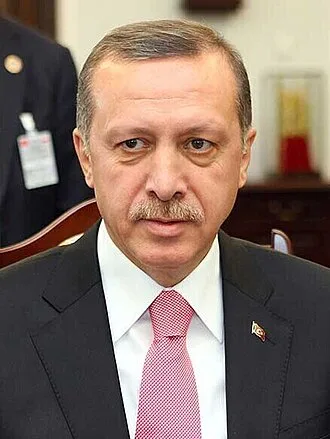
Recep Tayyip Erdoğan, leader of the AK Party and prime minister since 2003 after winning the 2002 Turkish general election, won with 51.79% of the vote. Former Organisation of Islamic Cooperation General Secretary Ekmeleddin İhsanoğlu, who ran as the joint candidate of 13 opposition parties including the Republican People's Party (CHP) and Nationalist Movement Party (MHP), came second with 38.44%.
The co-leader of the Peoples' Democratic Party (HDP) Selahattin Demirtaş, who received the backing of 8 left-wing parties, came third with 9.76%.
Erdoğan took over as president from Abdullah Gül on 28 August, while Ahmet Davutoğlu, who was elected leader of the AK Party, succeeded Erdoğan as prime minister on the same date. It has been speculated that Erdoğan will continue to pursue his political agenda as president while Davutoğlu takes a docile approach as prime minister, breaking away from the ceremonial and neutral functions of the presidency and potentially pursuing constitutional changes to turn Turkey into a presidential or semi-presidential system.
The election was criticised by both the political opposition and international observers for alleged media bias in favour of Recep Tayyip Erdoğan, corruption allegations, the inaccuracy of opinion polls and the misuse of official public resources during Erdoğan's campaign. While praising the authorities for safeguarding the right to assembly as well as the peaceful electoral conduct, the Organization for Security and Co-operation in Europe (OSCE) voiced concerns over the unequal distribution of campaign resources and media intimidation.
The historic 12-year low turnout of 74.13%, attributed to the fact that the election was held in summer while many citizens were on holiday, was seen by many politicians such as MHP leader Devlet Bahçeli as a significant factor in affecting the outcome. The election loss for the opposition CHP resulted in its leader Kemal Kılıçdaroğlu taking the decision to hold a party convention with a leadership election in response to growing dissatisfaction against his electoral performance.
Background
The Law on Presidential Elections accepted and put into effect on 20 January 2012 decided that presidential elections will be held in 2014 instead of 2012; within 60 days before the end of the seven-year term of incumbent president of Turkey Abdullah Gül, who will be the last indirectly elected President of Turkey. As Gül took office on 28 August 2007, the first possible day could be 29 June, but a date between 10 and 17 August is considered more reasonable.
It was decided in the same law that former presidents Kenan Evren, Süleyman Demirel, Ahmet Necdet Sezer and incumbent Abdullah Gül could not be nominated for a second term, but this was ruled unconstitutional by the Constitutional Court of Turkey, allowing them to run for a second term. Also, the Prime Minister of Turkey could be nominated for the presidency without having to resign from his post.
The presidential-election campaigns were declared to be held in an "American manner", where candidates could accept personal donations for their campaigns; however, one person could not donate more than 8,259 TL (approximately US$4,500) to a campaign.
Official candidates
Three candidates were nominated to participate in the election. A more detailed list of parties that endorsed them can be found in the "List of parties by presidential candidates" section.
Parliamentary nomination process
To run for election, a candidate needs to be nominated by at least 20 Members of Parliament in the Grand National Assembly, which constitutes to 3.73% of all sitting members. The parties represented in parliament are the AK Party, CHP, MHP, HDP, DBP and 14 independents, meaning that smaller parties such as the Felicity Party (SP) and the Great Union Party (BBP) could not nominate their own candidates due to the lack of parliamentary representation.
Three candidates obtained sufficient endorsements from parliament in order to register with the Supreme Electoral Council. The Electoral Council forbids any potential candidate from nominating themselves, since this would give unfair advantage to prospective candidates who were sitting Members of Parliament. The AK Party began collecting signatures for an unnamed candidate from all 311 eligible MPs out of their 312-seat total, with Recep Tayyip Erdoğan being the only MP to not sign.
Due to the debate on whether the CHP's candidate Ekmeleddin İhsanoğlu adhered to secular and Kemalist principles, 21 CHP MPs boycotted the nomination process. Six CHP MPs protested their leader's choice of candidate by attempting to nominate Emine Ülker Tarhan instead, though she herself stated that she would not stand as a candidate.
Out of the 14 independent MPs, three supported İhsanoğlu while two supported Demirtaş, with the remaining 9 boycotting the process altogether. Only 536 seats out of the 550 are occupied, with many vacant MPs having resigned or serving prison sentences due to their roles in the PKK, or the Sledgehammer and Ergenekon coup trials.
a Lists parties with parliamentary representation only
b Number of MPs from the parties that support these candidates, discounting independents
c Was named the Peace and Democracy Party (BDP), changed its name after the election
d Emine Ülker Tarhan publicly stated that she did not want to stand as a candidate, but received nominations from CHP MPs opposed to İhsanoğlu
21 Members of Parliament from the CHP, including former leader Deniz Baykal as well as potential presidential candidate Emine Ülker Tarhan, boycotted the nomination process.
Candidate selection
Justice and Development Party (AK Party)
Turkish and international media speculated that Recep Tayyip Erdoğan would almost certainly be the AKP's candidate for the presidency. This was proven correct on 1 July when Erdoğan's candidacy was announced. Abdullah Gül, the outgoing president of Turkey elected in 2007 caused media speculation regarding a potential candidacy in January 2014.
He announced that he would not stand on 29 June 2014. A full list of possible AK Party candidates which at one point showed intentions of running for election is as follows.
- Recep Tayyip Erdoğan, leader of the AKP (2001–2014) and Prime Minister of Turkey (2003–2014).
- Abdullah Gül, Prime Minister of Turkey (2002–2003), President of Turkey (2007–2014).
- Bülent Arınç, Deputy Prime Minister of Turkey (2009–2015) and Speaker of Parliament (2002–2007), endorsed Recep Tayyip Erdoğan.
Republican People's Party (CHP)
The two main opposition parties, the Republican People's Party (CHP) and the Nationalist Movement Party (MHP) had both expressed interest in fielding a joint candidate after the March 2014 local elections. In an unofficial vote of CHP MPs, Eskişehir mayor Yılmaz Büyükerşen was seen as a potential forerunner. A list of potential candidates which had expressed interest in running, or had been recommended as a candidate of the CHP or its parliamentary sister party DSP (Democratic Left Party) is as follows.
- Ekmeleddin İhsanoğlu, former secretary general of the Organisation of Islamic Co-operation, recommended by Kemal Derviş
- Kemal Kılıçdaroğlu, leader of the CHP since 2010, challenged by AK Party MP Egemen Bağış
- Yılmaz Büyükerşen, CHP mayor of Eskişehir, first recommended by Democrat Party president Hüsamettin Cindoruk
- Kamer Genç, CHP Member of Parliament for Tunceli
- Kemal Derviş, former economy minister and United Nations Development Program Administrator
- İlker Başbuğ, former Chief of the General Staff of Turkey, released from prison in March 2014
- Hikmet Çetin, former minister of foreign affairs, parliamentary speaker and CHP leader, recommended by Mustafa Sarıgül
- Ümit Nazlı Boyner, former president of Turkish Industry and Business Association (TÜSİAD)
- Mehmet Bekaroğlu, human rights activist, academic and former Welfare Party MP, recommended by CHP MP Muharrem İnce
- Mehmet Haberal, CHP Zonguldak MP, surgeon and founder of Başkent University
- Orhan Pamuk, novelist, screenwriter, academic and recipient of the 2006 Nobel Prize in Literature
- Emine Ülker Tarhan, CHP Member of Parliament for Ankara, supported against Ekmeleddin İhsanoğlu by Workers' Party, Republican Women's Association and Youth Union of Turkey
- Adnan Menderes – grandson of former prime minister Adnan Menderes, professor at Dokuz Eylül University
- Deniz Baykal – former leader of the CHP
- Sami Selçuk – former First President of Court of Cassation
- Mansur Yavaş – CHP mayoral candidate for Ankara in the 2014 local elections
- Metin Feyzioğlu – President of the Turkish Bars Association
- Haşim Kılıç – President of the Constitutional Court
- Meral Akşener – Vice speaker of the Grand National Assembly and former Interior Minister. MHP MP from Istanbul and supported by the CHP
- Yaşar Kemal – writer of Kurdish origin who has long been a candidate for the Nobel Prize in literature
- Aysel Çelikel – former minister of justice in 2002
- İlhan Kesici – former Motherland Party mayoral candidate for Istanbul and a CHP MP
- Yekta Güngör Özden – former president of the Constitutional Court between 1991 and 1998[failed verification]
- İlber Ortaylı, Turkish historian
- Rıza Türmen, former judge of the European Court of Human Rights
- Abdüllatif Şener, former Deputy Prime Minister of Turkey and founder of the Turkey Party
Nationalist Movement Party (MHP)
Prior to joint attempts by the CHP and MHP to nominate a single candidate, the following list contains Nationalist Movement Party politicians who were speculated to be potential MHP presidential candidates, as well as the final agreed candidate Ekmeleddin İhsanoğlu.
- Ekmeleddin İhsanoğlu, former Secretary General of the Organisation of Islamic Co-operation, recommended by Kemal Derviş
- Devlet Bahçeli, MHP leader since 1997
- Oktay Vural, MHP Member of Parliament from İzmir and MHP parliamentary group leader
- Meral Akşener – Vice speaker of the Grand National Assembly and former Interior Minister. MHP MP from Istanbul and supported by the CHP
- Yıldırım Tuğrul Türkeş – eldest son of MHP founder Alparslan Türkeş and MP for Ankara
- Engin Alan – former general and MHP Istanbul MP charged for his role in the Sledgehammer Coup Plan
- Abdullah Gül – 24th Prime Minister of Turkey and 11th President of Turkey
Peoples' Democratic Party (HDP)
The Peoples' Democratic Party (HDP) nominated co-leader Selahattin Demirtaş as their presidential candidate on 30 June 2014. Figen Yüksekdağ, the HDP's other co-leader, was also seen as a potential candidate especially since the party was a strong supporter of women's and minority rights.
- Selahattin Demirtaş, co-leader of the HDP
- Figen Yüksekdağ, co-leader of the HDP
Others
- Osman Pamukoğlu, retired general and leader of the Rights and Equality Party (HEPAR), with a petition urging 20 MPs to back his candidacy emerging on Change.org.
- Masum Türker, leader and declared candidate of the Democratic Left Party (DSP)
Campaigns
The Supreme Electoral Council of Turkey declared that the campaigning for the first round of the election would take place between 11 July and 9 August. For the run-off planned for 24 August, campaigning would have taken place between 11 and 23 August. The campaigns of all three candidates centred mainly on the 2014 Israel–Gaza conflict, the peace process with PKK rebels, the Gezi Park protests and 17 December 2013 government corruption scandal.
Erdoğan campaign
Incumbent Prime Minister Recep Tayyip Erdoğan formally announced his candidacy for the presidency on 1 July 2014 in a speech that lasted just over an hour. Speculation that he would be the AKP's candidate was widespread long before the announcement. On the same day, the Erdoğan logo was unveiled, and received criticism for bearing resemblance to the Obama 2008 presidential election campaign logo, as well as the Holiday Place logo.
A tweet from the finance minister, Mehmet Şimşek, which claimed that the logo has Arabic calligraphy of the Prophet Muhammad's name also sparked debate over the use of religion in the political campaign. Erdoğan's campaign slogan is "Milli İrade, Milli Güç, Hedef 2023" (National Will, National Strength, Target 2023).
On 11 July, Erdoğan unveiled a new campaign song and slogan, "Yeni Türkiye Yolunda Demokrasi, Refah, İtibar" (Democracy, Prosperity and Prestige on the Road to a New Turkey).
Erdoğan's campaign has been dominated by electoral rallies, beginning in Samsun on 5 July and then moving to Erzurum, mimicking Mustafa Kemal Atatürk's route which he took at the start of the Turkish War of Independence. His rally speeches mainly centred on his achievements as prime minister and also contained frequent attacks on both the opposition as well as Fethullah Gülen, the leader of the Hizmet Movement living in Pennsylvania.
During his Hatay rally on 21 July, he accused Gülen of not speaking out on behalf of the Palestinians in Gaza and accused Israel of "following in the footsteps of Hitler". During his Kahramanmaraş rally on 1 August, he claimed that the opposition CHP was supporting Israel during the Gaza crisis.
During his electoral rally in Van, Erdoğan attacked his rival Ekmeleddin İhsanoğlu for allegedly mistaking the Independence March, the Turkish national anthem, for a poem composed for the fallen soldiers at Çanakkale during the Gallipoli Campaign. In his Kahramanmaraş rally on 1 August, he showed the crowd a video of İhsanoğlu misreading the Independence March.
In addition to his electoral rallies, AKP activists have also launched a door-to-door operation in order to gather support by delivering food, clothing and other items to families. According to the OSCE, the Erdoğan campaign has also organised iftar tents during the month of Ramadan and has distributed toys and women's scarves at electoral rallies. On 15 July 2014, the government began a huge distribution of free coal to families in İzmir.
On 9 August, Erdoğan announced that he had received 1,350,796 donations, totaling ₺55,260,798 (approximately US$25,560,037). The scale of the donations and their magnitude in comparison with the other two candidates' funds resulted in several allegations of fraud being made by the political opposition.
İhsanoğlu campaign
Ekmeleddin İhsanoğlu was announced as the joint candidate of the Republican People's Party (CHP) and the Nationalist Movement Party (MHP) on 16 June 2014. The decision drew criticism from many CHP supporters due to his former role as Secretary General of the Organisation of Islamic Cooperation, which some members of the CHP saw as an organisation which lacked secular and Kemalist credentials.
An opinion poll on show of 23 Juneed that only 32% of CHP supporters were happy with their party's choice of candidate, compared to 75% of MHP supporters. Meanwhile, 68% of CHP supporters were dissatisfied with the decision, compared to only 25% of MHP supporters. In response to the controversy over his secular credentials, İhsanoğlu stated on 26 June that he thought of Mustafa Kemal Atatürk as a "national hero" and that he had defended secularism in many of his books.
On 4 July, he stated that he is "not an enemy of Atatürk," and that "incorporating religion into politics will lead to trouble." Former CHP leader Deniz Baykal, who was seen as a potential CHP nominee, criticised İhsanoğlu's candidacy, stating that the CHP and MHP should have held a vote amongst their members to choose a candidate.
Controversy arose over the allegations that İhsanoğlu had been a potential AKP candidate in the 2007 presidential election if Abdullah Gül was unable to win parliamentary approval. However, Gül was elected president with the help of the Nationalist Movement Party. İhsanoğlu himself stated that he had been on friendly terms with Erdoğan. He visited the serving president Abdullah Gül on 3 July.
On 7 July, İhsanoğlu stated that he would not base his campaign on election rallies, stating, "how right is it to force people outside under the heat in this holy month of Ramadan? When are we going to hold the rallies, before sahur or after iftar? We are visiting our provinces and districts, meeting local leaders and visiting our people." He also expressed his wish to hold a live televised debate with Erdoğan.
Following the conclusion of Ramadan, İhsanoğlu held his first election rally in Hatay on 2 August, reiterating his support for state secularism. İhsanoğlu's campaign slogan is "Ekmek için Ekmeleddin" (Ekmeleddin for bread), other slogans which will be used for the campaign include "Ekmeleddin to cultivate love, to cultivate prosperity and for bread." "Ekmek" means "to cultivate" at the same time.
Following Erdoğan's accusation that İhsanoğlu did not know the Independence March, İhsanoğlu responded by saying that since the author of the March, Mehmet Akif Ersoy was the best friend of his father, he had already learnt the anthem as a baby. In a statement, he claimed that the video that Erdoğan showed during his Kahramanmaraş rally was "doctored," and that he had "translated this unrivalled piece into Arabic, how is it possible that I wouldn't know it?" On 2 August, the pro-opposition newspaper Sözcü published footage of Recep Tayyip Erdoğan himself misreading the Independence March.
On 16 July, İhsanoğlu visited the Palestinian embassy in Ankara, denying reports that he had said on 4 July that Turkey should remain "neutral" in the Israeli-Palestinian issue. In a statement, he said that "I have never advocated Turkish neutrality. You cannot be neutral between the cruel and the oppressed." On 19 July, he stated that Palestine should take their case to the International Criminal Court.
In his vision, İhsanoğlu vowed to protect democracy, the rule of law, the separation of powers, the principles of Atatürk and national unity. He also advocated waiving the debts of Turkey's poorest citizens. He further stressed the need for greater involvement of non-governmental organisations as well as local authorities in the decision-making process in order to strengthen democracy.
In addition, he stresses the importance of environmental protection, greater rights to women and educational assistance to the nation's poorest children in order to turn Turkey into a "nation of knowledge" such as South Korea. İhsanoğlu states that because he is not the candidate of a single party, he would be able to solve national tensions between the opposition and government as well as bring about peace and stability to both Turkey and to the world through foreign policy.
On 9 August, İhsanoğlu announced that he had received a total of ₺8.5 million (approximately US$3.93 million) in donations to his campaign.