















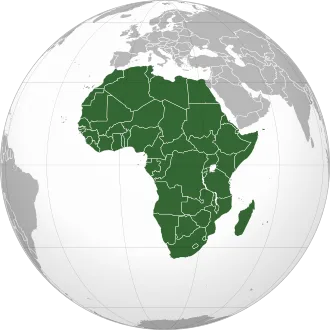
Africa straddles the equator and the prime meridian. The continent is surrounded by the Mediterranean Sea to the north, the Arabian plate and the Gulf of Aqaba to the northeast, the Indian Ocean to the southeast and the Atlantic Ocean to the west. France, Italy, Portugal, Spain, and Yemen have parts of their territories located on African geographical soil, mostly in the form of islands.
The continent includes Madagascar and various archipelagos. It contains 54 fully recognised sovereign states, eight cities and islands that are part of non-African states, and two de facto independent states with limited or no recognition. This count does not include Malta and Sicily, which are geologically part of the African continent.
Algeria is the largest country by area, and Nigeria is largest by population. Nations cooperate through the establishment of the African Union, which is headquartered in Addis Ababa.
Africa is highly biodiverse; it is the continent with the largest number of megafauna species, as it was least affected by the extinction of the Pleistocene megafauna. However, it is heavily affected by a wide range of environmental issues, including desertification, deforestation, water scarcity, and pollution. These entrenched environmental concerns are expected to worsen as climate change impacts Africa.
The UN Intergovernmental Panel on Climate Change has identified Africa as the continent most vulnerable to climate change.
The history of Africa is long, complex, and varied, and has often been under-appreciated by the global historical community. In African societies the oral word is revered, and they have generally recorded their history via oral tradition, which has led anthropologists to term them "oral civilisations", contrasted with "literate civilisations" which pride the written word.
African culture is rich and diverse both within and across regions, encompassing art, cuisine, music and dance, religion, and dress.
Africa, particularly Eastern Africa, is widely accepted to be the place of origin of humans and the Hominidae clade, also known as the great apes. The earliest hominids and their ancestors have been dated to around 7 million years ago, and Homo sapiens (modern human) are believed to have originated in Africa 350,000 to 260,000 years ago.
Throughout history the continent saw the rise and fall of many kingdoms and empires, such as Ancient Egypt, Makuria, the Fatimids, Mali, the Asante, Kongo, the Luba, Bunyoro, Great Zimbabwe, Imerina, and the Zulu. Despite the predominance of states, many societies were heterarchical and stateless. Slave trades created various diasporas, especially in the Americas.
From the late-19th century to early 20th century, driven by the Second Industrial Revolution, most of Africa was rapidly conquered and colonised by European nations, save for Ethiopia and Liberia. European rule had significant impacts on Africa's societies, and colonies were maintained for the purpose of economic exploitation and extraction of natural resources.
Most present states emerged from a process of decolonisation following World War II and established the Organisation of African Unity in 1963, the predecessor to the African Union. The nascent countries decided to keep their colonial borders, with traditional power structures used in governance to varying degrees.
Etymology
Afri was a Latin name used to refer to the inhabitants of what was then known as northern Africa, located west of the Nile river, and in its widest sense referring to all lands south of the Mediterranean, also known as Ancient Libya. This name seems to have originally referred to a native Libyan tribe, an ancestor of modern Berbers; see Terence for discussion.
The name had usually been connected with the Phoenician word ʿafar meaning "dust", but a 1981 hypothesis has asserted that it stems from the Berber word ifri (plural ifran) meaning "cave", in reference to cave dwellers.
The same word may be found in the name of the Banu Ifran from Algeria and Tripolitania, a Berber tribe originally from Yafran (also known as Ifrane) in northwestern Libya, as well as Ifrane, Morocco.
Under Roman rule, Carthage became the capital of the province Africa Proconsularis, following the Roman victory over the Carthaginians in the Third Punic War in 146 BC, which also included the coastal part of modern Libya. The Latin suffix -ica can sometimes be used to denote a land (e.g., in Celtica from Celtae, as used by Julius Caesar).
The medieval Muslim region of Ifriqiya, following its conquest of the Byzantine (Eastern Roman) Empire's Exarchatus Africae, preserved a form of the name. According to the Romans, Africa lies to the west of Egypt, while "Asia" was used to refer to Anatolia and lands to the east. In his Geographia, Ptolemy draws a definite line between the two continents by, indicating Alexandria along the prime meridian and making the Isthmus of Suez and the Red Sea the boundary between Asia and Africa.
As Europeans came to understand the real extent of the continent, the idea of "Africa" expanded with their knowledge.
Other etymological hypotheses have been postulated:
- 1st-century Jewish historian Flavius Josephus (Ant. 1.15) asserted that it was named for Epher, grandson of Abraham according to Genesis 25:4, whose descendants, he claimed, had invaded Libya.
- Isidore of Seville in his 7th-century Etymologiae XIV.5.2. suggests it comes from the Latin aprica, meaning "sunny".
- Massey, in 1881, stated it is derived from the Egyptian af-rui-ka, meaning "to turn toward the opening of the Ka". The ka is the energetic double of every person, and the "opening of the Ka" refers to a womb or birthplace. Africa would be, for the Egyptians, "the birthplace".
- Michèle Fruyt in 1976 proposed linking the Latin word with africus "south wind", which would be of Umbrian origin and mean originally "rainy wind".
- Robert R. Stieglitz of Rutgers University in 1984 proposed: "The name Africa, derived from the Latin *Aphir-ic-a, is cognate to Hebrew Ophir ['rich']."
- Ibn Khallikan and some other historians claim the name came from a Himyarite king called Afrikin ibn Kais ibn Saifi ("Afrikus son of Abraham") who subdued Ifriqiya.
- Arabic afrīqā (feminine noun) and ifrīqiyā, now usually pronounced afrīqiyā (feminine) 'Africa', from 'afara [' = 'ain, not 'alif] 'to be dusty' from 'afar 'dust, powder' and 'afir 'dried, dried up by the sun, withered' and 'affara 'to dry in the sun on hot sand' or 'to sprinkle with dust'.
- Possibly Phoenician faraqa in the sense of 'colony, separation'.
The terms "North Africa" and "Sub-Saharan Africa" have been subject to recent criticism from some scholars due to its historical root in colonialist discourse which arbitrarily separated Africa into a white "northern" Africa and black "southern" Africa, overlooking common genetic links and regional diversity across the continent.
History
In accordance with African cosmology, African historical consciousness viewed historical change and continuity, order and purpose within the framework of man and his environment, the gods, and his ancestors, and he believed himself part of a holistic spiritual entity. In African societies, the historical process is largely a communal one, with eyewitness accounts, hearsay, reminiscences, and occasionally visions, dreams, and hallucinations crafted into narrative oral traditions which are performed and transmitted through generations.
In oral traditions time is sometimes mythical and social, and ancestors were considered historical actors. Mind and memory shapes traditions, as events are condensed over time and crystallise into clichés.Oral tradition can be exoteric or esoteric. It speaks to people according to their understanding, unveiling itself in accordance with their aptitudes.
In African epistemology, the epistemic subject "experiences the epistemic object in a sensuous, emotive, intuitive, abstractive understanding, rather than through abstraction alone, as is the case in Western epistemology" to arrive at a "complete knowledge", and as such oral traditions, music, proverbs, and the like were used in the preservation and transmission of knowledge.
Prehistory
Africa is considered by most paleoanthropologists to be the oldest inhabited territory on Earth, with the Human species originating from the continent. During the mid-20th century, anthropologists discovered many fossils and evidence of human occupation perhaps as early as seven million years ago ("Before Present"; BP).
Fossil remains of several species of early apelike humans thought to have evolved into modern humans, such as Australopithecus afarensis radiometrically dated to approximately 3.9–3.0 million BP, Paranthropus boisei (c. 2.3–1.4 million BP) and Homo ergaster (c. 1.9 million–600,000 BP) have been discovered.
After the evolution of Homo sapiens approximately 350,000 to 260,000 BP, the continent was mainly populated by groups of hunter-gatherers. These first modern humans left Africa and populated the rest of the globe during the Out of Africa II migration dated to approximately 50,000 years BP, exiting either across Bab-el-Mandeb over the Red Sea, the Strait of Gibraltar, or the Isthmus of Suez.
Other migrations of modern humans have been dated to that time, with evidence of early human settlement found in southern Africa, Southeast Africa, North Africa, and the Sahara. During the African humid period, estimated to have been around 10,500 BP, the Sahara had again become a green fertile valley, and its populations returned from the interior and coastal highlands, with rock art paintings depicting a fertile Sahara and large populations discovered in Tassili n'Ajjer dating back perhaps 10 millennia.
However, the warming and drying climate meant that by 5,000 BP, the Sahara region was becoming increasingly dry and hostile. Around 3500 BC, due to a tilt in Earth's orbit, the Sahara experienced a period of rapid desertification. The domestication of cattle preceded agriculture and seems to have existed alongside hunter-gatherer cultures. It is speculated that by 6,000 BP, cattle were domesticated in North Africa.
In West Africa, a wet phase ushered in an expanding rainforest and wooded savanna from Senegal to Cameroon. Between 9,000 and 5,000 BP, Niger–Congo speakers domesticated the oil palm and raffia palm. Black-eyed peas and voandzeia (African groundnuts) were domesticated, followed by okra and kola nuts.
Since most of the plants grew in the forest, the Niger–Congo speakers invented polished stone axes for clearing forest. Pygmies are thought to have inhabited Central Africa for many millennia, splitting into eastern and western groups around 5,000 BP. Over 150,000 BP, there was an early dispersal of anatomically modern humans to Southern Africa, equated with the modern-day Khoisan who have preserved their traditional hunter-gatherer way of life.
4th millennium BC – 6th century AD
Northeast Africa
From 3500 BC, nomes (ruled by nomarchs) coalesced to form the kingdoms of Lower Egypt and Upper Egypt in northeast Africa. Around 3100 BC Upper Egypt conquered Lower Egypt to unify Egypt under the 1st dynasty, with the process of consolidation and assimilation completed by the time of the 3rd dynasty who formed the Old Kingdom of Egypt in 2686 BC.
The Kingdom of Kerma emerged around this time to become the dominant force in Nubia, controlling territory as large as Egypt between the first and fourth cataracts of the Nile.
The height of the Old Kingdom saw the construction of many great pyramids, though under the 6th dynasty power gradually decentralised to the nomarchs, culminating in the disintegration of the kingdom, exacerbated by drought and famine. Around 2055 BC, the 11th dynasty, based in Thebes, conquered the others to form the Middle Kingdom of Egypt, and the 12th dynasty expanded into Lower Nubia at the expense of Kerma.
Around 1700 BC, the Middle Kingdom fractured in two, and the Hyksos (a militaristic people from Palestine) invaded and conquered Lower Egypt, while Kerma coordinated invasions deep into Egypt to reach its greatest extent. In 1550 BC, the 18th dynasty expelled the Hyksos, and established the New Kingdom of Egypt.
The New Kingdom conquered the Levant from the Canaanites, Mittani, Amorites, and Hittites, and extinguished Kerma, incorporating Nubia into the empire, and sending the Egyptian empire into its golden age. Internal struggles, drought, famine, and invasions by a confederation of seafaring peoples contributed to the New Kingdom's collapse in 1069 BC.
The New Kingdom's collapse liberated the Kingdom of Kush in Nubia, which manoeuvred into power in Upper Egypt and conquered Lower Egypt in 754 BC to form the Kushite Empire. The Kushites ruled for a century and oversaw a revival in pyramid building, until they were driven out of Egypt by the Assyrians in 663 BC in reprisal for their expansion towards the Assyrian Empire.
The Assyrians installed a puppet dynasty that later gained independence and once more unified Egypt, until it was conquered by the Achaemenid Empire in 525 BC.
Egypt briefly regained independence from the Achaemenids under the 28th dynasty from 404 to 343 BC. The conquest of Achaemenid Egypt by Alexander the Great in 332 BC marked the beginning of Hellenistic rule and the installation of the Macedonian Ptolemaic dynasty.
The Ptolemaics lost their holdings outside of Africa to the Seleucids in the Syrian Wars, expanded into Cyrenaica, and briefly occupied part of Kush in the 3rd century BC. In the 1st century BC, Ptolemaic Egypt became entangled in a Roman civil war, leading to its conquest by the Romans in 30 BC.
Kush persisted as a major regional power until, having been weakened from internal rebellion amid worsening climatic conditions, invasions by Aksum and the Noba caused their disintegration into Makuria, Alodia, and Nobatia around the 5th century AD.
Horn of Africa
In the Horn of Africa, there was the Land of Punt, a kingdom on the Red Sea which was a close trading partner of Ancient Egypt in the 3rd and 2nd millennia BC. Archaeologist Rodolfo Fattovich equates it to the Gash Group in the Sudanese-Eritrean lowlands, and some scholars have hypothesised modern-day Somalia, while Kenneth Kitchen and Felix Chami locate it on Zanzibar Island.
In the Eritrean-Ethiopian Highlands, the kingdom of dʿmt rose c. 980 BC as the region was incorporated into global trading networks, and it exhibited Sabaean influences which most scholars attribute to a small migration of Sabaeans and their assimilation. Several scholars consider there to have been other contemporaneous states, and dʿmt's collapse in the mid-1st century BC saw the region inhabited by small polities.