















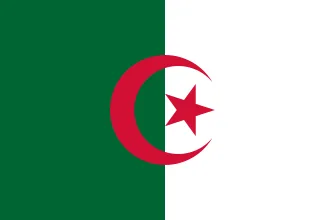
Algeria's territory has been a crossroads of cultures and civilizations for millennia, shaped first by indigenous Amazigh societies, including the Numidians, whose kingdom became one of the earliest major states in the region, as well as by Phoenician, Roman, Vandal, and Byzantine influences. From the 7th century onward, the spread of Islam and the arrival of Arab tribes gradually transformed the region's linguistic, religious, and cultural landscape, contributing to the development of a distinct Algerian identity rooted in both Arab-Islamic and Amazigh heritage.
Between the 8th and 15th centuries, Algeria was ruled by a succession of local Islamic dynasties including Rustamids, Fatimids, Zirids, Hammadids, Almohads and Zayyanids. In 1516, the Regency of Algiers was established, gradually emerging as a largely autonomous state owing nominal allegiance to the Ottoman Empire. After nearly three centuries as a major power in the Mediterranean, the country was invaded by France in 1830 and formally annexed in 1848, though it was not fully conquered and pacified until 1903.
French rule brought mass European settlement that displaced the local population; by mid-1870, indigenous Algerians declined by up to a third due to warfare, disease, and starvation. French colonization faced continuous Algerian resistance, from Emir Abdelkader's campaigns and the Mokrani Revolt to the rise of nationalist movements in the 20th century.
The Sétif and Guelma massacre in 1945 catalysed local resistance that culminated in the outbreak of the Algerian War in 1954. Algeria gained independence in 1962. It descended into a bloody civil war from 1992 to 2002, remaining in an official state of emergency until the 2010–2012 Algerian protests during the Arab Spring.
Algeria has a semi-arid climate, with the Sahara desert dominating most of the territory except for its fertile and mountainous north, where most of the population is concentrated. Its official languages are Arabic and Tamazight, while the vast majority of the population speak the Algerian dialect of Arabic. The usage of French persists, especially in media, education, and certain administrative matters, but has no official status.
Most Algerians identify as Arabs, while Berbers form a sizeable minority. Sunni Islam is the official religion and practiced by 99% of the population.
Algeria is a semi-presidential republic composed of 69 provinces (wilayas) and 1,541 communes. It is a regional power in North Africa and a middle power in global affairs, with the largest military budget in Africa. As of 2025, Algeria has the highest Human Development Index in continental Africa, and the third largest economy in Africa, due mostly to its large petroleum and natural gas reserves, which are the sixteenth and ninth largest in the world, respectively.
Sonatrach, the national oil company, is the largest company in Africa and a major supplier of natural gas to Europe. Algeria is a member of the African Union, the Arab League, the OIC, OPEC, the United Nations, and the Arab Maghreb Union, of which it is a founding member.
Name
Different forms of the name Algeria include: Arabic: الجزائر, al-Jazāʾir, Algerian Arabic: دزاير, dzāyer, French: l'Algérie. The country's full name is officially the People's Democratic Republic of Algeria (Arabic: الجمهورية الجزائرية الديمقراطية الشعبية, al-Jumhūriyah al-Jazāʾiriyah ad-Dīmuqrāṭiyah ash‑Shaʿbiyah; French: République algérienne démocratique et populaire, abbr. RADP; Standard Algerian Berber: Tagduda tazzayrit tamagdayt taɣerfant, ⵜⴰⴳⴷⵓⴷⴰ ⵜⴰⵣⵣⴰⵢⵔⵉⵜ ⵜⴰⵎⴰⴳⴷⴰⵢⵜ ⵜⴰⵖⴻⵔⴼⴰⵏⵜ).
Etymology
The name Algeria ultimately derives from the city of Algiers, whose Arabic name, al-Jazāʾir (الجزائر, meaning "the islands"), referred to the small islands once located off the city's coast. The term itself was a shortened form of Jazāʾir Banī Mazghanna (جزائر بني مزغنة, "the islands of the Bani Mazghanna"), named after a local Berber tribe.
The city was founded in 950 by the Sanhaja Berber Emir Buluggin ibn Ziri on the site of the ancient city of Icosium, and its name later appeared in the writings of medieval Muslim geographers such as Al-Bakri.
The modern state took its name from the Regency of Algiers, the Ottoman polity established in the central Maghreb during the early 16th century. Under Ottoman rule, a political and administrative structure gradually emerged that helped define the territory and borders of what would become Algeria. Contemporary sources referred to the land as Watan al-Jazāʾir (وطن الجزائر, "the country of Algiers"), while the Ottoman Turkish aristocracy settled in the region identified both itself and the local population as "Algerians."
History
Before the sixteenth century, the territory now known as Algeria was simply central North Africa; a large, dissident and unstable region organised around the family, village and tribe rather than strong central states. Unlike Tunisia and Morocco, which had developed centres of power earlier, it lacked comparable political hubs.
The physical landscape itself shaped these social and political patterns. Algeria comprises the sea, intermittent coastal plains, the Tell Atlas and Saharan Atlas ranges, the high plains and the harsh desert. The coastal plain was historically marshy, flood-prone and malarial, so the population settled mainly in the healthier uplands.
The Tell Atlas mountains, with their Mediterranean climate and reliable rainfall, were largely self-sufficient, supporting olives, wheat, dates, livestock and dense vegetation. They functioned as isolated “island republics” between the sea and the desert, with settlement patterns dictated by rainfall rather than rivers.
This geography created a lasting cultural and political divide. The plains were zones of armies, trade and Mediterranean contact, and coastal peoples viewed the mountains as dangerous. Mountain communities, by contrast, were fiercely independent and treated their landscape as a refuge from external power. The Arabs formalised the contrast as Bled el Makhzen (lit. 'lands of government') versus Bled es Siba (lit. 'lands of dissidence'), and successive rulers found the highland populations difficult to control.
Greek sources already portrayed the mountain peoples as turbulent, fair-skinned speakers of a Libyc language. Under the Numidian king Masinissa, whose territory roughly matched modern Algeria, tribes paid tribute to a central authority modelled on Alexander the Great’s Hellenistic state. Below this elite, however, Berber society remained organised by clans, lineages and tribes that valued self-reliance amid weak government.
Village councils of male family heads settled disputes, especially feuds, and fiercely protected local customary law and territory. These traditions of autonomy impeded the establishment of a state with a sophisticated administrative structure, yet they fostered a strong sense of place and a culture of resistance. Intimate knowledge of the landscape’s hiding places and natural strongholds was passed down through generations and deployed against Romans, Arabs, Ottomans, French and even the post-independence state.
The mountains thus became the domain of outlaws, rebels, dissident forms of Christianity and Islam, and the maquis—the “lions of the mountains” who resisted the French army—while remaining a distinctly masculine world centred on honour and respect for arms.
Prehistory and ancient history
Around ~1.8-million-year-old stone artifacts from Ain Hanech (Algeria) were considered to represent the oldest archaeological materials in North Africa. Stone artifacts and cut-marked bones that were excavated from two nearby deposits at Ain Boucherit are estimated to be ~1.9 million years old, and even older stone artifacts to be as old as ~2.4 million years.
Hence, the Ain Boucherit evidence shows that ancestral hominins inhabited the Mediterranean fringe in northern Africa much earlier than previously thought. The evidence strongly argues for early dispersal of stone tool manufacture and use from East Africa, or a possible multiple-origin scenario of stone technology in both East and North Africa.
Neanderthal tool makers produced hand axes in the Levalloisian and Mousterian styles (43,000 BC) similar to those in the Levant. Algeria was the site of the highest state of development of Middle Paleolithic Flake tool techniques. Tools of this era, starting about 30,000 BC, are called Aterian (after the archaeological site of Bir el Ater, south of Tebessa).
The earliest blade industries in North Africa are called Iberomaurusian (located mainly in the Oran region). This industry appears to have spread throughout the coastal regions of the Maghreb between 15,000 and 10,000 BC. Neolithic civilisation (animal domestication and agriculture) developed in the Saharan and Mediterranean Maghreb perhaps as early as 11,000 BC or as late as between 6000 and 2000 BC.
This life, richly depicted in the Tassili n'Ajjer paintings, predominated in Algeria until the classical period. The mixture of peoples of North Africa coalesced eventually into a distinct native population that came to be called Berbers, who are the indigenous peoples of northern Africa.
From their principal centre of power at Carthage, the Carthaginians expanded and established small settlements along the North African coast; by 600 BC, a Phoenician presence existed in the Algerian coast, such as Icosium in modern-day Algiers and Hippo Regius (modern Annaba). These settlements served as market towns as well as anchorages.
The Carthaginians avoided conquering the strong Berber tribes in the interior. Instead, they collected tribute, focused on trade (especially metals), and maintained friendly relations. The Berbers supplied them with goods, slaves, and skilled cavalry through trans-Saharan networks. Carthaginian culture strongly influenced nearby Berber tribes, who adopted many of its elements.
From the sixth century BC, under the Magonid dynasty, Carthage became more aggressive, partly due to rivalry with the Greeks, leading to conflict in Sicily in 580 BC.
As Carthaginian power grew, its impact on the indigenous population increased dramatically. By the fifth century BC, Berbers in what is now Algeria had developed mixed farming and pastoral economies, advanced manufacturing, trade and political organisation supported several states. By the third century BC, two major Berber kingdoms existed: the Masaesyli (from the Moulouya River in eastern Morocco to the Rhummel in Algeria) and the Massyli (in extreme eastern Algeria and western Tunisia).
In 203–202 BC, Masinissa of the Massyli, after being supported by Rome and playing a key role in the Battle of Zama against Carthaginian general Hannibal, defeated his western rivals (including Syphax) and unified the territories into the Kingdom of Numidia. Stretching from Tabarka in Tunisia to the Moulouya River, with its capital at Cirta (Constantine), Numidia represented a high point of Berber civilization.
Masinissa promoted agriculture, built a strong army and navy, and was praised by ancient writers such as Roman historian Livy as an exceptional ruler. After Masinissa's death in 148 BC, succession struggles arose. His grandson Jugurtha (r. 118–106 BC) reunified Numidia through ruthless means but provoked Rome through conflict and the massacre of Roman citizens at Cirta.
Despite brilliant resistance, Jugurtha was defeated and captured in 106 BC with the betrayal of his father-in-law Bocchus of Mauretania.
Rome successfully built local alliances in North Africa, such as the one with Massinissa against Carthage. However, it gradually tightened control by first turning Numidia into a protectorate, then dividing and weakening it. Later Berber client kings, such as Juba I (who supported Pompey and was defeated by Caesar at Thapsus in 46 BC), continued to rule diminished territories.
Augustus installed Juba II (r. 25 BC–c. 23 AD), a highly cultured scholar and husband of Cleopatra Selene, as client king of Mauretania (central Algeria and Morocco), bringing a period of prosperity. In 40 AD, Emperor Caligula executed Juba II's son Ptolemy. Following a subsequent Berber revolt, Rome abolished the last client kingdoms and imposed direct rule, dividing the territory into provinces (Mauretania Caesariensis, Mauretania Tingitana, and Africa Proconsularis).
Rome extensively integrated local elites: the Severan dynasty (192–235 AD) was of African origin, and Emperor Macrinus was born in Caesarea (modern Cherchell, Algeria) around 165 AD. He became Praetorian Prefect, assassinated Caracalla in 217, and ruled briefly for about 15 months. At its height, 90 out of 600 Roman senators came from North Africa.
While Rome brought in settlers and established colonies of veterans, its presence primarily promoted the assimilation of local populations, who preserved their languages and many traditions while adapting them to Latin and Roman gods. The Romans helped create and develop cities that relied heavily on local contributions.
Nevertheless, Roman rule had a largely negative long-term impact on Berber society. While coastal areas saw grand Roman construction, much of the interior was turned into grain-exporting latifundia, pushing Berbers into the hinterland where they retribalized and resisted for generations. Christianity spread in the 3rd–4th centuries.
Its most prominent Berber figures were Saint Augustine, the bishop of Hippo Regius (modern-day Annaba, Algeria) and his mother, Saint Monica. However, Christianity rapidly declined among Berbers after being associated with Roman exploitation, especially following the suppression of the Donatist movement.
By the time the Vandals ended Roman control in 429 AD, most of Algeria had returned to Berber tribal rule. Under King Genseric, the Vandal Kingdom successfully defended Carthage against two Byzantine expeditions from Constantinople in 460 and 468. A peace treaty in 474 brought several decades of stability. This period ended when Gelimer deposed his cousin Hilderic and seized power.
In 533, Emperor Justinian I, seeking to restore the Roman Empire, launched a major campaign against the Vandals. A large fleet commanded by General Belisarius sailed from Constantinople. After landing near Carthage, Belisarius decisively defeated the Vandals in two battles, occupied Carthage, and captured King Gelimer, who was exiled to Anatolia. Many Vandals were enslaved or expelled from North Africa.
Byzantine rule in Africa was limited mainly to the provinces of Byzacena, Proconsular Africa, and Numidia. While some urban life persisted, rural areas suffered from heavy taxation, frequent revolts, and insecurity. The devastating Justinian Plague further weakened the region. The Byzantines then faced resistance from the Moorish tribes of the Aurès Mountains.
Governor Solomon defeated them and reinforced control through an extensive fortification program, but he was killed in battle near Tebessa in 543. General John Troglita later restored a fragile peace, granting significant autonomy to the Moorish kingdoms. The most prominent of these were the Mauro-Roman and Altava Kingdoms.
A growing sense of local autonomy emerged, exemplified by the powerful governor Gregory the Patrician (from 646), who minted his own coins and moved the capital to Sufetula (Sbeitla).
Middle Ages
The Muslim conquest of the Maghreb took place between 647 and 709, marking the Arab-Islamic expansion into North Africa, which was then divided between Byzantine-controlled coastal territories and independent Berber kingdoms and tribes in the interior. The conquest unfolded in three main phases and ultimately brought most of the region under Umayyad Caliphate control.
The first invasion (647–648), led by Abdallah ibn Saad under Caliph Uthman, targeted the Exarchate of Carthage. The Arabs defeated the Byzantine patrician Gregory at the Battle of Sufetula, weakening Byzantine authority in Ifriqiya. However, the campaign did not extend beyond raiding. After a period of civil war in the Muslim world, a second wave began around 665–689.
Oqba ibn Nafi played a central role: in 670, he founded the city of Kairouan, which became a major Islamic base and cultural centre. He led ambitious campaigns deep into the interior, reportedly reaching the Atlantic coast, but faced strong resistance from Byzantine and Berber forces. A coalition led by the Berber leader Kusayla ambushed and killed Oqba at the Battle of Tahouda in 683. Kusayla temporarily captured Kairouan before being defeated.
The third and decisive phase (697–709) was led by Hassan ibn al-Nu'man and later Musa ibn Nusayr. Hassan recaptured and destroyed Carthage in 697 after fierce fighting against Byzantine reinforcements. A major Berber resistance then emerged under the legendary queen Kahina (Dihya), who initially defeated the Arabs in the Aurès Mountains.
However, Hassan returned with fresh troops, defeated and killed Kahina around 697. Musa ibn Nusayr completed the conquest of the western Maghreb, subduing Berber tribes, capturing Tangier, and integrating many converted Berbers into the Muslim army. By 709, the entire Maghreb was under Umayyad control.
Following the Berber general Tariq ibn Ziyad's conquest of Visigothic Spain in 711, Islam had already spread throughout North Africa, and Berbers actively participated in raids into Europe, reaching as far as Lyon and Autun in France. However, Berber converts were still treated as second-class non-Arabs; the difficult conquest of the Maghreb prompted the Umayyads to impose heavy taxation and oppressive governance.
Attracted by ideals of equality and religious purity, many Berbers supported Kharijite movements, triggering frequent revolts in Ifriqiya.
Following the Berber revolt numerous independent states emerged across the Maghreb. In 778, Abdel Rahman Ibn Rustam established a Kharijite emirate at Tahert in central Algeria known as the Rustamid imamate, marking the first independent Muslim state in the Maghrib. At its peak, the kingdom extended from Tlemcen to Tripoli.
It prospered through trans-Saharan trade. The Rustamids faced constant threats from the Aghlabids, backed by the Abbasid Caliphate, in the east, and the Alid Idrisids in the west. Due to the strict religious nature of Ibadi society, the imams frequently dealt with internal rebellions, which weakened their authority unless the ruler was particularly charismatic. The dynasty was defeated by the Fatimids in 909, prompting the Ibadis to settle in the M'zab region.
The Fatimid da'wa entered the Maghreb through the skilled Ismaili Shia missionary Abu Abdullah al-San'ani (al-Shi'i), who arrived around 900 and settled among the Kabyle Kutama Berbers near Sétif. He gradually gained their support through preaching the coming of the Mahdi, organized them militarily, and succeeded in overthrowing the Aghlabid dynasty.
In 909, he captured Kairouan and prepared the ground for the Fatimid state. He then liberated Ubayd Allah al-Mahdi from prison in Sijilmasa and handed him power. Al-Mahdi declared himself Caliph in 910, becoming the founder of the Fatimid Caliphate in Ifriqiya (Tunisia). The Fatimids imposed Ismaili Shia doctrine, faced strong opposition from the Sunni Maliki population, and dealt with several revolts, especially the major rebellion of Abu Yazid (the Man of the Donkey).