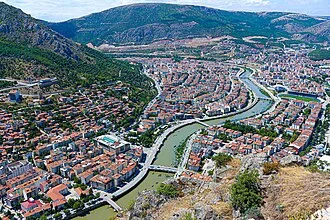
In antiquity, Amaseia was a fortified city high on the cliffs above the river. It has a long history as a wealthy provincial capital, producing kings and princes, artists, scientists, poets and thinkers, from the kings of Pontus, through Strabo the geographer, to many generations of the Ottoman imperial dynasty. With its Ottoman-period wooden houses and the tombs of the Pontus kings carved into the cliffs overhead, Amasya is attractive to visitors.
In recent years, there has been much investment in tourism, and therefore more foreign and Turkish tourists have visited the city.
During the early Ottoman rule, it was customary for young Ottoman princes to be sent to Amasya to govern and gain experience. Amasya was also the birthplace of the Ottoman sultans Murad II and Selim I. Traditional Ottoman houses near the Yeşilırmak and the other main historical buildings have been restored; these traditional Yalıboyu houses are now used as cafes, restaurants, pubs and hotels. Behind the Ottoman wooden houses one can see the rock tombs of the Pontic kings.
Etymology
According to Strabo the Greek name Ἀμάσεια comes from Amasis, the queen of the Amazons, who were said to have lived here. The name has changed little throughout history: Ἀμάσεια, Amaseia, Amassia and Amasia are all found on ancient Greek and Roman coinage and continue to be used in modern Greek. Armenian Ամասիա, Ottoman Turkish اماسیه, and modern Turkish Amasya all represent the same pronunciation.[citation needed]
History
Antiquity
Archaeological research shows that Amasya was first settled by the Hittites and subsequently by Phrygians, Cimmerians, Lydians, Greeks, Persians, and Armenians.[citation needed]
Hellenistic period
An independent Pontic kingdom with its capital at Amaseia was established by the Persian Mithridatic dynasty at the end of the 4th century BC, in the wake of Alexander's conquests. In the 1st century BC, it briefly contested Rome's hegemony in Anatolia. By 383 BC, the city was settled by Greeks, eventually becoming the capital of the Kingdom of Pontus from 333 BC to 26 BC.
Today, there are prominent ruins including the royal tombs of Pontus in the rocks above the riverbank in the centre of the city. Ancient district in northeastern Anatolia adjoining the Black Sea.[citation needed]
Roman-Byzantine period
Amaseia was captured by a force led by the Roman Lucullus in 70 BC from Armenia and was quickly made a free city and administrative center of his new province of Bithynia and Pontus by Pompey. By this time, Amaseia was a thriving city, the home of thinkers, writers and poets, and one of them, Strabo, left a full description of Amaseia as it was between 60 BC and 19 AD.
Around 2 or 3 BC, it was incorporated into the Roman province of Galatia, in the district of Pontus Galaticus. Around the year 112, the emperor Trajan designated it a part of the province of Cappadocia. Later in the 2nd century it gained the titles 'metropolis' and 'first city'. After the division of the Roman Empire by emperor Diocletian the city became part of the East Roman Empire (the Byzantine Empire). At this time it had a predominantly Greek-speaking population.[citation needed]
Amaseia was also referenced in the first book of the Alexiad. Amaseia was the town where Emperor Alexios I Komnenos received the Norman general Ursel as a captive from the Turkic general Tutach. Ursel had, according to the book, looted and pillaged the Eastern provinces of the Byzantine Empire until the at-the-time General Alexios convinced Tutach to capture him.
Alexios agreed that he would pay "...such a sum of money as no one ever gained before." to Tutach for the capture of Ursel, however Alexios had no cash to give and the Emperor was unable to fund it, so he attempted to raise money from the people of Amaseia, however this caused serious unrest. However, after a speech by Alexios, he arranged a mock-blinding of Ursel which promptly caused the people to contribute funds. However, this is likely to be biased.
Saints Theodore of Amasea (died by 319), a warrior saint, and the local bishop Asterius of Amasea (died c. 410), some of whose polished sermons survive, are notable Christian figures from the period.[citation needed]
In 2013, a 24-square-meter Christian mosaic belonging to the floor of a chapel was discovered, near a site where an illegal archaeological dig had been attempted. The mosaic, depicts apples, an apple tree, partridges and many geometric figures.
Early Turkish rulers
In 1075, ending 700 years of Byzantine rule, Amasya was conquered by the Turkmen Danishmend emirs. It served as their capital until the annexation of the Danishmendid dominions by the Seljuk ruler Kilij Arslan II. When he died, his realm was divided among his sons, and Amasya passed to Nizam ad-Din Arghun Shah. His rule was brief, as he lost it to his brother Rukn ad-Din Suleiman Shah, who subsequently became Sultan.
During the 13th century the city passed under the control of the Mongol Ilkhanate, and was ruled by Mongol governors, except for a brief rule by Taj ad-Din Altintash, son of the last Seljuk sultan, Mesud II.
Under the Seljuks and the Ilkhan, the city became a centre of Islamic culture and produced some notable individuals such as Yaqut al-Musta'simi (1221–1298) calligrapher and secretary of the last Abbasid caliph who was a Greek native of Amasya. Schools, mosques, tombs and other architecture of this period still remain.[citation needed]
In 1341, the emir Habiloghlu occupied the city, before it came under the rule of the Eretnid emirate. Hadji Shadgeldi Pasha took Amasya from the Eretnids under Ali Bey, and successfully fended off the claims of Kadi Burhan al-Din, who had supplanted the Eretnids. Shadgeldi was succeeded by his son Ahmed, who managed to retain his autonomy for a while, with Ottoman assistance; but in 1391/92, the mounting pressure forced him to cede the city to the Ottoman sultan Bayezid I, who installed his son, the future Mehmed I, as its governor.
Ottoman era
After the disastrous Battle of Ankara in 1402, Mehmed I fled to Amasya, which (along with nearby Tokat) became his main residence and stronghold during the Ottoman Interregnum.
As a result, the city enjoyed a special status under the Ottomans. A number of Ottoman princes were sent to the province of Amasya (the Rûm Eyalet) as governors in their youth, from Mehmed II in the late 14th century to Bayezid II in the 15th century, through to Murat III in the 16th century.[citation needed]
Suleiman the Magnificent often stayed in the city, and even received the Habsburg ambassador Ogier Ghiselin de Busbecq there. Already distinguished a cultural centre under the Seljuks, Amasya now "became one of the main seats of learning in Anatolia".
Between 1530 and 1545, several travelers documented a blood libel against some of the town's Jews. After the disappearance of a local Christian, several Jews living in town were blamed for killing him for ritual reasons. The Jews confessed under torture and were hanged. When the supposed victim was discovered to still be alive, Sultan Suleiman the Magnificent ordered that all accusations regarding religious rituals should be judged under "royal" and not local court.
In 1555, Amasya was also the location for the signing of the Peace of Amasya with the Safavid dynasty of Persia.[citation needed]
The population of Amasya at this time was very different from that of most other cities in the Ottoman Empire, as it was part of their training for the future sultans to learn about every nation of the Empire. Every millet of the Empire was represented in Amasya in a particular village—such as a Greek village, an Armenian village, a Bosnian village, a Tatar village, a Turkish village etc. (see: 1927 Population count data by DİE)
In the late 19th century, the city had 25,000–30,000 inhabitants, mainly Muslims, but also Armenians and Orthodox Greeks.
World War I and the Turkish War of Independence
In 1919 Amasya was the location of the final planning meetings held by Mustafa Kemal Atatürk for the building of a Turkish army to establish the Turkish republic following the collapse of the Ottoman Empire at the end of the First World War. It was here that Mustafa Kemal made the announcement of the Turkish War of Independence in the Amasya Circular.
This circular is considered as the first written document putting the Turkish War of Independence in motion. The circular, distributed across Anatolia, declared Turkey's independence and integrity to be in danger and called for a national conference to be held in Sivas (Sivas Congress) and before that, for a preparatory congress comprising representatives from the eastern provinces of Anatolia to be held in Erzurum in July (Erzurum Congress).[citation needed]
During the years of World War I and the Turkish War of Independence, the Christian inhabitants of Amasya (Armenian and Greek) suffered from atrocities. Many Armenian civilians fleeing the attacks sought refuge at the American missionary school Anatolia College, located in Merzifon outside Amasya. In 1921, Turkish troops closed down the school, and the local population relocated to Thessaloniki after the population exchange between Greece and Turkey.
Also, in 1921 there was the Amasya trials which were special ad hoc trials, organized by the Turkish National Movement, with the purpose to kill the Greek representatives of Pontus region under a legal pretext.
Ecclesiastical history
Amasea became the seat of a Christian metropolitan bishop in the Eastern Roman Empire, in particular from the 3rd century AD. As capital of the Late Roman province of Helenopontus, it also became its Metropolitan Archbishopric and included the suffragans of Amisus, Andrapa, Euchaitae, Ibora, Sinope, Zaliche and Zela. In the 10th century the metropolis ranked 11th among the metropolises of the Ecumenical Patriarchate of Constantinople.
From the 12th century the Christian element was reduced due to the Turkic migrations into Anatolia. In 1317, during a particularly violent Turkoman attack, the metropolitan Callistus, who had been appointed to fill a long-standing vacancy in 1315, was unable to enter his see. Thus, after gaining the permission of Patriarch John XIII, the metropolitanate was moved over to Limnia (which was deemed safer, as it was situated in the Empire of Trebizond) "until conditions improved and the Turks would permit him to enter Amaseia".
In 1384, the bishop of Limnia temporarily took charge of the metropolis of Amasea when its own metropolitan could not access the area.
Time, which always works by transforming and destroying that which exists everywhere, placed the once famous and great, most holy metropolitanate of Amaseia, in an impoverished state. As a result of the sacred judgement of God, she was wholly wasted and destroyed by the invasion of the foreigners... Even if in the beginning she was illustrious as a metropolitanate, she is now poverty-stricken to those who observe or consider her.
The Orthodox metropolis of Amasea was active until the Population exchange between Greece and Turkey (1923) and in 1922 counted c. 40,000 Christians, 20,000 of them being Greeks. The last active metropolitan bishop was Germanos Karavangelis. No longer being a residential diocese, Amasea is today listed by both the Eastern Orthodox Church and the Catholic Church as a titular see.
Titular Latin see
Rome suppressed the see formally c. 1600, but immediately transformed it into a titular archbishopric Amasea, of the highest (Metropolitan) rank, which has had the following archiepiscopal incumbents:
- (Giovanni) Battista Agucchia (1623.10.23 – death 1632.01.01), papal diplomat
- Fausto Poli (1633.03.14 – 1643.07.13), later created Cardinal-Priest of San Crisogono (1643.08.31 – death 1653.10.07), Bishop of Orvieto (Italy) (1644.05.23 – 1653.10.07)
- Egidio Colonna, Cassinese Benedictine Congregation (O.S.B. Cas.) (1643.12.19 – 1671.01.19); later Titular Latin Patriarch of Jerusalem (1636 – death 1637)
- Francesco de' Marini (1671.01.19 – 1686.04.27), former Bishop of Albenga (Italy) (1655.08.11 – 1666.03.29), Bishop of Molfetta (Italy) (1666.03.29 – 1670.10.06); later Titular Archbishop of Theodosia (see) (1686.04.27 – ?)
- Ferdinando d'Adda (1687.03.03 – 1690.02.13), the papal representative to King James II of England, ?later created Cardinal-Priest of S. Clemente (1690.04.10 – 1696.01.02), transferred repeatedly Cardinal-Priest of Santa Balbina (1696.01.02 – 1714.04.16), Prefect of Sacred Congregation of Rites (1701? – ?), Cardinal-Priest of S. Pietro in Vincoli (1714.04.16 – 1715.01.21), promoted Cardinal-Bishop of Albano (1715.01.21 – death 1719.01.27)
- Agostino Cusani (1696.04.02 – 1711.10.14), Apostolic Nuncio (papal ambassador) to France (1706.05.22 – 1711.10.14), Bishop of Diocese of Pavia (Italy) (1711.10.14 – 1724.07.12), created Cardinal-Priest of S. Maria del Popolo (1713.01.30 – death 1730.12.27)
- Fabritius Aurelius de Agostini (1712.10.05 – 1712.12.06)
- Giovanni Crisostomo Battelli (1716.10.05 – 1725.07.30)
- Giovanni Battista Gamberucci (1725.09.05 – 1738.11.28)
On 1742.02.15 it was united (as a mere title) with the residential Diocese of Pavia (Italy).
Since 1819.11.19 it is again suppressed as such and restored nominally as Metropolitan Titular archbishopric (highest rank, again). It is vacant for decades, having had the following archiepiscopal incumbents since:
- Jean-Paul-Gaston de Pins (1824.05.03 – 1850.11.30)
- József Krivinai Lonovics (1861.03.29 – 1866.11.27)
- Jean-Baptiste-François Pompallier, Marists (S.M.) (1869.04.19 – 1871.12.21)
- Silvestre Guevara y Lira (1877.01.09 – 1882.02.20)
- Giuseppe Macchi (1889.04.09 – 1897.08.19)
- Paul Rubian (1900.02.24 – 1911.04.16)
- Bertram Orth (1908.10.01 – 1931.02.10)
- Frantisek Kordác (1931.07.21 – 1934.04.26)
- Gustavo Testa (1934.06.04 – 1959.12.14) as Apostolic Delegate (papal diplomatic envoy) to Egypt and Arabia (1934.06.04 – 1945), later created Cardinal-Priest of S. Girolamo dei Croati (1959.12.17 – death 1969.02.28), Pro-President of Administration of the Patrimony of the Apostolic See (1961.10.04 – 1969.02.28), Secretary of Sacred Congregation for the Oriental Churches (1962.08.02 – 1965), promoted Pro-Prefect of Sacred Congregation for the Oriental Churches (1965 – 1967.08.15), and next Prefect of Sacred Congregation for the Oriental Churches (1967.08.15 – retired 1968.01.13)
- Gaetano Malchiodi (1960.01.26 – 1965.01.22)
- James Patrick Carroll (1965.10.15 – 1995.01.14)
The legend of Ferhat and Shirin
In its Turkish version, this classic tale of oriental folklore is held to have taken place in Amasya. The nearby mountain Ferhat is named for Farhad (Turkish spelling Ferhat), the hero of the legend, who for love of the princess Shirin (Turkish spelling Şirin) tried to win her father's favour and permission by tunnelling through the mountain to bring spring water to his palace.
Sadly, while he was working he was sent the false information that Shirin had died; upon which he threw himself onto the rocks in his grief. And his beloved princess died soon after. The story has since become a play by Nâzım Hikmet, a novel by Talip Apaydın, and an opera by Arif Melikov.[citation needed]
Climate
Amasya has a hot-summer Mediterranean climate (Csa) under Köppen classification and a hot summer oceanic climate (Doa) under the Trewartha classification.
It is warmer than central Anatolia, and its weather is not as cold in winter months. It has features of both the oceanic climate of the Black Sea and a continental Mediterranean climate.
Highest recorded temperature: 45.0 °C (113.0 °F) on 30 July 2000
Lowest recorded temperature: −21.0 °C (−5.8 °F) on 15 January 2008
Amasya today
The province of Amasya is known for producing high-quality, small, well-flavoured apples. The Amasya-Tokat region the main area of production. The city is not so developed industrial terms, but is attractive and well-preserved, especially when sitting by the river, which has a particular mystique on a winter evening when fog fills the valley.
Tourists (and soldiers from the local base) contribute valuable income to the shopkeepers. The railway line from Sivas to Samsun runs through Amasya, and there is an attractive Ottoman-era railway station.
The city of Amasya has some nightlife, mainly bars and cafes for visitors, and some basic restaurants. It is not a very conservative city, unlike other central and eastern Anatolian cities. Social life in this city, partly owing to tourism, becomes more animated especially during the summer period. Many international circus groups visit this city.
June 12 is a festival date for Amasya during this time, with many cultural and sporting activities on offer.
The local cuisine includes the local specialty toyga çorbası, a soup containing yogurt, drunk hot or cold. Other specialties include pastries with poppy seeds and tea, served by the riverbank.
The Amasya Merzifon Airport or Merzifon-Amasya Airport is located 41 kilometers northwest from the city. Previously, it was only used for military purposes, but has been open to civilian flights since 2008. There are daily one-hour flights from/to Istanbul.
Tourism
Tourism has been increasing. In 2011, there were 500,000 tourists, 11,000 foreign; in 2012, 600,000, 22,000 foreign; in 2013, 750,000 total; 1 million were projected for 2014. Foreign tourists are mostly Germans and East Asians, notably from Japan and South Korea. In consequence, many hotels, especially boutique hotels, are opening. Many traditional Ottoman wooden houses have been restored and are now used as boutique hotels, cafes, bars.