















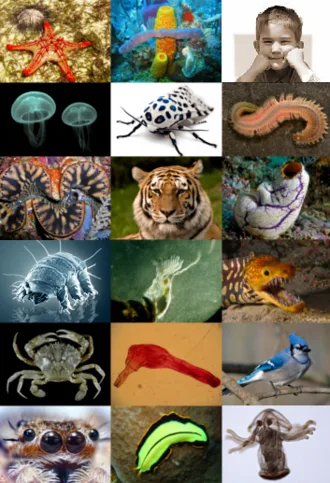
The animal kingdom is divided into five major clades, namely Porifera, Ctenophora, Placozoa, Cnidaria and Bilateria. Most living animal species belong to the clade Bilateria, a highly proliferative clade whose members have a bilaterally symmetric and significantly cephalised body plan, and the vast majority of bilaterians belong to two large clades: the protostomes, which include organisms such as arthropods, molluscs, flatworms, annelids and nematodes; and the deuterostomes, which include echinoderms, hemichordates and chordates, the last of which contains the vertebrates. The much smaller basal phylum Xenacoelomorpha have an uncertain position within Bilateria.
Animals are first represented in the fossil record in the Ediacaran period, with most modern animal phyla appearing as marine species in the Cambrian explosion, which began around 539 million years ago (Mya), and most classes during the Ordovician radiation 485.4 Mya. Common to all living animals, 6,331 groups of genes have been identified that may have arisen from a single common ancestor that lived about 650 Mya during the Cryogenian period.
Historically, Aristotle divided animals into those with blood and those without. Carl Linnaeus created the first hierarchical biological classification for animals in 1758 with his Systema Naturae, which Jean-Baptiste Lamarck expanded into 14 phyla by 1809. In 1874, Ernst Haeckel divided the animal kingdom into the multicellular Metazoa (now synonymous with Animalia) and the Protozoa, single-celled organisms no longer considered animals.
In modern times, the biological classification of animals relies on advanced techniques, such as molecular phylogenetics, which are effective at demonstrating the evolutionary relationships between taxa.
Humans make use of many other animal species for food (including meat, eggs, and dairy products), for materials (such as leather, fur, and wool), as pets and as working animals for transportation, and services. Dogs, the first domesticated animal, have been used in hunting, in security and in warfare, as have horses, pigeons and birds of prey; while other terrestrial and aquatic animals are hunted for sports, trophies or profits.
Non-human animals are also an important element of human culture, having appeared in cave arts and totems since the earliest times, and are frequently featured in mythology, religion, arts, literature, heraldry, politics, and sports.
Etymology
The word animal comes from the Latin noun animal of the same meaning, which is itself derived from Latin animalis 'having breath or soul'. The biological definition includes all members of the kingdom Animalia. In colloquial usage, the term animal is often used to refer only to nonhuman animals.
The term metazoa is derived from Ancient Greek μετα meta 'after' (in biology, the prefix meta- stands for 'later') and ζῷᾰ zōia 'animals', plural of ζῷον zōion 'animal'. A metazoan is any member of the group Metazoa.
Characteristics
Animals have several characteristics that they share with other living things. Animals are eukaryotic, multicellular, and aerobic, as are plants and fungi. Unlike plants and algae, which produce their own food, animals cannot produce their own food, a feature they share with fungi. Animals ingest organic material and digest it internally.
Structural features
Animals have structural characteristics that set them apart from all other living things, such as cells being surrounded by an extracellular matrix composed of collagen and elastic glycoproteins, motility to spontaneously move their bodies during at least part of their life cycle, and a blastula stage during embryonic development.
Typically, there is an internal digestive chamber with either one opening (in Ctenophora, Cnidaria, and flatworms) or two openings (in most bilaterians).
Development
Development in Bilateria and Cnidaria is controlled by Hox genes, which signal the times and places to develop structures such as body segments and limbs.
During development, the animal extracellular matrix forms a relatively flexible framework upon which cells can move about and be reorganised into specialised tissues and organs, making the formation of complex structures possible, and allowing cells to be differentiated. The extracellular matrix may be calcified, forming structures such as shells, bones, and spicules.
In contrast, the cells of other multicellular organisms (primarily algae, plants, and fungi) are held in place by cell walls, and so develop by progressive growth.
Reproduction
Nearly all animals make use of some form of sexual reproduction. They produce haploid gametes by meiosis; the smaller, motile gametes are spermatozoa and the larger, non-motile gametes are ova. These fuse to form zygotes, which develop via mitosis into a hollow sphere, called a blastula. In sponges, blastula larvae swim to a new location, attach to the seabed, and develop into a new sponge.
In most other groups, the blastula undergoes more complicated rearrangement. It first invaginates to form a gastrula with a digestive chamber and two separate germ layers, an external ectoderm and an internal endoderm. In most cases, a third germ layer, the mesoderm, also develops between them. These germ layers then differentiate to form tissues and organs.
Repeated instances of mating with a close relative during sexual reproduction generally leads to inbreeding depression within a population due to the increased prevalence of harmful recessive traits. Animals have evolved numerous mechanisms for avoiding close inbreeding.
Some animals are capable of asexual reproduction, which often results in a genetic clone of the parent. This may take place through fragmentation; budding, such as in Hydra and other cnidarians; or parthenogenesis, where fertile eggs are produced without mating, such as in aphids.
Ecology
Animals are categorised into ecological groups depending on their trophic levels and how they consume organic material. Such groupings include carnivores (further divided into subcategories such as piscivores, insectivores, ovivores, etc.), herbivores (subcategorised into folivores, graminivores, frugivores, granivores, nectarivores, algivores, etc.), omnivores, fungivores, scavengers/detritivores, and parasites.
Interactions between animals of each biome form complex food webs within that ecosystem. In carnivorous or omnivorous species, predation is a consumer–resource interaction where the predator feeds on another organism, its prey, who often evolves anti-predator adaptations to avoid being fed upon. Selective pressures imposed on one another lead to an evolutionary arms race between predator and prey, resulting in various antagonistic/competitive coevolutions.
Almost all multicellular predators are animals. Some consumers use multiple methods; for example, in parasitoid wasps, the larvae feed on the hosts' living tissues, killing them in the process, but the adults primarily consume nectar from flowers. Other animals may have very specific feeding behaviours, such as hawksbill sea turtles which mainly eat sponges.
Most animals rely on biomass and bioenergy produced by plants and phytoplanktons (collectively called producers) through photosynthesis. Herbivores, as primary consumers, eat the plant material directly to digest and absorb the nutrients, while carnivores and other animals on higher trophic levels indirectly acquire the nutrients by eating the herbivores or other animals that have eaten the herbivores.
Animals oxidise carbohydrates, lipids, proteins and other biomolecules in cellular respiration, which allows the animal to grow and to sustain basal metabolism and fuel other biological processes such as locomotion. Of the 550 gigatons of carbon biomass on Earth, animals account for 2 gigatons. Some benthic animals living close to hydrothermal vents and cold seeps on the dark sea floor consume organic matter produced through chemosynthesis (via oxidising inorganic compounds such as hydrogen sulfide) by archaea and bacteria.
Animals originated in the ocean; all extant animal phyla, except for Micrognathozoa and Onychophora, feature at least some marine species. However, several lineages of arthropods begun to colonise land around the same time as land plants, between 510 and 471 million years ago, during the Late Cambrian or Early Ordovician periods.
Vertebrates such as the lobe-finned fish Tiktaalik started to move on to land in the late Devonian, about 375 million years ago.
Animals occupy virtually all of earth's habitats and microhabitats, with faunas adapted to salt water, hydrothermal vents, fresh water, hot springs, swamps, forests, pastures, deserts, air, and the interiors of other organisms. Animals are however not particularly heat tolerant; very few of them can survive at constant temperatures above 50 °C (122 °F) or in the most extreme cold deserts of continental Antarctica.
The collective global geomorphic influence of animals on the processes shaping the Earth's surface remains largely understudied, with most studies limited to individual species and well-known exemplars.
Diversity
Size
The blue whale (Balaenoptera musculus) is the largest animal that has ever lived, weighing up to 190 tonnes and measuring up to 33.6 metres (110 ft) long. The largest extant terrestrial animal is the African bush elephant (Loxodonta africana), weighing up to 12.25 tonnes and measuring up to 10.67 metres (35.0 ft) long.
The largest terrestrial animals that ever lived were titanosaur sauropod dinosaurs such as Argentinosaurus, which may have weighed as much as 73 tonnes, and Supersaurus which may have reached 39 metres. Several animals are microscopic; some Myxozoa (obligate parasites within the Cnidaria) never grow larger than 20 μm, and one of the smallest species (Myxobolus szekeli) is no more than 8.5 μm when fully grown.
Numbers and habitats of major phyla
The following table lists estimated numbers of described extant species for the major animal phyla, along with their principal habitats (terrestrial, fresh water, and marine), and free-living or parasitic ways of life. Species estimates shown here are based on numbers described scientifically; much larger estimates have been calculated based on various means of prediction, and these can vary wildly.
For instance, around 25,000–27,000 species of nematodes have been described, while published estimates of the total number of nematode species include 10,000–20,000; 500,000; 10 million; and 100 million. Using patterns within the taxonomic hierarchy, the total number of animal species—including those not yet described—was calculated to be about 7.77 million in 2011.
Evolutionary origin
The first body fossils of animals appear in the Ediacaran, represented by forms such as Charnia and Spriggina. It had long been doubted whether these fossils truly represented animals, but the discovery of the animal lipid cholesterol in fossils of Dickinsonia establishes their nature. Animals are thought to have originated under low-oxygen conditions, suggesting that they were capable of living entirely by anaerobic respiration, but as they became specialised for aerobic metabolism they became fully dependent on oxygen in their environments.
Many animal phyla first appear in the fossil record during the Cambrian explosion, starting about 539 million years ago, in beds such as the Burgess Shale. Extant phyla in these rocks include molluscs, brachiopods, onychophorans, tardigrades, arthropods, echinoderms and hemichordates, along with numerous now-extinct forms such as the predatory Anomalocaris.
The apparent suddenness of the event may however be an artefact of the fossil record, rather than showing that all these animals appeared simultaneously. That view is supported by the discovery of Auroralumina attenboroughii, the earliest known Ediacaran crown-group cnidarian (557–562 mya, some 20 million years before the Cambrian explosion) from Charnwood Forest, England.
It is thought to be one of the earliest predators, catching small prey with its nematocysts as modern cnidarians do.
Some palaeontologists have suggested that animals appeared much earlier than the Cambrian explosion, possibly as early as 1 billion years ago. Early fossils that might represent animals appear for example in the 665-million-year-old rocks of the Trezona Formation of South Australia. These fossils are interpreted as most probably being early sponges.
Trace fossils such as tracks and burrows found in the Tonian period (from 1 gya) may indicate the presence of triploblastic worm-like animals, roughly as large (about 5 mm wide) and complex as earthworms. However, similar tracks are produced by the giant single-celled protist Gromia sphaerica, so the Tonian trace fossils may not indicate early animal evolution.
Around the same time, the layered mats of microorganisms called stromatolites decreased in diversity, perhaps due to grazing by newly evolved animals. Sterane biomarkers, which are usually indicative of demosponges, are found throughout the late Cryogenian and onward, but may also be produced by rhizarians. Objects such as sediment-filled tubes that resemble trace fossils of the burrows of wormlike animals have been found in 1.2 gya rocks in North America, in 1.5 gya rocks in Australia and North America, and in 1.7 gya rocks in Australia.
Their interpretation as having an animal origin is disputed, as they might be water-escape or other structures.
Phylogeny
External phylogeny
Animals are monophyletic, meaning they are derived from a common ancestor. Animals are the sister group to the choanoflagellates, with which they form the Choanozoa. Ros-Rocher and colleagues (2021) trace the origins of animals to unicellular ancestors, providing the external phylogeny shown in the cladogram. Uncertainty of relationships is indicated with dashed lines.
The animal clade had certainly originated by 650 mya, and may have come into being as much as 800 mya, based on molecular clock evidence for different phyla.
Internal phylogeny