The city was formerly known as Attaleia, founded around 200 BC by King Attalus II of Pergamon. Attaleia was soon conquered by the Romans. Roman rule saw the city thrive, including the construction of several new monuments, such as Hadrian's Gate, and the flourishing of nearby ancient cities such as Patara, Xanthos and Myra in the Lycia region; Perga, Aspendos and Side in Pamphylia; and Sagalassos, Antioch and Termessos in Pisidia.
These cities were already significant centers before Roman influence. Antalya has changed hands in history several times, including the Seljuk Empire in 1207 and the Ottoman Empire in 1391. Ottoman rule brought relative peace and stability for the next five hundred years. The city was occupied by Italy for three years in the aftermath of World War I, but was returned to Turkey during the Turkish War of Independence.
While the city itself only has modest elevation changes, Antalya has high mountains in all directions to its interior. With moisture being trapped, the local climate thus has high winter rainfall, while the interior bay setting results in very hot summers for a coastal city.
The city is Turkey's biggest international sea resort on the Turkish Riviera. Large-scale development and governmental funding has made it a prime destination for tourists. Antalya is currently the fourth-most visited city in the world, trailing behind only Istanbul, London, and Dubai, attracting more than 16.5 million foreign visitors in 2023.
Etymology
The city was founded as "Attaleia" (Ancient Greek: Ἀττάλεια), named after its founder Attalos II, king of Pergamon. This name, still in use in Greek, was later evolved in Turkish as Adalia and then Antalya.
Attaleia was also the name of a festival at Delphi and Attalis (Greek: Ἀτταλίς) was the name of an old Greek tribe at Athens. Despite the close similarity, there is no connection with the name Anatolia.
History
King Attalus II of Pergamon is looked on as founder of the city in about 150 BC, during the Hellenistic period. It was named Attaleia or Attalia (Ancient Greek: Ἀττάλεια) in his honour. The city served as a naval base for Attalus's powerful fleet. Excavations in 2008, in the Doğu Garajı plot, uncovered remains dating to the 3rd century BC, suggesting that Attaleia was a rebuilding and expansion of an earlier town.[citation needed]
Attaleia became part of the Roman Empire in 133 BC when Attalus III, a nephew of Attalus II, bequeathed his kingdom to Rome at his death in 133 BC. The city grew and prospered during the Ancient Roman period and was part of the Roman province of Pamphylia Secunda, whose capital was Perga. Christianity started to spread to the region even in the 1st century: Attaleia was visited by Paul of Tarsus and Barnabas, as recorded in the Acts of the Apostles: "Then they passed through Pisidia and came to Pamphylia.
And when they had spoken the word in Perga, they went down to Attaleia, and from there they sailed to Antioch". Some of the bishops attributed to the episcopal see of Attaleia in Pamphylia may instead have been bishops of Attalea in Lydia (Yanantepe), since Le Quien lists them under both sees. No longer a residential bishopric, Attalea in Pamphylia is today listed by the Catholic Church as a titular see.
The 13th-century Seljuk mosque at Attaleia, now in ruins, had been a Christian Byzantine basilica from the 7th century.[citation needed] The Great Mosque had also been a Christian basilica and the Kesik Minare Mosque had been the 5th-century Christian Church of the Panaghia or Virgin and was decorated with finely carved marble.[citation needed] The archaeological museum at Attaleia houses some sarcophagi and mosaics from nearby Perga and a casket of bones reputed to be those of St.
Nicholas, the bishop of Myra, further down the Turquoise coast. The area of Antalya was subject to naval attacks by the Arabs of the Abbasid Caliphate.[citation needed]
Attaleia was a major city in the Byzantine Empire. It was the capital of the Byzantine Theme of the Cibyrrhaeots, which occupied the southern coasts of Anatolia. According to the research of Speros Vryonis, it was the major naval station on the southern Anatolian coast, a major commercial center, and the most convenient harbor between the Aegean Sea and Cyprus and points further east. Besides the local merchants, "one could expect to see Armenians, Saracens, Jews, and Italians."
At the time of the accession of John II Komnenos in 1118, Attaleia was an isolated outpost surrounded by Turkish beyliks, accessible only by sea, but his capture of Sozopolis in 1120 re-opened land-communication with the city once more. Upon learning of the death of emperor Manuel I Komnenos in 1180, the Seljuk sultan Kilij Arslan II subjected the city to a long siege, but failed to take it.
Following the Sack of Constantinople by the Crusaders in 1204, Niketas Choniates records that Attaleia was the personal fiefdom of a certain Aldebrandus, "an Italian by birth who was strictly raised according to Roman tradition". When Kaykhusraw, sultan of the Seljuk Turks attempted to capture the city in 1206, Aldebrandus called Cyprus for help and received 200 infantry from the Latins.
The attackers were defeated after a siege of less than 16 days. Kaykhusraw would take Attaleia the following year and build its first mosque. Local Christians rebelled and captured Attaleia with aid of Walter of Montbéliard in 1212. Briefly restored Byzantine rule in Attaleia was ended by Kaykaus I in 1216.
The city and the surrounding region were conquered by the Seljuk Turks in the early 13th century. Attaleia was the capital of the Turkish beylik of Teke (1321–1423) until its conquest by the Ottoman Turks, except for a period of Cypriot rule between 1361 and 1373. The Arab traveller Ibn Battuta, who visited the city in 1335–1340, noted:
From Alanya I went to Antaliya [Adalia], a most beautiful city. It covers an immense area, and though of vast bulk is one of the most attractive towns to be seen anywhere, besides being exceedingly populous and well laid out. Each section of the inhabitants lives in a separate quarter. The Christian merchants live in a quarter of the town known as the Mina [the Port], and are surrounded by a wall, the gates of which are shut upon them from without at night and during the Friday service.
The Greeks, who were its former inhabitants, live by themselves in another quarter, the Jews in another, and the king and his court and Mamluks in another, each of these quarters being walled off likewise. The rest of the Muslims live in the main city. Round the whole town and all the quarters mentioned there is another great wall.
The town contains orchards and produces fine fruits, including an admirable kind of apricot, called by them Qamar ad-Din, which has a sweet almond in its kernel. This fruit is dried and exported to Egypt, where it is regarded as a great luxury.
In the second half of the 17th century, Ottoman explorer Evliya Çelebi wrote of a city of narrow streets containing 3,000 houses in 20 Turkish and four Greek neighborhoods.[citation needed] The town had grown beyond the city walls and the port was reported to hold up to 200 boats.[citation needed]
In the 19th century, in common with most of Anatolia, its sovereign was a "dere bey" (landlord or landowner). The family of Tekke Oğlu, domiciled near Perge had been reduced to submission in 1812 by Mahmut II, but continued to be a rival power to the Ottoman governor until the early 20th century, surviving by many years the fall of the other great beys of Anatolia.
The records of the Levent (Turkey) Company, which maintained an agency in Antalya until 1825, documented the local dere beys.
In the 20th century, the population of Antalya increased as Muslim refugees from the Caucasus and the Balkans moved into Anatolia. The economy was centered on its port that served the inland areas, particularly Konya. Antalya (then Adalia) was picturesque rather than modern. The chief attraction for visitors was the city wall, and outside a promenade, a portion of which survives. The government offices and the houses of the higher classes were outside the walls.
As of 1920, Antalya was reported as having a population of approximately 30,000. The harbor was described as small, and unsafe for vessels to visit in the winter. Antalya was exporting wheat, flour, sesame seeds, livestock, timber and charcoal. The latter two were often exported to Egypt and other goods to Italy or other Greek islands, who received mainly flour.
In 1920, the city had seven flour mills. Wheat was imported, and then processed in town before exportation. Antalya imported manufactured items, mainly from the United Kingdom.
The city had a Greek minority that made up 1/3 of the population until the population exchange. Antalya also had a tiny Armenian population which had a church on the street of "Hamam çikmazi" named Hovhannes Surp Garabed, which was later on demolished. Antalya also had a Jewish community which had a tiny Synagogue in the neighborhood of Balbey and a Talmud Torah.
The Synagogue was closed in 1948 and its exact location is not known, and the Synagogue might not exist anymore. The Jewish community had two graveyards and one was located across "Donerciler carsisi"and was demolished when the area was opened to construction, but one marble tombstone belonging to a Jew named Raphael Moshe was transferred to the Antalya Museum where it can be seen in the museum garden.
The city was occupied by Italy for three years (1919-22) in the aftermath of World War I, but was recaptured by a newly independent Turkey in the Turkish War of Independence.[citation needed] Large-scale development beginning in the 1970s transformed Antalya from a pastoral town into one of Turkey's largest metropolitan areas.[citation needed] Much of this has been due to tourism, which expanded in the 21st century. In 1987 singing diva Dalida held her last concert in Antalya.
Antalya was the host city for the 2015 G-20 summit and the Expo 2016. Five countries have their consular missions in Antalya including Belgium, Germany, Russia, Serbia and the United Kingdom.
Geography
Climate

The walled city is surrounded by a large metropolitan area. With high rates of immigration since the 1970s, this area contains large gecekondu neighborhoods that are not well-integrated into the fabric of the city and suffer from poor economic conditions and insufficient education. Gecekondu areas are concentrated in the Kepez district, where an estimated 70% of the houses were gecekondus in 2008. In 2011, it was estimated that there were 50–60,000 gecekondus in Antalya, housing around 250,000 people.
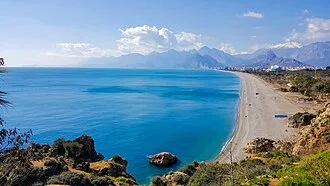
Antalya has beaches including Konyaaltı, Lara and Karpuzkaldıran. Beydağları and Saklikent are used for winter sports.
Historic sites in the city center
- Ancient monuments include the City Walls, Hıdırlık Tower, Hadrian's Gate (also known as Triple Gate), and the Clock Tower.
- Hadrian's Gate: constructed in the 2nd century by the Romans in honor of the Emperor Hadrian.
- İskele Mosque: A 19th-century Mosque near the marina.
- Karatay Medrese: A Medrese (Islamic theological seminary) built in 1250 by Emir Celaleddin Karatay.
- Kesik Minare (Broken Minaret) Mosque: Once a Roman temple then converted to a Byzantine Panayia church and finally into a mosque.
- Tekeli Mehmet Paşa Mosque: An 18th-century Mosque built in honor of Tekeli Mehmet Paşa.
- Yat Limanı: the harbour dating to Roman era.
- Yivli Minare (Fluted Minaret) Mosque: Built by the Seljuks and decorated with dark blue and turquoise tiles. This minaret eventually became the symbol of the city.
- Murat Pasha Mosque: A historic Ottoman mosque located in the city center.
- Aya Yorgi Church (Saint George Church): A historic church built by the Greeks of Antalya which is currently used as a museum housing exhibitions of historical artifacts.
- Saint Alypius Church: A tiny historic Greek Orthodox church which is still currently a functioning Orthodox Church.
- Sultan Aladdin Mosque: A historic building built as a Greek Orthodox church in 1834 and converted into a mosque in the 1950s and currently used as a Mosque.
- Ahi Yusuf Mosque: A historic mosque built in the year of 1249 and is possibly one of the oldest mosques in Antalya or even the oldest.
- Ahi Kizi Masjid: Historic masjid located in the old town.
- Kara Molla Masjid: Tiny historic masjid built in the 14th century.
- Balibey Mosque: A historic mosque built by the vizier Bali Pasha.
- Müsellim Mosque: A small historic mosque built by Hacı Osmanoğlu Mehmed Ağa in 1796.
- Antalya Synagogue: A historic Synagogue used as house currently in the Balbey neighborhood between Kavakli Masjid and the Balbey Kesik Minaret Mosque.
- Mevlevihane (Dervish lodge museum): A former Dervish lodge housing a museum about Dervishes and Sufism.
Main sights
- Akdeniz Kent Parkı
- Antalya Aquarium
- Arapsu Bridge
- Atatürk Culture Park (formerly named after Hasan Subaşı)
- Düden Waterfalls
- Heart of Antalya
- Karaalioglu Park
- Konyaaltı Beach
- Tünektepe
Green areas, recreation places
There are urban parks and protected natural areas located outside the cities, allowing the people to have fun, rest and get closer to nature. Some of them are green areas around lake, pond and dam lakes, and some are highland and forest areas.
The prime urban green areas include Antalya City Forest, Atatürk Park, Kepez City Forest.
The largest amusement park in Antalya is the Aktur Park. Other modern recreational areas include 3 aquaparks in the city, Konyaaltı, Lara beaches, Beachpark especially for summer holidays, while Saklıkent also has facilities for skiing in the winter months.
The preserved nature areas include Güllük Mountain National Park in Antalya-Korkuteli highway, Mount Olympus National Park in Kemer and Düden and Kurşunlu Waterfalls. Other protected areas include the Damlataş and the Karain Cave and the Guver Cliff.
It offers picnic and recreation facilities in various parts of the city. Picnic areas, rafting facilities in Köprülü Kanyon in Manavgat. The part of Korkuteli-Antalya border in western part of Antalya is covered with forests. In these areas, picnic areas, playground, restaurant and similar facilities are provided. There are lake and forest views on the promenade at Feslikan Plateau to the west of the city center where visitors can also enjoy nature sports and nature walks.
The oil wrestling competition festival organized in summer, what accompanied with concerts. The pond in Doyran town, located to the west of city is very suitable for picnic and fishing.